Visine classic
Poland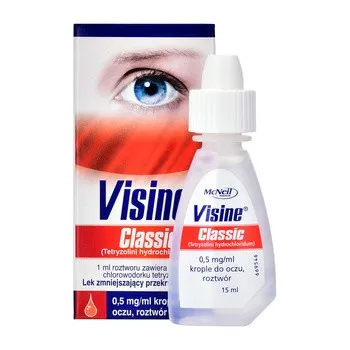
Table of Contents
| Package leaflet: Information for the patient |
Warning! Keep this leaflet! Information on the immediate packaging in a foreign language.
Visine Classic (Vispring), 0.5 mg/ml (0.05% w/v), eye drops, solution
Tetryzolini hydrochloridum
Visine Classic and Vispring are different trade names of the same medicinal product.
Please read this leaflet carefully before using the medicine, as it contains
important information for the patient.
This medicine should always be used exactly as described in this patient leaflet or as directed by a
physician or pharmacist.
- Keep this leaflet for future reference.
- If you need advice or further information, please consult your pharmacist.
- If you experience any adverse reactions, including any not listed in this leaflet, inform your doctor or pharmacist. See section 4.
- If there is no improvement after 2 days, or if you feel worse, consult your doctor.
Table of contents of the leaflet
- What Visine Classic is and what it is used for
- Important information before using Visine Classic
- How to use Visine Classic
- Possible side effects
- How to store Visine Classic
- Contents of the pack and other information
1. What Visine Classic is and what it is used for
Visine Classic eye drops are indicated for symptomatic treatment of conditions associated with
conjunctival oedema and hyperaemia resulting from irritation, e.g. due to smoke, dust, wind,
chlorinated water, cosmetics, as well as allergic inflammatory conditions such as hay fever or
pollen allergy.
The eye drops relieve accompanying symptoms such as burning, itching, pain, excessive
lacrimation, and irritation.
2. Important information before using Visine Classic
When not to use Visine Classic
- if the patient is allergic to tetrahydrozoline or any of the other ingredients of this medicine (listed in section 6),
- in patients with narrow-angle glaucoma,
- in children under 2 years of age.
Warnings and precautions
Before starting to use Visine Classic, consult your doctor or pharmacist.
If eye pain, disturbances in vision, persistent or worsening eye irritation or redness occur, or if symptoms do not improve, worsen, or new symptoms appear, discontinue use and consult a doctor.
Prolonged use or overuse of the medicine may lead to increased or recurrent eye redness.
The medicine may cause temporary dilation of the pupil.
In patients with severe cardiovascular disorders (e.g. coronary heart disease, arterial hypertension, pheochromocytoma) and/or metabolic disorders (e.g. diabetes, hyperthyroidism), treated with monoamine oxidase inhibitors (MAOIs)—including within 10 days after discontinuation—and other drugs that may increase blood pressure, as well as in patients with atrophic rhinitis, keratoconjunctivitis, or glaucoma, Visine Classic eye drops should be used only after careful consideration of potential benefits and risks.
Visine Classic and other medicines
Patients taking MAO inhibitors or other medications that may increase blood pressure should use Visine Classic eye drops only after consultation with a doctor.
Consult your doctor before using Visine Classic with other eye medications.
Pregnancy, breastfeeding, and fertility
If the patient is pregnant or breastfeeding, suspects she may be pregnant, or is planning to become pregnant, she should consult a doctor or pharmacist before using this medicine.
Due to possible systemic adverse effects, use of Visine Classic eye drops during pregnancy and breastfeeding should only be considered after careful evaluation of risks and benefits by a physician.
There are no data available on the passage of tetrahydrozoline across the placental barrier or into breast milk.
Driving and operating machinery
Visine Classic may cause temporary blurred vision. In such cases, driving or operating machinery should be avoided.
Visine Classic contains benzalkonium chloride
The medicine contains 0.1 mg of benzalkonium chloride per millilitre.
Avoid contact of the medicine with contact lenses.
Benzalkonium chloride may be absorbed by soft contact lenses, potentially altering their colour. Remove contact lenses before instilling the drops and wait at least 15 minutes before reinserting them.
Benzalkonium chloride may also cause eye irritation, particularly in individuals with dry eye syndrome or corneal disorders (the transparent layer at the front of the eye). If abnormal sensations, stinging, or eye pain occur after using the medicine, the patient should contact a doctor.
Visine Classic contains boric acid and sodium borate
Do not use in children under 2 years of age due to the presence of boron, which may cause fertility impairment.
3. How to use Visine Classic
This medicine should always be used exactly as described in this patient leaflet or as directed by a doctor or pharmacist. If in doubt, consult a doctor or pharmacist.
Children under 6 years of age
Do not use in children under 2 years of age. In children aged 2 to 6 years, use only under medical supervision.
Adults and children over 6 years of age
Unless otherwise advised by a doctor, instill 1 to 2 drops into the affected eye up to 3 times daily. Contact lenses should be removed before instillation and reinserted approximately 15 minutes after using the medicine.
Use in children under 12 years of age should be supervised by an adult.
This medicine must not be used for longer than 2 days. Use beyond 2 days should only occur under medical supervision.
Method of administration
To avoid contamination of the medicine, do not touch any surface with the applicator tip.
- Wash your hands thoroughly before instilling the drops.
- Unscrew the cap.
- Tilt your head backwards and gently pull down the lower eyelid to create a pouch between the eyelid and the eyeball.
- Gently squeeze the bottle and turn it upside down. Reduce pressure slightly to allow a small amount of air into the bottle. Thanks to the special applicator with a safe, rounded tip, even the slightest pressure will release one drop. If the drop misses the eye, instill another one.
- After instillation, gently press the inner corner of the eye. This helps prevent the medicine from draining into the body.
- If the medicine needs to be administered to the other eye, repeat the steps described above.
- After instillation, replace the cap on the bottle.
Discard the medicine if it changes colour or becomes cloudy.
Use of a larger than recommended dose of Visine Classic
Symptoms of overdose are usually not associated with ocular administration of Visine Classic.
However, swallowing the medicine may cause serious adverse effects. If Visine Classic is swallowed by an infant or young child, there is a risk of poisoning. Reported overdose symptoms include: nausea, vomiting, lethargy, tachycardia, slowed breathing, bradycardia, hypotension, sedation, drowsiness, pupil dilation, stupor, hypothermia, drooling, coma.
Keep out of reach and sight of children. In case of accidental ingestion, seek immediate medical help.
Missed dose of Visine Classic
Do not use a double dose to make up for a missed dose.
4. Possible adverse reactions
Like all medicines, this medicine can cause adverse reactions, although not everybody gets them.
The frequency of the possible adverse reactions listed below is defined as follows:
Common (more than 1 in 100 people but less than 1 in 10 people): visual disturbances and eye irritation (pain, stinging, burning).
Very rare (less than 1 in 10,000 people): increased lacrimation, pupil dilation, and reactions at the application site, including eye or periocular burning, erythema, irritation, swelling, pain, and itching.
Frequency not known (cannot be estimated from available data): sensation of dry eye and headache.
Reporting of adverse reactions
If any adverse reactions occur, including any not listed in this leaflet, inform your doctor or pharmacist. Adverse reactions can be reported directly to the Department for Monitoring Adverse Drug Reactions of the Office for Registration of Medicinal Products, Medical Devices and Biocidal Products, Al. Jerozolimskie 181 C, 02-222 Warsaw, phone: +48 22 49 21 301, fax: +48 22 49 21 309, website: https://smz.ezdrowie.gov.pl.
Reporting adverse reactions helps to provide more information on the safety of this medicine.
5. How to store Visine Classic
Do not store above 30°C.
Keep the medicine out of sight and reach of children.
Do not use Visine Classic after the expiry date stated on the packaging.
The expiry date refers to the last day of the stated month.
The drops are sterile in the factory-sealed bottle. After 28 days from first opening,
the bottle should be discarded, even if the medicine has not been fully used.
Medicines must not be disposed of via wastewater or household waste. Ask your
pharmacist how to dispose of medicines no longer in use. This will help
protect the environment.
6. Contents of the pack and other information
What Visine Classic contains
- The active substance is tetryzoline hydrochloride.
- The other ingredients are: sodium chloride, boric acid, disodium edetate, benzalkonium chloride solution, sodium borate, purified water.
What Visine Classic looks like and contents of the pack
A 15 ml LDPE bottle with dropper and cap in a cardboard box.
For more detailed information, please contact the responsible party or parallel importer.
Responsible party in Greece, country of export:
Johnson & Johnson Hellas Consumer AE
Aigialeias & Epidavrou 4
15125 Marousi
Athens, Greece
Manufacturer:
Janssen Pharmaceutica N.V.
Turnhoutseweg 30
2340 Beerse
Belgium
Parallel importer:
InPharm Sp. z o.o.
ul. Strumykowa 28/11
03-138 Warsaw
Poland
Repackaged in:
Pharma Innovations Sp. z o.o.
ul. Jagiellońska 76
03-301 Warsaw
Poland
InPharm Sp. z o.o. Services sp. k.
ul. Chełmżyńska 249
04-458 Warsaw
Poland
Marketing authorisation number in Greece, country of export: 44533/9-5-2008
23905/20-12-2011
62892/15/15-03-2017
Parallel import licence number: 322/19