Virgan 1.5 mg/g eye ointment
Poland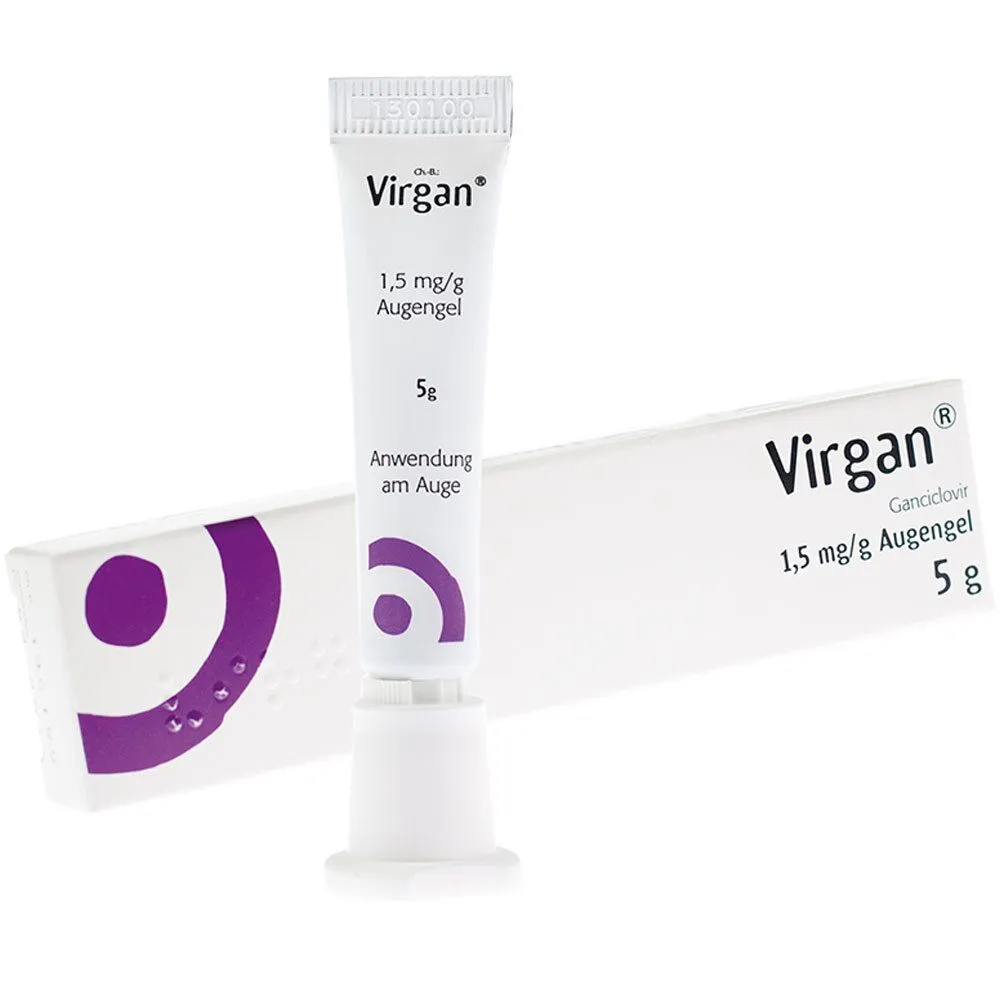
Table of Contents
Patient Information Leaflet
Keep this leaflet! The information on the immediate packaging is in a foreign language.
Virgan 1.5 mg/g eye gel
Ganciclovir
Please read all of this leaflet carefully before using this medicine because it contains important information for you.
- Keep this leaflet so that you can read it again if necessary.
- If you have any questions, please consult your doctor or pharmacist.
- This medicine has been prescribed for a specific individual. Do not give it to others. This medicine may harm other people, even if their symptoms are the same.
- If you experience any adverse reactions, including any not listed in this leaflet, inform your doctor or pharmacist. See section 4.
Contents of the leaflet
- What Virgan is and what it is used for
- What you need to know before using Virgan
- How to use Virgan
- Possible side effects
- How to store Virgan
- Contents of the pack and other information
1. What Virgan is and what it is used for
Virgan is an eye gel containing an antiviral agent called ganciclovir.
It is indicated for the treatment of certain superficial viral infections of the eye (cornea).
2. Important information before using Virgan
When not to use Virgan
- if the patient is allergic to ganciclovir, acyclovir, or any of the other ingredients of this medicine (listed in section 6).
- during pregnancy and breastfeeding, unless otherwise advised by a doctor.
- in men and women of childbearing age who are not using a method of birth control. In addition, men being treated with Virgan are advised to use a local method of contraception (e.g. condom) during treatment and for three months after its completion. Women being treated with Virgan are advised to use contraceptive measures during treatment and for 6 months after its completion.
Warnings and precautions
Before starting treatment with Virgan, discuss this with your doctor.
- Do not swallow.
- Avoid touching the eyes and eyelids with the dropper tip.
- Contact lens wear: Avoid contact of the medicine with soft contact lenses (see also Virgan contains benzalkonium chloride).
Children and adolescents
Due to lack of detailed studies, use in children under 18 years of age is not recommended.
Virgan with other medicines
If the patient is using any other eye drops, they should:
first apply the other ophthalmic medicine,
wait 15 minutes,
then apply Virgan as the last medicine.
Tell your doctor or pharmacist about all medicines the patient is currently taking or has recently taken, as well as any medicines the patient plans to use.
Pregnancy, breastfeeding and fertility
This medicine should not be used during pregnancy and breastfeeding, unless otherwise advised by a doctor.
See also section 2: When not to use Virgan.
If the patient is pregnant, suspects she may be pregnant, or is planning to have a child, she should consult her doctor before using this medicine. Only a doctor can modify the treatment.
Driving and operating machinery
After instillation of the medicine, temporary blurred vision may occur. Wait until vision returns to normal before driving or operating machinery.
Virgan contains benzalkonium chloride
This medicine contains 2.625 micrograms of benzalkonium chloride per drop of gel, equivalent to 0.075 mg/g.
Benzalkonium chloride may be absorbed by soft contact lenses and may cause discoloration of contact lenses. Contact lenses should be removed before applying this medicine and may be reinserted 15 minutes after application.
Benzalkonium chloride may also cause eye irritation, particularly in cases of dry eye syndrome or corneal disorders (the transparent layer at the front of the eye). If the patient experiences unusual eye reactions after using this medicine, such as stinging or eye pain, they should inform their doctor.
3. How to use Virgan
Dosage
This medicine should always be used as directed by a doctor or pharmacist. If in doubt,
consult a doctor or pharmacist.
The recommended dose is 1 drop, 3 to 5 times daily.
Use in children
The use of this eye gel in children under 18 years of age is not recommended.
Administration method
This medicine is intended for ocular use (in the eye[s] requiring treatment).
Wash hands thoroughly before using the medicine.
Look upwards, gently pull the lower eyelid downwards and lightly squeeze the tube to instill the medicine into the infected eye.
Close the tube after use.
- Duration of treatment: Treatment usually does not exceed 21 days.
Use of more than the recommended dose of Virgan
Continue treatment as directed by the doctor.
If an overdose is suspected, consult a doctor or pharmacist immediately.
Missed dose of Virgan
Do not use a double dose to make up for a missed dose.
If you have any further questions about the use of this medicine, consult your doctor or pharmacist.
4. Possible adverse reactions
Like all medicines, this medicine can cause adverse reactions, although not everyone will experience them.
Eye disorders:
Very common: may occur in more than 1 in 10 people
- transient burning or stinging, eye irritation, blurred vision.
Common: may occur in less than 1 in 10 people
- corneal inflammation (punctate keratitis), conjunctival redness (conjunctival hyperaemia).
Reporting of adverse reactions
If any adverse reactions occur, including any adverse reactions not listed in the leaflet, inform a doctor or pharmacist. Adverse reactions can be reported directly to the Department of Monitoring of Adverse Drug Reactions of the Office for Registration of Medicinal Products, Medical Devices and Biocidal Products, Al. Jerozolimskie 181C, 02-222 Warsaw, phone: + 48 22 49 21 301, fax: + 48 22 49 21 309; website: https://smz.ezdrowie.gov.pl.
Reporting adverse reactions enables continuous monitoring of the benefit-risk balance of the medicine.
5. How to store Virgan
Keep this medicine out of the sight and reach of children.
No special storage conditions are required.
Do not use this medicine after the expiry date stated on the packaging. The expiry date refers to the last day of the stated month.
After opening the tube, do not store the medicine for longer than 4 weeks.
Medicines should not be disposed of via wastewater or household waste. Ask your pharmacist how to dispose of medicines no longer required. These measures will help protect the environment.
6. Contents of the pack and other information
What Virgan contains
- The active substance is ganciclovir. One gram of gel contains 1,5 mg of ganciclovir.
- The other ingredients are: carbomer (Carbopol 974P), sorbitol, sodium hydroxide, benzalkonium chloride and purified water.
What Virgan looks like and contents of the pack
The medicine is available in a tube with an applicator and cap containing 5 grams of gel.
For more detailed information, please contact the Marketing Authorisation Holder or Parallel Importer.
Marketing Authorisation Holder in Greece, country of export:
Laboratoires THÉA
12, rue Louis Blériot
63017 Clermont-Ferrand Cedex 2
France
Manufacturer:
FARMILA-THEA FARMACEUTICI Spa
Via Enrico Fermi, 50
Settimo Milanese (MI)
Italy
Parallel Importer:
InPharm Sp. z o.o.
ul. Strumykowa 28/11
03-138 Warszawa
Poland
Repackaged by:
InPharm Sp. z o.o. Services sp. k.
ul. Chełmżyńska 249
04-458 Warszawa
Poland
Marketing Authorisation numbers in Greece, country of export: 1596/11-1-2006
12135/03-02-2014
Parallel Import Licence number: 441/19
This medicinal product is authorised for sale in the European Economic Area countries under the following names:
Czech Republic, France, Germany, Greece, Hungary, Italy, Luxembourg, Poland, Spain………Virgan