Vigantol
Poland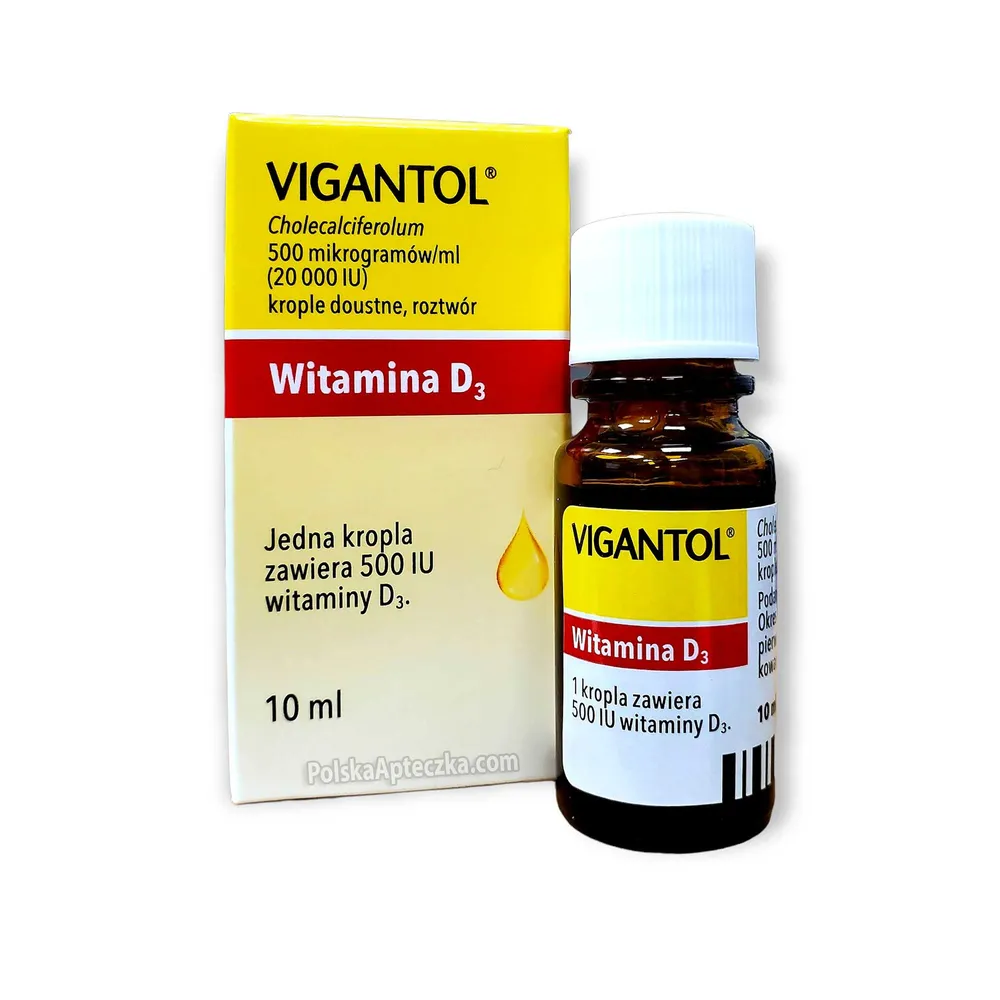
Table of Contents
Package leaflet: Information for the user
Warning! Keep this leaflet! The information on the immediate packaging is in a foreign language.
Vigantol
500 micrograms/ml (20,000 IU/ml), oral drops, solution
Cholecalciferol
Vigantol and Вигантол are trade names of the same medicinal product written in Polish and
Bulgarian.
Please read this leaflet carefully before using the medicine, as it contains
important information for the patient.
This medicine should always be used exactly as described in this patient leaflet or as directed by
a doctor or pharmacist.
- Keep this leaflet for future reference.
- If you need advice or further information, consult your pharmacist.
- If you experience any adverse reactions, including any possible adverse reactions not listed in this leaflet, inform your doctor, pharmacist, or nurse. See section 4.
- If your condition does not improve or worsens, contact your doctor.
Contents of the leaflet
- What Vigantol is and what it is used for
- Important information before taking Vigantol
- How to take Vigantol
- Possible side effects
- How to store Vigantol
- Contents of the pack and other information
1. What Vigantol is and what it is used for
Vigantol contains the active substance vitamin D (cholecalciferol), which is important in the process of bone formation. Vitamin D (cholecalciferol) is physiologically produced in the skin upon exposure to UV radiation, and can also be supplied to the body through diet.
In vitamin D deficiency, impaired bone mineralization (rickets) or loss of calcium from bones (osteomalacia) may occur.
Vigantol is used:
- for the prevention of rickets and osteomalacia in children and adults,
- for the prevention of rickets in preterm infants,
- for the prevention of disorders in cases where there is a risk of vitamin D deficiency in children and adults,
- for the prevention of vitamin D deficiency in children and adults,
- as adjunctive treatment in osteoporosis in adults.
2. Important information before using Vigantol
When not to use Vigantol
- if the patient is allergic to the active substance or to any of the other ingredients of this medicine (listed in section 6),
- in case of hypercalcaemia (excessively high calcium levels in the blood) or hypercalciuria (excessive excretion of calcium in urine),
- if the patient has kidney stones or severe renal insufficiency,
- in case of pseudohypoparathyroidism.
Warnings and precautions
Before starting treatment with Vigantol, consult a doctor or pharmacist, as Vigantol should be used under medical supervision:
- if the patient is also taking other medicines containing vitamin D, because additional doses of vitamin D should only be taken under medical supervision,
- if the patient has sarcoidosis (an immune system disorder which may increase vitamin D levels in the body),
- if the patient has impaired kidney function,
- if the patient is being treated with cardiac glycosides or diuretics,
- in newborns, infants and young children,
- if vitamin D treatment is long-term, as in such cases the doctor should monitor serum and urinary calcium levels and assess kidney function by measuring blood creatinine concentration.
Vigantol with other medicines
Inform your doctor or pharmacist about all medicines currently or recently taken, as well as any medicines you plan to take.
Antacids used to treat acidity and containing aluminium, when taken together with Vigantol, may increase blood aluminium levels, increasing the risk of aluminium toxicity to bones.
Antacids containing magnesium used concurrently with Vigantol may increase blood magnesium levels.
Certain antiepileptic, sedative or hypnotic drugs (containing phenytoin and barbiturates) taken together with Vigantol may reduce its effectiveness.
Some diuretics (thiazides) may lead to hypercalcaemia (increased calcium levels) caused by reduced renal excretion of calcium. During long-term treatment, serum and urinary calcium levels should be monitored.
Concomitant use of glucocorticosteroids (synthetic corticosteroid hormones) may counteract the effect of Vigantol.
Vigantol may enhance the effects and toxicity of cardiac glycosides, increasing the risk of cardiac arrhythmias. In such cases, the doctor should monitor serum and urinary calcium levels and perform periodic ECG examinations.
Concurrent use of vitamin D metabolites or analogues (e.g. calcitriol) and Vigantol is possible only under medical prescription and only in exceptional cases, provided that serum calcium levels are monitored.
Rifampicin and isoniazid may reduce the effectiveness of Vigantol.
Pregnancy and breastfeeding
If the patient is pregnant or breastfeeding, suspects she may be pregnant, or is planning to have a child, she should consult a doctor before using this medicine.
Pregnancy
Vigantol should be used during pregnancy only under medical supervision.
Vitamin D overdose during pregnancy should be avoided, as it may lead to delayed physical and mental development, heart defects, and retinal disorders (retinopathy) in the child.
Breastfeeding
Consult a doctor before using this medicine.
Driving and operating machinery
Vigantol has no influence on the ability to drive motor vehicles or operate machinery.
3. How to use Vigantol
This medicine should always be taken exactly as described in this patient leaflet or as directed by your doctor or pharmacist. If in doubt, consult your doctor.
Dosage
- Premature infants: 2 drops daily of Vigantol (1000 IU vitamin D). After reaching the corrected age of 40 weeks, the prophylactic dose should be reduced. The dosage must be determined by the attending physician.
- Newborns and infants (up to 12 months of age): 1 drop daily of Vigantol (corresponding to 500 IU vitamin D).
Vigantol should be used under medical supervision in premature infants, newborns, and infants. Do not exceed the recommended dose.
- Children and adolescents: 1 drop daily of Vigantol (corresponding to 500 IU vitamin D).
- Adults and elderly individuals: 2 drops daily of Vigantol (corresponding to 1000 IU vitamin D).
- Adjunctive treatment of osteoporosis in adults: 4 drops daily of Vigantol (corresponding to 2000 IU vitamin D).
- Adults with obesity (including elderly individuals) and individuals over 75 years of age: 8 drops daily of Vigantol (corresponding to 4000 IU vitamin D).
Do not use this medicinal product long-term or in higher doses without medical supervision. Additionally, do not use other medicines, dietary supplements, or foodstuffs containing vitamin D (cholecalciferol), calcitriol, or other vitamin D metabolites or analogs simultaneously without medical supervision.
Method of administration
Premature infants, newborns, and infants:
Vigantol should be administered to children from the second week of life until the end of the first year of life. Administer the drops with a spoonful of milk or food. If the drops are added to a bottle or food, ensure that the child consumes the entire meal; otherwise, the full dose will not be ingested.
Older children and adults
Vigantol should be taken with a spoonful of liquid.
Overdose of Vigantol
If more Vigantol has been taken than recommended, contact your doctor.
The doctor will decide on appropriate treatment.
Symptoms of overdose: nausea, vomiting, diarrhoea followed by constipation, loss of appetite, fatigue, headache, muscle pain, joint pain, muscle weakness, drowsiness, azotemia (increased concentration of nitrogen compounds in blood), excessive thirst, polyuria, and dehydration. With high calcium levels in blood, cardiac arrhythmias, renal failure, psychoses, and even coma may occur. Laboratory findings include hypercalcemia (increased calcium concentration in blood), hypercalciuria (excessive excretion of calcium in urine), and increased serum 25-hydroxycholecalciferol levels. There is no specific antidote for vitamin D.
Overdose requires measures to control hypercalcemia, which may be prolonged and sometimes life-threatening. In case of overdose, inform your doctor, who will decide on appropriate treatment.
Missed dose of Vigantol
Do not take a double dose to make up for a missed dose.
4. Possible adverse reactions
Like all medicines, this medicine can cause adverse reactions, although not everyone experiences them.
Gastrointestinal disorders such as constipation, bloating, nausea, abdominal pain or diarrhoea.
Hypersensitivity reactions such as: skin itching, rash or urticaria.
In case of prolonged use of high doses – hypercalcaemia (excess calcium in the blood) and hypercalciuria (excessive excretion of calcium in urine). In isolated cases, fatal outcomes have been reported.
Reporting of adverse reactions
If any adverse reactions occur, including any adverse reactions not listed in this leaflet, inform your doctor, pharmacist or nurse.
Adverse reactions can be reported directly to the Department of Monitoring Adverse Drug Reactions of the Office for Registration of Medicinal Products, Medical Devices and Biocidal Products: Al. Jerozolimskie 181C, 02-222 Warsaw, tel.: + 48 22 49 21 301, fax: + 48 22 49 21 309, website: https://smz.ezdrowie.gov.pl.
Adverse reactions can also be reported to the marketing authorisation holder or parallel importer.
By reporting adverse reactions, further information on the safety of this medicine can be collected.
5. How to store Vigantol
Keep the medicine out of sight and reach of children.
Store the bottle in the outer packaging to protect it from light.
The shelf life of the medicine after first opening the container is 12 months.
Do not use this medicine after the expiry date stated on the packaging. The expiry date refers to the last day of the stated month.
Medicines must not be disposed of via wastewater or household waste. Ask your pharmacist how to dispose of medicines no longer in use. This helps protect the environment.
6. Contents of the packaging and other information
What the medicine Vigantol contains
- The active substance is cholecalciferol. 1 ml (40 drops) contains 500 µg cholecalciferol (equivalent to 20,000 IU vitamin D). One drop contains 12.5 µg cholecalciferol (equivalent to 500 IU vitamin D).
- Other components: medium-chain triglycerides.
What the medicine Vigantol looks like and contents of the pack
Vigantol is an oral drop solution.
The bottle is closed with a screw cap and contains a dropper.
The pack contains a 10 ml bottle placed in a cardboard box.
Responsible entity in Bulgaria, country of export:
P&G Health Germany GmbH
Sulzbacher str.40
65824 Schwalbach am Taunus
Germany
Manufacturer:
Lusomedicamenta Sociedade Técnica Farmacêutica, S.A.
Estrada Consiglieri Pedroso, n.° 66, 69-B
Queluz de Baixo
2730-055 Barcarena
Portugal
Parallel importer:
Allpharm Sp. z o.o. sp.k.
ul. M. Zdziechowskiego 11/4
02-659 Warsaw
Poland
Repackaged in:
CEFEA Sp. z o.o. Sp. Synoptis Industrial Sp. z o.o. Shiraz Productions Sp. z o.o.
sp. k. Forteczna 35-37 ul. Tymiankowa 24/28
ul. Działkowa 56 87-100 Toruń 95-054 Ksawerów
02-234 Warsaw
Poland
Marketing authorization number in Bulgaria, country of export: 9900340
Parallel import authorization number: 35/23