Verrucutan
Poland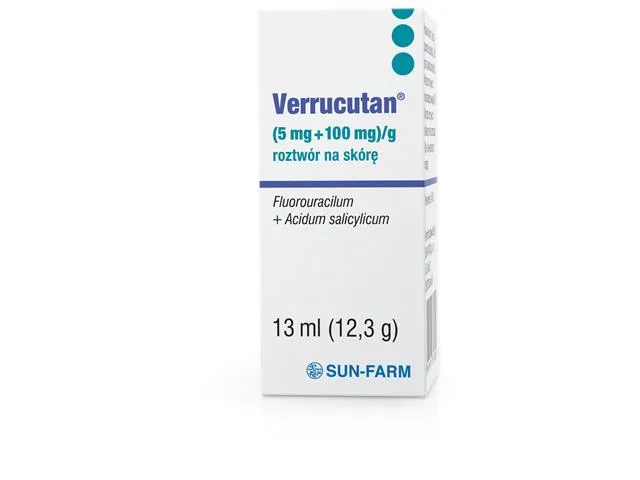
Table of Contents
Package leaflet: Information for the user
Verrucutan, (5 mg + 100 mg)/g, solution for skin application
Fluorouracilum + Acidum salicylicum
Please read this leaflet carefully before using the medicine, because it contains
important information for the patient.
- Keep this leaflet, so that you can read it again if necessary.
- Consult your doctor or pharmacist if you have any doubts.
- This medicine has been prescribed for a specific individual. Do not pass it on to others. The medicine may harm another person, even if their symptoms are the same.
- If the patient experiences any adverse reactions, including any not listed in this leaflet, inform a doctor or pharmacist. See section 4.
Table of contents of the leaflet
- What Verrucutan is and what it is used for
- Important information before using Verrucutan
- How to use Verrucutan
- Possible adverse effects
- How to store Verrucutan
- Contents of the pack and other information
1. What Verrucutan is and what it is used for
Verrucutan is a medicine for warts.
Verrucutan is used for common warts, plantar warts (verrucae plantaris),
and flat warts (flat warts of youth) on hands and feet.
2. Important information before using Verrucutan
When not to use Verrucutan
if the patient is allergic to fluorouracil, salicylic acid, or any of the other
components of this medicine (listed in section 6),
if the patient is breastfeeding,
if the patient is pregnant or cannot definitely exclude being pregnant,
in infants,
if the patient has renal insufficiency,
if the patient is taking certain antiviral drugs used in the treatment of chickenpox or
shingles (treatment of Herpes zoster).
Concomitant use of Verrucutan with brivudine, sorivudine and/or similar drug groups used in the treatment of shingles is not allowed. Treatment with Verrucutan may be started no earlier than 4 weeks after discontinuation of the above-mentioned drugs. Simultaneous use of one of the active substances of this medicine, fluorouracil, with brivudine, sorivudine and their derivatives may lead to a significant increase in adverse reactions of Verrucutan. Treatment with fluorouracil must not be initiated within at least 4 weeks after ending treatment with brivudine or sorivudine for shingles.
If the patient has recently been treated for shingles infection, this should be reported to the doctor.
Verrucutan is not intended for application over large skin areas (larger than 25 cm²), and contact of the medicine with eyes and mucous membranes must be avoided.
Warnings and precautions
Before starting treatment with Verrucutan, consult a doctor or pharmacist if the patient has been diagnosed with deficiency of dihydropyrimidine dehydrogenase (DPD) enzyme activity (complete DPD deficiency).
Caution is advised when taking concomitantly phenytoin, used in the treatment of epileptic seizures. Verrucutan may increase blood levels of phenytoin. Therefore, during treatment with Verrucutan, blood levels of phenytoin should be monitored regularly.
If warts are located in areas of skin with a thin epidermis, the medicine should be applied less frequently and the treatment should be monitored more closely by a physician, as salicylic acid contained in Verrucutan may cause scarring.
If the patient has impaired sensation of touch, pain, or temperature (sensory disturbances, e.g. due to diabetes), close medical supervision of treatment is required.
During application, care should be taken to avoid staining materials or products made of acrylic (e.g. acrylic bathtubs), as the medicine causes stains that cannot be removed.
Verrucutan is flammable until a film forms after application.
Keep away from fire or flames.
Verrucutan must not be applied to bleeding skin lesions.
Children
Verrucutan must not be used in infants. In children, the risk of overdose is higher than in adults; therefore, especially in young children, the recommended treatment area and frequency must not be exceeded.
Verrucutan and other medicines
Tell your doctor or pharmacist about all medicines you are currently taking, have recently taken, or plan to take.
This is particularly important because when several medicines are taken simultaneously, the effects of individual drugs may be enhanced or diminished.
Do not use Verrucutan if the patient is taking or has taken within the last 4 weeks certain antiviral drugs used in the treatment of viral diseases such as chickenpox or shingles (brivudine, sorivudine or their derivatives).
Special caution is required if the patient is taking certain anticonvulsant drugs (phenytoin). Based on systemic use of fluorouracil in cancer treatment, it is known that concomitant use with phenytoin may lead to increased phenytoin levels.
Since salicylic acid may be absorbed systemically, interactions between salicylic acid and methotrexate (a medicine used in the treatment of certain rheumatic diseases, cancers or severe psoriasis) and sulfonylurea derivatives (present in certain antidiabetic drugs lowering blood glucose levels) are possible.
Pregnancy and breastfeeding
If the patient is pregnant or breastfeeding, suspects she may be pregnant, or is planning to become pregnant, she should consult a doctor or pharmacist before using this medicine.
Use of this medicine during pregnancy and breastfeeding is contraindicated.
Do not use in women in whom pregnancy cannot definitely be excluded.
Driving and operating machinery
No special precautions required.
Verrucutan contains dimethyl sulfoxide and alcohol (ethanol)
Dimethyl sulfoxide may cause skin irritation.
This medicine contains 171.5 mg/g of alcohol (ethanol), which may cause irritation of damaged skin.
3. How to use Verrucutan
This medicine should always be used exactly as directed by the doctor or pharmacist. In case of doubt, consult the doctor or pharmacist.
Dosage
Unless otherwise prescribed by a doctor, Verrucutan should be applied 2 to 3 times daily to each wart.
Method of administration
For topical use only.
Apply the medicine only to the wart. Do not apply to healthy skin. The surrounding skin may be protected by applying a paste or ointment. If necessary, the doctor or pharmacist may recommend a suitable protective product. It is recommended to clean the applicator and neck of the bottle before each application. For very small warts, a toothpick or similar device may be used instead of the applicator for precise application. Before each application of Verrucutan, remove the residual layer from the previous application by gently scraping it off.
In the case of periungual or subungual warts, care must be taken not to damage the nail matrix and to prevent Verrucutan from penetrating into the nail bed.
Verrucutan is not intended for use on large skin areas. The maximum treated area should not exceed 25 cm² of skin surface.
Regular medical check-ups during therapy are recommended. Clinical experience shows that in many cases, e.g. in the case of prominently protruding common warts or plantar warts, removal of residual necrotic tissue by a physician after treatment with Verrucutan may be necessary.
Duration of treatment
The usual treatment period is 6 weeks.
After disappearance of the lesions, continue treatment for another week.
If the effect of the medicine seems too strong or too weak, consult a doctor or pharmacist.
Use of more than the recommended dose of Verrucutan
In case of overdose, contact a doctor immediately.
Missed dose of Verrucutan
Do not use a double dose to make up for a missed dose. Continue treatment as directed by the doctor or as described in this leaflet.
Stopping Verrucutan treatment
If treatment with Verrucutan is discontinued, consult a doctor.
If you have any further questions about the use of this medicine, consult your doctor or pharmacist.
4. Possible adverse reactions
Like all medicines, this medicine can cause adverse reactions, although not everyone will experience them.
Very common (may occur in more than 1 in 10 people):
at the site of application: redness, inflammation, irritation, burning, pain, itching.
Common (may occur in no more than 1 in 10 people):
at the site of application: bleeding, scab formation, exudation, erosion (superficial skin damage).
Headache may occur.
Uncommon (may occur in no more than 1 in 100 people):
at the site of application: skin inflammation, swelling, ulceration. Dry eye, eye itching, excessive tearing may occur.
Rare (may occur in no more than 1 in 1000 people):
Intense burning sensation may occur; in such a case, treatment should be discontinued.
Due to the presence of salicylic acid in the product, mild irritation symptoms may occur, such as skin inflammation and hypersensitivity reactions (contact allergic reactions).
Symptoms of irritation may also include itching, redness, and blistering outside the area where the medicine has contacted the skin.
In the area of warts, whitish discoloration and skin peeling may occur.
Reporting of adverse reactions
If any adverse effects occur, including any not listed in this leaflet, inform your doctor or pharmacist. Adverse reactions can be reported directly to the Department of Monitoring Adverse Drug Reactions at the Office for Registration of Medicinal Products, Medical Devices and Biocidal Products
Al. Jerozolimskie 181C
02-222 Warsaw
Phone: +48 22 49 21 301
Fax: +48 22 49 21 309
Website: https://smz.ezdrowie.gov.pl
Adverse reactions may also be reported to the marketing authorization holder.
Reporting adverse reactions helps provide more information on the safety of this medicine.
5. How to store Verrucutan
Keep out of sight and reach of children.
Do not use this medicine after the expiry date stated on the packaging after "EXP".
The expiry date refers to the last day of the stated month.
Do not store above 30°C.
Do not store in a refrigerator or freeze.
Shelf-life after first opening of the bottle: 6 months.
After each use, the bottle must be tightly closed, as the medicine dries quickly when exposed to air, making further proper use impossible. If the medicine has dried out, it must not be used. Do not use Verrucutan if crystals have formed in it.
Medicines should not be disposed of via wastewater or household waste. Ask your pharmacist how to dispose of medicines no longer required. This will help protect the environment.
Warning: This medicine is flammable. Keep away from fire or flame.
6. Contents of the packaging and other information
What Verrucutan contains
The active substances in this medicinal product are: fluorouracil and salicylic acid.
1 g of solution contains 5 mg of fluorouracil and 100 mg of salicylic acid.
Other ingredients are: dimethyl sulfoxide, absolute ethanol, ethyl acetate, butyl methacrylate and
methyl methacrylate copolymer (80:20), piroxilin.
What Verrucutan looks like and contents of the pack
Verrucutan is a clear, colourless to slightly orange solution for topical use on the skin.
Packaging type: brown glass bottle with a child-resistant polyethylene screw cap, supplied with a polyethylene spatula, in a cardboard box.
Pack sizes: 13 ml (12.3 g) and 14 ml (13.2 g).
Not all pack sizes may be marketed.
Marketing Authorisation Holder and Manufacturer
Marketing Authorisation Holder:
SUN-FARM Sp. z o.o.
ul. Dolna 21
05-092 Łomianki
Manufacturer:
SUN-FARM Sp. z o.o.
ul. Dolna 21
05-092 Łomianki
mibe GmbH Arzneimittel
Münchener Straße 15
06796 Brehna
Germany
This medicinal product is authorised in the Member States of the European Economic Area under the following names:
Croatia Verrucutan 5 mg/g + 100 mg/g otopina za kožu
Germany Verrucutan 5 mg/g + 100 mg/g Lösung zur Anwendung auf der Haut
Poland Verrucutan