Verorab
Poland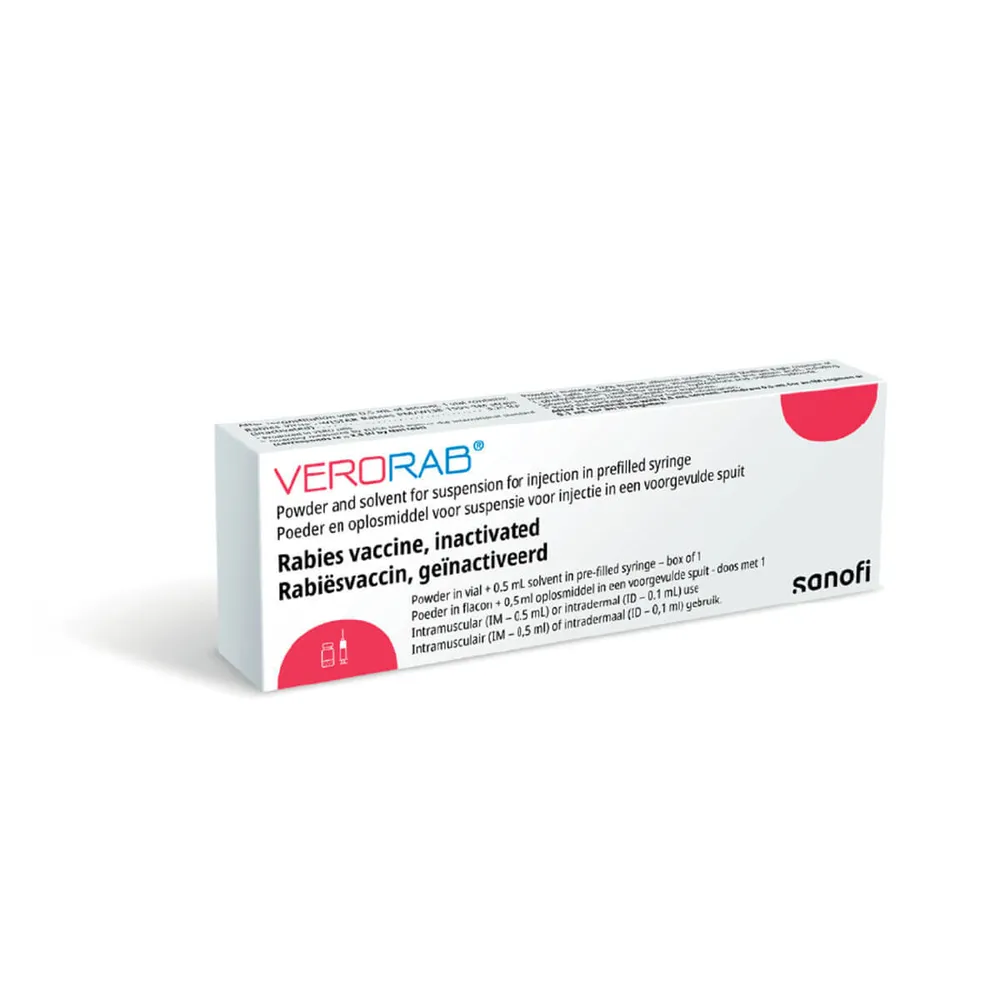
Table of Contents
- Package leaflet: Information for the user
- 1. What VERORAB vaccine is and what it is used for
- 2. Important information before using VERORAB vaccine
- 3. How to use VERORAB vaccine
- 4. Possible adverse reactions
- 5. How to store VERORAB vaccine
- 6. Contents of the pack and other information
- Information intended exclusively for medical personnel:
Package leaflet: Information for the user
VERORAB, powder and solvent for suspension for injection
Rabies vaccine for human use, produced in cell cultures
Please read this leaflet carefully before using the vaccine, because
it contains important information for the patient.
- Keep this leaflet, as you may need to read it again.
- If you have any questions, please consult your doctor or pharmacist.
- This vaccine has been prescribed for a specific individual only. Do not pass it on to others. The vaccine may harm others.
- If the patient experiences any adverse reactions, including any not listed in this leaflet, inform the doctor. See section 4.
Leaflet contents
- What VERORAB vaccine is and what it is used for
- Important information before using VERORAB vaccine
- How to use VERORAB vaccine
- Possible side effects
- How to store VERORAB vaccine
- Contents of the pack and other information
1. What VERORAB vaccine is and what it is used for
VERORAB vaccine is indicated for the prevention of rabies both before and after exposure to the rabies virus in all age groups.
Prevention of rabies prior to exposure (pre-exposure vaccination)
Pre-exposure vaccination should be offered to individuals at high risk of infection with the rabies virus.
All individuals who are continuously exposed to infection should be vaccinated, e.g. laboratory staff working in diagnostic, research, and production facilities handling the rabies virus. Immunity should be maintained by administration of booster doses (see "Dosage").
Vaccination is also recommended for the following groups, taking into account the frequency of exposure to infection risk:
- Veterinarians and their assistants, animal caretakers (including those who have contact with bats), foresters (hunters), and taxidermists,
- Individuals who have contact with potentially rabid animals (such as dogs, cats, skunks, raccoons, bats),
- Adults and children residing in or travelling to areas where there is a risk of rabies infection.
2. Important information before using VERORAB vaccine
When not to use VERORAB vaccine:
Pre-exposure vaccination
- if the patient is allergic to the vaccine or any of the other components of this vaccine (listed in section 6),
- if an allergic reaction occurred after previous administration of VERORAB vaccine or any other vaccine with the same composition,
- if fever or an acute illness is present (in such cases, vaccination should preferably be postponed).
Post-exposure vaccination
- Considering that confirmed rabies infection is fatal, there are no contraindications to vaccination after exposure.
Warnings and precautions
- As with all vaccines, VERORAB may not protect 100% of vaccinated individuals.
- VERORAB vaccine must not be administered intravenously; ensure that the needle is not located within a blood vessel.
- Use with caution in individuals with allergy to polymyxin B, streptomycin, neomycin (present in the vaccine in trace amounts) or any other antibiotic from the same group.
- If the vaccine is administered to individuals with known immunosuppression due to disease or treatment, a serological test should be performed 2 to 4 weeks after vaccination; see “Dosage”.
- VERORAB vaccine should be administered with caution to individuals with low platelet count (thrombocytopenia) or coagulation disorders due to the risk of bleeding which may occur after intramuscular injection.
VERORAB vaccine contains phenylalanine, potassium and sodium
- VERORAB vaccine contains 4.1 micrograms of phenylalanine per 0.5 ml dose, equivalent to 0.068 micrograms/kg for a 60 kg individual. Phenylalanine may be harmful in patients with phenylketonuria, a rare genetic disorder in which phenylalanine accumulates because the body cannot properly eliminate it.
- VERORAB vaccine contains less than 1 mmol of potassium (39 mg) and sodium (23 mg) per dose, meaning the vaccine is considered “potassium-free” and “sodium-free”.
VERORAB vaccine and other medicines
Immunosuppressive drugs, including long-term systemic corticosteroid therapy, may negatively affect antibody production and may render vaccination ineffective.
Therefore, a serological test is recommended 2 to 4 weeks after the last dose of vaccine; see “Warnings and precautions”.
Adults and children may receive VERORAB vaccine at the same time as typhoid fever vaccine. These vaccines must be administered in different body sites and must not be mixed in the same syringe.
When administered simultaneously with any other medicinal product, including rabies immunoglobulins, vaccination must be performed at different sites using separate syringes.
Since rabies immunoglobulin may interfere with the development of immune response to the vaccine, recommendations regarding administration of rabies immunoglobulin must be strictly followed.
Inform your doctor about all medicines currently used, recently taken, or planned to be taken.
Pregnancy, breastfeeding and fertility
Pregnancy
One animal toxicity study conducted with another inactivated rabies vaccine, VERORABVAX, showed no harmful effect on fertility or fetal development.
Clinical use of rabies vaccines (inactivated strain “WISTAR Rabies PM/WI38-1503-3M”) in a small number of pregnant women has not shown any teratogenic or toxic effects on the fetus.
Considering the severity of the disease, vaccination during pregnancy should be carried out according to the recommended vaccination schedule when there is a high risk of infection.
Breastfeeding
This vaccine may be used during breastfeeding.
If the patient is pregnant or breastfeeding, suspects she may be pregnant, or plans to become pregnant, she should consult her doctor before receiving this vaccine.
Fertility
The vaccine has not been evaluated for effects on fertility in men or women.
Driving and operating machinery
Dizziness has been frequently reported after vaccination, which may transiently affect the ability to drive or operate machinery.
3. How to use VERORAB vaccine
This vaccine should always be used as directed by a physician. If in doubt, consult a doctor or
pharmacist.
Dosage
For intramuscular ( im .) administration, the recommended dose is 0.5 ml of reconstituted vaccine.
For intradermal ( id .) administration, the recommended dose is 0.1 ml of reconstituted vaccine at each
injection site.
VERORAB may be administered to both children and adults at the same doses.
Pre-exposure prophylaxis
As part of pre-exposure vaccination, patients may receive the vaccine according to one of the
vaccination schedules presented in Table 1 and in accordance with official local recommendations,
if available.
Table 1: Pre-exposure vaccination schedule
Day 0 Day 7 Day 21 or 28
Intramuscular administration (dose 0.5 ml)
Traditional schedule 1 dose 1 dose 1 dose
Administration im . – 0.5 ml
Weekly schedule 1 dose 1 dose
Administration im . – 0.5 ml
Intradermal administration (dose 0.1 ml)
Weekly schedule 2 doses 2 doses
Administration id . – 0.1 ml
Post-exposure prophylaxis
Post-exposure prophylaxis should be initiated as soon as possible after suspected contact with the
rabies virus.
In all cases, wound treatment must be performed immediately or as soon as possible after exposure
(thoroughly flush and clean bites and scratches with soap or detergent and copious amounts of
water and/or virucidal agents). This should be done before administering rabies vaccine or rabies
immunoglobulin, if indicated.
The rabies vaccine should be administered strictly according to the degree of exposure (exposure
category), the patient's immunization status, and the animal's rabies status (in accordance with
official local recommendations; see Table 2 with WHO recommendations).
Post-exposure vaccination must be performed under the supervision of a physician, at a specialized
centre, and as soon as possible after exposure.
If necessary, treatment may be supplemented with tetanus prophylaxis and antibiotic therapy to
prevent infections other than rabies.
Table 2: Categories of exposure severity (exposure) according to WHO
| Exposure Category | Type of contact with a domestic or wild animal suspected of rabies, confirmed rabies, or an animal unavailable for examination | Recommended post-exposure prophylaxis |
| I | Touching or feeding animals. Saliva contact with intact skin. (no exposure) | None, if reliable medical documentation is availablea. |
| II | Minor bites on exposed skin. Minor scratches or abrasions without bleeding. (exposure) | Administer vaccine immediately. Discontinue treatment if, during a 10-day observation period, the animal remains healthyb, or if laboratory testing at a reliable facility using appropriate diagnostic techniques confirms the absence of rabies virus in the animal. Contact with bats should be considered category III. |
| III | Single or multiple transdermal bites or scratchesc, contamination of mucous membranes or broken skin with animal saliva, exposure due to direct contact with bats. (severe exposure) | Immediately administer rabies vaccine and rabies immunoglobulin, preferably as soon as possible after initiation of post-exposure prophylaxis. Rabies immunoglobulin may be administered up to 7 days after the first vaccine dose. Discontinue treatment if, during a 10-day observation period, the animal remains healthy or if laboratory testing at a reliable facility using appropriate diagnostic techniques confirms the absence of rabies virus in the animal. |
a If a dog or cat originating from or staying in an area of low risk of infection does not show symptoms of the disease and can be placed under observation, treatment may be postponed.
b This observation period applies only to dogs and cats. With the exception of endangered species, other domestic or wild animals suspected of rabies should be euthanized, and their tissues examined for the presence of rabies antigen using appropriate laboratory techniques.
c Bites to highly innervated areas, particularly the head, neck, face, hands, and genitals, are classified as category III due to the high density of nerves in these regions.
Table 3: Management according to the animal's status
| Circumstances | Procedure regarding | Remarks | |
| animals | patient | ||
| Animal is unavailable Suspicious circumstances or circumstances not raising suspicion. | Transport to a specialized rabies treatment center for treatment. | Treatment(b) is always complete. | |
| Animal is dead Suspicious circumstances or circumstances not raising suspicion. | Send brain for examination to an authorized laboratory. | Transport to a specialized rabies treatment center for treatment. | Treatment(b) is discontinued if the test result is negative, otherwise it is continued. |
| Animal alive Circumstances not raising suspicion. | Subject to veterinary observation(a). | Postponement of anti-rabies treatment. | Treatment(b) is applied depending on the outcome of veterinary observation of the animal. |
| Animal alive Suspicious circumstances. | Subject to veterinary observation(a). | Transport to a specialized rabies treatment center for treatment. | Treatment(b) is discontinued if veterinary observation does not confirm initial suspicions, otherwise it is continued. |
In France, three veterinary certificates are issued during the observation period – on days 0, 7, and 14 – attesting to the absence of rabies symptoms.
According to WHO recommendations, the minimum observation period for dogs and cats is 10 days.
Treatment is recommended depending on the severity of the wound: see Table 2.
Post-exposure prophylaxis in previously unvaccinated individuals
- Essen regimen – vaccine administered on days 0, 3, 7, 14, and 28 (a total of 5 injections of 0.5 ml each), or
- Zagreb regimen (2-1-1 regimen): On day 0, one dose is administered into the right deltoid muscle and one dose into the left deltoid muscle; subsequently, on days 7 and 21, one dose is administered into the deltoid muscle area (a total of 4 injections of 0.5 ml each). In young children, the vaccine should be administered into the anterolateral thigh.
In category III exposures (see Table 2), rabies immunoglobulin should be administered simultaneously with the vaccine. In such cases, if possible, the vaccine should be administered at a different site, on the opposite side of the body.
For further information, refer to: Package leaflet for the immunoglobulin used.
Vaccination should not be discontinued unless, based on evaluation by a veterinarian (animal observation and/or laboratory analysis), it has been determined that the animal does not have rabies.
Post-exposure prophylaxis in previously vaccinated individuals
According to WHO recommendations, previously vaccinated individuals are patients who can document complete prior pre-exposure prophylaxis (PrEP) or post-exposure prophylaxis (PEP), as well as individuals who interrupted the PEP series after at least two doses of cell-culture-derived rabies vaccine.
Previously vaccinated individuals should receive one dose of vaccine intramuscularly on days 0 and 3. Rabies immunoglobulin is not indicated for these individuals.
Use in immunocompromised individuals
- Pre-exposure prophylaxis: In immunocompromised individuals, the traditional 3-dose vaccination schedule (described under "Pre-exposure prophylaxis") should be used, and a serological test for neutralizing antibodies should be performed 2 to 4 weeks after the last dose to confirm whether an additional vaccine dose is needed.
- Post-exposure prophylaxis: In immunocompromised individuals, only the complete vaccination schedule should be used (as specified under "Post-exposure prophylaxis in previously unvaccinated individuals"). Rabies immunoglobulin should be administered in conjunction with the vaccine for both exposure categories II and III (see Table 2).
Children and adolescents
The same vaccine dose should be used in children and adolescents as in adults (0.5 ml intramuscularly or 0.1 ml intradermally).
Method of administration
- Intramuscular administration (im): The vaccine should be administered into the anterolateral thigh muscle in infants and young children, and into the deltoid muscle in older children and adults.
- Intradermal administration (id): The vaccine should preferably be administered into the upper arm or forearm.
If the Zagreb regimen is used, on day 0 one dose should be administered into each deltoid muscle (left and right), followed by one dose on day 7 and one dose on day 21.
VERORAB vaccine must not be administered into the gluteal muscle area.
The vaccine must not be administered intravenously.
Administration of a dose larger than recommended of VERORAB vaccine
Not applicable.
Missed dose of VERORAB vaccine
The physician will decide when to administer the missed dose.
Discontinuation of VERORAB vaccine administration
Not applicable.
4. Possible adverse reactions
Like all medicines, this vaccine may cause adverse reactions, although not everybody will experience them.
Severe allergic reactions:
Severe allergic reactions (anaphylactic reactions) may occur at any time, although they are very
rare. If a patient or child experiences an anaphylactic reaction, contact a doctor or healthcare
professional immediately, or go straight to the nearest hospital emergency department.
Symptoms of anaphylactic reaction usually appear very quickly after injection and may include
rash, itching, difficulty breathing, shortness of breath, swelling of the face, lips, throat or tongue.
Other adverse reactions:
Most adverse reactions occur within 3 days after vaccination and resolve spontaneously within 1 to 3 days of onset. These have been reported with the following frequencies:
Very common: may affect more than 1 in 10 people
- General malaise
- Headache
- Muscle pain
- Pain at injection site
- Redness at injection site
- Swelling at injection site
- In infants only – irritability, persistent crying, drowsiness
Common: may affect up to 1 in 10 people
- Fever
- Swollen lymph nodes
- Allergic reactions such as rash and itching
- Influenza-like symptoms
- Itching at injection site
- Hardening at injection site
- In infants only – difficulty sleeping
Uncommon: may affect up to 1 in 100 people
- Loss of appetite
- Nausea
- Abdominal pain
- Diarrhea
- Vomiting
- Chills
- Fatigue, unusual weakness
- Dizziness
- Joint pain
- Bruising at injection site
Rare: may affect up to 1 in 1,000 people
- Difficulty breathing
Frequency not known: frequency cannot be estimated from available data
- Swelling of the face, lips, mouth, tongue or throat, which may cause difficulty in swallowing or breathing
- Sudden sensorineural hearing loss
Reporting of adverse reactions
If any adverse reactions occur, including any unlisted side effects not mentioned in this leaflet, inform a doctor, pharmacist or nurse. Adverse reactions can also be reported directly to the Department of Monitoring Adverse Drug Reactions at the Office for Registration of Medicinal Products, Medical Devices and Biocidal Products:
Al. Jerozolimskie 181C
02-222 Warsaw
Tel.: +48 22 49 21 301; fax: +48 22 49 21 309
Website: https://smz.ezdrowie.gov.pl
Adverse reactions can also be reported to the Marketing Authorisation Holder.
Reporting adverse reactions helps provide more information on the safety of this medicine.
5. How to store VERORAB vaccine
Keep out of the sight and reach of children.
Store in a refrigerator (2 °C – 8 °C). Do not freeze.
Store in the original outer packaging to protect from light.
Do not use this vaccine after the expiry date stated on the packaging following EXP.
The expiry date (EXP) refers to the last day of the month indicated.
Medicines must not be disposed of via wastewater or household waste. Ask your pharmacist how to dispose of medicines no longer required. This helps protect the environment.
6. Contents of the pack and other information
What Verorab vaccine contains
- After reconstitution, each 0.5 ml vial contains: Inactivated rabies virus, strain Wistar Rabies PM/WI38-1503-3M, 3.25 IU propagated on VERO cells, quantified by ELISA assay in accordance with the international standard.
- Other components are:
Powder: maltose, 20% human albumin solution, Basal Medium Eagle (a mixture of mineral salts including potassium, vitamins, dextrose and amino acids including phenylalanine), water for injections, hydrochloric acid, sodium hydroxide.
Solvent: sodium chloride, water for injections.
What Verorab vaccine looks like and contents of the pack
1 vial of powder + 1 pre-filled syringe with needle containing 0.5 ml solvent – in a cardboard box.
10 vials of powder + 10 pre-filled syringes with needle containing 0.5 ml solvent – in a cardboard box.
5 vials of powder + 5 ampoules of solvent each 0.5 ml – in a cardboard box.
Marketing Authorisation Holder
Sanofi Winthrop Industrie
82 Avenue Raspail
94250 Gentilly, France
Manufacturer
Sanofi Winthrop Industrie
1541 avenue Marcel Mérieux
69280 Marcy l’Etoile, France
Sanofi Winthrop Industrie
Voie de l’Institut - Parc Industriel d’Incarville
B.P 101
27100 Val de Reuil, France
Sanofi-Aventis Zrt.
Bdg. DC5 - Campona Utca 1.
Budapest XXII - 1225 Budapest - Hungary
Information intended exclusively for medical personnel:
Vaccination schedule recommendations must be strictly followed.
Syringe-vial
Instructions for use:
- Remove the seal from the vial containing the lyophilized powder.
- Screw the plunger into the syringe, if supplied separately.
- Inject the solvent into the vial containing the lyophilized powder.
- Gently rotate the vial until a homogeneous suspension is obtained.
- The reconstituted vaccine should be clear, homogeneous, and free of particles.
- Discard the syringe used for reconstitution of the vaccine.
- Use a new syringe with a new needle to withdraw the prepared vaccine.
- The needle used to withdraw the prepared vaccine should be replaced with a new needle for intramuscular or intradermal injection. The needle length used for vaccine administration should be appropriate for the patient.
Ampoule
Instructions for use:
- Remove the seal from the vial containing the lyophilized powder.
- Break off the top of the ampoule. Draw up the solvent using a syringe.
- Inject the solvent into the vial containing the lyophilized powder.
- Gently rotate the vial until a homogeneous suspension is obtained.
- The reconstituted vaccine should be clear, homogeneous, and free of particles.
- Withdraw the suspension using a syringe.
- The needle used to withdraw the prepared vaccine should be replaced with a new needle for intramuscular or intradermal injection. The needle length used for vaccine administration should be appropriate for the patient.
If VERORAB vaccine is administered by intramuscular route, it must be used immediately after reconstitution.
If VERORAB vaccine is administered by intradermal route, the vaccine may be used within 6 hours after reconstitution, provided it is stored at a temperature not exceeding 25 °C and protected from light. After reconstitution with 0.5 mL of solvent, 0.1 mL doses of the vaccine should be withdrawn from the vial under aseptic conditions. Remaining vaccine may be used for another patient. Before each withdrawal, gently rotate the vial until a homogeneous suspension is obtained. A new needle and syringe must be used to withdraw and administer each dose of vaccine to each patient to avoid cross-contamination. Unused vaccine must be discarded after 6 hours.
Any unused portions of the medicinal product or waste materials should be disposed of in accordance with local regulations.
This medicinal product is available only by prescription.