Vermox
Poland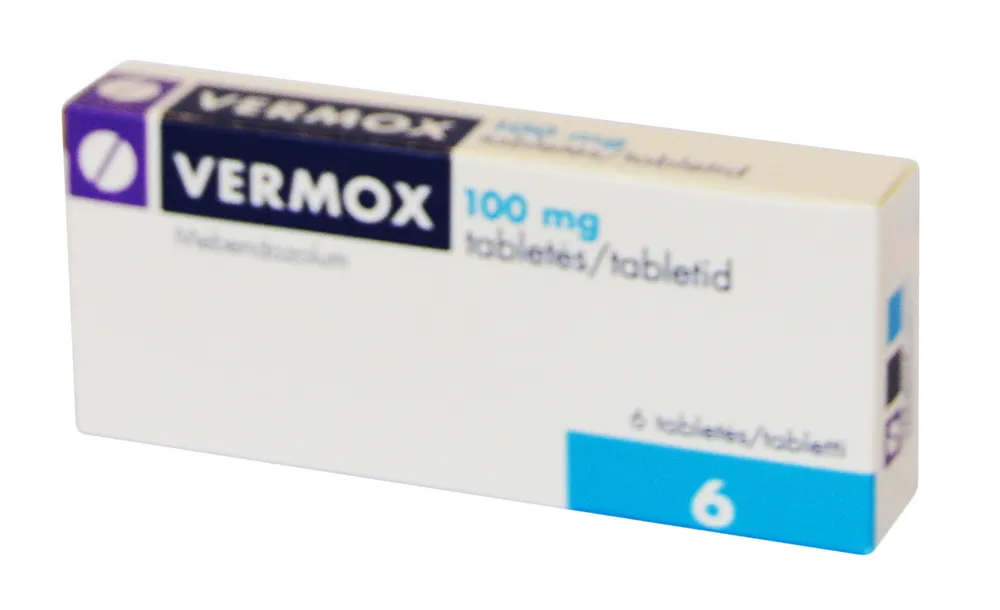
Table of Contents
Package leaflet: Information for the patient
Warning! Keep this leaflet! Information on the immediate packaging is in a foreign language.
Vermox, 100 mg, tablets
Mebendazole
Please read the following information carefully before using the medicine, as it contains
important information for the patient.
- Keep this leaflet, as you may need to read it again.
- If you have any questions, please consult your doctor or pharmacist.
- This medicine has been prescribed for a specific individual. Do not pass it on to others. The medicine may harm another person, even if their symptoms are the same.
- If any adverse reactions occur in the patient, including any adverse reactions not listed in this leaflet, inform your doctor or pharmacist. See section 4.
Table of contents of the leaflet:
- What is Vermox and what is it used for
- Important information before taking Vermox
- How to take Vermox
- Possible side effects
- How to store Vermox
- Contents of the pack and other information
1. What is Vermox and what is it used for
Vermox is an anthelmintic medicine with a broad spectrum of activity, used in the treatment of adults and children.
Vermox is indicated for the treatment of gastrointestinal parasitic infections (infestations), single or mixed, caused by the following parasite species: pinworm ( Enterobius vermicularis ), whipworm ( Trichuris trichiura ), roundworm ( Ascaris lumbricoides ), duodenal hookworm ( Ancylostoma duodenale ), and American hookworm ( Necator americanus ).
2. Information before using Vermox
When not to use Vermox:
- if the patient is allergic to mebendazole or to any of the other ingredients of this medicine (listed in section 6).
Warnings and precautions
Before starting treatment with Vermox, consult your doctor or pharmacist.
Vermox should always be used according to the doctor's recommendations, and medical supervision must continue until symptoms resolve.
It is very important to maintain personal hygiene during and after treatment to prevent recurrence of infection and transmission of parasites to other people.
Cases of impaired liver and kidney function, as well as decreased white blood cell count (neutropenia), have been reported in patients treated with mebendazole.
No special diet or laxatives are required during treatment.
Children
Seizures (convulsive seizures) have been reported in children, including infants. Vermox should not be used in children under 1 year of age.
Vermox should be used in children aged 1 to 2 years only if decided by a doctor.
Vermox and other medicines
Inform your doctor or pharmacist about any medicines the patient is currently taking or has recently taken, as well as any medicines planned for future use.
Concomitant use of cimetidine may affect the efficacy of mebendazole. Concomitant use of mebendazole with metronidazole should be avoided due to the risk of serious adverse reactions.
Taking Vermox with food and drink
Tablets should be taken with water. There is no need to use laxatives or follow a special diet during treatment.
Pregnancy, breastfeeding and fertility
If the patient is pregnant, breastfeeding, suspects she may be pregnant, or is planning to become pregnant, she should consult a doctor or pharmacist before using this medicine.
As a precautionary measure, use of Vermox should be avoided, especially during the first trimester of pregnancy.
During pregnancy and breastfeeding, Vermox may be used only if a doctor decides it is necessary.
Driving and operating machinery
Vermox has no effect or has a negligible effect on the ability to drive and operate machinery.
Vermox contains sodium
The medicine contains less than 1 mmol (23 mg) of sodium per tablet, meaning the medicine is considered "sodium-free".
Vermox contains Sunset Yellow FCF (E 110)
The medicine contains the colouring Sunset Yellow FCF (E 110), which may cause allergic reactions.
3. How to use Vermox
This medicine should always be taken exactly as prescribed by the doctor. In case of doubt, consult your doctor or pharmacist.
Strictly follow the dosage prescribed by your doctor. Medical supervision is necessary until symptoms have resolved (e.g. until the recommended stool test has been performed).
Oral administration
Tablets should be taken with water, preferably in the evening. The tablet may be taken whole, chewed, or crushed to facilitate swallowing. The score line is intended only to facilitate breaking the tablet for ease of swallowing and does not allow for dividing the tablet into equal doses.
Before administering the tablet to a young child, crush the tablet. Always supervise the child while taking this medicine.
No special diet or laxatives are required during treatment.
Adults and children over 2 years of age:
- Enterobiasis (pinworm infection): Single dose of 100 mg (1 tablet). Due to the risk of frequent re-infection, repeat treatment is recommended after 2 to 4 weeks.
- Ascariasis, trichuriasis, ancylostomiasis, or mixed infections:
200 mg per day (1 tablet in the morning and 1 tablet in the evening) for 3 consecutive days.
Use in children over 2 years of age
For enterobiasis, ascariasis, trichuriasis, ancylostomiasis, or mixed infections, the dosage is the same as in adults, regardless of body weight or age of the child.
Use in children under 2 years of age
For children under 2 years of age, see section 2, "Important information before using Vermox".
Overdose of Vermox
Accidental overdose may cause abdominal cramps, nausea, vomiting, and diarrhea. In patients treated for prolonged periods with high doses, rare cases of transient liver function disorders (hepatitis), kidney function disorders (glomerulonephritis), and neutropenia (marked decrease in granulocyte count—certain white blood cells) have been observed.
In case of accidental overdose of Vermox, contact your doctor or pharmacist, or go immediately to the nearest hospital emergency department. Bring the medicine package and the enclosed leaflet with you.
Missed dose of Vermox
Do not take a double dose to make up for a missed dose.
Take the next dose at the usual time and continue taking the medicine as prescribed by your doctor.
Stopping Vermox treatment
If treatment with Vermox is discontinued prematurely, the treatment may be ineffective.
In case of any further doubts regarding the use of this medicine, consult your doctor or pharmacist.
4. Possible adverse reactions
Like any medicine, this medicine can cause adverse reactions, although they do not occur in everyone.
If Vermox is used at the recommended doses, it usually does not cause any discomfort.
If any of the following symptoms occur in a patient:
- hypersensitivity reactions (allergic reactions), including angioedema (sudden allergic swelling of the skin and mucous membranes of the face, throat, lips or larynx), skin eruptions, rash and urticaria, breathing difficulties, feeling of weakness,
- severe skin reactions with spreading rash with blisters and peeling skin, particularly around the mouth, nose, eyes and genital organs (Stevens-Johnson syndrome) or severe skin peeling (toxic epidermal necrolysis),
- fatigue, loss of appetite, abdominal pain, vomiting, pale stools, dark urine, yellowing of the skin or whites of the eyes (hepatitis),
- frequent infections (neutropenia, agranulocytosis), the use of Vermox should be discontinued immediately and the patient should contact a doctor without delay.
In clinical trials, discomfort in the lower abdomen, bloating, diarrhoea and rash were observed not very frequently (in less than 1% of individuals).
The following adverse reactions have also been reported during the use of Vermox:
Frequent adverse reactions (may occur in less than 1 in 10 people):
- abdominal pain.
Uncommon adverse reactions (may occur in less than 1 in 100 people):
- nausea, vomiting.
Rare adverse reactions (may occur in less than 1 in 1000 people):
- dizziness.
Very rare adverse reactions (may occur in less than 1 in 10,000 people):
- decreased number of certain types of white blood cells, leading to more frequent infections (neutropia),
- allergic reactions (including severe),
- seizures,
- liver function disorders,
- hepatitis,
- urticaria,
- hair loss,
- skin eruptions,
- allergic swelling (angioedema),
- severe skin reactions.
The following adverse reactions have been reported very rarely (i.e. may occur in less than 1 in 10,000 people) with long-term use at doses significantly exceeding the recommended doses:
- kidney inflammation (glomerulonephritis),
- marked decrease in the number of white blood cells, increasing the risk of infections (agranulocytosis).
Additional adverse reactions in children
Seizures have very rarely been reported in children.
Reporting of adverse reactions
If any adverse reactions occur, including any adverse reactions not listed in this leaflet, inform a doctor or pharmacist. Adverse reactions can be reported directly to the Department for Monitoring Adverse Drug Reactions, Office for Registration of Medicinal Products, Medical Devices and Biocidal Products, Al. Jerozolimskie 181C, 02-222 Warsaw,
tel.: + 48 22 49 21 301, fax: + 48 22 49 21 309,
website: https://smz.ezdrowie.gov.pl.
Reporting adverse reactions helps to provide more information on the safety of the medicine.
5. How to store Vermox
Keep the medicine out of the sight and reach of children.
Store below 25°C, in the original packaging.
Do not use this medicine after the expiry date stated on the packaging.
The expiry date refers to the last day of the stated month.
Medicines should not be disposed of via wastewater or household waste. Ask your pharmacist how to dispose of medicines no longer in use. This will help protect the environment.
6. Contents of the packaging and other information
What Vermox contains
- The active substance is mebendazole. Each tablet contains 100 mg of mebendazole.
- The other ingredients are: microcrystalline cellulose, sodium carboxymethyl starch (type A), talc, corn starch, sodium saccharin, magnesium stearate, hydrogenated vegetable oil (type I), orange flavour, colloidal anhydrous silica, sodium lauryl sulphate, sunset yellow S (E 110).
What Vermox looks like and contents of the pack
Flat, round, light orange tablets, marked with the word "JANSSEN" on one side and the letters "Me" and "100" separated by a dividing line on the other side.
6 tablets in a PVC/Al blister pack, in a cardboard carton.
For more detailed information, please contact the marketing authorisation holder or the parallel importer.
Marketing authorisation holder in Romania, the country of export:
Janssen Pharmaceutica NV
Turnhoutseweg 30
B-2340 Beerse
Belgium
Manufacturer:
Lusomedicamenta Sociedade Técnica Farmacêutica, S.A.
Estrada Consiglieri Pedroso 69-B
Queluz de Baixo, 2730-055 Barcarena, Portugal
Parallel importer:
InPharm Sp. z o.o.
ul. Strumykowa 28/11
03-138 Warsaw
Poland
Repackaged by:
InPharm Sp. z o.o. Services sp. k.
ul. Chełmżyńska 249
04-458 Warsaw
Poland
Marketing authorisation number in Romania, the country of export: 9447/2016/01
Parallel import authorisation number: 816/12