Veregen
Poland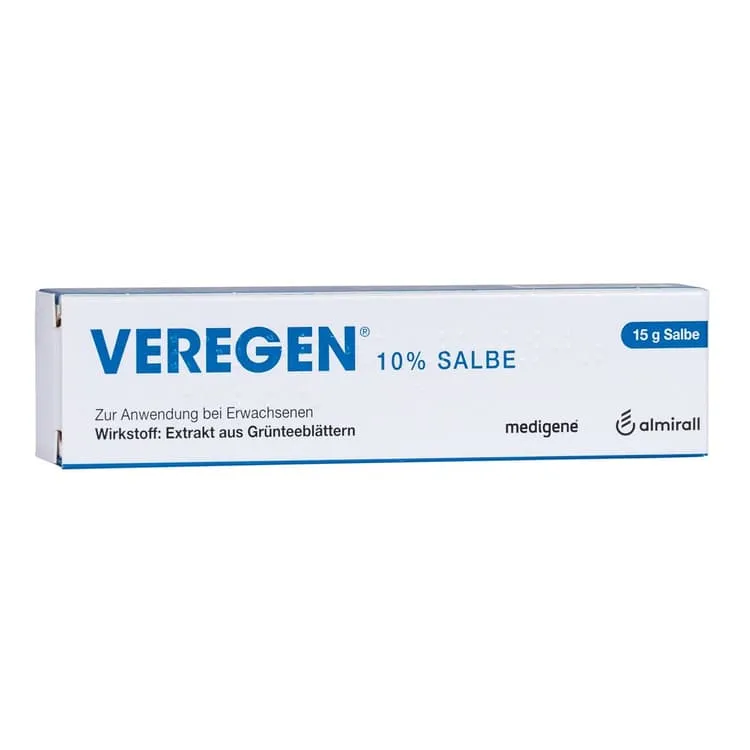
Table of Contents
Package leaflet: Information for the user
Veregen, 100 mg/g, ointment
Green tea leaf extract
Please read all of this leaflet carefully before using this medicine because it contains important information for you.
- Keep this leaflet. You may need to read it again.
- If you have any further questions, ask your doctor.
- This medicine has been prescribed for you only. Do not pass it on to others. It may harm them, even if their symptoms are the same as yours.
- If you experience any adverse reactions, including any not listed in this leaflet, tell your doctor. See section 4.
Contents of the leaflet:
- What Veregen is and what it is used for
- Important information before using Veregen
- How to use Veregen
- Possible side effects
- How to store Veregen
- Contents of the pack and other information
1. What Veregen is and what it is used for
Veregen is a herbal medicinal product intended for topical use only.
The active substance is green tea leaf extract. Veregen is used to treat genital warts ( Condylomata acuminata ) on the external genital area and around the anus. Veregen is used in adults with normal immune system function.
If there is no improvement after 4–6 weeks of treatment, or if your condition worsens, consult your doctor.
2. Important information before using Veregen
Before starting treatment with Veregen, discuss it with your doctor.
When not to use Veregen
- if the patient is allergic (hypersensitive) to green tea extract or any of the other ingredients of this medicine (listed in section “6. Contents of the pack and other information”).
Warnings and precautions
- Consult your doctor if the patient has liver problems or an impaired immune system. Veregen should not be used in case of liver function disorders (e.g. if there is abnormal fluid accumulation in the abdomen, or yellowing of the skin due to liver dysfunction) or when the immune system is weakened (due to disease or other medications being taken).
- Do not use Veregen until the area to be treated has completely healed after previous pharmacological or surgical treatment.
- Avoid contact with eyes, nostrils, lips, and inside the mouth. If the ointment accidentally gets into these areas, wipe it off and/or rinse with water.
- Do not apply to open wounds, damaged skin, or inflamed skin.
- Veregen must not be applied to mucous membranes; therefore, it is not intended for the treatment of warts located inside the vagina, cervix, urethra, or within the anal canal.
- Female patients with external genital warts should use the ointment with caution, as treatment in this area may more frequently cause severe local adverse reactions.
- Uncircumcised men treating warts under the foreskin should retract the foreskin daily and wash the area to prevent phimosis (inability to pull back the foreskin from the glans penis). If early signs of phimosis are observed (e.g. open sores, skin hardening, or increasing difficulty in retracting the foreskin), treatment must be stopped and a doctor consulted.
- Veregen does not eliminate HPV virus nor prevent transmission of the disease; therefore, special caution should be taken regarding sexual activity; see section “3. How to use Veregen” of this leaflet.
- If the sexual partner is infected with HPV, treatment is recommended. Treating the partner may help prevent re-infection. In case of doubt, consult your doctor.
- Do not expose the treated area to sunlight or use sunlamps or sunbeds.
- Veregen may stain clothing and bed linen.
- Mild local skin reactions such as redness, itching, irritation (usually burning), pain, and swelling at the application site are very common and should not lead to discontinuation of treatment. These symptoms should improve after the first few weeks of treatment; see section “4. Possible side effects”.
Children and adolescents
Veregen is not recommended for use in children and adolescents under 18 years of age.
Veregen with other medicines
Tell your doctor or pharmacist about all medicines the patient is currently taking or has recently taken, as well as any medicines they plan to take, or if the patient has recently undergone other treatment for genital or perianal warts. Veregen should not be used together with other treatments in the area of the warts. Veregen should not be used if the skin has not healed after other treatment.
Veregen with food and drink
No interaction with food or drink.
As a precautionary measure, to avoid possible interactions or adverse effects, do not use Veregen simultaneously with dietary supplements containing high amounts of green tea leaf extract.
Pregnancy, breastfeeding, and fertility
If the patient is pregnant, breastfeeding, suspects she may be pregnant, or plans to become pregnant, she should consult her doctor before using this medicine.
Pregnancy
There are no data or only limited data on the use of Veregen in pregnant women. Animal studies have shown harmful effects on reproduction.
Therefore, as a precaution, use of Veregen during pregnancy should be avoided, despite the apparent low systemic exposure to epigallocatechin gallate (the main component of green tea) following topical application (see section “3. How to use Veregen”).
Breastfeeding
It is not known whether Veregen or its metabolites pass into human milk. Therefore, it is not known whether there is a risk to the breastfed infant. Risk to the breastfed infant cannot be excluded.
However, following topical application of the medicine in the mother, the risk of adverse effects in the breastfed infant appears to be low.
Fertility
There is no evidence indicating an effect on fertility when Veregen is used as recommended by a doctor.
Driving and operating machinery
No studies on the effect of Veregen on the ability to drive and operate machinery have been conducted. However, it is unlikely that Veregen would affect the ability to drive or operate machinery.
Veregen contains isopropyl myristate and polyglycol monostearate monopalmitate propylene glycol
Veregen contains, among other ingredients, high amounts of isopropyl myristate, which may cause skin irritation and sensitization, and polyglycol monostearate monopalmitate propylene glycol, which may cause skin irritation.
3. How to use Veregen
This medicine should always be used exactly as prescribed by your doctor. If in doubt, consult your doctor or pharmacist.
The recommended dose is a maximum of 0.5 cm of ointment (corresponding to 250 mg) applied to all warts combined, three times daily (in the morning, at midday, and in the evening).
- Wash your hands before and after applying the ointment.
- Apply a small amount of Veregen ointment with your fingers directly to each wart, evenly covering all warts and leaving a thin layer of ointment on them.
- Do not use the ointment internally (do not insert into the anus, urethra, or vagina).
- Do not cover or bandage the treated area after applying the ointment.
- It is not necessary to wash off the ointment from the treated area before the next application. However, if the patient washes the treated area or takes a bath, the ointment should be reapplied.
- Apply Veregen three times daily (in the morning, at midday, and in the evening).
- New warts may appear during treatment; these should be treated in the same way.
- Genital warts are a sexually transmitted disease; therefore, sexual partners may become infected through sexual contact. Condoms should be used until all warts have completely disappeared. Using condoms helps prevent reinfection.
- Veregen may weaken latex condoms and vaginal diaphragms. Before sexual activity, thoroughly wash off the ointment with warm water and mild soap, then put on a condom. Ask your doctor about additional contraceptive methods.
- Female patients using tampons during menstruation: insert the tampon before applying the ointment. If it is necessary to change the tampon while ointment is present on the skin, take care to avoid transferring the ointment into the vagina. If ointment accidentally gets into the vagina, wash it off immediately with warm water and mild soap.
- Treatment with Veregen should be continued until all warts have completely healed, but for no longer than 16 weeks, even if new warts appear during treatment. If warts do not resolve or if the disease recurs, consult your doctor.
Use in children and adolescents (under 18 years of age)
Veregen is not approved for use in children and adolescents under 18 years of age.
Elderly patients
Data on the use of Veregen in elderly patients are limited.
Liver function impairment
Veregen should not be used in patients with impaired liver function (e.g., if ascites or jaundice due to liver dysfunction is present).
Overdose of Veregen
More severe local reactions may occur (see sections “2. Important information before using Veregen” and “4. Possible side effects”).
Wash off any excess ointment with mild soap and water.
In case of accidental ingestion, contact your doctor immediately.
Missed dose of Veregen
Continue with the next dose at the usual time. Do not apply a double dose to make up for a missed dose.
Stopping Veregen treatment
Failure to completely heal the warts may occur.
If you have any further questions about the use of this medicine, consult your doctor or pharmacist.
4. Possible adverse reactions
Like all medicines, this medicine can cause adverse reactions, although not everybody gets them.
Most adverse reactions with Veregen are due to local effects of the medicine on the skin and occur at or around the treated wart area. In many patients, redness, itching, irritation, pain or swelling may occur. Mild reactions may be expected and should decrease during the first weeks of treatment. However, if the intensity of local skin reactions negatively affects the patient's daily activities or if blisters occur, consult a doctor. It may be necessary to interrupt treatment.
Treatment may be resumed once the skin reaction has subsided. In case of a local reaction involving the formation of blisters, consult a doctor.
If severe local reactions occur causing unacceptable discomfort, such as local inflammation/infection, ulcers, swollen lymph nodes, or any other severe reaction (e.g. phimosis or urethral stricture, difficulty urinating or severe pain), treatment must be discontinued, the ointment should be washed off with warm water and mild soap, and medical advice must be sought immediately.
The following frequency categories have been used to classify adverse reactions:
| Very common | may occur in more than 1 in 10 people |
| Common | may occur in up to 1 in 10 people |
| Uncommon | may occur in up to 1 in 100 people |
Very common:
- Local skin reactions at the site of warts where Veregen was applied, including: redness, itching, irritation/burning, pain, swelling, ulcers, skin hardening, and blisters
Common:
- Local skin reactions such as peeling, exudate, bleeding, swelling
- Swelling of lymph nodes (inguinal)
- Urethral stenosis
Uncommon:
- Local scarring, skin fissures, dryness, discomfort, erosion, increased or decreased sensation, lump, nodules, skin inflammation, and skin discoloration at the application site, local necrosis, eczema
- Pustules at the application site, infections at the application site, genital herpes infection, staphylococcal infection, fungal vaginal infection, urethritis or vulvovaginitis
- Painful urination, increased frequency of urination, or urinary urgency
- Balanitis and balanoposthitis, dyspareunia
- Rash, hypersensitivity
Adverse reactions observed only during use of the higher strength ointment
(Veregen 150 mg/g):
- Bacterial skin infection (pyoderma), vulvitis
- Meatal stenosis/urination difficulties, vaginal discharge
Reporting of adverse reactions
If any adverse effects occur, including any adverse effects not listed in this leaflet, inform your doctor or pharmacist. Adverse reactions can be reported directly to the Department of Monitoring Adverse Drug Reactions, Office for Registration of Medicinal Products, Medical Devices and Biocidal Products, Al. Jerozolimskie 181 C, 02-222 Warsaw, Tel.: +48 22 49 21 301, Fax: +48 22 49 21 309, Website: https://smz.ezdrowie.gov.pl
Adverse reactions can also be reported to the marketing authorization holder.
Reporting adverse reactions helps to provide more information on the safety of the medicinal product.
5. How to store Veregen
Keep this medicine out of the sight and reach of children.
Do not store above 25°C.
Use within 6 weeks after first opening the tube.
Do not use this medicine after the expiry date stated on the tube and the carton after "Expiry date". The expiry date refers to the last day of the specified month.
Medicines should not be disposed of via wastewater or household waste. Ask your pharmacist how to dispose of medicines no longer required. This will help protect the environment.
6. Contents of the pack and other information
What Veregen contains
The active substance in Veregen is an extract from green tea leaves. 1 g of ointment contains 100 mg of extract
(in the form of a dried, purified extract) from Camellia sinensis (L.) O. Kuntze, folium (green tea leaves) (24-56:1), corresponding to: 55-72 mg of (-)-epigallocatechin gallate.
Primary solvent for extraction: water
Other ingredients are:
white soft paraffin (contains all-rac-α-tocopherol),
white wax,
isopropyl myristate,
oleyl alcohol,
propylene glycol monostearate palmitate.
What Veregen looks like and contents of the pack
Veregen is a brown, smooth ointment free from granular particles, supplied in tubes of two sizes: 15 g and 30 g.
Marketing Authorisation Holder and Manufacturer
Marketing Authorisation Holder
ORNYX OÜ
Ida-Viru maakond
Jõhvi vald, Edise küla
Aiandi keskus 7, 41558
Estonia
Manufacturer
C.P.M. ContractPharma GmbH
Frühlingsstraße 7
83620 Feldkirchen-Westerham
Germany
This medicinal product is authorised in the European Economic Area and the United Kingdom (Northern Ireland) under the following names:
Austria: Veregen 10% Salbe
Belgium: Veregen pommade
Bulgaria: Вереген 10% маз
Croatia: Veregen 100 mg/g mast
Cyprus: Veregreen 10% Αλοιφή
Estonia: Veregen
France: VEREGEN 10%, pommade
Greece: Veregreen 10% Αλοιφή
Spain: Veregen 100 mg/g pomada
Netherlands: Veregen 10%, zalf
Ireland: Catephen 10 % ointment
Lithuania: Veregen 100 mg/g tepalas
Luxembourg: Veregen 10 %
Latvia: Veregen 100 mg/g ziede
Germany: Veregen 10% Salbe
Poland: Veregen
Portugal: Veregen
Czech Republic: Veregen
Slovakia: Veregen 100 mg/g masť
Romania: Veregen 100 mg/g unguent
Slovenia: Veregen 100 mg/g mazilo
Hungary: Veregen 10% kenőcs
United Kingdom (Northern Ireland): Catephen 10 % ointment
Italy: Veregen