Ventolin
Poland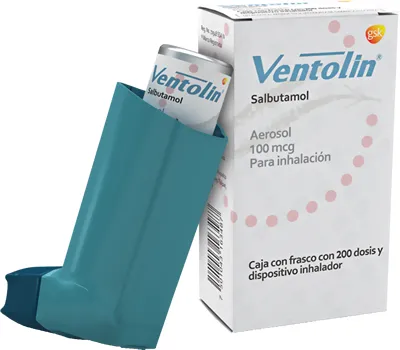
Table of Contents
Patient Information Leaflet
Caution! Please keep this leaflet. The information on the immediate packaging is in a foreign language.
Ventolin (Ventolin 100 Inhaler CFC-Free)
100 mcg/inhalation dose, inhalation aerosol, suspension
Salbutamolum
Ventolin and Ventolin 100 Inhaler CFC-Free are different trade names for the same medicine.
Please read this leaflet carefully before using the medicine, as it contains important information for the patient.
- Keep this leaflet for future reference.
- If you have any questions, consult your doctor or pharmacist.
- This medicine has been prescribed for a specific individual. Do not share it with others. This medicine may harm others, even if their symptoms are identical.
- If you experience any adverse effects, including those not listed in this leaflet, inform your doctor, pharmacist, or nurse. See section 4.
Table of contents:
- What Ventolin is and what it is used for
- Important information before using Ventolin
- How to use Ventolin
- Possible side effects
- How to store Ventolin
- Contents of the pack and other information
1. What Ventolin is and what it is used for
Ventolin contains a medicine called salbutamol. It belongs to a group of medicines known as fast-acting bronchodilators.
Bronchodilators:
- help keep the airways open, making breathing easier,
- help reduce chest tightness, wheezing, and coughing associated with asthma.
Ventolin is used to treat breathing problems in adults, adolescents, and children aged 4 years and older who have asthma or similar conditions. It is also used to prevent asthma symptoms triggered by physical exertion and exposure to allergens (substances that cause asthma attacks), such as house dust, pollen, cat or dog fur, and cigarette smoke.
2. Important information before using Ventolin
When not to use Ventolin
- if the patient is allergic to salbutamol sulfate or any of the other ingredients of this medicine (listed in section 6),
- in threatened miscarriage,
- in preventing premature labour.
Warnings and precautions
Before starting treatment with Ventolin, consult your doctor if the patient:
- has poorly controlled asthma (e.g. asthma symptoms occur frequently or worsen, or the patient has reduced physical capacity). The doctor may recommend starting or increasing the dose of a medicine, such as an inhaled corticosteroid, to achieve disease control,
- has high blood pressure,
- has hyperthyroidism,
- has previously had heart problems, such as irregular or rapid heartbeat or chest pain,
- has low blood potassium levels,
- is taking xanthine derivatives (e.g. theophylline) or steroids for asthma treatment,
- is taking diuretics (water tablets), sometimes used in the treatment of high blood pressure or heart disease. ➔ If the patient is taking any of these medicines, the doctor may recommend monitoring blood potassium levels. ➔ Consult your doctor whether any of the above conditions apply to the patient.
Consult your doctor if the duration of action of the medicine is shorter than 3 hours.
Ventolin and other medicines
Tell your doctor about all medicines the patient is currently taking or has recently taken, including medicines obtained without a prescription.
Some medicines may affect the action of Ventolin or increase the risk of adverse effects. These include:
- beta-blocking agents, such as propranolol, used in the treatment of high blood pressure or other heart conditions.
➔ The doctor will decide whether the patient can use Ventolin together with these medicines.
Pregnancy and breastfeeding
Ventolin is generally not recommended for use during pregnancy.
If the patient is pregnant or breastfeeding, suspects she may be pregnant, or is planning to have a child, she should consult her doctor before using this medicine. The doctor will assess whether she can take Ventolin during this period.
Driving and operating machinery
No effects on the ability to drive or operate machinery have been observed.
3. How to use Ventolin
Ventolin must always be used as directed by the doctor. In case of doubt, contact your doctor.
Ventolin is for inhalation use only through the mouth.
Increasing the dose or frequency of use is allowed only under medical supervision.
Patients who have difficulty coordinating inhalation with releasing the medication from the inhaler may use Ventolin with a spacer device.
Children under 5 years of age may use Ventolin with a Babyhaler spacer device.
Ventolin should be used as needed, not regularly.
If a patient’s asthma is active (for example, frequent symptoms or exacerbations such as breathlessness interfering with speaking, eating or sleeping, coughing, wheezing, chest tightness or reduced physical activity), they should inform their doctor immediately. The doctor may initiate or increase the dose of medication needed to maintain control of asthma symptoms, such as an inhaled corticosteroid.
If the patient feels that the medication is not working as well as usual, they should inform their doctor as soon as possible (for example, if higher doses are needed to relieve breathing difficulties, or asthma symptoms do not improve within at least 3 hours after using the inhaler), because asthma may be worsening and a different treatment may be necessary.
If the patient uses Ventolin more than twice a week to relieve asthma symptoms, excluding preventive use before physical exertion, this indicates poorly controlled asthma and increases the risk of severe asthma attacks (asthma exacerbations), which can lead to serious complications, be life-threatening, and even result in death. The patient should contact their doctor promptly to review their asthma treatment. If the patient is using a daily anti-inflammatory lung medication, such as an inhaled corticosteroid, it is important to continue regular use even if they feel better.
The patient should inform their doctor if the medication no longer works as before, as this may indicate worsening asthma control and a change in treatment may be necessary.
Adults and adolescents aged 12 years and older
- To relieve sudden bronchospasm, inhale one to two puffs (100 to 200 micrograms of salbutamol).
- For prevention before exercise or expected exposure to an allergen, usually two puffs (2 × 100 micrograms of salbutamol) should be taken 10–15 minutes before exercise or allergen exposure.
- Long-term treatment: 2 puffs (2 × 100 micrograms of salbutamol) up to 4 times daily.
Maximum daily dose is 800 micrograms (2 puffs no more than 4 times within 24 hours).
Children under 12 years of age
- To relieve sudden bronchospasm, inhale one puff (100 micrograms of salbutamol). If necessary, the dose may be increased to two puffs (2 × 100 micrograms).
- For prevention before exercise or expected exposure to an allergen, usually one puff (100 micrograms of salbutamol) should be taken 10–15 minutes before exercise or allergen exposure. If necessary, the dose may be increased to 2 puffs (2 × 100 micrograms).
- Long-term treatment: up to 200 micrograms 4 times daily.
Maximum daily dose is 800 micrograms (2 puffs no more than 4 times within 24 hours).
Instructions for using the inhaler
The doctor, nurse or pharmacist should instruct the patient on how to use the inhaler correctly.
The medication is contained in a pressurized canister fitted with a plastic actuator and mouthpiece.
Checking the inhaler
Before first use, check that the inhaler works. Remove the mouthpiece cap by gently pressing the sides of the cap with the thumb and index finger.
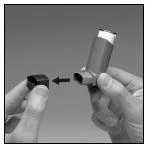
Figure 1
To ensure the inhaler is working, shake it vigorously, point the mouthpiece away from you, and release one puff into the air.
If the inhaler has not been used for one week or longer, remove the mouthpiece cap, shake the inhaler vigorously, and release two puffs into the air.
Using the inhaler
It is important to begin breathing slowly, as slowly as possible, even before using the inhaler.
- Use the inhaler while standing or sitting.
- Remove the mouthpiece cap from the inhaler (as shown in Figure 1). Check the mouthpiece inside and outside to ensure it is clean and free of foreign objects.
- Shake the inhaler 4 or 5 times to remove any foreign particles and to ensure the contents are evenly mixed before use.
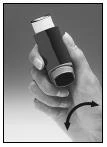
Figure 2
It is important not to rush the steps described in points 4–7.
- Hold the inhaler upright with your fingers, placing your thumb under the base of the inhaler, below the mouthpiece. Breathe out deeply, as deeply as possible.
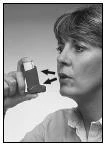
Figure 3
- Place the mouthpiece in your mouth and close your lips tightly around it. Do not bite the mouthpiece.
Page 4 of 8
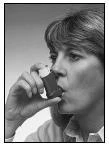
Figure 4
- Immediately after starting to inhale through your mouth, press down on the inhaler to release Ventolin medication, then continue a slow, deep inhalation.
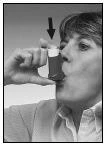
Figure 5
- Hold your breath, remove the inhaler from your mouth, and lift your finger from the inhaler cap. Hold your breath for several seconds, or as long as is comfortable without causing discomfort, then breathe out slowly.
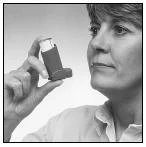
Figure 6
- If the doctor has prescribed two puffs, wait about half a minute before repeating steps 3–7.
- After inhalation, always replace the mouthpiece cap to prevent dust from entering. Securely attach the cap by pressing it into place. If you do not hear a click when attaching the cap, remove it, turn it around, and try again. Do not use excessive force.
Cleaning the inhaler
To prevent blockage, clean the inhaler at least once a week. To clean the inhaler:
- Remove the mouthpiece cap.
- Do not remove the metal canister from the plastic casing during cleaning or at any other time.
- Wipe the mouthpiece inside and outside, and the outside of the plastic casing, with a dry cloth or tissue.
- Replace the mouthpiece cap. When properly attached, you should hear a click. If you do not hear a click, remove the cap, turn it around, and try again. Do not use excessive force.
Do not immerse the metal canister in water.
Page 5 of 8
Accidental overdose of Ventolin
If more Ventolin has been used than recommended, contact your doctor or pharmacist immediately for advice. Keep the cardboard packaging of the medicine to show the doctor.
The following symptoms may occur:
- faster than normal heartbeat,
- tremors,
- excessive excitability. These symptoms usually resolve within a few hours. Additionally, the following may occur:
- decreased blood potassium levels (hypokalaemia),
- abdominal pain, increased lung ventilation (rapid breathing), shortened breathing despite reduced wheezing, cold hands and feet, irregular heartbeat, thirst (symptoms suggesting lactic acidosis).
Missed dose of Ventolin
If a dose of Ventolin is missed, take it as soon as possible, then continue using the medicine as directed by the doctor.
Do not take a double dose to make up for a missed dose.
If you have any further doubts about using this medicine, consult your doctor or pharmacist.
4. Possible adverse effects
If, immediately after taking this medicine, breathing worsens or wheezing increases, you must stop using the medicine immediately and contact your doctor immediately.
Like all medicines, Ventolin can cause adverse effects, although they do not occur in everyone.
Below are the adverse effects observed in patients taking Ventolin.
Symptoms to be aware of
Allergic reactions: Very rare (occurring in fewer than 1 in 10,000 patients taking the medicine). Symptoms include:
- skin rash (urticaria) or redness,
- swelling, mainly of the face, lips, tongue or throat (angioedema),
- increased wheezing in the airways, cough or difficulty breathing,
- sudden feeling of weakness or dizziness (which may lead to falling or loss of consciousness).
➔ Contact your doctor immediately if any of the above symptoms occur. Discontinue use of Ventolin.
Contact your doctor immediately if the patient experiences:
- sensation of faster or stronger than usual heartbeat (palpitations). This is usually not dangerous and subsides shortly after taking the medicine,
- sensation of irregular heartbeat. Do not discontinue use of Ventolin unless otherwise advised by your doctor.
Adverse effects occurring frequently (occurring in fewer than 1 in 10 patients, but more frequently than 1 in 100 patients taking the medicine):
- tremors,
- headache, Page 6 of 8
- rapid heartbeat.
Adverse effects occurring less frequently (occurring in fewer than 1 in 100 patients, but more frequently than 1 in 1,000 patients taking the medicine):
- palpitations,
- irritation of the mucous membranes of the mouth and throat,
- muscle cramps.
Adverse effects occurring rarely (occurring in fewer than 1 in 1,000 patients, but more frequently than 1 in 10,000 patients taking the medicine):
- decreased potassium levels in the blood,
- peripheral vasodilation.
Adverse effects occurring very rarely (occurring in fewer than 1 in 10,000 patients taking the medicine):
- allergic reactions (see above),
- excessive excitability,
- cardiac arrhythmias,
- paradoxical bronchospasm. As with other inhaled medicines, paradoxical bronchospasm may occur, characterized by wheezing immediately after taking the medicine. In such a case, administration of Ventolin must be stopped immediately and the patient should contact their doctor. The doctor will assess the patient's condition and, if necessary, recommend alternative treatment.
Adverse effects occurring with unknown frequency
- myocardial ischemia, which may manifest as chest pain.
➔ If any of the adverse effects worsen or if any adverse effects not listed in this leaflet occur, inform your doctor or pharmacist.
Reporting of adverse effects
If any adverse effects occur, including those not listed in this leaflet, inform your doctor, pharmacist or nurse. Adverse effects can be reported directly to the Department of Monitoring Adverse Drug Reactions, Office for Registration of Medicinal Products, Medical Devices and Biocidal Products, Al. Jerozolimskie 181C, 02-222 Warsaw, phone: +48 22 49 21 301, fax: +48 22 49 21 309, website: https://smz.ezdrowie.gov.pl
Reporting adverse effects helps to gather more information on the safety of the medicine.
5. How to store Ventolin
Keep the medicine out of the sight and reach of children.
Store below 30°C. Store in the original packaging. Protect
from direct sunlight. Do not store in the refrigerator or freeze.
The container contains a pressurised suspension. Do not expose to temperatures above
50°C. Do not pierce, damage, or burn the container, even if it appears to be empty.
As with most inhaled medicines in pressurised containers,
the effectiveness of the medicine may be reduced if the inhaler is cold.
After inhalation, replace the cap on the mouthpiece. Do not force the cap on.
Do not use this medicine after the expiry date stated on the packaging.
The expiry date refers to the last day of the stated month.
Page 7 of 8
Medicines must not be disposed of via wastewater or household waste. Ask
your pharmacist how to dispose of medicines no longer required. This will help
protect the environment.
6. Contents of the pack and other information
What Ventolin contains
- The active substance is salbutamol in the form of salbutamol sulfate. Each dose of Ventolin contains 100 mcg (micrograms) of salbutamol as salbutamol sulfate.
- The other ingredient is: 1,1,1,2-tetrafluoroethane (HFA 134a).
This medicine contains fluorinated greenhouse gases.
Each inhaler contains 18 g of HFC-134a (also known as 1,1,1,2-tetrafluoroethane or HFA 134a), corresponding to 0.0257 tonnes of CO equivalent (global warming potential GWP = 1430).
What Ventolin looks like and contents of the pack
A pressurized aluminium container containing 200 doses, closed with a metering valve, fitted with a plastic actuator, in a cardboard box.
For more detailed information, please contact the responsible party or the parallel importer.
Marketing Authorisation Holder in Romania, the country of export:
GlaxoSmithKline (Ireland) Limited
12 Riverwalk, Citywest Business Campus, Dublin 24, Ireland
Manufacturer:
Glaxo Wellcome S.A.
Avenida de Extremadura 3
09400 Aranda de Duero
Burgos, Spain
Glaxo Wellcome Productions
Zone Industrielle no. 2, 23 Rue Lavoisier, 27000 Evreux, France
Parallel Importer:
Delfarma Sp. z o.o., ul. Św. Teresy od Dzieciątka Jezus 111, 91-222 Łódź
Relabelled and repackaged in:
Delfarma Sp. z o.o., ul. Św. Teresy od Dzieciątka Jezus 111, 91-222 Łódź
Marketing Authorisation number in Romania, the country of export: 675/2008/01
Parallel Import Authorisation number: 44/26
Page 8 of 8