Venomenhal
Poland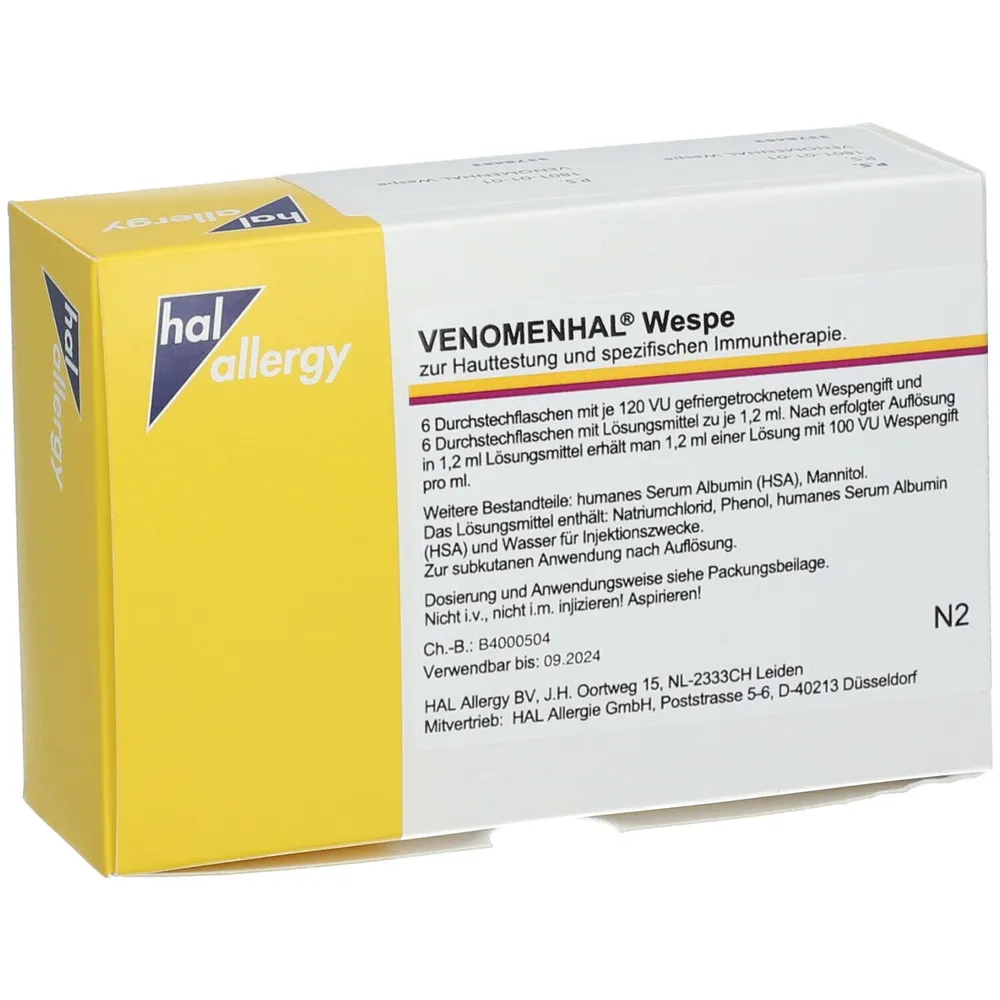
Table of Contents
Package leaflet: Information for the patient
VENOMENHAL
Hymenoptera venom (wasp or bee),
bee venom 120 VU
or
wasp venom 120 VU,
powder and solvent for solution for skin testing and specific immunotherapy.
Treatment kit for initial and maintenance therapy.
Please read carefully the entire leaflet before using the medicine, as it contains
important information for the patient.
- Keep this leaflet, as you may need to read it again.
- If you have any questions, please consult your doctor or nurse.
- This medicine has been prescribed for a specific individual. Do not pass it on to others. It may harm someone else, even if their symptoms are the same.
- If you experience any adverse effects, including any not listed in this leaflet, inform your doctor or nurse. See section 4.
Leaflet contents:
- What VENOMENHAL is and what it is used for
- Important information before using VENOMENHAL
- How to use VENOMENHAL
- Possible side effects
- How to store VENOMENHAL
- Contents of the pack and other information
1. What VENOMENHAL is and what it is used for
VENOMENHAL is used for diagnosis (skin testing) and specific immunotherapy (desensitization) of allergic diseases mediated by specific immunoglobulin E (IgE) antibodies in response to Hymenoptera venom (wasp or bee).
The indication should be based on a detailed clinical history confirming an allergic reaction to insect venom in the patient.
2. Important information before using VENOMENHAL
When not to use VENOMENHAL
- if the patient has hypersensitivity (allergy) to any of the other components of this medicine (listed in section 6)
- if the patient has been diagnosed with immunosuppression (e.g. due to taking immunosuppressive drugs)
- if the patient suffers from autoimmune diseases (e.g. rheumatoid disease)
- if the patient has severe bronchial asthma, particularly with FEV (one-second forced expiratory volume) persistently below 70% of predicted value, or glucocorticosteroid-dependent bronchial asthma
- if the patient has cardiovascular insufficiency, or is being treated with β-adrenolytic drugs or ACE inhibitors (angiotensin-converting enzyme inhibitors)
- if the patient has contraindications to adrenaline (epinephrine) use (e.g. hyperthyroidism)
- if the patient has serious psychiatric disorders, difficulty in communication, or does not comply with physician's instructions
- if the patient has active tuberculosis
- if the patient has malignant neoplastic diseases
- if the patient is pregnant or suspects she may be pregnant. If treatment was initiated prior to pregnancy, it may be continued according to the attending physician's recommendation.
Warnings and precautions
Immunotherapy medicines should be prescribed and administered only by specialist allergologists experienced in allergy treatment.
Acute or chronic eczema (e.g. atopic dermatitis) at the test site, secondary inflammatory or degenerative skin conditions (e.g. ichthyosis, scleroderma), generalized urticaria, or induced urticaria (dermographism) may affect skin reactivity and significantly alter the results of skin tests.
Physical exertion (sports, heavy physical work) should be avoided before and after each injection of the medicine.
Immediately consult a physician if burning pain, itching, or sensation of warmth occur on or under the tongue, in the throat, hands, or soles of the feet. These symptoms may precede anaphylactic shock, characterized by cyanosis (bluish skin discoloration), drop in arterial blood pressure, tachycardia, breathing difficulties, and loss of consciousness.
Treatment consists of life-saving interventions.
Other adverse reactions: see section 4. Possible adverse reactions.
Inform your physician if you have experienced any of the above symptoms in the past.
Children and adolescents
Particular caution should be exercised when administering VENOMENHAL to children under 5 years of age. The benefit-risk ratio should be individually assessed for each child.
Clinical efficacy data in children aged 5 years and older are limited; however, safety data do not indicate a higher risk than in adults.
VENOMENHAL and other medicines
Inform your physician about all medicines currently or recently taken, including those available without prescription.
During allergen immunotherapy, treatment that suppresses immune system activity should not be used. Concurrent use of antihypertensive drugs (β-adrenolytic agents, angiotensin-converting enzyme [ACE] inhibitors) may lead to severe reactions even after small allergen doses.
If the patient is simultaneously taking antiallergic drugs (antihistamines, mast cell degranulation inhibitors, or corticosteroids), sensitivity to previously well-tolerated venom doses may change. Moreover, skin reactivity may be altered, and skin tests performed during this period may yield false or unreliable results.
Bacterial and viral prophylactic vaccinations should not be administered earlier than 7 days after the last VENOMENHAL injection (except in life-threatening situations).
The next VENOMENHAL injection may be administered only after complete resolution of the vaccination reaction, but not earlier than 7 days after vaccination.
Bee venom must never be mixed with wasp venom.
VENOMENHAL with food and drink
Food and drink do not affect the efficacy of VENOMENHAL.
Pregnancy and breastfeeding
Pregnancy
Currently, there are no adequately documented data on the use of allergen immunotherapy in pregnant women. The potential risk to the mother and human fetus is unknown.
VENOMENHAL therapy should not be initiated during pregnancy. If treatment was started before conception, it may be continued according to the attending physician's recommendation.
Breastfeeding
VENOMENHAL therapy should not be initiated during breastfeeding. If treatment was started before conception, it may be continued according to the attending physician's recommendation.
Driving and operating machinery
Very rarely, a feeling of mild fatigue may occur. This possibility should be taken into account when driving or operating machinery.
3. How to use VENOMENHAL
Always use this medicine exactly as your doctor has told you. If you have any doubts, consult your doctor.
Using a higher than recommended dose of VENOMENHAL
If you have any doubts, consult your treating physician for advice.
Missing a dose of VENOMENHAL
In this case, consult your treating physician to establish a new schedule.
Stopping the use of VENOMENHAL
If you have any further doubts regarding the use of this medicine, consult your doctor.
4. Possible adverse reactions
Like all medicines, this medicine can cause adverse reactions, although not everyone experiences them.
There is an increased risk of adverse reactions occurring during dose escalation. This may
occur particularly in patients being treated with bee venom or in patients who have elevated
levels of the enzyme tryptase in the blood and (or) increased numbers of mast cells in the body.
The increased risk of adverse reactions occurs more frequently in women and in patients with
advanced allergy.
The following adverse reactions may occur within 30 minutes after injection. Delayed reactions
may occur several hours after administration. In such cases, the physician will individually reassess
whether to continue therapy.
Possible adverse reactions:
- anaphylactic shock
- headache
- facial skin redness
- cough, shortness of breath, wheezing
- diarrhoea, stomach discomfort, nausea, vomiting
- itching, rash, urticaria, eczema, skin redness
- swelling of the facial skin, oral mucosa and (or) throat
- joint swelling and pain
- swelling and discomfort at the injection site, malaise, fatigue, itching or urticaria, pain, fever
- rapid heartbeat, abnormal blood pressure
In rare cases, anaphylactic shock may occur. Typical warning symptoms include pricking, burning, itching and a sensation of warmth on and under the tongue, in the throat, and particularly in the palms and soles.
Reporting of adverse reactions
If any adverse reactions occur, including any possible adverse reactions not listed in this leaflet, consult your doctor, pharmacist or nurse. Adverse reactions can be reported directly to the Department of Monitoring Adverse Drug Reactions, Office for Registration of Medicinal Products, Medical Devices and Biocidal Products, Al. Jerozolimskie 181 C, PL-02 222 Warsaw, Tel.: + 48 22 49 21 301, Fax: + 48 22 49 21 309, Website: https://smz.ezdrowie.gov.pl
Adverse reactions can also be reported to the marketing authorization holder.
Reporting adverse reactions helps to provide more information on the safety of the medicine.
5. How to store VENOMENHAL
Store in a refrigerator (2°C - 8°C).
Do not freeze.
Solutions that have been frozen must not be used!
Keep the medicine out of the sight and reach of children.
Shelf life after reconstitution of the powder:
100 VU/ml insect venom concentration 6 months
Shelf life after dilution of the solution for concentrations:
10 VU/ml insect venom 6 months
1 VU/ml insect venom 6 months
0.1 VU/ml insect venom 6 months
<0.1 VU/ml insect venom 1 day
Do not use the medicine after the expiry date stated on the packaging after the words
"Expiry date:". The expiry date refers to the last day of the stated month.
Medicines must not be disposed of via wastewater or household waste. Ask your
pharmacist what to do with medicines no longer required. This will help
protect the environment.
6. Contents of the pack and other information
What VENOMENHAL contains
The active substance is:
Lyophilized insect venom (wasp or bee)
The other ingredients are:
human albumin
mannitol
Solvent:
sodium chloride, phenol, human albumin, water for injections
Diluent:
sodium chloride, phenol, human albumin, water for injections
What VENOMENHAL looks like and contents of the pack
The strength of the product is expressed in venom units (VU).
Set for initial and maintenance treatment:
6 vials containing 120 VU of lyophilized bee venom or 120 VU of lyophilized wasp venom, and
6 vials with 1.2 ml of solvent.
Set for preparing dilutions:
10 vials containing 4.5 ml of diluent.
Marketing Authorisation Holder and Manufacturer
Hal Allergy B.V.
J.H. Oortweg 15, 2333 CH Leiden
P.O. Box 1204, 2302 BE Leiden, The Netherlands
For further information, please contact the representative of the Marketing Authorisation Holder.
Centrofarm Sp. z o.o.
Leszczynowa 1
05-092 Kiełpin, Łomianki
Tel: +48 691 810 590