Venofer
Poland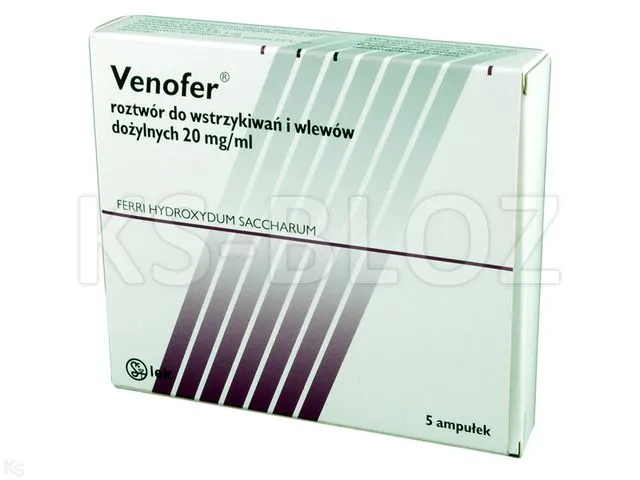
Table of Contents
- Package leaflet: Information for the user
- 1. What Venofer is and what it is used for
- 2. Important information before administering Venofer to the patient
- 3. How Venofer is administered
- 4. Possible adverse reactions
- 5. How to store Venofer
- 6. Contents of the packaging and other information
- Information intended exclusively for healthcare professionals:
Package leaflet: Information for the user
Warning!
Keep this leaflet. The information on the immediate packaging is in a foreign language.
Venofer
Venofer, 20 mg iron(III) ions/ml, solution for injection and infusion
Ferri hydroxidum saccharum
Please read the entire leaflet carefully before using this medicine, as it contains
important information for the patient.
- Keep this leaflet to be able to read it again if necessary.
- If you have any doubts, consult your doctor or pharmacist.
- This medicine has been prescribed for a specific individual. Do not pass it on to others. This medicine may harm another person, even if their symptoms are the same.
- If the patient experiences any adverse reactions, including any not listed in this leaflet, inform the doctor, pharmacist, or nurse. See section 4.
Table of contents of the leaflet:
- What Venofer is and what it is used for
- Important information before receiving Venofer
- How Venofer is given
- Possible side effects
- How to store Venofer
- Contents of the pack and other information
1. What Venofer is and what it is used for
Venofer is a solution for intravenous injection used to replenish iron stores in the body.
Iron is used in the bone marrow for the production of haemoglobin (Hb).
Venofer is used in the treatment of iron deficiency cases requiring supplementation.
The medicine is particularly used:
- when there is a clinical need for rapid systemic replenishment of iron stores,
- in patients who do not tolerate oral iron therapy or in whom such medicinal products cannot be administered,
- when oral iron preparations are ineffective (e.g. active inflammatory bowel disease).
2. Important information before administering Venofer to the patient
When not to use Venofer:
- if the patient has anemia not caused by iron deficiency;
- if the patient has excessively high iron levels in the body or if their body does not utilize iron properly;
- if the patient is allergic (hypersensitive) to the medicine or to any of the other ingredients of this medicine (listed in section 6);
- if the patient has previously experienced serious allergic reactions (hypersensitivity) to other injectable iron-containing preparations.
Do not administer Venofer if any of the above apply. In case of
doubt, consult a physician before starting treatment with Venofer.
Warnings and precautions
Before starting treatment with Venofer, discuss the following with a physician or nurse:
- if the patient has previously had allergies to medicines;
- if the patient has systemic lupus erythematosus;
- if the patient has rheumatoid arthritis;
- if the patient has severe asthma, eczema, or other atopic allergy;
- if the patient has any infections;
- if the patient has liver problems.
If in doubt whether any of the above points apply, consult a physician or pharmacist before starting treatment with Venofer.
Venofer and other medicines
As with all parenteral iron preparations, Venofer should not be used concomitantly with oral iron preparations, as the absorption of oral iron is reduced in such cases.
Pregnancy and breastfeeding
Venofer has not been studied with regard to use during the first three months of pregnancy. It is important to inform the physician if the patient is pregnant, suspects she may be pregnant, or is planning to become pregnant.
If pregnancy occurs during treatment, medical advice should be sought.
The physician will decide whether the patient should receive the medicine.
During breastfeeding, medical advice should be sought before taking Venofer.
Driving and operating machinery
After administration of Venofer, symptoms such as dizziness, confusion, or feeling faint may occur. In such cases, the patient should not drive or operate machinery until these symptoms have resolved. In case of doubt, consult a physician.
Venofer contains sodium
Venofer contains up to 7 mg of sodium (the main component of table salt) per ml. This corresponds to 0.4% of the maximum recommended daily dietary sodium intake for adults.
3. How Venofer is administered
The physician will decide the dose of Venofer to be administered, as well as how often and for how long the treatment should be given. To adjust the dose, the physician will perform blood tests.
Venofer will be administered by a physician or nurse in one of the following ways:
- slow intravenous injection – 1 to 3 times per week;
- intravenous infusion (drip) – 1 to 3 times per week;
- during dialysis – Venofer will be administered into the venous line of the dialysis apparatus. Venofer may only be administered in locations where rapid and appropriate medical assistance is available in case of hypersensitivity reactions.
After each administration, the patient should remain under the supervision of a physician or nurse for at least 30 minutes to monitor for the occurrence of adverse reactions.
4. Possible adverse reactions
Like all medicines, this medicine can cause adverse reactions, although not everyone will experience them.
The most commonly reported adverse reactions in clinical studies were: taste disturbances,
such as a metallic taste, low or high blood pressure, and reactions at the injection/infusion site, nausea.
Allergic reactions (may occur in up to 1 in 100 people)
If a patient experiences an allergic reaction, the doctor should be informed immediately. Symptoms
may include:
- Low blood pressure (dizziness, lightheadedness, fainting).
- Facial swelling.
- Breathing difficulties.
- Chest pain, which may be a sign of a sometimes severe allergic reaction called Kounis syndrome. If a patient suspects an allergic reaction, they should immediately inform their doctor or nurse.
Other adverse reactions:
Common (may occur in up to 1 in 10 people)
- Taste disturbances, such as a metallic taste. This symptom usually does not last for a long time.
- Low or high blood pressure.
- Nausea.
- Reactions at the injection/infusion site, such as pain, irritation, itching, bruising, or skin discoloration due to extravasation of the medicine.
Uncommon (may occur in up to 1 in 100 people)
- Headache or dizziness.
- Abdominal pain or diarrhoea.
- Vomiting.
- Wheezing, breathing difficulties.
- Itching, rash.
- Muscle spasms, cramps, or muscle pain.
- Tingling or numbness.
- Reduced sensation to touch.
- Phlebitis (vein inflammation).
- Flushing, burning sensation.
- Constipation.
- Joint pain.
- Limb pain.
- Back pain.
- Chills.
- Weakness, fatigue.
- Swelling of hands and feet.
- Pain.
- Increased liver enzyme activity (ALT, AST, GGT) in blood.
- Increased serum ferritin concentration.
Rare (may occur in up to 1 in 1,000 people)
- Fainting.
- Drowsiness or somnolence.
- Palpitations.
- Change in urine color.
- Chest pain.
- Excessive sweating.
- Fever.
- Increased lactate dehydrogenase activity in blood.
Other adverse reactions occurring with unknown frequency include: feeling of reduced
concentration, confusion; loss of consciousness; anxiety; tremor or shaking; swelling of the face, lips, tongue,
or throat, which may cause breathing difficulties; slow heart rate; fast heart rate;
circulatory collapse; phlebitis leading to blood clots; acute airway narrowing;
itching, urticaria, rash, or skin redness; cold sweat; general malaise; skin pallor; sudden, life-threatening allergic reactions (anaphylaxis).
Influenza-like symptoms may occur within a few hours to several days after injection; typical
symptoms include high body temperature and muscle and joint pain.
Reporting of adverse reactions
If any adverse reactions occur, including any not listed in this leaflet, inform a doctor, pharmacist, or nurse. Adverse reactions can be reported directly to: Department for Monitoring Adverse Drug Reactions, Office for Registration of Medicinal Products, Medical Devices and Biocidal Products, Al. Jerozolimskie 181C, 02-222 Warsaw, Tel.: +48 22 49 21 301, Fax: +48 22 49 21 309, Website: https://smz.ezdrowie.gov.pl
Reporting adverse reactions helps to provide more information on the safety of the medicine.
5. How to store Venofer
Keep this medicine out of sight and reach of children.
Do not use this medicine after the expiry date stated on the packaging. The expiry date refers to the last day of the stated month.
Store below 25°C. Keep the ampoules in the outer packaging to protect from light. Do not freeze.
Medicines must not be disposed of via wastewater or household waste. Ask your pharmacist how to dispose of medicines no longer required. Such measures will help protect the environment.
6. Contents of the packaging and other information
What Venofer contains
1 ml of solution contains 20 mg of iron as iron(III) hydroxide complex with sucrose.
1 ampoule (5 ml) contains 100 mg of iron.
Excipients: sodium hydroxide, solution (for pH adjustment), water for injections.
What Venofer looks like and contents of the pack
Venofer is a sterile, dark brown, opaque aqueous solution for intravenous use only, either as an injection or intravenous infusion (after dilution), containing iron(III) hydroxide complex with sucrose. The solution also contains sodium hydroxide, solution, and water for injections.
Venofer is available in 5 ml ampoules, each containing 100 mg of iron. Ampoules are packed in cardboard boxes; each box contains 5 ampoules.
For more detailed information, please contact the Marketing Authorisation Holder or the Parallel Importer.
Marketing Authorisation Holder in the Czech Republic, country of export:
Vifor France, 100-101 Terrasse Boieldieu, Tour Franklin La Défense 8, 92042 Paris La Défense Cedex, France
Manufacturer:
Vifor France, 100-101 Terrasse Boieldieu, Tour Franklin La Défense 8, 92042 Paris La Défense Cedex, France
Parallel Importer:
Delfarma Sp. z o.o., ul. Św. Teresy od Dzieciątka Jezus 111, 91-222 Łódź
Repackaged in:
Delfarma Sp. z o.o., ul. Św. Teresy od Dzieciątka Jezus 111, 91-222 Łódź
Marketing Authorisation number in the Czech Republic, country of export: 12/051/04-C
Parallel Import Licence number: 103/23
Information intended exclusively for healthcare professionals:
Administration
Patients must be carefully monitored for subjective and objective signs of hypersensitivity reactions during and after each administration of Venofer.
Venofer must be administered only under the direct supervision of medical personnel trained in the assessment and treatment of anaphylactic reactions, and in a facility fully equipped with resuscitation equipment. Patients should be observed for adverse reactions for at least 30 minutes following each administration of Venofer.
Dosage
The total cumulative dose of Venofer must be calculated individually for each patient and must not be exceeded.
Dosage calculation:
The total cumulative dose of Venofer, equivalent to the total iron deficit (mg), is determined based on hemoglobin concentration and body weight. The Venofer dose for each patient must be calculated according to the patient's total iron deficit using the Ganzoni formula, for example:
Total iron deficit [mg] = body weight [kg] x (target hemoglobin concentration – current hemoglobin concentration) [g/dl] x 2.4* + tissue iron stores [mg]
| Body weight below 35 kg: | Target hemoglobin concentration = 13 g/dl, body iron stores = 15 mg/kg body weight. |
| Body weight 35 kg or higher: | Target hemoglobin concentration = 15 g/dl, body iron stores = 500 mg/kg body weight. |
- Coefficient 2.4 = 0.0034 (iron content in hemoglobin = 0.34%) x 0.07 (blood volume = 7% of body weight) x 1000 (conversion factor from [g] to [mg]) x 10
| Total dose of Venofer (in milliliters) = | Total iron deficiency [mg] 20 mg iron/ml |
Total amount of Venofer drug (ml) to be administered depending on the patient's body weight,
current Hb concentration, and target Hb concentration*.
| Body weight | Number of vials (1 Venofer vial corresponds to 5 ml) to be administered | |||
| Hb 6.0 g/dl | Hb 7.5 g/dl | Hb 9.0 g/dl | Hb 10.5 g/dl | |
| 5 kg | 1.5 | 1.5 | 1.5 | 1 |
| 10 kg | 3 | 3 | 2.5 | 2 |
| 15 kg | 5 | 4.5 | 3.5 | 3 |
| 20 kg | 6.5 | 5.5 | 5 | 4 |
| 25 kg | 8 | 7 | 6 | 5.5 |
| 30 kg | 9.5 | 8.5 | 7.5 | 6.5 |
| 35 kg | 12.5 | 11.5 | 10.0 | 9.0 |
| 40 kg | 13.5 | 12.0 | 11.0 | 9.5 |
| 45 kg | 15.0 | 13.0 | 11.5 | 10.0 |
| 50 kg | 16.0 | 14.0 | 12.0 | 10.5 |
| 55 kg | 17.0 | 15.0 | 13.0 | 11.0 |
| 60 kg | 18.0 | 16.0 | 13.5 | 11.5 |
| 65 kg | 19.0 | 16.5 | 14.5 | 12.0 |
| 70 kg | 20.0 | 17.5 | 15.0 | 12.5 |
| 75 kg | 21.0 | 18.5 | 16.0 | 13.0 |
| 80 kg | 22.5 | 19.5 | 16.5 | 13.5 |
| 85 kg | 23.5 | 20.5 | 17.0 | 14.0 |
| 90 kg | 24.5 | 21.5 | 18.0 | 14.5 |
| Body weight below 35 kg: | Target hemoglobin concentration = 13 g/dl |
| Body weight 35 kg or higher: | Target hemoglobin concentration = 15 g/dl |
To convert hemoglobin concentration from mM to g/dl, multiply the value by 1.6.
If the total required dose exceeds the maximum allowable single dose, administration should be
spread over time. If no improvement in hematological parameters is observed after 1–2 weeks,
the original diagnosis should be reconsidered.
Calculation of iron dose in case of iron deficiency due to blood loss and as a supportive measure
in autologous transfusion
The dose of Venofer required to correct iron deficiency can be calculated using the following
formulas:
If the volume of blood lost is known: administration of 200 mg iron (10 ml of Venofer) should
result in an increase in hemoglobin concentration approximately equivalent to transfusion of 1
unit of blood (400 ml with hemoglobin concentration = 15 g/dl).
| Required amount of iron [mg] | = number of units of blood lost x 200 mg or |
| Required volume of Venofer drug [ml] | = number of units of blood lost x 10 ml |
If hemoglobin concentration is lower than expected: the formula assumes that there is no need
to replenish tissue iron stores. Required iron dose [mg] = body weight [kg] x 2.4
(target hemoglobin concentration – current hemoglobin concentration) [g/dl]
| Example: for a patient with body weight = 60 kg, with hemoglobin deficit = 1 g/dl | → administer 150 mg of iron |
| → administer 7.5 ml of Venofer solution |
Intravenous infusion
The Venofer medicinal product must be diluted in sterile 0.9% m/V sodium chloride (NaCl) solution. The medicinal product
should be diluted immediately before infusion and prepared according to the following recommendations:
| Dose of Venofer (mg iron) | Dose of Venofer (ml of Venofer solution) | Maximum volume of sterile 0.9% m/V NaCl solution for dilution | Minimum infusion time |
| 100 mg | 5 ml | 100 ml | 15 minutes |
| 200 mg | 10 ml | 200 ml | 30 minutes |
| 300 mg | 15 ml | 300 ml | 1.5 hours |
| 400 mg | 20 ml | 400 ml | 2.5 hours |
| 500 mg | 25 ml | 500 ml | 3.5 hours |
Intravenous injection
Venofer may be administered by slow intravenous injection at a rate of 1 ml of undiluted solution per minute, not exceeding a volume of 10 ml (200 mg of iron) per injection.
Injection into the venous line of a dialysis apparatus
Venofer may be administered during hemodialysis directly into the venous line of the dialysis apparatus, in accordance with recommendations for intravenous injection.
Pharmaceutical incompatibilities
Do not mix the medicinal product with other medicinal products, except with sterile 0.9% sodium chloride solution for dilution. Precipitation and (or) interactions may occur when mixed with other solutions or medicinal products. Compatibility with containers other than glass, polyethylene, or PVC is not known.
Special precautions for preparation of the medicinal product for use
Before use, visually inspect the ampoules for presence of precipitate and for any damage to the ampoule. Only use ampoules containing a clear, homogeneous solution free from precipitate.
Stability and compatibility
Shelf-life after first opening of the container:
From a microbiological point of view, the product should be used immediately.
Shelf-life after dilution in 0.9% m/V sodium chloride (NaCl) solution:
Chemical and physical stability of the solution remains for up to 12 hours at room temperature after preparation.
From a microbiological point of view, the preparation should be used immediately after dilution in 0.9% sodium chloride solution. If not used immediately, the person deciding on delayed administration is responsible for determining the storage duration and conditions. This period should not exceed 3 hours at room temperature, unless the reconstitution was carried out under strictly controlled aseptic conditions.