Vastaloma
Poland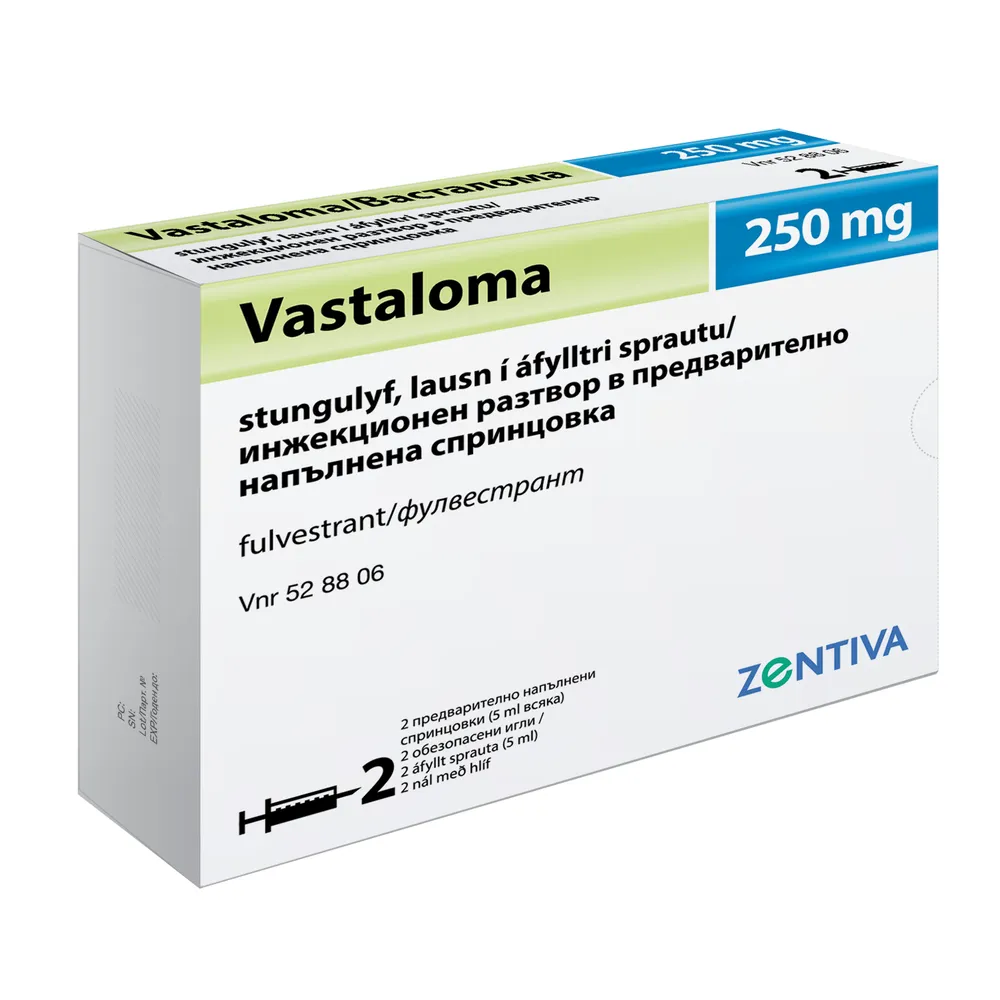
Table of Contents
- Package leaflet: Information for the patient
- 1. What Vastaloma is and what it is used for
- 2. Important information before administering Vastaloma
- 3. How Vastaloma is administered
- 4. Possible adverse reactions
- 5. How to store Vastaloma
- 6. Contents of the package and other information
- Information intended exclusively for healthcare professionals:
Package leaflet: Information for the patient
Vastaloma, 250 mg/5 ml, solution for injection in pre-filled syringe
Fulvestrantum
Please read all of this leaflet carefully before use, as it contains
important information for the patient.
- Keep this leaflet, as you may need to read it again.
- If you have any further questions, please ask your doctor, pharmacist, or nurse.
- This medicine has been prescribed for a specific individual. Do not pass it on to others. It may harm other people, even if their symptoms are the same.
- If you experience any adverse reactions, including any not listed in this leaflet, inform your doctor, pharmacist, or nurse. See section 4.
Contents of the leaflet
- What Vastaloma is and what it is used for
- Important information before using Vastaloma
- How to use Vastaloma
- Possible side effects
- How to store Vastaloma
- Contents of the pack and other information
1. What Vastaloma is and what it is used for
Vastaloma contains the active substance fulvestrant, which belongs to a group of medicines known as estrogen receptor blockers. Estrogens are female sex hormones that can sometimes influence the development of breast cancer.
Vastaloma is used:
- as a single agent in the treatment of postmenopausal women with a certain type of breast cancer called estrogen receptor-positive breast cancer that is locally advanced or has spread to other parts of the body (metastatic), or
- in combination with palbociclib in the treatment of women with a certain type of breast cancer called hormone receptor-positive, human epidermal growth factor receptor 2 (HER2)-negative breast cancer that is locally advanced or has spread to other parts of the body (metastatic). Women who have not yet reached menopause will also receive a medicine called a gonadotropin-releasing hormone (LHRH) agonist.
When Vastaloma is administered in combination with palbociclib, it is important to also read the leaflet provided with palbociclib. If you have any questions about palbociclib, please consult your treating physician.
2. Important information before administering Vastaloma
When NOT to administer Vastaloma
- if the patient is allergic to fulvestrant or any of the other ingredients of Vastaloma (listed in section 6)
- if the patient is pregnant or breastfeeding
- if the patient has severe liver function impairment
Warnings and precautions
Inform your doctor, pharmacist, or nurse before administration of Vastaloma if any of the following health problems have ever occurred:
- if kidney or liver disease has ever been diagnosed
- if thrombocytopenia (low platelet count, which enables blood clotting) or a bleeding disorder has been diagnosed
- if thrombotic disease has ever occurred
- if bone mineral density reduction (osteoporosis) has ever occurred
- alcohol dependence.
Children and adolescents
Vastaloma must not be used in children and adolescents under 18 years of age.
Vastaloma and other medicines
Tell your doctor or pharmacist about all medicines you are currently taking or have recently taken, as well as any medicines you plan to take.
In particular, inform your doctor if the patient is taking anticoagulant medicines (medicines that prevent blood clots).
Pregnancy and breastfeeding
Vastaloma must not be used during pregnancy. If the patient could become pregnant, she should use effective contraception during treatment with Vastaloma and for 2 years after the last dose.
Breastfeeding must not be performed during treatment with Vastaloma.
Driving and operating machinery
Vastaloma has not been shown to affect the ability to drive or operate machinery. However, if fatigue occurs after administration of Vastaloma, driving and operating machinery must not be undertaken.
Vastaloma contains ethanol (alcohol)
Vastaloma contains 500 mg of ethanol per injection, equivalent to 100 mg/ml (10% m/v). This amount in each injection corresponds to 13 ml of beer or 5 ml of wine.
It is unlikely that the amount of alcohol contained in this medicine will have an effect on adults or adolescents.
The alcohol contained in this medicine may affect the action of other medicines. If the patient is taking other medicines, discuss this with the doctor or pharmacist.
If the patient is pregnant or breastfeeding, she should inform the doctor or pharmacist before using this medicine.
If the patient is alcohol-dependent, she should inform the doctor or pharmacist before using this medicine.
Vastaloma contains 500 mg of benzyl alcohol
Vastaloma contains 500 mg of benzyl alcohol per pre-filled syringe, equivalent to 100 mg/ml. Benzyl alcohol may cause allergic reactions.
Vastaloma contains 750 mg of benzyl benzoate
Vastaloma contains 750 mg of benzyl benzoate per pre-filled syringe, equivalent to 150 mg/ml.
3. How Vastaloma is administered
Vastaloma is administered by a doctor or nurse. The medicine will be slowly injected
intramuscularly in two consecutive injections of 5 ml each, administered in separate buttocks.
The recommended dose is 500 mg of fulvestrant (two injections of 250 mg/5 ml), given once a month,
and an additional 500 mg dose administered 2 weeks after the first dose.
If you have any further questions regarding the use of this medicine, consult your doctor, pharmacist, or nurse.
4. Possible adverse reactions
Like all medicines, this medicine can cause adverse reactions, although not everyone will experience them.
Serious adverse reactions
If any of the following adverse reactions occur, it is essential to contact a doctor immediately and without delay:
- Allergic reactions (hypersensitivity), including swelling of the face, lips, tongue and (or) throat, which may be symptoms of anaphylactic reactions
- Thromboembolic disease (increased risk of venous thrombosis)*
- Hepatitis
- Liver failure
If any of the adverse reactions listed below occur, inform your doctor, pharmacist or nurse:
Very common adverse reactions (may occur in more than 1 in 10 people)
- Reactions at the injection site, i.e. pain and (or) inflammation
- Changes in liver enzyme activity (in blood tests)*
- Nausea
- Feeling of weakness, fatigue*
- Joint pain and musculoskeletal pain
- Hot flushes
- Skin rash
- Allergic reactions (hypersensitivity), including swelling of the face, lips, tongue and (or) throat
All other adverse reactions:
Common adverse reactions (may occur in up to 1 in 10 people)
- Headache
- Vomiting, diarrhoea or loss of appetite*
- Urinary tract infections
- Back pain*
- Increased bilirubin levels (a pigment produced by the liver)
- Thromboembolic disease (increased risk of venous thrombosis)*
- Decreased platelet count (thrombocytopenia)
- Vaginal bleeding
- Lower back pain radiating to one leg (sciatica)
- Sudden weakness, numbness, tingling or loss of movement in the leg, especially on one side of the body, sudden difficulty walking or maintaining balance (peripheral neuropathy)
Uncommon adverse reactions (may occur in up to 1 in 100 people)
- Thick, white vaginal discharge and vaginal candidiasis (infection)
- Bruising and bleeding at the injection site
- Increased gamma-glutamyltransferase activity, a liver enzyme measured in blood tests
- Hepatitis
- Liver failure
- Numbness, tingling and pain
- Anaphylactic reactions
* Includes adverse reactions for which the influence of Vastaloma cannot be assessed due to the presence of underlying disease.
Reporting of adverse reactions
If any adverse reactions occur, including any adverse reactions not listed in this leaflet, inform your doctor, pharmacist or nurse.
Department of Monitoring Adverse Drug Reactions
Office for Registration of Medicinal Products, Medical Devices and Biocidal Products
Al. Jerozolimskie 181C 02-222 Warsaw
Tel.: +48 22 49 21 301
Fax: +48 22 49 21 309
Website: https://smz.ezdrowie.gov.pl
Adverse reactions may also be reported to the marketing authorization holder.
Reporting adverse reactions helps to provide more information on the safety of the medicine.
5. How to store Vastaloma
Keep this medicine out of the sight and reach of children.
Do not use this medicine after the expiry date stated on the carton or on the syringe label following "EXP". The expiry date refers to the last day of the stated month.
Store and transport in a refrigerated condition (2°C - 8°C).
Storage of the product at temperatures outside the range of 2°C - 8°C should be minimized. Avoid storage at temperatures above 30°C, and do not exceed a total duration of 28 days at an average storage temperature below 25°C (but outside the 2°C - 8°C range). If temperature excursions occur, recommended storage conditions should be immediately reinstated (store and transport refrigerated at 2°C - 8°C). Exposure to inappropriate storage temperatures may have a cumulative effect on product quality, and the 28-day period must not be exceeded during the shelf life of Vastaloma. Exposure to temperatures below 2°C does not damage the product, provided it is not stored below -20°C.
Keep the pre-filled syringe in its original packaging to protect from light.
Healthcare personnel are responsible for the proper storage, handling, and disposal of packaging after use of Vastaloma.
This medicine may pose a risk to the aquatic environment. Medicines must not be disposed of via wastewater or household waste. Ask your pharmacist how to dispose of medicines no longer required. Such measures will help protect the environment.
6. Contents of the package and other information
What Vastaloma contains
The active substance is fulvestrant. Each pre-filled syringe (5 ml) contains 250 mg of fulvestrant.
Other components (excipients) are: ethanol (96 percent), benzyl alcohol (E1519),
benzyl benzoate, purified castor oil.
What Vastaloma looks like and contents of the pack
Vastaloma is a clear, colourless to yellow, viscous solution in a pre-filled syringe made of colourless glass type I, with a polystyrene plunger stopper sealed with an elastomeric closure and a protective cap, contained in a cardboard box. Each syringe contains 5 ml of fulvestrant solution. Two pre-filled syringes should be used to administer the recommended monthly dose of 500 mg.
Three pack sizes of the medicinal product Vastaloma are available, containing 1, 2 or 6 pre-filled syringes. The packs also contain 1, 2 or 6 administration needles with a safety device (BD SafetyGlide).
Marketing Authorisation Holder
Alvogen Pharma Trading Europe EOOD
86 Bulgaria blvd.,
1680 Sofia
Bulgaria
Manufacturer
Laboratorios Farmalán, S.A.
Calle La Vallina, s/n, Edificio 2
Polígono Industrial Navatejera
24193 Villaquilambre, León
Spain
This medicinal product is authorised in the following European Union Member States under the following names:
Netherlands Vastaloma 250 mg solution for injection in a pre-filled syringe
Bulgaria Васталома 250 mg инжекционен разтвор в предварително напълнена спринцовка
Hungary Vastaloma 250mg oldatos injekció előretöltött fecskendőben
Iceland Vastaloma
Poland Vastaloma
Romania Vastaloma 250 mg soluție injectabilă seringa preumpluta
Information intended exclusively for healthcare professionals:
Vastaloma, 500 mg (2 x 250 mg/5 ml, solution for injection) should be administered using
two prefilled syringes (see section 3).
Administration instructions
Warning – Do not place the safety needle (BD SafetyGlide, Safety Hypodermic Needle) in an autoclave
before use. Avoid hand contact with the needle during administration and disposal of the product.
Applies to both syringes:
- Remove the glass vial from its container and inspect it for damage.
- Open the outer packaging of the safety needle (BD SafetyGlide).
- Prior to administration of parenteral solutions, visually inspect the solution for particulate matter and discoloration.
- Hold the syringe vertically by the fluted section (C). With the other hand, grasp the cap (A) and gently twist the rigid plastic cap counterclockwise (see Figure 1).
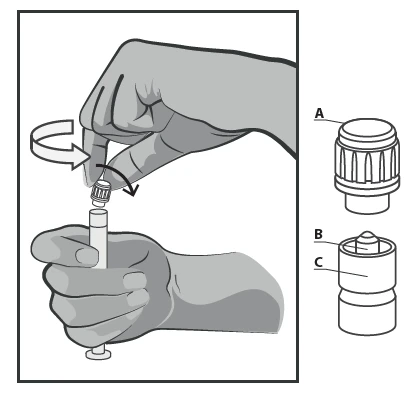
Figure 1
- Remove the rigid plastic cap (A) in an upright vertical position. To maintain sterility, do not touch the syringe tip (B) (see Figure 2).
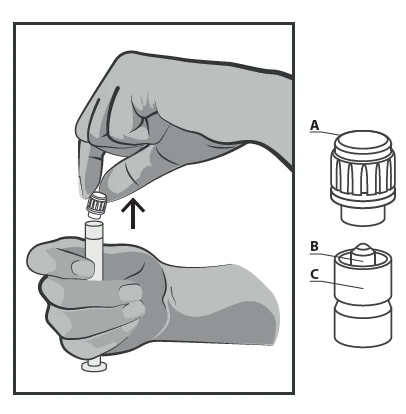
Figure 2
- Attach the safety needle to the Luer-Lock tip and screw it on securely (see Figure 3).
- Confirm that the needle is properly connected to the Luer tip before proceeding to the upright position.
- Bring the filled syringe close to the administration site.
- Remove the needle cap.
- Expel any excess air from the syringe.
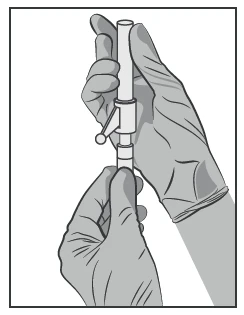
Figure 3
- Administer the medicinal product intramuscularly, slowly (1–2 minutes/injection), into the gluteal muscle (site on the buttock). For the convenience of the person administering, the needle bevel is located on the same surface of the needle as the safety needle mechanism lever (see Figure 4).
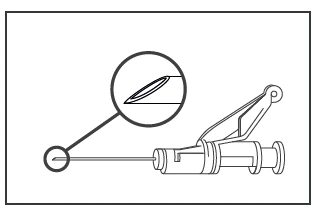
Figure 4
- Immediately after injection, activate the safety needle mechanism by pushing forward with one finger the lever arm of the safety needle mechanism (see Figure 5).
Warning: Act to ensure safety for yourself and others. Listen for the click and visually confirm that the needle tip is fully retracted and shielded.
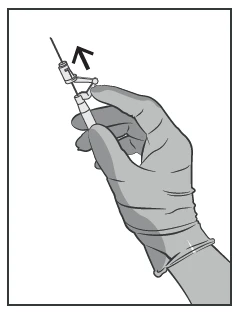
Figure 5
Disposal of waste
The prefilled syringe is for single use only.
This medicinal product may pose a risk to the aquatic environment. Any unused residues or waste must be disposed of in accordance with local regulations.