Vaqta 25
Poland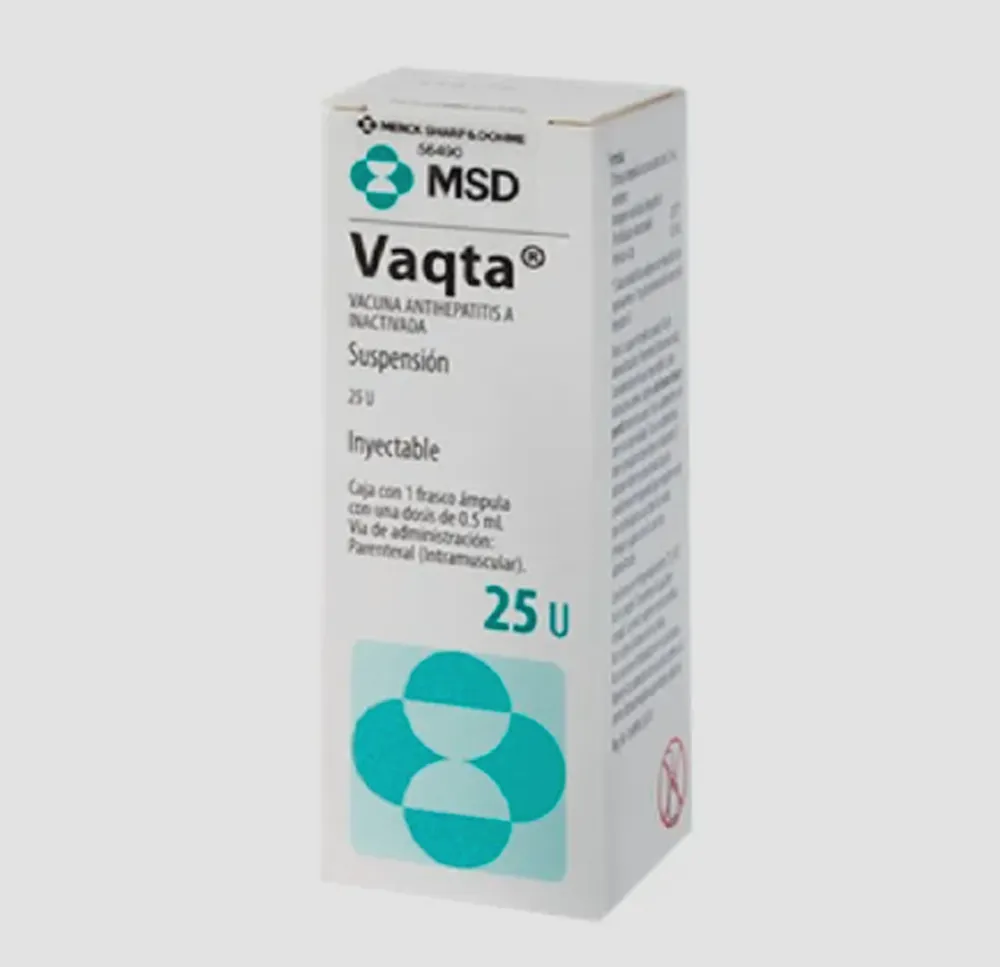
Table of Contents
Package leaflet: Information for the user
VAQTA 25, 25 U/0.5 ml, injection suspension
Vaccinum hepatitidis A inactivatum adsorbatum
Inactivated, adsorbed hepatitis A vaccine.
For children and adolescents.
Please read all of this leaflet carefully before using this vaccine because it contains
important information for you.
- Keep this leaflet as you may need to read it again.
- If you have any further questions, please ask your doctor, pharmacist, or nurse.
- This vaccine has been prescribed for a specific individual. Do not pass it on to others. It may harm someone else even if their symptoms are the same.
- If you experience any adverse effects, including any not listed in this leaflet, tell your doctor, pharmacist, or nurse. See section 4.
Leaflet contents
- What VAQTA 25 vaccine is and what it is used for
- Important information before using VAQTA 25 vaccine
- How to use VAQTA 25 vaccine
- Possible side effects
- How to store VAQTA 25 vaccine
- Contents of the pack and other information
1. What VAQTA 25 vaccine is and what it is used for
The vaccine is indicated for active immunization against infections caused by the hepatitis A virus. The vaccine is recommended for healthy children from the age of 12 months and adolescents up to and including 17 years of age who are at risk of infection or transmission of the disease, and in whom infection may be life-threatening (e.g. individuals diagnosed with hepatitis C virus infection).
VAQTA 25 vaccine should be used in accordance with official recommendations.
For optimal immunity, the first dose of the vaccine should be administered at least 2 weeks (preferably 4 weeks) before potential exposure to the hepatitis A virus.
The vaccine does not protect against viral hepatitis caused by viruses other than type A.
2. Important information before using VAQTA 25 vaccine
When not to use VAQTA 25 vaccine
- if the child has an allergy to the active substance or to any of the other ingredients of the vaccine (listed in section 6),
- if the child has a severe illness with fever, vaccination should be postponed.
Warnings and precautions
You should inform the doctor about:
- past and current illnesses and allergies,
- occurrence of allergic reactions after receiving the first dose,
- pregnancy or intention to become pregnant.
The vaccine may contain trace amounts of neomycin and formaldehyde used during the manufacturing process.
In individuals with cancer, those undergoing cancer treatment, or those with weakened immunity for other reasons, the VAQTA 25 vaccine may not protect against infection to the same extent as in healthy individuals.
Since hepatitis A virus (HAV) infection may develop asymptomatically over a long period, it is possible that a vaccinated person may already be infected with the virus. In such individuals, the vaccine may not prevent the development of hepatitis A.
The packaging contains latex rubber. It may cause severe allergic reactions.
Like other vaccines, VAQTA 25 may not protect all individuals who receive it.
VAQTA 25 and other medicines
The VAQTA 25 vaccine can be administered simultaneously with vaccines against measles, mumps, rubella, varicella, 7-valent conjugated pneumococcal vaccine, inactivated poliomyelitis vaccine, diphtheria, tetanus, acellular pertussis vaccine, and Haemophilus influenzae type b (Hib) vaccine.
Although data on use in individuals aged 12 months to 17 years are not available, studies in adults aged 18 to 54 years have shown that VAQTA 25 may be given simultaneously with the yellow fever vaccine and the typhoid fever vaccine.
Data on simultaneous administration with other vaccines are limited.
VAQTA 25 vaccine must not be mixed in the same syringe with other vaccines. If simultaneous administration is necessary, different injection sites and separate syringes should be used.
The VAQTA 25 vaccine can also be administered simultaneously with immunoglobulin. In such cases, separate syringes and different injection sites should be used.
Pregnancy and breastfeeding
Pregnancy:
It is not known whether administration of VAQTA 25 vaccine to pregnant women may cause fetal harm. VAQTA 25 vaccine should be given to pregnant women only when clearly needed and when, in the opinion of the physician, the benefits outweigh the potential risks to the fetus.
Breastfeeding:
Inform the doctor if you are breastfeeding. VAQTA 25 vaccine should be given to breastfeeding women only when clearly needed.
Driving and operating machinery
There is no information suggesting that the vaccine affects the ability to drive or operate machinery.
VAQTA 25 contains sodium
This medicine contains less than 1 mmol of sodium (23 mg) per dose, i.e. this medicine is considered to be "sodium-free".
3. How to administer VAQTA 25 vaccine
Primary dose
Children and adolescents from 12 months of age up to and including 17 years should receive a single dose of 0.5 ml (25 U) of the vaccine at the chosen time.
The safety and efficacy of the vaccine in children under 12 months of age have not been established.
Booster dose
Children and adolescents who received the primary dose between 12 months and 17 years of age inclusive should receive a booster dose of the vaccine, also 0.5 ml (25 U), between 6 and 18 months after administration of the first dose.
Antibodies against hepatitis A virus (HAV) persist for at least 10 years after administration of the second dose (i.e. the booster dose). A duration of antibody persistence of at least 25 years is expected.
VAQTA 25 may be administered as a booster dose at 6–12 months following primary vaccination performed with another inactivated hepatitis A vaccine.
If the booster dose of the vaccine is not administered at the recommended time, the decision on further management should be made by the physician.
The vaccine should be administered INTRAMUSCULARLY into the deltoid muscle.
In individuals with bleeding disorders in whom intramuscular injection may pose a risk of hemorrhage (e.g. patients with hemophilia), the vaccine may be administered intramuscularly following preventive measures such as administration of medications indicated for the treatment of hemophilia or other appropriate therapy, or application of a compression dressing. In such individuals, the vaccine may be administered subcutaneously.
The vaccine should not be administered subcutaneously or intradermally, as this may result in a lower immunological response than expected.
The vaccine must not be administered intravenously.
4. Possible adverse reactions
Like any medicine, the VAQTA 25 vaccine may cause adverse reactions, although they do not
occur in everyone.
The vaccine is generally well tolerated.
Adverse reactions reported in children aged 12 to 23 months
Very common (occurring in 1 or more out of 10 vaccinated individuals):
- pain/tenderness at the injection site, redness at the injection site
Common (occurring in 1 or more out of 100 and less than 1 out of 10 vaccinated individuals):
- swelling at the injection site, feeling of warmth at the injection site, bruising at the injection site
- fever
- irritability
- diarrhoea
Uncommon (occurring in 1 or more out of 1,000 and less than 1 out of 100 vaccinated individuals):
- decreased or loss of appetite
- sleep disturbances, drowsiness, feeling of fatigue – lethargy, lack of energy, restlessness
- crying
- runny nose, cough, stuffy nose
- vomiting
- rash, diaper dermatitis
- malaise
- induration at the injection site, rash at the injection site
Rare (occurring in 1 or more out of 10,000 and less than 1 out of 1,000 vaccinated individuals):
- various types of allergies
- dehydration
- agitation, nervousness, feeling of anxiety, screaming
- dizziness, headache, balance disorders
- crusts on the eyelid margins
- asthma, respiratory tract obstruction, sneezing, runny or itchy nose, mouth and throat pain
- nausea, abdominal pain/discomfort, excess gas in the stomach or intestines (flatulence), frequent defecation, belching, regurgitation, constipation, change in stool color
- rash, itching and redness of the skin, blisters, sensation of moisture or warmth on the skin, sweating
- joint inflammation
- at the injection site: bleeding, itching, discoloration, induration or itchy rash, pain, discomfort
- weakness/fatigue, gait disturbances, feeling of warmth
Adverse reactions reported in children and adolescents aged 2 to 17 years
Very common (occurring in 1 or more out of 10 vaccinated individuals):
- pain and tenderness at the injection site
Common (occurring in 1 or more out of 100 and less than 1 out of 10 vaccinated individuals):
- headache
- feeling of warmth, redness and swelling at the injection site, fever, petechiae at the injection site
Uncommon (occurring in 1 or more out of 1,000 and less than 1 out of 100 vaccinated individuals):
- irritability
- dizziness
- abdominal pain, vomiting, diarrhoea, nausea
- rash, itching
- pain in the arm (limb into which the injection was administered), joint pain, muscle pain
- fatigue, itching at the injection site, and pain/tenderness
Rare (occurring in 1 or more out of 10,000 and less than 1 out of 1,000 vaccinated individuals):
- loss of appetite
- nervousness
- drowsiness, unusual sensory feelings such as tingling
- ear pain
- hot flushes with redness
- stuffy nose, watery nasal discharge, cough
- urticaria, sweating
- stiffness
- hardening at the injection site, influenza-like symptoms, chest pain, pain, feeling of warmth, scab at the injection site, stiffness/tension and pricking sensation
Adverse reactions reported after marketing authorization:
Very rare (occurring in less than 1 out of 10,000 vaccinated individuals, including single cases):
- Guillain-Barré syndrome (muscle weakness, abnormal sensation, tingling sensation in arms, legs and upper body)
- decreased platelet count
Reporting of adverse reactions
If any adverse reactions occur, including any adverse reactions not listed in this leaflet, inform your doctor, pharmacist, or nurse. Adverse reactions can be reported directly to the Department of Monitoring of Adverse Drug Reactions of the Office for Registration of Medicinal Products, Medical Devices and Biocidal Products: Al. Jerozolimskie 181C, 02-222 Warsaw, Tel.: +48 22 49 21 301, Fax: +48 22 49 21 309, Website: https://smz.ezdrowie.gov.pl .
Adverse reactions can also be reported to the marketing authorization holder.
Reporting adverse reactions helps provide more information on the safety of the medicine.
5. How to store the VAQTA 25 vaccine
Store in a refrigerator (2°C – 8°C).
DO NOT FREEZE.
Keep the vaccine out of the sight and reach of children.
Do not use the VAQTA 25 vaccine after the expiry date stated on the packaging following EXP.
Medicines must not be disposed of via wastewater or household waste. Ask your pharmacist how to dispose of medicines no longer required. This will help protect the environment.
6. Contents of the pack and other information
What VAQTA 25 vaccine contains
1 dose of vaccine (0.5 ml) contains:
- The active substance is: Hepatitis A virus, strain CR326F (inactivated) ……………25 U
Propagated in human diploid fibroblast cell culture (MRC-5).
Adsorbed on amorphous aluminium hydroxyphosphosulphate (0.225 mg Al).
Units defined according to the manufacturer's internal method – Merck Sharp & Dohme LLC.
- The excipients are: sodium tetraborate, sodium chloride, water for injections.
What VAQTA 25 vaccine looks like and contents of the pack
Available pack sizes:
1 vial of 0.5 ml in a cardboard box.
10 vials of 0.5 ml in a cardboard box.
1 pre-filled syringe of 0.5 ml in a cardboard box.
Not all pack sizes may be marketed.
Marketing Authorisation Holder and Manufacturer
Marketing Authorisation Holder: MSD Polska Sp. z o.o., Chłodna 51, 00-867 Warsaw,
tel. 22 549 51 00, e-mail: [email protected].
Manufacturer: Merck Sharp & Dohme B.V., Waarderweg 39, 2031 BN Haarlem, The Netherlands.