Valinger
Poland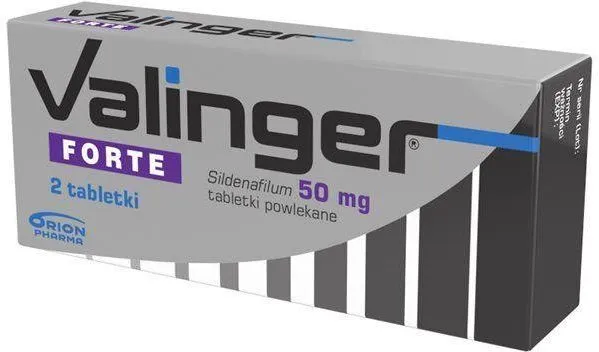
Instructions for Use
Before taking the medicine, please use the diagnostic tool provided!
Package leaflet: Information for the patient
Valinger, 25 mg, coated tablets
Sildenafilum
Please read this leaflet carefully before using the medicine, as it contains
important information for the patient.
This medicine should always be used exactly as described in this patient leaflet or as directed by
the physician or pharmacist.
- Keep this leaflet for future reference.
- If advice or further information is needed, please consult your pharmacist.
- If the patient experiences any adverse reactions, including any possible adverse reactions not listed in this leaflet, inform the doctor or pharmacist. See section 4.
- If there is no improvement after using the medicine, or if the patient feels worse, contact the doctor.
Table of contents of the leaflet
- What Valinger is and what it is used for
- Important information before taking Valinger
- How to take Valinger
- Possible side effects
- How to store Valinger
- Contents of the pack and other information
1. What Valinger is and what it is used for
Valinger contains the active substance sildenafil, which belongs to a group of medicines called phosphodiesterase type 5 (PDE5) inhibitors. The medicine works by helping to relax blood vessels in the penis, increasing blood flow to the penis during sexual stimulation. Valinger helps achieve an erection only if the patient is sexually stimulated.
Valinger is used to treat adult men with erectile dysfunction, sometimes referred to as impotence. This condition is defined as the inability to achieve or maintain an erection sufficient for sexual intercourse.
2. Important information before taking Valinger
When not to take Valinger:
- If the patient is allergic to sildenafil or any of the other ingredients of this medicine (listed in section 6).
- If the patient is taking nitrates, as their concomitant use may cause a dangerous drop in blood pressure. If the patient is taking any of these medicines, they should inform their doctor; these medicines are often used to relieve symptoms of angina (i.e. chest pain). If in doubt, consult a doctor or pharmacist.
- If the patient is taking medicines that release nitric oxide (e.g. amyl nitrite, so-called "poppers"), as their combined use may cause a dangerous drop in blood pressure.
- If the patient is taking riociguat. This medicine is used to treat pulmonary hypertension (i.e. high blood pressure in the lungs) and chronic thromboembolic pulmonary hypertension (i.e. high blood pressure in the lungs caused by blood clots). PDE5 inhibitors such as Valinger have been shown to enhance the blood pressure-lowering effect of this medicine. If the patient is taking riociguat or is unsure, they should inform their doctor.
- If the patient has severe heart or liver problems.
- If the patient has recently had a stroke or heart attack, or if they have low blood pressure.
- If the patient has certain rare inherited eye diseases (such as retinitis pigmentosa).
- If the patient has ever experienced vision loss due to non-arteritic anterior ischemic optic neuropathy (NAION).
Warnings and precautions
Before starting Valinger, discuss the following with a doctor or pharmacist:
- If the patient has sickle cell anaemia (a disorder of red blood cells), leukaemia (a blood cancer), or multiple myeloma (a cancer of the bone marrow).
- If the patient has been diagnosed with anatomical deformation of the penis or Peyronie's disease.
- If the patient has heart problems. The doctor should carefully assess whether the heart condition allows for the additional physical strain associated with sexual activity.
- If the patient has a stomach ulcer or bleeding disorders (such as haemophilia).
- If the patient experiences sudden worsening of vision or sudden vision loss, they should stop taking Valinger immediately and contact a doctor without delay.
Valinger should not be used in patients in whom erectile dysfunction has not been diagnosed.
Valinger should not be used concomitantly with other oral or topical treatments for erectile dysfunction.
Valinger is not intended for use in women.
Valinger should not be used concomitantly with medicines used to treat pulmonary arterial hypertension (PAH) containing sildenafil or other PDE5 inhibitors.
Special considerations in patients with renal or hepatic impairment
Patients with impaired kidney or liver function should inform their doctor. Patients with impaired kidney or liver function should not take a dose of sildenafil higher than 25 mg.
Children and adolescents
Valinger should not be used in individuals under 18 years of age.
Valinger and other medicines
Tell your doctor or pharmacist about all medicines the patient is currently taking, has recently taken, or plans to take.
Valinger tablets may interact with certain medicines, especially those used to treat chest pain. In case of a medical emergency, inform the doctor or pharmacist that the patient has taken Valinger and when. Do not take Valinger with other medicines without medical advice.
Do not take Valinger if the patient is taking nitrates, as their concomitant use may cause a dangerous drop in blood pressure. Always inform the doctor or pharmacist if the patient is taking medicines commonly used to treat angina (i.e. chest pain).
Do not take Valinger if the patient is taking medicines that release nitric oxide (e.g. amyl nitrite), as their combined use may cause a dangerous drop in blood pressure.
Inform the doctor or pharmacist if the patient is already taking riociguat.
If the patient is taking protease inhibitors used in the treatment of HIV infection, they should inform their doctor; in such cases, treatment should be initiated with the lowest dose of sildenafil (25 mg).
In some patients taking alpha-blockers for high blood pressure or benign prostatic hyperplasia, dizziness or lightheadedness may occur, which may be symptoms of orthostatic hypotension (a drop in blood pressure upon standing up or sitting up quickly). Such symptoms have been reported in some patients taking sildenafil together with alpha-blockers. These symptoms are most likely to occur within 4 hours after taking Valinger. To reduce the risk of such symptoms, the patient should be on a stable dose of their alpha-blocker before starting Valinger. The doctor may decide to initiate treatment with a low dose of sildenafil (25 mg). If symptoms of low blood pressure (dizziness, lightheadedness, feeling faint) occur, the patient should lie down or sit down and wait for symptoms to subside. Drinking water, breathing fresh air, tensing abdominal muscles, or crossing legs may also help. Avoid rapid standing or sitting up.
If the patient is taking medicines containing sacubitril with valsartan, used in the treatment of heart failure, inform the doctor or pharmacist.
Valinger with food, drink and alcohol
Valinger may be taken with or without food. However, taking Valinger with a heavy meal may delay the onset of the medicine's effect.
The ability to achieve an erection may be temporarily impaired after alcohol consumption. To maximise the effectiveness of Valinger, significant amounts of alcohol should be avoided before taking the medicine.
Pregnancy, breastfeeding and fertility
Valinger is not indicated for use in women.
Driving and using machines
Valinger may cause dizziness and visual disturbances. Patients should assess how they react to Valinger before driving or operating machinery.
Excipients
The medicine contains less than 1 mmol (23 mg) of sodium per tablet, i.e. the medicine is considered "sodium-free".
3. How to take Valinger
This medicine should always be taken exactly as described in the patient leaflet or as directed by your doctor or pharmacist. If in doubt, consult your doctor or pharmacist.
The recommended dose is 25 mg (1 tablet). Your doctor may recommend a different dosage regimen after consultation.
Valinger must not be taken more than once a day.
Do not take Valinger together with other medicines containing sildenafil.
Take Valinger approximately one hour before planned sexual activity. Swallow the tablet whole with a glass of water.
If you feel the effect of Valinger is too strong or too weak, consult your doctor or pharmacist.
Valinger helps achieve an erection only in the presence of sexual stimulation. The time to onset of effect varies between individuals, but usually ranges from half an hour to one hour. The effect of Valinger may occur later if taken with a heavy meal.
If an erection does not occur after taking Valinger or if the duration of erection is insufficient for sexual intercourse, inform your doctor.
Taking more than the recommended dose of Valinger
Adverse effects may occur more frequently and may be more severe.
Taking a dose higher than 100 mg does not increase the medicine's effectiveness.
Do not take more tablets than indicated in the patient leaflet.
Contact your doctor if you have taken more tablets than recommended.
If you have any further questions about the use of this medicine, consult your doctor or pharmacist.
4. Possible adverse reactions
Like all medicines, this medicine can cause adverse reactions, although not everyone will experience them.
Adverse reactions reported with Valinger are usually mild to moderate in intensity and short-lived.
If any of the following serious adverse reactions occur in a patient,
discontinue Valinger and seek immediate medical help.
Allergic reaction – occurs uncommonly (may occur in up to 1 in 100 people).
Symptoms include sudden wheezing, difficulty breathing, dizziness, swelling of the eyelids, face, lips or throat.
Chest pain (occurs uncommonly):
If chest pain occurs during or after sexual intercourse:
- Adopt a semi-upright position and try to relax.
- Do not take nitrates to relieve chest pain.
Prolonged and sometimes painful erections – occur rarely (may occur in up to 1 in 1000 people).
If an erection lasts longer than 4 hours, contact a doctor immediately.
Sudden decrease or loss of vision – occurs rarely.
Serious skin reactions – occur rarely.
Symptoms may include severe peeling and swelling of the skin, formation of blisters in the mouth, genital area and around the eyes, fever.
Seizures or convulsions – occur rarely.
Other adverse reactions:
Very common (may occur in more than 1 in 10 people): headache.
Common (may occur in up to 1 in 10 people): nausea, sudden facial flushing, hot flushes (symptoms include sudden feeling of warmth in the upper body), indigestion, visual disturbances (seeing coloured halos, light sensitivity, blurred vision or reduced visual acuity), stuffy nose, dizziness.
Uncommon (may occur in up to 1 in 100 people): vomiting, skin rash, eye irritation, eye redness, eye pain, seeing flashes of light, bright vision, light sensitivity, watery eyes, palpitations, rapid heartbeat, high blood pressure, low blood pressure, muscle pain, drowsiness, reduced sense of touch, dizziness, tinnitus, dry mouth, blocked or stuffy sinuses, nasal mucositis (symptoms include runny nose, sneezing and nasal congestion), upper abdominal pain, gastroesophageal reflux disease (symptoms include heartburn), blood in urine, pain in hands or feet, nosebleeds, feeling of warmth and fatigue.
Rare (may occur in up to 1 in 1000 people): fainting, stroke, heart attack, irregular heartbeat, transient reduction in blood flow to part of the brain, throat tightness, lip numbness, bleeding into the back of the eye, eye irritation, retinal disease caused by atherosclerosis, iris disorders, double vision, reduced visual acuity, abnormal sensations inside the eye, swelling of eyes or eyelids, increased intraocular pressure (glaucoma), short-sightedness, eye strain, small particles or spots in the visual field, seeing halos around light sources (halo effect), pupil dilation, discolouration of the white part of the eye, penile bleeding, blood in semen, dry nose, nasal swelling, feeling of irritation, and sudden weakness or loss of hearing.
After the medicine was placed on the market, rare cases of unstable angina (heart disease) and sudden death have been reported. In most, but not all, patients who experienced these adverse reactions, cardiovascular disorders were present prior to taking this medicine. It is not possible to determine whether these adverse reactions were directly related to the use of sildenafil.
Reporting of adverse reactions
If any adverse reactions occur, including any not listed in this leaflet, inform your doctor or pharmacist. Adverse reactions can be reported directly to the Department of Monitoring Adverse Reactions of Medicinal Products at the Office for Registration of Medicinal Products, Medical Devices and Biocidal Products
Al. Jerozolimskie 181C
02-222 Warsaw
Tel.: +48 22 49 21 301
Fax: +48 22 49 21 309
Website: https://smz.ezdrowie.gov.pl
Adverse reactions may also be reported to the marketing authorization holder.
Reporting adverse reactions helps provide more information on the safety of this medicine.
5. How to store Valinger
Keep this medicine out of sight and reach of children.
No special storage instructions apply to this medicine.
Do not use this medicine after the expiry date stated on the carton after "Expiry date (EXP)". The expiry date refers to the last day of the stated month.
Medicines must not be disposed of via wastewater or household waste. Ask your pharmacist how to dispose of medicines no longer required. These measures will help protect the environment.
6. Contents of the pack and other information
What Valinger contains
The active substance is sildenafil. Each tablet contains 25 mg of sildenafil in the form of
sildenafil citrate.
The other ingredients are:
- Tablet core: calcium hydrogen phosphate dihydrate, microcrystalline cellulose, magnesium stearate, colloidal anhydrous silica, sodium croscarmellose.
- Coating: hypromellose (2910; 6 mPa·s), titanium dioxide (E 171), macrogol 6000, talc, indigo carmine, lac (E 132).
What Valinger tablets look like and contents of the pack
Valinger coated tablets are blue, elongated, biconvex in shape, marked with "25" on one side. The tablet dimensions are 10 x 5 mm. The tablets are contained in blisters with 2 tablets per blister, and in perforated blisters with 4 x 1 tablet.
Not all pack sizes may be marketed.
Marketing Authorisation Holder
Orion Corporation
Orionintie 1
FI-02200 Espoo
Finland
Manufacturer
Orion Corporation Orion Pharma
Orionintie 1
FI-02200 Espoo
Finland
Laboratorios Normon, S.A.
Ronda de Valdecarrizo, 6
28760 Tres Cantos, Madrid
Spain
Orion Corporation Orion Pharma
Joensuunkatu 7
FI-24100 Salo
Finland
For more detailed information, please contact the representative of the Marketing Authorisation Holder:
Orion Pharma Poland Sp. z o.o.
[email protected]
Similar Medications
-
Actigra forte
Form: tablets, film-coated
Active substance Dosage sildenafil 50 mg Manufacturer: Biofarm Sp. z o.o., Laboratorios Normon, S.A.
-
Activra
Form: tablets, film-coated
Active substance Dosage sildenafil 25 mg Manufacturer: Biofarm Sp. z o.o., Laboratorios Normon, S.A.
-
Ervasil
Form: tablets, film-coated
Active substance Dosage sildenafil citrate 35.125 mg Manufacturer: Adamed Pharma S.A.
-
Ervasil max
Form: tablets, film-coated
Active substance Dosage sildenafil citrate 70.25 mg Manufacturer: Adamed Pharma S.A.
-
Maxigra
Form: tablets, film-coated
Active substance Dosage sildenafil citrate 140.48 mg Manufacturer: Polpharma Pharmaceutical Works S.A.
-
Maxigra go
Form: tablets, film-coated
Active substance Dosage sildenafil 25 mg Manufacturer: Polpharma Pharmaceutical Works S.A.
-
Maxigra max
Form: tablets, film-coated
Active substance Dosage sildenafil citrate 70.24 mg Manufacturer: Polpharma Pharmaceutical Works S.A.
-
Maxon
Form: tablets, film-coated
Active substance Dosage sildenafil citrate 140.48 mg Manufacturer: Adamed Pharma S.A.
-
Maxon active
Form: tablets, film-coated
Active substance Dosage sildenafil citrate 32.12 mg Manufacturer: Adamed Pharma S.A.
-
Maxon forte
Form: tablets, film-coated
Active substance Dosage sildenafil citrate 70.24 mg Manufacturer: Adamed Pharma S.A.
-
Menup
Form: tablets, film-coated
Active substance Dosage sildenafil citrate 35.125 mg Manufacturer: Adamed Pharma S.A.
-
Menup forte
Form: tablets, film-coated
Active substance Dosage sildenafil citrate 70.25 mg Manufacturer: Adamed Pharma S.A.
This page has been machine-translated and may contain inaccuracies. The original data is available in the manufacturing country's language.
Last data check: June 04, 2026 · Data source: Rejestr Produktów Leczniczych (URPL)