Unidox solutab
Poland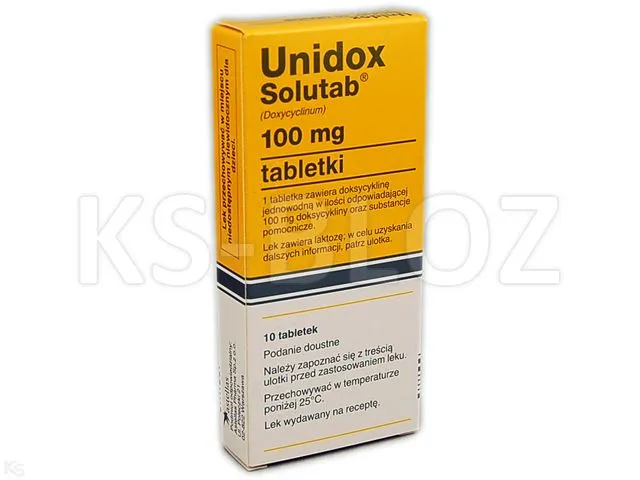
Table of Contents
Package leaflet: Information for the patient
Unidox Solutab, 100 mg, dispersible tablets for oral suspension
Doxycyclinum
Please read all of this leaflet carefully before taking this medicine, because it contains
important information for you.
- Keep this leaflet, as you may need to read it again.
- If you have any further questions, please ask your doctor or pharmacist.
- This medicine has been prescribed for you personally. Do not pass it on to others. It may harm them, even if their symptoms are the same as yours.
- If you experience any side effects, including any not listed in this leaflet, tell your doctor or pharmacist. See section 4.
Table of contents
- What Unidox Solutab is and what it is used for
- What you need to know before taking Unidox Solutab
- How to take Unidox Solutab
- Possible side effects
- How to store Unidox Solutab
- Contents of the pack and other information
1. What Unidox Solutab is and what it is used for
The active substance in Unidox Solutab – doxycycline – is an antibiotic belonging to the tetracycline group, used to treat infections caused by microorganisms sensitive to doxycycline.
Unidox Solutab is used in the treatment of infections affecting the following organs and tissues:
- mild community-acquired pneumonia, including infections caused by the following atypical pathogens: Chlamydophila (formerly Chlamydia) pneumoniae; Mycoplasma pneumoniae and Chlamydophila (formerly Chlamydia) psittaci;
- acute exacerbation of chronic bronchitis;
- genitourinary tract infections (sexually transmitted diseases) – infections caused by Chlamydia trachomatis, including uncomplicated urethral, cervical and rectal infections; non-gonococcal urethritis caused by Ureaplasma urealyticum; doxycycline is also indicated in the treatment of chancroid, lymphogranuloma venereum and granuloma venereum, and is one of the possible drugs used in the treatment of gonorrhoea and syphilis;
- skin infections – acne vulgaris, when antibiotic treatment is necessary;
- gastrointestinal tract infections – Entamoeba spp. infections as adjunctive therapy, cholera (Vibrio cholerae);
- Lyme disease (borreliosis);
- eye infections – conjunctivitis caused by Chlamydia trachomatis;
- Q fever caused by Coxiella burnetii;
- rickettsial infections;
- other infections – relapsing fever (Borrelia recurrentis), plague (Yersinia pestis), tularemia (Francisella tularensis), brucellosis (Brucella spp.), anthrax (Bacillus anthracis), psittacosis (Chlamydia psittaci);
- leptospirosis;
- pasteurellosis;
- malaria caused by chloroquine-resistant Plasmodium falciparum;
- malaria prophylaxis. Tetracyclines should not be used in Salmonella spp. infections.
Official guidelines on the appropriate use of antibacterial agents should be taken into account.
2. Important information before taking Unidox Solutab
When not to use Unidox Solutab:
- if the patient is allergic to doxycycline or any of the other ingredients of this medicine (listed in section 6);
- if the patient is allergic to other tetracyclines;
- during the second and third trimesters of pregnancy (see also "Pregnancy, breastfeeding and fertility"). Unidox Solutab should not be used during tooth development (pregnancy, infancy, and childhood under 8 years of age), as its use may cause permanent tooth discoloration (yellow-gray-brown) or impair normal tooth development. The effect of doxycycline on tooth discoloration and delayed bone growth in newborns and infants breastfed by women who have taken the drug cannot be excluded (see also "Pregnancy, breastfeeding and fertility"). There may be circumstances (e.g. severe or life-threatening conditions) in which a doctor prescribes Unidox Solutab to a child under 8 years of age, considering that the expected benefits outweigh the risks of treatment.
Warnings and precautions
Before starting treatment with Unidox Solutab, discuss the following with your doctor:
- if the patient has previously had microorganisms resistant to other tetracyclines;
- if the patient is exposed to direct sunlight or uses a solarium. Unidox Solutab may increase skin sensitivity to sunlight and cause skin burns.
- if the patient has liver function disorders and/or is taking high doses of Unidox Solutab together with other drugs harmful to the liver, or has previously had liver function disorders, medical monitoring is required;
- if the patient has blood coagulation disorders.
Discontinue use and immediately inform your doctor if, during treatment (see also section 4): - a severe skin reaction occurs (see section 4). Discontinue use and consult your doctor.
- symptoms of erythema (reddening) appear after exposure to sunlight or solarium. Discontinue treatment and consult your doctor.
Immediately inform your doctor if, during treatment: - persistent diarrhoea with fever occurs (see section 4). Consult your doctor, as this may be a sign of pseudomembranous or staphylococcal enterocolitis (complications occasionally associated with antibiotic use). The doctor may decide to discontinue the drug and prescribe appropriate treatment. To rehydrate, drink plenty of fluids prepared from special rehydration products available in pharmacies. Do not take anti-diarrhoeal drugs.
- headache, blurred vision, double vision, nausea, vomiting, pulsating tinnitus, dizziness, pain behind the eyes, or flashes of light in the eyes occur. Consult your doctor, as these may be symptoms of benign intracranial hypertension associated with doxycycline use.
- an additional infection occurs (infection with microorganisms resistant to doxycycline, including fungal infections). The doctor may recommend discontinuing the drug and initiating appropriate treatment.
Taking the medicine immediately before going to bed or with insufficient water may cause oesophagitis or oesophageal ulceration.
If the patient is taking Unidox Solutab long-term, the doctor may recommend periodic laboratory tests (e.g. blood morphology, liver or kidney function tests).
Unidox Solutab and other medicines
Inform your doctor about all medicines currently or recently taken, as well as any medicines planned for future use.
Unidox Solutab may interact with the following medicines:
- drugs that neutralize gastric juice (drugs used to reduce gastric acidity). Avoid concomitant use of preparations containing aluminium, calcium, or magnesium, and products containing iron or bismuth salts.
- activated charcoal, ion-exchange resins (e.g. cholestyramine), may reduce doxycycline absorption. These medicinal products should be taken 2–3 hours after taking Unidox Solutab;
- substances increasing gastric pH (including products containing calcium) affect tetracycline (including Unidox Solutab) absorption. Do not take these products together with Unidox Solutab.
- Chinapryl (a drug used for hypertension and congestive heart failure) may reduce doxycycline absorption.
- anticoagulants – concomitant use of Unidox Solutab with anticoagulants enhances their effect; the doctor may adjust the anticoagulant dose.
- other bactericidal antibiotics (including beta-lactam antibiotics) – using these antibiotics together with Unidox Solutab may reduce their effectiveness. Do not use them simultaneously.
- substances inducing liver enzymes (e.g. barbiturates and their derivatives, rifampicin, carbamazepine, diphenylhydantoin, primidone, phenytoin, alcohol) – concomitant use with Unidox Solutab may weaken its effect.
- methoxyflurane (an anaesthetic) – concomitant use with Unidox Solutab may cause kidney damage.
- concomitant administration of cyclosporine with Unidox Solutab must be closely monitored by a doctor, as blood cyclosporine levels may increase.
- sulfonylurea derivatives (used in diabetes) – Unidox Solutab may enhance their effect. The doctor may adjust the dose of glucose-lowering medication.
- retinoids (vitamin A derivatives). There is a risk of transient increased intracranial pressure if doxycycline is used shortly before, during, or after retinoid treatment. Concomitant use of these drugs should be avoided.
- urine glucose tests – test results obtained during Unidox Solutab treatment may be unreliable. The drug may cause false-positive laboratory results, such as increased urinary catecholamine levels. Inform your doctor if laboratory tests are planned, that you are taking Unidox Solutab.
Unidox Solutab with food and drink
It is recommended to take the suspension (after evenly dispersing the tablet in water) during a meal.
Pregnancy, breastfeeding and fertility
If the patient is pregnant or breastfeeding, suspects she may be pregnant, or plans to become pregnant, she should consult her doctor before using this medicine.
Tetracyclines may cause disturbances in fetal bone and tooth development; therefore, Unidox Solutab should not be used during the second and third trimesters of pregnancy. As a precautionary measure, use of Unidox Solutab during the first trimester of pregnancy is also not recommended.
Doxycyclines should not be used during breastfeeding. Tetracyclines pass into human milk, and their effect on tooth discoloration and delayed bone growth in newborns and infants breastfed by women taking these drugs cannot be excluded. A decision should be made whether to discontinue breastfeeding or to discontinue Unidox Solutab therapy, taking into account the benefits of breastfeeding for the child and the benefits of treatment for the mother.
In animal studies, oral administration of doxycycline had adverse effects on fertility and reproductive performance. There are no data on the effect of doxycycline on human fertility.
Driving and using machines
Unidox Solutab has a moderate influence on the ability to drive and operate machinery. Since Unidox Solutab may cause dizziness, blurred or double vision, the patient should ensure how they react to the medicine before driving or operating machinery. If any of these symptoms occur, driving and operating machinery should be avoided.
Unidox Solutab contains approximately 64.1 mg of lactose
If the patient has previously been diagnosed with intolerance to certain sugars, the patient should contact their doctor before taking this medicine.
3. How to take Unidox Solutab
This medicine should always be taken as prescribed by your doctor. If in doubt, consult your doctor or pharmacist.
Children aged 8 years to less than 12 years
Doxycycline should be used in children aged 8 to less than 12 years only when other medicines are unavailable, likely to be ineffective, or contraindicated.
In such cases, the following doses are recommended:
In children with body weight of 45 kg or less: 4.4 mg/kg body weight on the first day (single dose or divided into two doses), followed by 2.2 mg/kg body weight from the second day onwards (single dose or divided into two doses). In the treatment of more severe infections, a dose of up to 4.4 mg/kg body weight may be administered throughout the treatment period.
For children weighing more than 45 kg, the adult dose should be administered: see below.
The duration of treatment depends on the type of infection.
Unidox Solutab cannot provide a dose lower than 100 mg. Your doctor will decide which other available medicinal product containing doxycycline should be used.
Adults and children aged 12 to less than 18 years
200 mg on the first day (single dose or divided doses), followed by 100 mg daily. In the treatment of more severe infections, 200 mg should be administered throughout the treatment period. The duration of treatment depends on the type of infection.
Duration of treatment
Treatment usually lasts from 5 to 10 days. The medicine should be taken for at least 1–2 days after symptoms have resolved. In some infections, your doctor may decide to extend treatment beyond 10 days.
Dosing in specific infections
Urinary and genital tract infections: for uncomplicated urethral, cervical, and anorectal infections in adults caused by Chlamydia trachomatis, and non-gonococcal urethritis caused by Ureaplasma urealyticum, 100 mg twice daily for 7 days is recommended.
Alternative treatment for acute epididymo-orchitis caused by Chlamydia trachomatis or Neisseria gonorrhoeae: 100 mg twice daily for 10 days.
Primary and secondary syphilis: 200 mg twice daily for 2 weeks.
Granuloma inguinale: 200 mg for 21 days.
Lyme disease: 200 mg daily for 14 to 21 days (in early stages of the disease) up to 1 month (in later stages of the disease).
Anthrax: post-exposure prophylaxis – 100 mg twice daily for 60 days; cutaneous form – 100 mg twice daily for 60 days; respiratory and gastrointestinal forms – initially 100 mg twice daily as part of combination therapy; total treatment duration is 60 days.
Acne vulgaris: usually 50 mg of doxycycline daily for up to 12 weeks.
Method of administration
- The tablet should be dispersed in a small amount of water (minimum 50 ml) and stirred well until a uniform suspension is obtained. The suspension should be taken immediately after preparation.
- Do not swallow the tablet before mixing it with water.
- The suspension should be taken while standing or sitting.
- The medicine should be taken well before bedtime (do not take immediately before going to sleep). It is important not to lie down for at least 30 minutes after drinking the mixture, so that it can pass into the stomach as quickly as possible, thereby preventing irritation of the throat or oesophagus (the tube connecting the throat to the stomach).
- The suspension is best taken during a meal.
The breakline on the tablet is not intended for dividing the tablet into equal doses and is included for aesthetic reasons.
Taking more Unidox Solutab than prescribed
Contact your doctor immediately.
Liver damage may occur, with symptoms such as vomiting, fever, jaundice, bruising, and dark stools, as well as changes in certain liver function, kidney function, and blood coagulation parameters.
Overdose may cause irritation and ulceration of the oesophagus, accompanied by retrosternal pain, difficulty swallowing, and oesophagitis. This can be prevented by taking the tablet with a large amount of water (approximately 200 ml; children: approximately 125 ml). Inducing vomiting is not recommended to prevent oesophageal irritation.
Overdose is treated symptomatically. Your doctor will monitor electrolyte balance and may recommend administration of activated charcoal and/or a laxative. Hemodialysis does not remove doxycycline from the body.
Missed dose of Unidox Solutab
If you miss a dose at the scheduled time, take it as soon as possible, unless it is nearly time for the next dose. In that case, do not take the missed dose and continue with your regular dosing schedule.
If you have any further doubts about the use of this medicine, consult your doctor or pharmacist.
4. Possible adverse reactions
Like all medicines, this medicine can cause adverse reactions, although not everyone will experience them.
If any of the following adverse reactions occur, stop taking the medicine immediately and contact your doctor as soon as possible:
Rare (occurs in 1 to 10 people out of 10,000):
- Drug reaction with eosinophilia and systemic symptoms manifesting as fever, swollen lymph nodes, or skin rash (DRESS syndrome, drug reaction with eosinophilia and systemic symptoms)
- Inflammation of the small intestine and colon (including Clostridium difficile-associated colitis), presenting as stomach upset, loss of appetite, severe and persistent or bloody diarrhoea
- Bullous erythema multiforme (Stevens-Johnson syndrome), toxic epidermal necrolysis (Lyell's syndrome) – severe skin reaction characterized by blistering over large areas of the skin, mouth, eyes, and genital organs
Very rare (occurs in less than 1 person out of 10,000):
- Hypersensitivity reaction (including: anaphylactic shock, anaphylaxis, anaphylactoid reaction, anaphylactoid purpura, hypotension, pericarditis, angioedema, exacerbation of systemic lupus erythematosus, dyspnoea, serum sickness, peripheral oedema, tachycardia, and urticaria), which may manifest as sudden onset of wheezing, difficulty breathing, chest pain, fever, swelling of the eyelids, face or lips, rash or itching (particularly over large areas of the body)
- Meningeal irritation with papilledema (which may include headache, blurred vision, double vision, nausea, vomiting, tinnitus, dizziness, retro-orbital pain, and visual flashes)
- Pseudomembranous colitis, presenting as abdominal pain and diarrhoea with fever
If any of the following adverse reactions occur, contact your doctor as soon as possible:
Uncommon (occurs in 1 to 10 people out of 1,000):
- Photosensitivity, which may present as skin rash, itching, redness or severe sunburn – in such case, treatment should be discontinued and medical advice sought immediately
Rare (occurs in 1 to 10 people out of 10,000):
- Haemolytic anaemia, thrombocytopenia, neutropenia, eosinophilia. If blood test results are outside the normal range, contact your doctor.
- Joint pain, muscle pain
Frequency not known (cannot be estimated from available data):
- Jarisch-Herxheimer reaction, causing fever, chills, headache, muscle pain and skin rash, which is usually self-limiting. This may occur shortly after starting doxycycline treatment for spirochetal infections, e.g. Lyme disease.
- Oesophagitis, oesophageal ulceration, presenting as difficulty swallowing, sore throat, heartburn
- Tachycardia (rapid heartbeat)
Other adverse reactions.
Common (occurs in 1 to 10 people out of 100):
- Vaginitis, candidiasis
- Nausea, anal itching, black hairy tongue, stomatitis, inflammation of the urogenital area
- Disturbances in bone development
- Disturbances in tooth development
- Skin irritation
Uncommon (occurs in 1 to 10 people out of 1,000):
- Headache
- Vomiting, diarrhoea, glossitis
- Maculopapular and erythematous rash
Rare (occurs in 1 to 10 people out of 10,000):
- Brown-black discoloration of the thyroid gland
- Anorexia
- Tinnitus
- Pericarditis
- Eruptions
- Abdominal pain, difficulty swallowing, dyspepsia, pancreatitis, inhibition of vitamin B-producing bacteria
- Liver function disorders, hepatotoxicity with transient increase in liver enzyme activity, hepatitis, jaundice, liver failure
- Urticaria, exfoliative dermatitis
- Increased blood urea concentration
- Skin pigmentation (darker spots on the skin)*
Very rare (occurs in less than 1 person out of 10,000):
- Bulging fontanelle
Frequency not known (cannot be estimated from available data):
- Prolongation of prothrombin time
- Porphyria
- Photo-onycholysis (separation of the nail from the nail bed, sometimes leading to complete nail detachment after sun exposure)
- Hypoplasia of enamel, tooth discoloration (see also section 2 "When not to take Unidox Solutab")
- Fixed drug eruptions
*with long-term use of doxycycline
Reporting of adverse reactions
If any adverse reactions occur, including any adverse reactions not listed in this leaflet, inform your doctor or pharmacist.
Adverse reactions can be reported directly to the Department of Monitoring of Adverse Drug Reactions at the Office for Registration of Medicinal Products, Medical Devices and Biocidal Products
Al. Jerozolimskie 181C
02-222 Warsaw
Tel: +48 22 49 21 301
Fax: +48 22 49 21 309
Website: https://smz.ezdrowie.gov.pl
Adverse reactions can also be reported to the marketing authorization holder.
Reporting adverse reactions helps to provide more information on the safety of the medicine.
5. How to store Unidox Solutab
Keep this medicine out of sight and reach of children.
Do not use this medicine after the expiry date stated on the carton or blister pack following:
"EXP:". The expiry date refers to the last day of the specified month.
Store below 25°C.
Medicines should not be disposed of via wastewater or household waste. Ask your pharmacist how to dispose of medicines no longer in use. This will help protect the environment.
6. Contents of the pack and other information
What Unidox Solutab contains
- The active substance is doxycycline. Each oral suspension tablet contains 100 mg of doxycycline in the form of doxycycline monohydrate.
- The other ingredients are: microcrystalline cellulose, saccharin (E 954), hydroxypropyl cellulose (E 463), hypromellose (E 464), colloidal silicon dioxide (E 551), magnesium stearate (E 572), lactose.
What Unidox Solutab looks like and contents of the pack
Yellow (light yellow or grayish-yellow to brown with specks), round, biconvex tablets for oral suspension, marked with "173" on one side and a division line on the other side. The division line on the tablet does not serve for dividing the tablet into equal doses and is included for aesthetic reasons.
The cardboard box contains one blister with 10 tablets.
Marketing Authorisation Holder
CHEPLAPHARM Arzneimittel GmbH
Ziegelhof 24
17489 Greifswald
Germany
Manufacturer
Dragenopharm Apotheker Püschl GmbH
Göllstraße 1
84529 Tittmoning
Germany
Astellas Pharma Europe B.V.
Sylviusweg 62
2333 BE Leiden, The Netherlands