Unasyn
Poland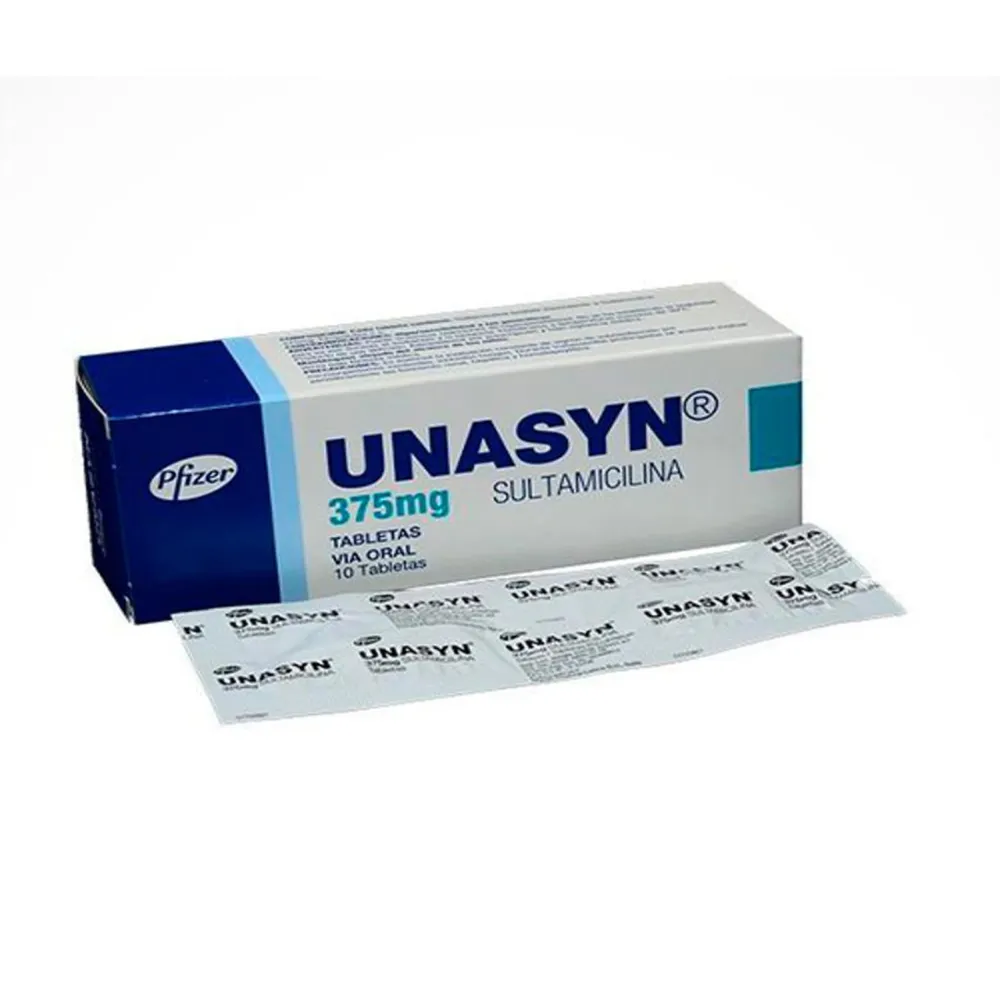
Table of Contents
Package leaflet: Information for the patient
Unasyn, 375 mg, film-coated tablets
Sultamicillin
Please read this leaflet carefully before taking this medicine, as it contains important information for you.
- Keep this leaflet for future reference.
- If you have any questions, please consult your doctor, pharmacist, or nurse.
- This medicine has been prescribed for a specific individual. Do not pass it on to others. This medicine may harm others, even if their symptoms are the same.
- If you experience any adverse reactions, including any not listed in this leaflet, inform your doctor, pharmacist, or nurse. See section 4.
Table of contents of the leaflet
- What Unasyn is and what it is used for
- Important information before taking Unasyn
- How to take Unasyn
- Possible side effects
- How to store Unasyn
- Contents of the pack and other information
1. What Unasyn is and what it is used for
Unasyn contains sultamicillin, which belongs to the β-lactam antibiotics.
This medicine is used to treat the following infections caused by microorganisms sensitive to sultamicillin:
- upper respiratory tract infections, including sinusitis, otitis media, and tonsillitis;
- lower respiratory tract infections, including bacterial pneumonia and bronchitis;
- urinary tract infections and pyelonephritis;
- skin and soft tissue infections;
- gonococcal infections. Unasyn may also be used in patients requiring treatment with sulbactam and ampicillin following an initial treatment phase with intramuscular or intravenous formulations of these drugs.
2. Information before using Unasyn
When not to use Unasyn
- if the patient is allergic to sultamicillin or any of the other ingredients of this medicine (listed in section 6).
- if the patient has a known hypersensitivity to penicillins.
Warnings and precautions
- Exercise special caution when using Unasyn in patients with a history of hypersensitivity to drugs or multiple allergens.
- If severe skin reactions occur, discontinue Unasyn and consult a doctor for appropriate management (see section 4 "Possible side effects").
- If superinfection with microorganisms resistant to the drug, including fungi, occurs, discontinue treatment. Appropriate therapy may be required.
- If diarrhoea associated with the use of the medicine occurs (which may appear even up to two months after completion of treatment), seek medical advice immediately. During treatment with almost any antibacterial agent, including sultamicillin, dangerous bacteria may overgrow, causing inflammation of the intestine. This complication may range from mild diarrhoea to fatal colitis. Discontinuation of the drug and/or initiation of specific treatment may be necessary.
- If any of the following adverse effects occur: abdominal pain, itching, dark urine, yellowing of the skin or eyes, nausea (feeling sick), or general malaise, inform the doctor immediately. These symptoms may indicate liver damage caused by ampicillin with sulbactam.
- Unasyn should not be used in patients with infectious mononucleosis (a viral disease). This medicine breaks down in the body into sulbactam and ampicillin, which may cause skin rash in patients with mononucleosis.
- Use Unasyn with caution in newborns, as their kidney function is not fully developed, and the kidneys are the main route of elimination of active substances after oral administration of Unasyn.
- During prolonged treatment, the doctor will recommend periodic monitoring of kidney, liver, and haematopoietic system function.
Use of Unasyn in patients with renal impairment
In patients with severe renal impairment, the doctor will recommend an appropriate dosage adjustment – see section 3 "How to use Unasyn".
Pregnancy, breastfeeding and fertility
If the patient is pregnant or breastfeeding, suspects she may be pregnant, or is planning to have a child, she should consult her doctor before using this medicine.
Sulbactam and ampicillin cross the placenta. The safety of using this medicine in pregnant women has not been studied. Therefore, Unasyn is not recommended during pregnancy unless the expected benefit outweighs the potential risk.
Exercise caution when using Unasyn in breastfeeding women. Small amounts of sulbactam and ampicillin pass into human milk. Use of Unasyn in breastfeeding women may cause allergy, diarrhoea, candidiasis, or rash in the breastfed infant. Unasyn is not recommended during breastfeeding.
Driving and operating machinery
Consider the possibility of dizziness occurring.
Unasyn with other medicines
Inform the doctor about all medicines currently taken or recently used, as well as any medicines the patient plans to take.
Special caution is recommended when using the following medicines:
Allopurinol (a medicine used, among others, in the treatment of gout) – concomitant use with Unasyn may be associated with the occurrence of rash.
Anticoagulants (medicines that slow blood clotting, used in the treatment of thrombosis) – Unasyn may enhance the effect of these medicines.
Bacteriostatic agents, e.g. chloramphenicol, erythromycin, sulfonamides, and tetracyclines (medicines that inhibit microbial growth) may interfere with the bactericidal action of penicillins.
Oral contraceptives containing estrogens, e.g. ethinylestradiol – during treatment with Unasyn, the patient should use another or additional method of contraception.
Methotrexate (a cytostatic agent used, among others, in the treatment of cancer and certain rheumatic diseases); concomitant use with Unasyn increases the risk of toxicity.
Non-steroidal anti-inflammatory drugs (NSAIDs), e.g. acetylsalicylic acid, indomethacin, phenylbutazone (medicines used to treat fever and mild to moderate pain of various origins); concomitant use with Unasyn prolongs its effect.
Probenecid (a medicine used, among others, in the treatment of gout) – concomitant use with Unasyn increases the risk of toxicity.
Effect on laboratory test results
In patients taking Unasyn, false-positive results for glucose in urine may occur when certain reagents (Benedict's, Fehling's, or Clinitest) are used. In pregnant women, transient decreases in total estriol, estriol glucuronide, estrone, and estradiol concentrations have been observed after administration of ampicillin.
Unasyn contains lactose
If the patient has previously been diagnosed with intolerance to certain sugars, the patient should consult a doctor before taking this medicine.
Unasyn contains sodium
This medicine contains less than 1 mmol (23 mg) of sodium per tablet, meaning it is considered "sodium-free".
3. How to use Unasyn
This medicine should always be taken exactly as prescribed by the doctor. In case of doubt, consult
your doctor.
Do not discontinue treatment without consulting your doctor. If in doubt, contact your doctor
again.
The recommended dose of sultamicillin for adults (including elderly patients) is
375 to 750 mg (1 or 2 tablets) administered orally twice daily.
In adults and children, treatment is usually continued for 48 hours after the fever
and other symptoms have subsided. The treatment period usually lasts from 5 to 14 days, but the doctor may extend it if necessary.
In the treatment of uncomplicated gonorrhea, the doctor may prescribe a single dose of
2.25 g (6 tablets) of sultamicillin. To prolong the maintenance of high serum concentrations of sulbactam
and ampicillin, the doctor may prescribe concomitant administration of 1 g of probenecid.
In the treatment of gonorrhea, if the doctor suspects concomitant syphilis infection, prior to administering
sultamicillin, the doctor will recommend performing a dark-field examination of secretions,
followed by monthly serological tests for at least 4 months.
It is recommended that treatment of infections caused by hemolytic streptococci
last at least 10 days to prevent acute rheumatic fever or post-streptococcal glomerulonephritis.
Use in children and infants
In the treatment of most infections in children weighing less than 30 kg, the dose of sultamicillin is
25 to 50 mg/kg body weight per day, divided into two doses administered orally, depending on the severity of the infection and the doctor's assessment.
For children weighing more than 30 kg, the adult dosage regimen should be used.
Use in patients with renal impairment
In patients with severe renal impairment (creatinine clearance ≤ 30 ml/min), the doctor will recommend
increasing the intervals between doses.
Overdose of Unasyn
If more Unasyn has been taken than prescribed, contact your doctor or pharmacist immediately.
If necessary, the doctor will prescribe appropriate symptomatic treatment.
Missed dose of Unasyn
Do not take a double dose to make up for a missed dose.
4. Possible adverse reactions
Like all medicines, this medicine can cause adverse reactions, although not everyone experiences them.
If any of the following serious adverse reactions occur, seek immediate medical attention:
- signs of severe allergic reactions, such as swelling of the face, lips, tongue or other parts of the body (angioedema), shortness of breath, wheezing or difficulty breathing (anaphylactic shock, anaphylactoid reactions, hypersensitivity reactions), and (or) symptoms of sudden, severe chest pain associated with any of the above symptoms (also known as Kounis syndrome or allergic myocardial infarction)
- severe skin rash, including redness and swelling of the skin (urticaria), blisters or peeling, accompanied by sore throat, fever, mouth ulcers, throat, nose, genital areas, hands or feet [toxic epidermal necrolysis (Lyell's syndrome), bullous erythema multiforme (Stevens-Johnson syndrome), erythema multiforme (see section 2), exfoliative dermatitis, acute generalized exanthematous pustulosis]. These are symptoms of severe skin allergic reactions
- yellowing of the skin or whites of the eyes, dark urine, abdominal pain, malaise and itchy skin ( hyperbilirubinemia or increased bilirubin concentration (see section 2), cholestatic hepatitis, cholestasis (cholestasis), jaundice, liver function abnormalities (see section 2)
- severe or persistent diarrhea, even if it occurs up to 2 months after taking the medicine (pseudomembranous colitis)
- seizures ( convulsions )
Other adverse reactions:
Very common (may affect more than 1 in 10 people):
- diarrhea
Common (may affect up to 1 in 10 people):
- candidiasis (yeast infection)
- headache
- vomiting, nausea, abdominal pain
- rash, itching
Uncommon (may affect up to 1 in 100 people):
- drowsiness
- fatigue, malaise
- glossitis, oral mucositis
- hyperbilirubinemia (increased bilirubin concentration) (see section 2)
- joint pain
Rare (may affect up to 1 in 1,000 people):
- dizziness
- colitis
- tubulointerstitial nephritis
- exfoliative dermatitis (severe skin reactions with peeling or detachment of the epidermis) (see section 2)
Frequency not known (frequency cannot be estimated from available data):
- pseudomembranous colitis
- reduced susceptibility of pathogenic bacteria to the antibiotic used
- aplastic anemia, prolonged blood clotting time, granulocytopenia, hemolytic anemia, thrombocytopenia (changes in the number of different types of blood cells), leukopenia, neutrophil granulocytopenia, eosinophilia, anemia, thrombocytopenia (low platelet count affecting blood coagulation)
- anaphylactic shock, anaphylactoid reactions, Kounis syndrome (allergic myocardial infarction), hypersensitivity reactions
- loss of appetite
- convulsions, symptoms of nervous system damage (including mood changes, agitation, insomnia, depression, psychosis, visual disturbances, tinnitus)
- allergic vasculitis
- dyspnea
- bloody vomiting, bleeding from the small intestine and (or) colon, dry mouth, epigastric pain, taste disturbances, bloating, black hairy tongue, discoloration of the tongue
- cholestatic hepatitis, cholestasis (cholestasis), jaundice, liver function abnormalities (see section 2)
- toxic epidermal necrolysis (Lyell's syndrome), bullous erythema multiforme (Stevens-Johnson syndrome), erythema multiforme (see section 2)
- swelling of the face, lips, tongue and (or) throat with difficulty swallowing or breathing (angioedema), erythema, blisters, dermatitis, redness or cyanosis of the skin (urticaria), acute generalized exanthematous pustulosis
- platelet aggregation disorder, increased alanine aminotransferase activity, increased aspartate aminotransferase activity
Adverse reactions written in italics are associated with the use of ampillin only
and (or) sulbactam with ampicillin administered by intramuscular or intravenous route.
Adverse reactions associated with the use of sultamicillin and ampicillin and (or)
sulbactam, ampicillin administered by intramuscular or intravenous route.
Reporting of adverse reactions
If any adverse reactions occur, including any possible adverse reactions not listed in this leaflet, inform your doctor, pharmacist or nurse.
Adverse reactions can be reported directly to the Department of Monitoring of Adverse Drug Reactions of the Office for Registration of Medicinal Products, Medical Devices and Biocidal Products
Al. Jerozolimskie 181C
02-222 Warsaw
Tel.: +48 22 49 21 301
Fax: +48 22 49 21 309
Website: https://smz.ezdrowie.gov.pl
Adverse reactions can also be reported to the marketing authorization holder or its representative.
Reporting adverse reactions helps to provide more information on the safety of the medicine.
5. How to store Unasyn
Keep this medicine out of the sight and reach of children.
Store below 25°C. Protect from moisture.
Do not use this medicine after the expiry date stated on the packaging. The expiry date refers to the last day of the stated month.
6. Contents of the pack and other information
What Unasyn contains
- The active substance is sultamicillin. One coated tablet contains 375 mg of sultamicillin in the form of sultamicillin tosylate, which is a common prodrug of sulbactam and ampicillin, corresponding quantitatively to 147 mg of sulbactam and 220 mg of ampicillin.
- Other ingredients are: lactose (see section 2 “Unasyn contains lactose”), corn starch, sodium carboxymethyl starch (see section 2 “Unasyn contains sodium”), hydroxypropylcellulose, magnesium stearate; coating ingredients: polyethylene glycol 6000, hypromellose (hydroxypropylmethylcellulose), titanium dioxide, talc.
What Unasyn looks like and contents of the pack
PVC/PVDC/Aluminium/PVDC foil blisters.
Pack contains 12 tablets – 2 blisters with 6 tablets each.
Marketing Authorisation Holder:
Pfizer Europe MA EEIG
Boulevard de la Plaine 17
1050 Bruxelles
Belgium
Manufacturer:
Haupt Pharma Latina S.r.l.
Latina (LT)
Strada Statale 156 Km 47,600
04100 Borgo San Michele
Italy
For more detailed information about this medicine, please contact the local representative of the Marketing Authorisation Holder:
Pfizer Polska Sp. z o.o.
tel. 22 335 61 00
Other sources of information
Detailed information about this medicine is available on the website of the Office for Registration of Medicinal Products, Medical Devices and Biocidal Products http://urpl.gov.pl