Ultrapiryna plus
Poland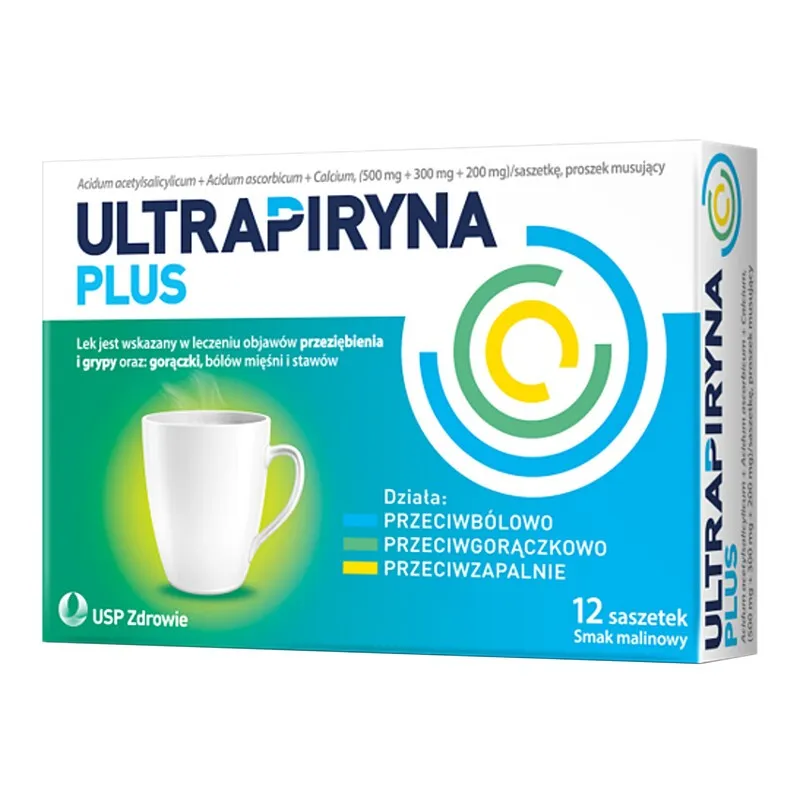
Table of Contents
Package leaflet: information for the patient
ULTRAPIRYNA PLUS, (500 mg + 300 mg + 200 mg)/sachet, effervescent powder
Acidum acetylsalicylicum + Acidum ascorbicum + Calcium
Please read the entire leaflet carefully before use, as it contains important information for the patient.
This medicine should always be used exactly as described in this patient leaflet or as directed by a
physician or pharmacist.
- Keep this leaflet for future reference.
- If you need advice or further information, consult a pharmacist.
- If you experience any adverse reactions, including any possible side effects not listed in this leaflet, inform your doctor or pharmacist. See section 4.
- If there is no improvement after 3–5 days, or if your condition worsens, consult a doctor.
Table of contents:
- What Ultrapiryna Plus is and what it is used for
- Important information before taking Ultrapiryna Plus
- How to take Ultrapiryna Plus
- Possible side effects
- How to store Ultrapiryna Plus
- Contents of the pack and other information
1. What Ultrapiryna Plus is and what it is used for
Ultrapiryna Plus contains acetylsalicylic acid, ascorbic acid (vitamin C), and calcium.
Acetylsalicylic acid belongs to the group of non-steroidal anti-inflammatory drugs (NSAIDs). It acts as an antipyretic, analgesic, and anti-inflammatory agent.
Ascorbic acid (vitamin C) and calcium support normal function of blood vessel walls. They reduce vascular permeability and exert anti-exudative and anti-edematous effects.
Calcium, by reducing blood vessel wall permeability, acts anti-exudatively, anti-edematously, anti-inflammatorily, and anti-allergically. Additionally, calcium ions stimulate the body's defense mechanisms and are essential in blood coagulation and bone remodeling processes.
The medicine is used for the symptomatic treatment of cold and flu, as well as for:
fever,
muscle and joint pain,
headaches, including migraine,
toothache,
neuralgia.
2. Important information before using Ultrapiryna Plus
When not to use Ultrapiryna Plus
if the patient is allergic to acetylsalicylic acid or other salicylates, ascorbic acid, calcium,
or any of the other ingredients of this medicine (listed in section 6),
if the patient has active peptic ulcer disease of the stomach or duodenum; inflammatory conditions of the
gastrointestinal tract,
if the patient has increased tendency to bruising or bleeding (bleeding diathesis, coagulation disorders),
if the patient is taking anticoagulant medicines,
if the patient has acid-base balance disorders (diabetes, uraemia, tetany),
if the patient has significantly increased calcium levels in the blood,
if the patient has a history of bronchial asthma attacks triggered by salicylates or substances with similar action, particularly nonsteroidal anti-inflammatory drugs,
if the patient has severe kidney disease,
if the patient has severe liver disease,
if the patient has severe heart failure,
if the patient is in the last trimester of pregnancy,
if the patient has phenylketonuria (a genetic disorder characterized by deficiency of an enzyme called phenylalanine hydroxylase),
in children under 12 years of age,
if the patient is taking methotrexate (used, among others, in cancer diseases and rheumatoid arthritis) at doses of 15 mg per week or higher.
Warnings and precautions
Before starting to take Ultrapiryna Plus, discuss this with your doctor or pharmacist:
if the patient is allergic (hypersensitive) to other medicines from the group of nonsteroidal anti-inflammatory drugs,
if the patient has allergies (e.g. hay fever) or asthma,
if the patient has uterine bleeding or excessive menstrual bleeding,
if the patient uses an intrauterine contraceptive device,
if the patient is scheduled for surgery (do not take the medicine at least 5 days before the procedure),
if the patient has gout,
if the patient has had stomach or duodenal ulcers or gastrointestinal bleeding,
if the patient has kidney or liver function disorders,
if the patient has moderate heart failure (heart disease which may manifest as shortness of breath and swelling of the feet),
if the patient has hypertension,
if the patient lacks the enzyme called glucose-6-phosphate dehydrogenase, due to the risk of haemolytic anaemia,
if the patient has heart problems, has had a stroke, or there are suspicions of risk of these conditions (e.g. high blood pressure, diabetes, elevated cholesterol, smoking).
Taking the medicine at the lowest effective dose for the shortest necessary period to relieve symptoms reduces the risk of adverse effects (e.g. on the gastrointestinal tract and circulatory system).
Long-term use of high doses may lead to overdose.
Taking medicines containing acetylsalicylic acid may be associated with a small increased risk of heart attack (myocardial infarction) or stroke. This risk increases with long-term use of high doses. Do not use higher doses or longer treatment duration than recommended—3 to 5 days.
During certain viral infections, particularly influenza A, influenza B, or varicella (chickenpox), especially in children and adolescents, there is a risk of Reye's syndrome—a rare but life-threatening condition. Persistent vomiting during infection may indicate Reye's syndrome and requires immediate medical attention.
The risk of Reye's syndrome during viral infections may increase if acetylsalicylic acid is administered simultaneously, although a causal relationship has not been proven.
For these reasons, medicines containing acetylsalicylic acid should not be used in children under 12 years of age, and in adolescents over 12 years of age, acetylsalicylic acid-containing medicines should be used only under medical advice.
Ascorbic acid (vitamin C) contained in the medicine may interfere with the results of certain tests performed by redox methods (e.g. determination of glucose or creatinine in blood and urine, faecal occult blood testing).
Ultrapiryna Plus and other medicines
Tell your doctor or pharmacist about all medicines currently or recently taken, as well as those the patient plans to take, especially if the patient is also taking:
methotrexate, used, among others, in cancer diseases and rheumatoid arthritis (see also above),
an anticoagulant medicine that inhibits platelet aggregation (e.g. coumarin derivative, heparin, ticlopidine),
an antidiabetic medicine (insulin, sulfonylurea derivative),
a sulfonamide (used in bacterial infections),
phenytoin or valproic acid (antiepileptic medicines),
an anti-inflammatory medicine: corticosteroids or nonsteroidal anti-inflammatory drugs,
a cardiac glycoside (digoxin and strophantin derivatives, medicines used in heart diseases),
a medicine used in the treatment of gout (e.g. probenecid),
a diuretic (e.g. furosemide, thiazide diuretic),
a medicine lowering blood pressure (angiotensin-converting enzyme inhibitors, e.g. captopril, enalapril),
an amphetamine derivative (e.g. used in ADHD treatment),
a medicine used in depression treatment: selective serotonin reuptake inhibitors (SSRIs) and tricyclic antidepressants (e.g. opipramol, doxepin),
fluoride compounds,
vitamin D and a calcium channel blocker (used in hypertension).
A 3-hour interval should be maintained between taking antibacterial medicines from the group of fluoroquinolones, tetracyclines, and Ultrapiryna Plus.
Metamizole (a substance with analgesic and antipyretic action) may reduce the effect of acetylsalicylic acid on platelet aggregation (clumping of blood cells and clot formation) if these medicines are used simultaneously. Therefore, caution should be exercised when using metamizole in patients receiving acetylsalicylic acid.
Ultrapiryna Plus with food, drink, and alcohol
The medicine should be taken after meals.
Consuming alcohol during treatment may intensify the irritating effect of acetylsalicylic acid on the gastrointestinal tract.
Pregnancy, breastfeeding, and fertility
If the patient is pregnant or breastfeeding, suspects she may be pregnant, or is planning to have a child, she should consult a doctor or pharmacist before using this medicine.
Do not use Ultrapiryna Plus during pregnancy or breastfeeding.
Acetylsalicylic acid contained in Ultrapiryna Plus may adversely affect fertility in women. This effect is reversible and resolves after discontinuation of treatment.
Driving and operating machinery
Ultrapiryna Plus, when used at recommended doses, has no effect or negligible effect on the ability to drive vehicles and operate machinery.
Warnings regarding excipients
The medicine contains 178 mg of sodium per dose (1 sachet), equivalent to 8.9% of the WHO-recommended maximum daily sodium intake of 2 g for adults.
The medicine contains 25 mg of aspartame in each sachet. Aspartame is a source of phenylalanine. It may be harmful to patients with phenylketonuria. This is a rare genetic disorder in which phenylalanine accumulates in the body due to improper excretion.
Ultrapiryna Plus contains 0.75 g of sucrose per dose (1 sachet) (included in the colouring agent). The medicine contains glucose (as a component of maltodextrin). If the patient has previously been diagnosed with intolerance to certain sugars, the patient should consult a doctor before taking the medicine.
The medicine contains 0.055 mg of sodium benzoate (E211) per single dose (1 sachet).
Ultrapiryna Plus contains carmine (E120) (included in raspberry flavouring).
3. How to use Ultrapiryna Plus
This medicine should always be taken exactly as described in the patient leaflet or as directed by a
physician or pharmacist. If in doubt, consult your doctor or pharmacist.
Recommended dose:
Adults:
1 or 2 sachets. If necessary, the dose may be repeated every 4 to 8 hours, up to 3 times a day.
Maximum daily dose is 6 sachets.
Elderly patients (over 65 years of age):
1 sachet. If necessary, the dose may be repeated every 4 to 8 hours, up to 3 times a day.
Maximum daily dose is 3 sachets.
Use in children and adolescents
Do not give to children under 12 years of age (see section 2).
Adolescents over 12 years of age – only on medical advice:
1 sachet. If necessary, the dose may be repeated every 4 to 8 hours, up to 3 times a day.
Maximum daily dose is 3 sachets.
Dissolve the contents of one sachet in half a glass of lukewarm water, stir and drink.
Take after meals.
Do not use Ultrapiryna Plus for longer than 3–5 days.
Taking more Ultrapiryna Plus than recommended
If a dose exceeding the recommended daily dose is accidentally taken, symptoms of overdose may occur (related to the presence of acetylsalicylic acid): increased breathing rate, nausea, vomiting, visual and hearing disturbances (tinnitus), dizziness, acid-base and electrolyte imbalances (e.g. potassium deficiency), decreased blood glucose levels, skin reactions.
In cases of acute poisoning, symptoms may include delirium, tremor, shortness of breath, excessive sweating, psychomotor agitation, high fever, and coma.
If more than the recommended dose has been taken, seek immediate medical advice from a doctor or pharmacist.
If you have any further doubts about using this medicine, consult your doctor or pharmacist.
4. Possible adverse reactions
Like all medicines, this medicine can cause adverse reactions, although not everyone experiences them.
You should contact your doctor immediately if:
- gastrointestinal bleeding occurs, presenting as coffee-ground-like vomit or tarry stools,
- allergic reactions occur (such as skin manifestations: rash, urticaria, severe breathing difficulties or wheezing, shortness of breath).
Other adverse reactions may also occur:
- increased risk of bleeding,
- exacerbation or recurrence of peptic ulcer disease,
- nausea, vomiting, abdominal pain,
- blood coagulation disorders,
- increased menstrual bleeding,
- erosions of the gastrointestinal mucosa,
- asthma attack in adults or shortness of breath,
- edema,
- hypertension,
- heart failure,
- dizziness,
- tinnitus,
- sweating.
The use of medicines containing acetylsalicylic acid may be associated with a slight increase in the risk of myocardial infarction (heart attack) or stroke.
Reporting of adverse reactions
If any adverse effects occur, including any adverse effects not listed in this leaflet, inform your doctor or pharmacist. Adverse reactions can be reported directly to the Department for Monitoring Adverse Reactions of Medicinal Products at the Office for Registration of Medicinal Products, Medical Devices and Biocidal Products, Al. Jerozolimskie 181C, 02-222 Warsaw, Tel.: +48 22 49 21 301, Fax: +48 22 49 21 309, Website: https://smz.ezdrowie.gov.pl
Adverse reactions can also be reported directly to the marketing authorization holder.
Reporting adverse reactions helps to provide more information on the safety of the medicine.
5. How to store Ultrapiryna Plus
Do not store above 25°C.
Keep in the original packaging to protect from moisture.
Keep the medicine out of sight and reach of children.
Do not use this medicine after the expiry date stated on the packaging after EXP.
The expiry date refers to the last day of the stated month.
Do not use this medicine if you notice any changes in the appearance of the powder in the sachets.
Medicines must not be disposed of via wastewater or household waste. Ask your pharmacist how to dispose of medicines you no longer use. This will help protect the environment.
6. Contents of the pack and other information
What Ultrapiryna Plus contains
- The active substances are: acetylsalicylic acid 500 mg/sachet, ascorbic acid (vitamin C) 300 mg/sachet, calcium (as calcium lactogluconate) 200 mg/sachet.
- The other ingredients (excipients) are: sodium hydrogen carbonate, citric acid, povidone K-25, raspberry flavour (containing, among others: maltodextrin, sodium benzoate (E211), carmine (E120)), aspartame (E951), beta-carotene 1% (E160a) (containing: DL-alpha-tocopherol, sucrose, medium-chain saturated triglycerides, crystalline beta-carotene, crystalline sodium ascorbate, maltodextrin, gum arabic, silicon dioxide), sodium lauryl sulfate.
What Ultrapiryna Plus looks like and contents of the pack
The medicine is a pink effervescent powder with visible white particles, packed in sachets.
Outer packaging – a cardboard box containing 6, 8, 10, 12, 14, 20 or 28 sachets and a patient information leaflet.
Not all pack sizes may be marketed.
Marketing Authorisation Holder
US Pharmacia Sp. z o.o.
Ziębicka Street 40
50-507 Wrocław
{logo}
Manufacturer
Wörwag Pharma Operations spółka z ograniczoną odpowiedzialnością
General Marian Langiewicz Street 58, 95-050 Konstantynów Łódzki
For further information, please contact the marketing authorisation holder's representative:
USP Zdrowie Sp. z o.o.
Poleczki Street 35, 02-822 Warsaw
Tel.: +48 (22) 543 60 00