Ulcamed
Poland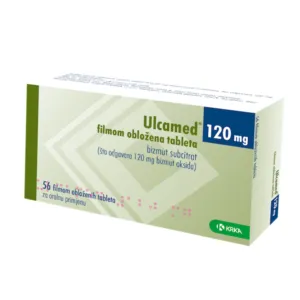
Table of Contents
Patient Information Leaflet
Ulcamed, 120 mg coated tablets
bismuthi oxidum
Please read this leaflet carefully before taking this medicine, as it contains important information for you.
- Keep this leaflet, as you may need to read it again.
- If you have any further questions, please consult your doctor or pharmacist.
- This medicine has been prescribed for a specific individual. Do not pass it on to others. This medicine may harm other people, even if their symptoms are the same.
- If you experience any adverse reactions, including any not listed in this leaflet, inform your doctor or pharmacist. See section 4.
Table of Contents
- What Ulcamed is and what it is used for
- Important information before taking Ulcamed
- How to take Ulcamed
- Possible side effects
- How to store Ulcamed
- Contents of the pack and other information
1. What Ulcamed is and what it is used for
Symptoms affecting the upper gastrointestinal tract may be caused by inflammation of the mucous membranes of the stomach and duodenum (the first part of the small intestine). Ulcamed treats ulcers and mucosal inflammation by forming a protective layer (a kind of patch) and helps prevent further irritation caused by gastric hydrochloric acid. It also has antibacterial properties against Helicobacter pylori, bacteria that may cause mucosal inflammation and ulcers. To cure ulcers, complete elimination (eradication) of the bacteria is necessary. Ulcamed helps eliminate or reduce inflammation caused by these bacteria. Your doctor may prescribe Ulcamed in combination with other medicines to help eradicate Helicobacter pylori.
2. Information before using Ulcamed
When not to use Ulcamed
- if the patient is allergic to bismuth oxide or any of the other ingredients of this medicine (listed in section 6),
- if the patient has severe kidney disease (severe renal impairment).
Warnings and precautions
Before starting to use Ulcamed, discuss this with a doctor or pharmacist.
Do not use other medicines containing bismuth while taking Ulcamed.
Prolonged use of medicines containing bismuth is not recommended. Your doctor will advise using
Ulcamed for no longer than 2 months.
Children and adolescents
Ulcamed is not indicated for use in children and adolescents.
Ulcamed with other medicines
Tell your doctor or pharmacist about all medicines the patient is currently taking or has recently taken, as well as any medicines the patient plans to take.
Do not take other agents that reduce gastric acidity within half an hour before or after taking Ulcamed, as they may affect the action of this medicine.
Ulcamed may reduce the effect of tetracycline antibiotics taken simultaneously.
Ulcamed with food and drink
Do not eat or drink for half an hour before or after taking Ulcamed. Milk, fruits and fruit juices may particularly adversely affect the medicine's action.
Pregnancy, breastfeeding and fertility
If the patient is pregnant or breastfeeding, suspects she may be pregnant, or is planning to have a baby, she should consult a doctor or pharmacist before using this medicine.
Do not use Ulcamed during pregnancy or breastfeeding unless absolutely necessary.
Driving and operating machinery
It is unlikely that Ulcamed affects the ability to drive or operate machinery.
Ulcamed contains potassium
This medicine contains 1.19 mmol (or 46.58 mg) of potassium per tablet. This should be taken into account in patients with impaired kidney function and in patients controlling potassium intake in their diet.
3. How to use Ulcamed
This medicine should always be used according to the doctor's or pharmacist's instructions. If in doubt,
consult a doctor or pharmacist.
The recommended dose for adults is 4 tablets, which can be taken according to the following treatment regimens:
- 1 tablet four times daily on an empty stomach (half an hour before main meals and before bedtime), or
- 2 tablets twice daily on an empty stomach, half an hour before breakfast and half an hour before dinner or before bedtime.
Ulcamed tablets should be swallowed whole with an adequate amount of water.
Do not eat or drink anything for half an hour before or after taking the tablet. If a meal is skipped, the tablet(s) should still be taken.
Duration of treatment
For treatment of gastric or duodenal ulcers, the duration of one treatment cycle is 4 to 8 weeks.
For H. pylori eradication, the choice of combination therapy and duration of treatment (7 to 14 days)
should take into account patient tolerance, national, regional and local bacterial resistance data, and therapeutic guidelines.
The maximum duration of one treatment cycle is 2 months. Do not take Ulcamed or other bismuth-containing preparations for longer than this period. Do not take bismuth-containing preparations during the following 2 months after completing treatment with Ulcamed.
Use of a higher than recommended dose of Ulcamed
Do not be concerned if one or two additional tablets have been taken. However, if a significantly larger number of tablets has been taken at once or within a short time, consult a doctor immediately. The doctor will take appropriate preventive measures to avoid bismuth absorption. Additionally, kidney function monitoring will be recommended for several weeks.
Missed dose of Ulcamed
Do not take a double dose to make up for a missed dose.
If a dose is missed, take the forgotten dose as soon as possible before the next scheduled dose. If it is already time for the next dose, skip the missed dose.
4. Possible adverse reactions
Like any medicine, this medicine may cause adverse reactions, although not everyone will experience them.
A potentially life-threatening allergic reaction may occur during treatment with Ulcamed.
Symptoms of allergy include sudden wheezing, swelling of the lips, tongue and throat, difficulty swallowing,
rash, and even fainting.
If any of these symptoms occur, treatment with Ulcamed must be discontinued and you must immediately
contact your doctor. These are severe adverse reactions, but they are very rare (may affect up to 1 in 10,000 people).
Other adverse reactions include:
Very common (may affect more than 1 in 10 patients):
- Dark discoloration of stool (faeces). This should not concern the patient and will resolve soon after discontinuation of treatment.
Uncommon (may affect no more than 1 in 100 patients):
- Nausea, vomiting, constipation, diarrhoea;
- Rash, urticaria.
Reporting of adverse reactions
If any adverse reactions occur, including any adverse reactions not listed in this leaflet, inform your doctor or pharmacist. Adverse reactions can be reported directly to the Department of Monitoring of Adverse Drug Reactions of the Office for Registration of Medicinal Products, Medical Devices and Biocidal Products, Al. Jerozolimskie 181C, 02-222 Warsaw, phone: +48 22 49 21 301, fax: +48 22 49 21 309, website: https://smz.ezdrowie.gov.pl
Adverse reactions can also be reported to the marketing authorization holder.
Reporting adverse reactions enables better assessment of the medicine's safety.
5. How to store Ulcamed
Keep this medicine out of sight and reach of children.
Do not use this medicine after the expiry date stated on the cardboard box after EXP. The expiry date refers to the last day of the stated month.
Store in the original packaging to protect from light and moisture.
There are no special temperature storage requirements for this medicine.
Medicines must not be disposed of via wastewater or household waste. Ask your pharmacist how to dispose of medicines no longer required. This will help protect the environment.
6. Contents of the packaging and other information
What Ulcamed contains
- The active substance is bismuth oxide. Each coated tablet contains 120 mg of bismuth oxide (as bismuth potassium citrate ammoniate).
- The other ingredients are: corn starch, povidone K30, potassium polyacrylate, macrogol 6000, magnesium stearate in the tablet core; and polyvinyl alcohol, macrogol 4000, talc, titanium dioxide (E 171) in the tablet coating. See section 2, "Ulcamed contains potassium".
What Ulcamed looks like and contents of the pack
White to almost white, round (10 mm in diameter), coated tablets, slightly convex on both sides with bevelled edges. Mottling of the tablet surface is acceptable.
Cartons containing 28, 30, 40, 42, 45, 56 or 60 coated tablets in blisters.
Not all pack sizes may be marketed.
Marketing Authorisation Holder and Manufacturer
KRKA, d.d., Novo mesto, Šmarješka cesta 6, 8501 Novo mesto, Slovenia
This medicinal product is authorised in the Member States of the European Economic Area under the following names:
| AT | Ulcamed 120 mg Filmtabletten |
| HU | Ulcamed 120 mg filmtabletta |
| PL | Ulcamed 120 mg tablets |
| RO | Ulcamed 120 mg film-coated tablets |
| SK | Ulcamed 120 mg film-coated tablets |
| SI | Bismuth Oxide Krka 120 mg film-coated tablets |
| HR | Ulcamed 120 mg film-coated tablets |
| BG | Ulcamed 120 mg film-coated tablets |
| LT | Ulcamed 120 mg film-coated tablets |
| EE | Ulcamed 120 mg film-coated tablets |
| CZ | Ulcamed 120 mg film-coated tablets |