Tussal antitussicum
Poland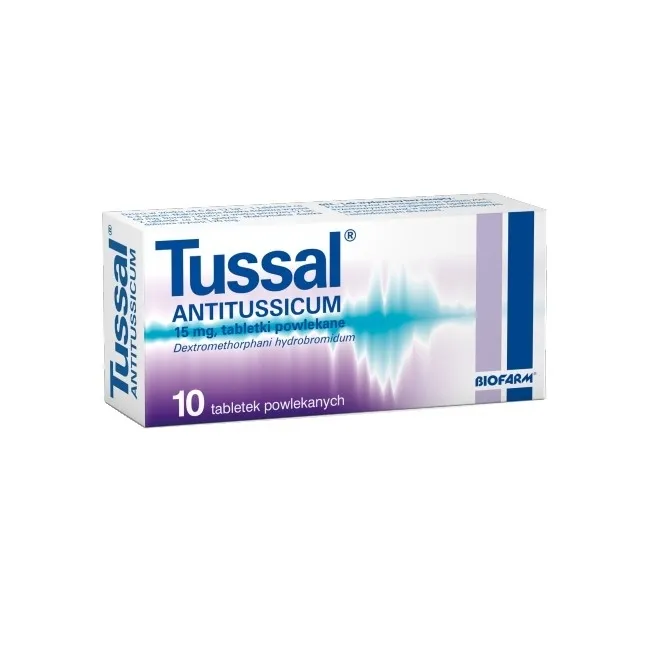
Table of Contents
Patient Information Leaflet
Tussal Antitussicum, 15 mg, coated tablets
Dextromethorphani hydrobromidum
Please read all of this leaflet carefully before taking this medicine, because it contains
important information for you.
- Always take this medicine exactly as described in this patient leaflet or as directed by your doctor or pharmacist. Keep this leaflet as you may need to read it again.
- If you need advice or further information, please consult your pharmacist.
- If you experience any side effects, including any possible side effects not listed in this leaflet, inform your doctor or pharmacist. See section 4.
- If there is no improvement after 4 days, or if you feel worse, consult your doctor.
Contents of the leaflet:
- What Tussal Antitussicum is and what it is used for
- What you need to know before taking Tussal Antitussicum
- How to take Tussal Antitussicum
- Possible side effects
- How to store Tussal Antitussicum
- Contents of the pack and other information
1. What Tussal Antitussicum is and what it is used for
Tussal Antitussicum contains dextromethorphan, an active substance with antitussive properties.
Dextromethorphan acts centrally by suppressing the cough centre in the central nervous system.
Tussal Antitussicum is indicated for:
- Symptomatic treatment of dry cough of various origins (not associated with mucus accumulation in the respiratory tract).
If there is no improvement after 4 days, or if you feel worse, consult your doctor.
2. Important information before using Tussal Antitussicum
When not to use Tussal Antitussicum:
- if the patient is allergic to dextromethorphan hydrobromide or any of the other ingredients of this medicine (listed in section 6),
- if the patient has bronchial asthma or inflammatory conditions of the lower respiratory tract,
- if the patient has respiratory insufficiency or there is a risk of its occurrence,
- if the patient has severe liver impairment,
- if the patient is currently taking monoamine oxidase inhibitors or has taken such medicines within the last 14 days (see also section "Tussal Antitussicum and other medicines"),
- if the patient has productive cough (cough with expectoration),
- if the woman is breastfeeding,
- if the child is under 6 years of age.
Warnings and precautions
Use of this medicine may lead to dependence. Therefore, treatment should be short-term.
Before starting to use Tussal Antitussicum, consult a doctor or pharmacist:
- if, despite using Tussal Antitussicum, cough persists for more than 4 days and the illness is accompanied by fever, headache or rash, the patient should contact a doctor immediately,
- in patients with impaired liver function (see also section "When not to use Tussal Antitussicum"). Medical advice should be sought before using the medicine.
Tussal Antitussicum contains dextromethorphan. Due to the risk of overdose, check whether other medicines currently taken contain dextromethorphan. Particular caution is advised when using this product in adolescents and young adults, as well as in patients with a history of misuse of medicinal products or psychoactive substances.
Alcohol must not be consumed during treatment with Tussal Antitussicum.
Tussal Antitussicum and other medicines
Tell your doctor or pharmacist about all medicines the patient is currently taking or has recently taken, as well as any medicines the patient plans to take, including those available without a prescription.
Do not take Tussal Antitussicum during treatment with monoamine oxidase inhibitors (medicines used, among others, in depression) or within 14 days after stopping such treatment (see section "When not to use Tussal Antitussicum"), because dextromethorphan taken simultaneously with monoamine oxidase inhibitors or within 14 days after discontinuation of such medicines may cause collapse, coma, nausea, high fever, and increased blood pressure.
Before taking Tussal Antitussicum, talk to a doctor or pharmacist if the patient is taking any of the following medicines:
- quinidine, amiodarone, flecainide, propafenone (medicines used in cardiac arrhythmias), fluoxetine (a medicine used in depression); these medicines may inhibit the metabolism of dextromethorphan in the liver, thereby increasing its serum concentration and intensifying adverse effects.
- central nervous system depressants, e.g. sedatives, hypnotics, anxiolytics, antidepressants (paroxetine, sertraline, bupropion), antipsychotics (haloperidol, perphenazine, thioridazine); concomitant use of these medicines with dextromethorphan may enhance central nervous system depression, manifesting as excitation, disorientation, tremor, insomnia, diarrhea, and respiratory depression.
- other medicines that inhibit the cytochrome P450 2D6 enzyme system in the liver and thus inhibit dextromethorphan metabolism, e.g. methadone, terbinafine, cinacalcet.
- certain antidepressants or antipsychotics; Tussal Antitussicum may interact with them causing changes in mental status (e.g. excitation, hallucinations, coma) and other symptoms such as body temperature above 38°C, increased heart rate, unstable blood pressure, exaggerated reflex responses, muscle rigidity, lack of coordination, and/or gastrointestinal symptoms (e.g. nausea, vomiting, diarrhea).
Pregnancy, breastfeeding and fertility
If the patient is pregnant or breastfeeding, suspects she may be pregnant, or is planning to have a child, she should consult a doctor or pharmacist before using this medicine.
Pregnancy
Consult a doctor or pharmacist before taking any medicine.
The medicine may be used during pregnancy only if, in the doctor's opinion, the benefit to the mother outweighs the potential risk to the fetus.
Breastfeeding
Consult a doctor or pharmacist before taking any medicine.
It is not known whether dextromethorphan passes into breast milk; therefore, the medicine should not be used in breastfeeding women.
Driving and operating machinery
Tussal Antitussicum may impair the ability to drive and operate machinery.
Tussal Antitussicum contains lactose
If the patient has been previously diagnosed with intolerance to certain sugars, the patient should consult a doctor before taking the medicine.
3. How to use Tussal Antitussicum
This medicine should always be taken exactly as described in the patient leaflet or as directed by a doctor or pharmacist. If in doubt, consult a doctor or pharmacist.
The medicine is administered orally.
Tussal Antitussicum tablets should be given to children and adolescents aged 6 to 16 years only on the
advice of a doctor.
Children aged 6 to 12 years
1 tablet every 6–8 hours. The maximum daily dose is 60 mg of dextromethorphan (4 tablets).
Adults and children over 12 years of age
2 tablets every 6–8 hours. The maximum daily dose is 120 mg of dextromethorphan (8 tablets).
Do not exceed the recommended doses.
Children and adolescents
In case of overdose in children, severe adverse effects may occur, including neurological disturbances. Caregivers should not administer doses higher than recommended.
Use of Tussal Antitussicum in elderly patients
Dose adjustment is not necessary.
Taking more than the recommended dose of Tussal Antitussicum
If a patient takes more than the recommended dose of Tussal Antitussicum, the following symptoms may occur: nausea and vomiting, central nervous system stimulation (excitation, nervousness, restlessness, irritability), dizziness, slurred speech, ataxia, blurred vision, involuntary muscle contractions, confusion, drowsiness, disturbances of consciousness, involuntary rapid eye movements (nystagmus), cardiac disorders (rapid heartbeat), coordination disturbances, psychosis with visual hallucinations, and increased excitability.
Other symptoms of a significant overdose may include coma, severe respiratory depression, and seizures.
If any of the above symptoms occur, seek immediate medical advice or go to hospital.
In case of overdose, symptomatic and supportive treatment is recommended.
Missed dose of Tussal Antitussicum
Do not take a double dose to make up for a missed dose.
Stopping Tussal Antitussicum
If you have any further doubts regarding the use of this medicine, consult your doctor or pharmacist.
4. Possible adverse reactions
Like all medicines, this medicine can cause adverse reactions, although not everyone will experience them.
The following adverse reactions may occur during treatment with this medicine:
Gastrointestinal disorders: nausea, vomiting, stomach pain, constipation.
Central nervous system disorders: dizziness, drowsiness.
Immune system disorders: allergic reactions: rash, urticaria, angioedema (a serious allergic reaction causing swelling of the face, lips, tongue or throat, which may make breathing difficult), bronchospasm (causing difficulty in breathing or wheezing).
Reporting of adverse reactions
If any adverse reactions occur, including any adverse reactions not listed in this leaflet, inform a doctor or pharmacist. Adverse reactions can be reported directly to the Department of Monitoring of Adverse Drug Reactions at the Office for Registration of Medicinal Products, Medical Devices and Biocidal Products:
Al. Jerozolimskie 181C, 02-222 Warsaw
Tel.: +48 22 49 21 301, Fax: +48 22 49 21 309
E-mail: [email protected]
Adverse reactions can also be reported to the marketing authorization holder.
Reporting adverse reactions enables further information on the safety of this medicine to be collected.
5. How to store Tussal Antitussicum
Store below 25°C.
Keep in the original packaging.
Keep the medicine out of sight and reach of children.
Do not use this medicine after the expiry date stated on the blister and the cardboard
pack. The expiry date refers to the last day of the stated month.
Medicines should not be disposed of via wastewater or household waste. Ask your
pharmacist how to dispose of medicines no longer in use. This will help protect
the environment.
6. Contents of the pack and other information
What Tussal Antitussicum contains
- The active substance is dextromethorphan hydrobromide. One tablet contains 15 mg of dextromethorphan hydrobromide.
- Other ingredients: monohydrate lactose, microcrystalline cellulose, pregelatinized starch, magnesium stearate.
Coating ingredients: hypromellose, titanium dioxide, polyethylene glycol 400.
What Tussal Antitussicum looks like and contents of the pack
Tussal Antitussicum tablets are round, film-coated, biconvex, white in colour, with a smooth surface and a breakline on one side.
The tablet can be divided into halves.
Pack:
A cardboard box containing 10 tablets in a blister.
Batch number and expiry date are printed on the outer packaging and on the blister.
Blister marking: the first part (embossed 6 digits) indicates the batch number, and the second part (6 following digits) the expiry date.
Marketing Authorisation Holder and Manufacturer
Biofarm Sp. z o.o.
ul. Wałbrzyska 13
60-198 Poznań
For further information, please contact the representative of the Marketing Authorisation Holder:
Poland
Biofarm Sp. z o.o.
ul. Wałbrzyska 13
60-198 Poznań
Poland
tel. 061 66 51 500