Tuberculin ppd rt23 ajv
Poland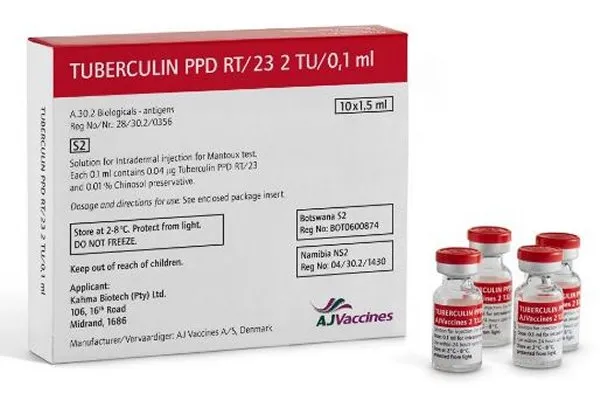
Table of Contents
- Patient Information Leaflet
- 1. What Tuberculin PPD RT23 AJV is and what it is used for
- 2. Important information before undergoing a skin test
- 4. Possible side effects
- 5. How to store Tuberculin PPD RT23 AJV
- 6. Contents of the package and other information
- Information intended exclusively for healthcare professionals
Patient Information Leaflet
Tuberculin PPD RT23 AJV, 2 T.U./0.1 ml, solution for injection
Purified protein derivative for use in humans
Please read all of this leaflet carefully before undergoing the skin test, as it contains
important information for the patient.
- Keep this leaflet, so that you can read it again if necessary.
- If you have any further questions, please consult your doctor, pharmacist, or nurse.
- If you experience any adverse reactions, including those not listed in this leaflet, inform your doctor, pharmacist, or nurse. See section 4.
Table of contents
- What Tuberculin PPD RT23 AJV is and what it is used for
- Important information before undergoing the skin test
- How the skin test is performed
- Possible side effects
- How to store Tuberculin PPD RT23 AJV
- Contents of the pack and other information
1. What Tuberculin PPD RT23 AJV is and what it is used for
Tuberculin PPD RT23 AJV is a diagnostic agent containing purified protein derivatives obtained from cultures of Mycobacterium tuberculosis, used for performing a skin test:
- in the diagnosis of infection with Mycobacterium tuberculosis
- to determine eligibility for BCG vaccination (against tuberculosis) only in individuals with a negative tuberculin test result, or as a test following vaccination.
Tuberculin PPD RT23 AJV is intended for individuals of all age groups.
2. Important information before undergoing a skin test
When not to perform the test:
- if the patient is allergic to tuberculin or to any of the other ingredients of this medicine (listed in section 6).
- if the patient previously experienced severe reactions at the site of administration of tuberculin products. A severe skin reaction may present as blisters, ulceration at the injection site, and skin necrosis in the center of an extensive tuberculin reaction. Necrosis usually resolves within several days.
Warnings and precautions
Before undergoing a skin test with Tuberculin PPD RT23 AJV, discuss it with your doctor, pharmacist,
or nurse.
You should inform your doctor if the patient:
- has ever had tuberculosis
- has been vaccinated against tuberculosis
- recently had an infection caused by non-tuberculous mycobacteria
- has been vaccinated within the last 4–6 weeks against a viral disease, e.g. measles, mumps, rubella
- is currently suffering from a viral infection, e.g.: measles, mumps, mononucleosis, chickenpox, influenza
- has kidney failure
- has diabetes
- has cancer
- is infected with HIV
- has sarcoidosis
- is taking immunosuppressive medicines (e.g. corticosteroids)
Severe allergic reactions have been observed after administration of tuberculin – see section 4.
Whenever possible, individuals undergoing a skin test should be observed for signs of allergic reactions for 20 minutes after administration.
Tuberculin PPD RT23 AJV and other medicines
Inform your doctor or pharmacist about all medicines currently taken, recently taken, or planned to be taken.
See "Warnings and precautions".
Tuberculin PPD RT23 AJV can be safely administered simultaneously with all live and inactivated vaccines.
Pregnancy and breastfeeding
If the patient is pregnant, breastfeeding, suspects she might be pregnant, or is planning to have a child, she should consult her doctor or pharmacist before undergoing a skin test.
The skin test may be performed during pregnancy and breastfeeding.
Driving and operating machinery
Tuberculin PPD RT23 AJV has no effect or has a negligible effect on the ability to drive
motor vehicles and operate machinery.
Tuberculin PPD RT23 AJV contains potassium and sodium
The medicine contains less than 1 mmol (39 mg) of potassium and less than 1 mmol (23 mg) of sodium per dose, meaning the medicine is considered "sodium- and potassium-free".
3. How the skin test is performed
A doctor or nurse will inject Tuberculin PPD RT23 AJV into the upper layer of the skin on the forearm.
The recommended dose is always 0.1 ml, both for children and adults.
After injection, a raised swelling of 8–10 mm in diameter should appear, lasting approximately 10 minutes.
The result of the skin test will be evaluated by a doctor or nurse after 48–72 hours.
There may be an irregular, slightly raised induration surrounded by redness, which should decrease by 72 hours.
If you have any further doubts regarding the use of this medicine, please consult your doctor, pharmacist, or nurse.
4. Possible side effects
Like all medicines, this medicine can cause side effects, although not everybody gets them.
Severe side effects
Very rare side effects: may occur in less than 1 in 10,000 people
- severe allergic reactions (anaphylaxis) such as swelling of the lips, face and throat, and breathing difficulties. If any of these reactions occur, contact a doctor immediately.
Other side effects:
Common side effects: may affect up to 1 in 10 people
- pain, itching or irritation at the injection site.
Uncommon side effects: may affect up to 1 in 100 people
- fever
- swollen lymph nodes
Rare side effects: may affect up to 1 in 1,000 people
- superficial skin damage (skin necrosis), which usually resolves within a few days
- blisters
Frequency not known: cannot be estimated from the available data
- ulceration at the injection site
- headache
- urticaria
Reporting of side effects
If any side effects occur, including any side effects not listed in this leaflet, inform a doctor, pharmacist or nurse. Side effects can also be reported directly to:
Department of Monitoring Adverse Drug Reactions
Office for Registration of Medicinal Products, Medical Devices and Biocidal Products
Al. Jerozolimskie 181C
02 222 Warsaw
Tel.: + 48 22 49 21 301
Fax: + 48 22 49 21 309
Website: https://smz.ezdrowie.gov.pl
Side effects can also be reported to the marketing authorization holder.
Reporting side effects helps to provide more information on the safety of this medicine.
5. How to store Tuberculin PPD RT23 AJV
Keep this medicine out of the sight and reach of children.
Do not use this medicine after the expiry date stated on the label. The expiry date refers to the last day of the stated month.
Store in a refrigerator (2°C – 8°C).
Keep in the original packaging to protect from light.
From a microbiological standpoint, Tuberculin PPD RT23 AJV should be used immediately after opening.
If not used immediately after opening, the user is responsible for the storage duration and conditions.
Generally, storage time should not exceed 24 hours at a temperature of 2°C – 8°C.
Medicines must not be disposed of via wastewater or household waste. Ask your pharmacist how to dispose of medicines no longer in use.
Such measures will help protect the environment.
Tuberculin PPD RT23 AJV does not contain any living material.
6. Contents of the package and other information
What Tuberculin PPD RT23 AJV contains
- The active substance is: Tuberculin PPD RT23.
1 dose (0.1 ml) of Tuberculin PPD RT23 AJV 2 T.U. contains:
0.04 micrograms of tuberculin PPD RT23.
- Other components are: disodium phosphate dihydrate, sodium chloride, potassium dihydrogen phosphate, potassium hydroquinoline sulfate, polysorbate 80, water for injections.
What Tuberculin PPD RT23 AJV looks like and contents of the pack
Tuberculin PPD RT23 AJV is a solution for injection.
It is a clear, colourless to slightly yellow solution.
Pack sizes: 1 or 10 vials containing 1.5 ml of solution (15 doses) in a cardboard carton.
Not all pack sizes may be marketed.
Marketing Authorisation Holder and Manufacturer
AJ Vaccines A/S
5, Artillerivej
DK-2300 Copenhagen S
Denmark
tel.: +45 7229 7000
e-mail: [email protected]
For further information, please contact the representative of the Marketing Authorisation Holder:
AJ Vaccines A/S
Branch in Poland
ul. Grójecka 22/24 m.53
02-021 Warsaw
tel: +48 22 668 86 73
Information intended exclusively for healthcare professionals
Special warnings and precautions for use
Anaphylactic reactions occur very rarely. However, during the Mantoux tuberculin test, treatment measures for such reactions should always be available. Whenever possible, individuals undergoing the skin test should be observed for signs of allergic reactions for 20 minutes after administration.
Subcutaneous and intramuscular administration of Tuberculin PPD RT23 AJV must be avoided, as no elevation will form after such administration, and the Mantoux tuberculin test should be repeated on the other arm or on the same arm at a distance of at least 4 cm from the first injection site.
The medicinal product contains less than 1 mmol (39 mg) of potassium and less than 1 mmol (23 mg) of sodium per dose, meaning the medicinal product is considered "free of sodium and potassium".
Identifiability
To improve the traceability of biological medicinal products, the name and batch number of the administered product should be clearly documented.
Interactions with other medicines and other forms of interaction
Various factors, such as age, malnutrition, renal failure, diabetes, immunosuppression caused by medicinal products (e.g. corticosteroids) or diseases such as cancer, HIV infection, or sarcoidosis, may lead to false-negative results in the tuberculin test. Viral infections (such as measles, mumps, mononucleosis, varicella, influenza, etc.) may reduce reactivity to tuberculin for several months.
Reduced reactivity may be observed after administration of vaccines containing live viruses, such as measles, mumps, or rubella vaccines. As a consequence, false-negative results may occur. Therefore, if the Mantoux tuberculin test cannot be performed simultaneously with measles, mumps, and rubella vaccination, the test should be postponed for 4–6 weeks.
Tuberculin PPD RT23 AJV may be safely administered simultaneously with all inactivated and live vaccines.
Many patients dually infected with HIV and Mycobacterium tuberculosis are anergic to tuberculin. In patients with severe forms of tuberculosis (e.g. laryngeal tuberculosis), reactivity to tuberculin may be diminished.
Prior BCG vaccination or recent infection with environmental non-tuberculous mycobacteria may cause cross-sensitization and lead to a false-positive Mantoux test result.
Dosage and method of administration
Dosage
The dose is 0.1 ml of solution.
Tuberculin PPD RT23 AJV is administered intradermally.
Method of administration
The following is a detailed description of the administration of Tuberculin PPD RT23 AJV:
- 0.1 ml of solution should be administered using a 1 ml syringe with graduations and a short, bevelled needle (25 Ga or 26 Ga).
- The injection must be administered strictly intradermally into the middle third of the forearm, as reactions may be weaker when administered closer to the wrist or elbow joint.
- The skin should be lightly stretched, and the needle tip should be almost parallel to the skin surface, with the bevel facing upward. The needle tip is inserted into the superficial layer of the dermis.
- The needle should remain visible through the epidermis during insertion. The solution should be injected slowly. After injection, a small, pale elevation of 8–10 mm in diameter should appear, lasting approximately 10 minutes.
- If no elevation appears, the injection was administered too deeply, and the tuberculin test should be repeated on the other forearm or on the same forearm, but at a site at least 4 cm away from the first injection site (see section 4.4).
National guidelines regarding the performance of the Mantoux tuberculin test may be taken into consideration.
Evaluation of the reaction
A positive reaction to Tuberculin PPD RT23 AJV is defined as a flat, irregular, slightly raised induration of at least 6 mm in diameter, surrounded by erythema. The reaction should be evaluated 48–72 hours after test administration. After approximately 72 hours, the induration should begin to subside. Only induration (not erythema) should be considered when evaluating the reaction. The diameter of the induration is measured perpendicular to the long axis of the forearm using a transparent, flexible plastic ruler and recorded in millimeters. Recommendations for the interpretation of the Mantoux tuberculin test are provided in Table 1.
Table 1: Interpretation of skin test results
| Mantoux test result Diameter of induration in millimeters | ||
| Negative 0 – 5 mm | Positive 6 – 14 mm | Strongly positive Above 15 mm |
Alternative interpretations may be used, depending on national recommendations, individual factors,
and epidemiological circumstances.
Interpretation
A positive reaction indicates an immune response to one or more of the following factors:
- infection with the Mycobacterium tuberculosis complex, including M. tuberculosis, M. bovis, M. africanum, M. microti, or M. tuberculosis subsp. caprae,
- infection with nontuberculous mycobacteria,
- previous BCG vaccination (in individuals vaccinated with BCG, a positive result typically appears 4–8 weeks after vaccination).
It is unlikely that reactions larger than 15 mm are caused by prior BCG vaccination or exposure to environmental mycobacteria.
Decreased tuberculin sensitivity
In most individuals, tuberculin sensitivity indicating infection with M. tuberculosis or related mycobacteria usually persists throughout life, but in some individuals it may gradually decrease.
Tuberculin sensitivity often declines within a few years in individuals vaccinated with BCG.
Booster effect
If tuberculin is administered to individuals whose tuberculin sensitivity has decreased, the skin test reaction may be weak or absent. Repeating the tuberculin test several weeks or months later may elicit a stronger response, known as the booster effect.
Repeat tuberculin testing will not induce a positive reaction in individuals who previously lacked cell-mediated immunity to Tuberculin PPD antigens.
Repeat tuberculin testing
If repeat tuberculin testing is required, e.g., in healthcare workers exposed to tuberculosis infection, a two-step method is recommended. In individuals who showed a weak or no reaction to the initial Mantoux tuberculin skin test, a second tuberculin test should be performed within 2–4 weeks after the first test.
Conversion of the skin test in such individuals is defined as a reaction to the second test greater than 10 mm and an increase of at least 6 mm compared to the reaction in the first test.
Individuals showing skin test conversion after the second test should be considered to have had a prior infection with mycobacteria or to have been vaccinated with BCG. If the result of the second test is negative, the individual should be considered not infected.
It should be emphasized that the predictive value of the skin test and the expected risk of tuberculosis should be assessed individually.