True test 36
Poland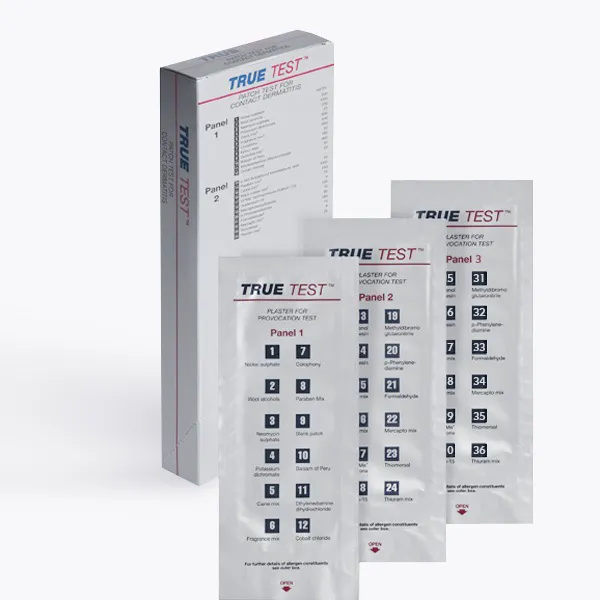
Instructions for Use
Package leaflet: Information for the user
TRUE Test 36, Patch Test Panels
TRUE Test 36 consists of 3 panels – self-adhesive patch strips. Each panel contains 12 test patches,
for a total of 36 patches. 35 patches are coated with a layer containing test substances. One
patch (patch No. 9) is a blank (empty) patch.
Active substance micrograms/cm micrograms/patch
Panel No. 1 1. Nickel sulfate 200 162
- Sterol alcohols from lanolin 1000 810
- Neomycin sulfate 600 486
- Potassium dichromate 54 44
- Kathon CG 630 510
- Fragrance mix 430 348
- Colophony 1200 972
- Paraben mix 1000 810
- Blank patch - -
- Peru balsam 800 648
- Ethylenediamine dihydrochloride 50 41
- Cobalt chloride 20 16
Panel No. 2 13. p-tert-Butylphenol-formaldehyde resin 45 36
- Epoxy resin 50 41
- Carbon black mix 250 203
- Black rubber mix 75 61
- Cl+Me-isothiazolinone 4 3
- Quaternium-15 100 81
- Methyl dibromo glutaronitrile 5.0 4.1
- Paraphenylenediamine 80 65
- Formaldehyde 180 146
- Mercaptan mix 75 61
- Thiomersal 7 6
- Thiuram mix 27 22
Panel No. 3 25. Diazolidinyl urea 550 450
- Quinoline mix 190 154
- Tixocortol pivalate 3.0 2.4
- Sodium gold thiosulfate 75 61
- Imidazolidinyl urey 600 490
- Budesonide 1.0 0.81
- Hydrocortisone-17-butyrate 20 16
- Mercaptobenzothiazole 75 61
- Bacitracin 600 490
- Parthenolide 3.0 2.4
- Disperse blue 106 50 41
- 2-Bromo-2-nitropropane-1,3-diol 250 200
a) Five parts benzocaine and one part each of cinchocaine hydrochloride and tetracaine hydrochloride.
b) Five parts geraniol, oak moss extract, four parts each of hydroxycitronellal and cinnamic alcohol, two parts each of cinnamic aldehyde and eugenol, and one part each of isoeugenol and amyl cinnamic aldehyde.
c) Methylparaben, ethylparaben, propylparaben, butylparaben, and benzylparaben in equal weight proportions.
d) Diphenylguanidine, diethyldithiocarbamate zinc, and dibutyldithiocarbamate zinc in equal weight proportions.
e) Two parts N-isopropyl-N’-phenyl-paraphenylenediamine, five parts N-cyclohexyl-N’-phenyl-paraphenylenediamine, and five parts N,N’-diphenyl-paraphenylenediamine.
f) Currently contains N-hydroxymethyl imid of succinic acid.
g) Morpholinylmercaptobenzothiazole, N-cyclohexylbenzothiazylsulfonamide, and disulfide dibenzothiazyl in equal weight proportions.
h) Disulfiram, dipentamethylenethiuram disulfide, tetramethylthiuram disulfide, and tetramethylthiuram monosulfide in equal weight proportions.
i) Cliochinol and chlorocinol in equal weight proportions.
Please read this leaflet carefully before using this medicinal product because it contains important
information for the patient.
- Keep this leaflet for future reference. If you have any questions, please consult your doctor, pharmacist, or nurse.
- This medicine has been prescribed for a specific individual. Do not pass it on to others. It may harm someone else, even if their symptoms are the same.
- If the patient experiences any adverse reactions, including any not listed in this leaflet, inform the doctor, pharmacist, or nurse. See section 4.
Contents of the leaflet
- What TRUE Test 36 is and what it is used for
- Important information before using TRUE Test 36
- How to use TRUE Test 36
- Possible side effects
- How to store TRUE Test 36
- Contents of the pack and other information
1. What TRUE Test 36 is and what it is used for
TRUE Test 36 is used in the diagnosis of allergic contact dermatitis. Contact dermatitis is a skin reaction to foreign substances that cause an allergic response. TRUE Test 36 is a ready-to-use patch test system designed to identify the cause of allergic contact dermatitis.
TRUE Test 36 is intended for use in adults.
The test consists of 3 self-adhesive patch strips, each containing 12 patches. Each patch contains a test substance that may provoke a skin reaction in individuals with hypersensitivity. These substances are known as allergens. Each patch contains a different allergen, and one patch is blank (contains no allergen). TRUE Test 36 contains 35 of the most common allergens/mixtures of allergens, as well as one blank patch.
TRUE Test 36 is used to confirm sensitization to any of the test substances (allergens) included in the panels. If a substance to which the patient is allergic comes into contact with the skin, it will cause an inflammatory reaction known as contact dermatitis.
These substances may be components of perfumes or aftershaves, ointments or creams, rubber gloves, industrial chemicals, etc. The substances in TRUE Test 36 are well-known allergens. If the patient is allergic to a specific substance contained in a patch, the skin reaction under that patch will include redness and inflammation. If the patient is not allergic to a particular substance in a patch, no skin reaction will occur. It is possible to be allergic to more than one test substance.
2. Information before using TRUE Test 36
When not to use TRUE Test 36
- If there is severe or generalized skin inflammation. Testing should be postponed until symptoms have subsided.
- If the patient is allergic to any of the other components of TRUE Test 36 (listed in section 6).
Warnings and precautions
- Avoid exposing the test area to sunlight. Tanning may cause missed positive reactions to allergens to which the patient is sensitized.
- Avoid excessive sweating while wearing the test patches.
- If the patient is taking medications that suppress the immune system, such as systemic steroids (e.g. prednisolone) or topical steroid creams/ointments (e.g. hydrocortisone), these should not be used for at least two weeks prior to starting the test.
- In cases of "angry back syndrome" — a condition in which skin hypersensitivity is triggered by inflammation elsewhere on the body. If reactions occur to all test patches, retesting on another day may be necessary.
- In patients who have previously experienced anaphylactoid reactions, the use of TRUE Test 36 should be carefully considered.
Contact a physician before using TRUE Test 36 if any of the above factors apply. The physician will determine the appropriate course of action.
Allergy: Rarely, sensitization to substances present in the patches may occur during use of TRUE Test 36. Reactions appearing more than 10 days after patch application may indicate contact hypersensitivity.
TRUE Test 36 should only be applied to skin that is free from:
- acne lesions
- scars
- inflammatory skin lesions
- skin changes that may interfere with test results. In case of doubt, consult a physician.
Protect the test site from moisture. During bathing or showering, care must be taken not to wet the patch or the surrounding skin. If the patch becomes wet, it may detach, allowing the test substances to be washed out.
Avoid all situations such as sunbathing or physical exercise that could lead to patch detachment.
Butylated hydroxyanisole (BHA) (E320) and butylated hydroxytoluene (BHT) (E312) are present in patch No. 7 Rosin (panel 1) to preserve its stability. BHA and BHT may cause local skin reactions (e.g. contact dermatitis), which could lead to a false-positive reaction to Rosin.
Children
TRUE Test 36 is not recommended for use in children, as safety and efficacy have not been established in this patient group.
TRUE Test 36 and other medicines
Before applying TRUE Test 36, inform your doctor or pharmacist about all medicines currently or recently taken, including those obtained without a prescription. Remember that a dermatologist may not be aware of other medications being used.
At least 2 weeks before testing, discontinue the use of topical or oral corticosteroids if the daily dose equals or exceeds 20 mg of prednisolone, as corticosteroids may suppress positive test reactions.
Pregnancy, breastfeeding and fertility
TRUE Test 36 is not recommended for use in pregnant women. If the patient is pregnant or suspects she may be pregnant, she should consult a physician before using TRUE Test 36.
Driving and operating machinery
It is unlikely that the use of TRUE Test 36 will affect the ability to drive or operate machinery. If in doubt, discuss this with your doctor.
3. How to use TRUE Test 36
TRUE Test 36 is applied by a physician.
- Open the package and remove the TRUE Test 36 panel.
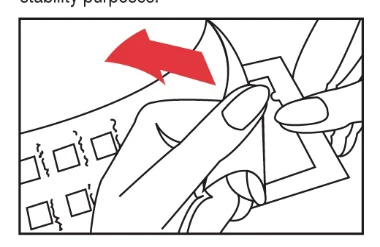
- Remove the protective film covering the surface of the panel. Be careful not to touch the test substances. The packaging of panel 2 contains a drying agent ensuring stability.
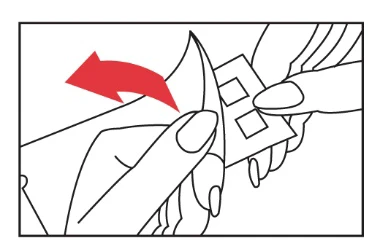
- Apply the test patch to the patient's back – alternatively, to the outer part of the upper arm. Carefully smooth the surface of the patch from the center outwards to ensure good contact between each allergen and the skin. Both patches are attached on either side of the spine, a few centimeters away from it. The third panel is placed next to one of the other panels.
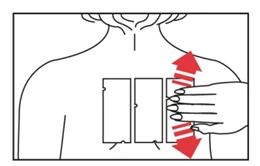
- Use a special medical marker to mark on the skin the positions corresponding to the two cut-outs on each patch.
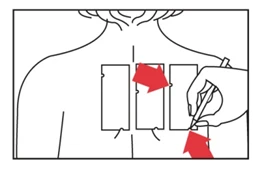
TRUE Test 36 should remain on the skin for 48 hours. It must not be removed or repositioned.
Care should be taken to avoid wetting the patch (e.g., by water or sweat).
If the patch is removed or detaches prematurely, it is possible that positive skin reactions may not occur even to allergens to which the patient is truly sensitized. If the patch is removed or detaches before 48 hours have elapsed, contact the physician.
After 48 hours, the patient or physician may remove the patches.
When should test results be read?
The physician should read the test results half an hour after patch removal and again 1–2 days after removal, when allergic reactions have fully developed and mild skin irritations have subsided.
Certain allergens may occasionally cause reactions that appear later than 4–5 days after patch removal. In such cases, the physician should be informed.
What will the physician evaluate?
The physician should carefully examine the test area for signs of allergic reaction. Such a reaction typically appears as a rash with swelling, redness, and small blisters. However, redness alone does not necessarily indicate an allergic reaction. If an allergy is confirmed, the physician will provide the following information:
- where in daily life exposure to irritating substances is likely,
- how best to avoid these substances. The physician may suggest alternative substances to use instead of those that should be avoided.
In case of doubt, consult a physician or pharmacist.
If discomfort is felt in the test areas, contact the physician.
The physician may decide to remove the test.
4. Possible adverse reactions
Like all medicines, this product can cause adverse reactions, although not everyone will experience them.
Very common adverse reactions (may affect more than 1 in 10 people) include:
- irritation caused by the patch, which usually resolves quickly, skin burning, and prolonged reactions to the test. A positive test reaction usually disappears within 1–2 weeks, whereas a prolonged test reaction may persist for weeks or months.
Common adverse reactions (may affect up to 1 in 10 people) include:
- transient skin depigmentation or discoloration due to test reaction.
- skin redness caused by irritation or inflammation (erythema).
Uncommon adverse reactions (may affect 1 in 100 people) include:
- exacerbation of inflammatory skin lesions.
Rare adverse reactions (may affect 1 in 1000 people) include:
- sensitization to the substance on the test panel.
Frequency not known (frequency cannot be estimated from available data):
- anaphylactic reaction (systemic reaction, with possible occurrence of life-threatening drop in blood pressure).
- hypersensitivity (allergic reaction).
In very rare cases, and only in relation to specific substances, an anaphylactic reaction (systemic reaction with possible life-threatening drop in blood pressure) has occurred. Allergy departments are prepared to treat such cases arising from other causes. No anaphylactic-type reactions have been reported following the use of TRUE Test 36.
Reporting of adverse reactions
If any adverse reactions occur, including any adverse reactions not listed in this leaflet, inform your doctor. Adverse reactions can be reported directly to the Department of Monitoring Adverse Drug Reactions, Office for Registration of Medicinal Products, Medical Devices and Biocidal Products
Al. Jerozolimskie 181C
PL-02 222 Warsaw
Tel.: + 48 22 49 21 301
Fax: + 48 22 49 21 309
Website: https://smz.ezdrowie.gov.pl
Adverse reactions can also be reported to the marketing authorization holder.
Reporting adverse reactions helps to provide more information on the safety of this medicinal product.
5. How to store TRUE Test 36
Store in a refrigerator (2°C - 8°C).
Keep the medicine out of the sight and reach of children.
Do not use this medicine after the expiry date stated on the packaging. The expiry date (EXP) refers to the last day of the specified month.
Medicines must not be disposed of via wastewater or household waste. Ask your pharmacist how to dispose of medicines no longer required. These measures will help protect the environment.
6. Contents of the package and other information
What TRUE Test 36 contains
In addition to the active substances listed on the first page, the test contains the following excipients:
Polyester fiber patch with adhesive (ethylene-vinyl acetate copolymer) containing acrylic adhesive, polyester flakes, povidone 90, hydroxypropylcellulose, methylcellulose, beta-cyclodextrin, sodium carbonate, sodium bicarbonate, butylhydroxyanisole, and butylhydroxytoluene.
What TRUE Test 36 looks like and contents of the packaging
Each panel is covered with a silicone-coated polyethylene film and packed in a sealed multilayer package.
The package containing panel 2 includes a desiccant, ensuring allergen stability during storage.
Pack contents: 10 kits (1 kit = one panel no. 1, one panel no. 2, and one panel no. 3).
Marketing Authorisation Holder and Manufacturer
SmartPractice Denmark ApS
Herredsvejen 2
3400 Hillerød
Denmark
[email protected]
Polish Representative:
BENEMEDO Sp. z o.o.
ul. Floriańska 2
03-707 Warsaw
24-02-2021
Information intended exclusively for healthcare professionals:
Each TRUE Test 36 package includes a template enabling rapid identification of the allergen causing a reaction. To ensure correct reading, skin markings should correspond to the cuts on the template. Note that side 1 of the template corresponds to panel no. 1, and side 2 of the template corresponds to panel no. 2.
Interpretation of results recommended by the International Contact Dermatitis Research Group:
- Negative reaction
? Doubtful reaction; slight macular erythema, minimal infiltration, or absence of inflammatory infiltration
- Weak positive reaction (non-vesicular); erythema, mild inflammatory infiltration; papular changes may occur
++ Strong positive reaction (vesicular); erythema, inflammatory infiltration, papular changes, vesicles
+++ Very strong positive reaction; intense erythema, infiltration, coalescing vesicles
IR Irritant reactions of various types
NT Not tested
Note
- Patients who show no reaction may still be sensitized to substances not included in this set. Furthermore, false-negative reactions may occur. Repeating the test or testing with additional substances may be indicated.
- A positive reaction should fulfill the criteria of an allergic reaction (papular or vesicular erythema and inflammatory infiltration).
- The presence of crusts, diffusely scattered papules, or uniform erythematous changes without inflammatory infiltration typically indicates irritation and does not indicate an allergic reaction.
In assessing a positive reaction, the number of "+" signs in the reaction intensity scale for test substances is less important than confirming the allergic nature of the reaction (as opposed to non-specific irritant reactions).
Some allergens (neomycin sulfate, paraphenylenediamine, sterol alcohols from lanolin, kathon CG, gold sodium thiosulfate, parthenolide, disperse blue 106, bacitracin, imidazolidinyl urea, diazolidinyl urea, budesonide, 17-hydrocortisone valerate, 21-tixocortol pivalate) may occasionally cause reactions that become apparent only 4–5 days after test application. Patients should be informed about this. Delayed reactions should be verified during a follow-up visit on day 5–7.
All positive reactions should be carefully evaluated considering the patient's clinical history and individual symptoms, especially in cases of positive reactions to specific allergens with lower clinical relevance (e.g., gold sodium thiosulfate).
Contraindications
Severe or generalized skin inflammation. Testing should be postponed until acute symptoms have resolved.
Hypersensitivity to any of the excipients, except the active substances.
Special warnings and precautions for use
Sensitization to a substance in the test panel occurs only rarely. A reaction appearing on day 10 or later after test application may indicate contact sensitization.
The "angry back" syndrome is a condition in which widespread skin inflammation occurs, possibly triggered by inflammation at another body site or by a strong allergic reaction to tested allergens. Therefore, particular caution is required when interpreting test results in patients showing multiple positive reactions to individual test substances.
To verify false-positive results, repeat testing after a certain interval may be necessary.
In patients with a history of anaphylactoid reactions, the use of TRUE Test 36 should be carefully considered.
Excessive sweating and exposure to sunlight at the test site should be avoided.
Sunburn may reduce test reactivity and lead to false-negative results.
The physician should not apply the patch to acne-affected skin, scars, inflammatory lesions, or other skin changes that could affect test results.
In case of a strong reaction following patch testing, topical corticosteroids may be used. In rare cases, systemic corticosteroids may be required.
Butylhydroxyanisole (BHA) (E320) and butylhydroxytoluene (BHT) (E312) are present as antioxidants in patch no. 7 Colophony (panel 1). BHA and BHT may cause local skin reactions (e.g., contact dermatitis), which could lead to false-positive reactions to colophony.
This page has been machine-translated and may contain inaccuracies. The original data is available in the manufacturing country's language.
Last data check: June 04, 2026 · Data source: Rejestr Produktów Leczniczych (URPL)