Trosicam
Poland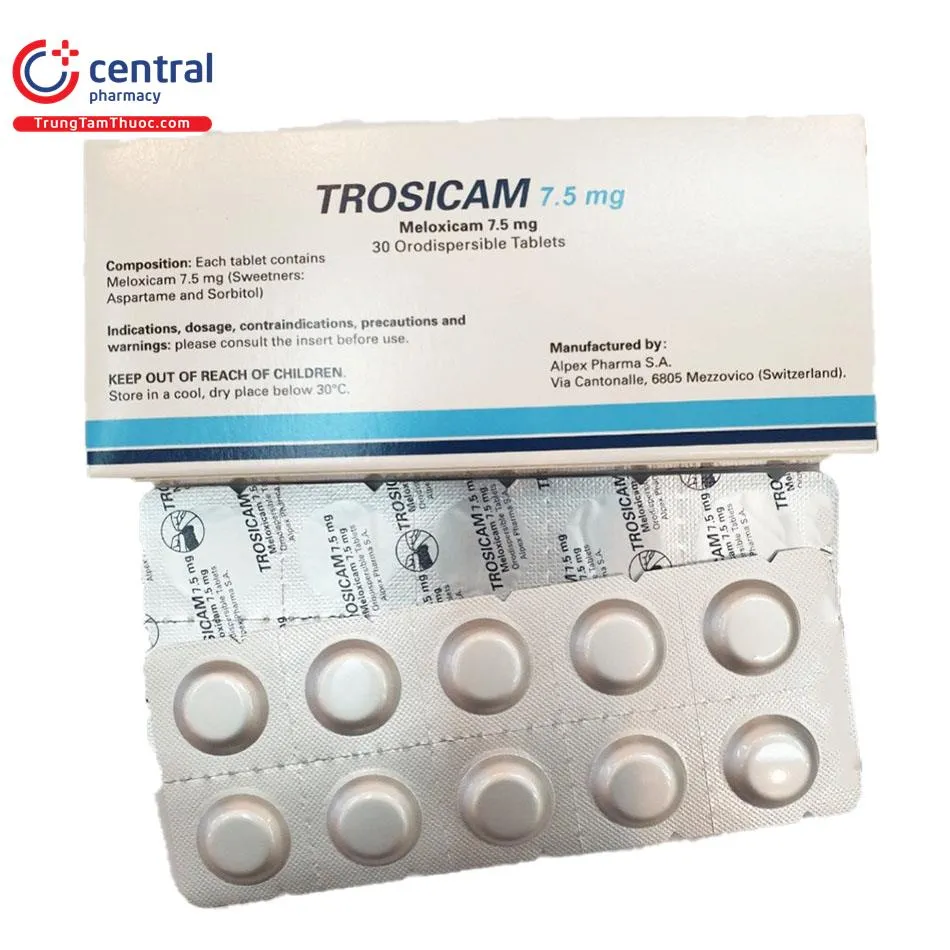
Table of Contents
TROSICAM
15 mg Orodispersible Tablets
Meloxicam
Please read the entire leaflet before use, as it contains important information for the patient.
- Keep this leaflet for future reference.
- If you have any further questions, consult your doctor or pharmacist.
- This medicine has been prescribed for a specific individual. Do not pass it on to others. This medicine may harm others, even if their symptoms are identical.
- If you experience any adverse reactions, including those not listed in this leaflet, inform your doctor or pharmacist. See section 4.
TABLE OF CONTENTS OF THE LEAFLET:
1. What Trosicam is and what it is used for
2. Important information before taking Trosicam
3. How to take Trosicam
4. Possible side effects
5. How to store Trosicam
6. Contents of the pack and other information
1. WHAT TROSICAM IS AND WHAT IT IS USED FOR
Trosicam belongs to a group of medicines called non-steroidal anti-inflammatory drugs (NSAIDs), used to reduce inflammation and pain in joints and muscles. (Orodispersible tablets dissolve easily in the mouth.)
Trosicam is used for:
- Short-term treatment of symptoms during flare-ups of osteoarthritis;
- Long-term treatment of symptoms of:
- Rheumatoid arthritis,
- Ankylosing spondylitis (spinal arthritis).
If there is no improvement or if the patient feels worse after 20 days, medical advice should be sought.
2. IMPORTANT INFORMATION BEFORE TAKING TROSICAM
When not to take Trosicam:
- If the patient is allergic to meloxicam or any of the other ingredients of this medicine (listed in section 6);
- If the patient is pregnant or planning to become pregnant, or is breastfeeding;
- If the patient has an allergy (hypersensitivity) to acetylsalicylic acid or other non-steroidal anti-inflammatory drugs (NSAIDs);
- If the patient previously experienced asthma (wheezing), nasal polyps with watery nasal discharge, skin swelling, or urticaria after taking acetylsalicylic acid or other anti-inflammatory drugs;
- If the patient currently has or has previously had gastric or duodenal ulcer disease;
- If the patient currently has or has previously experienced bleeding from the stomach, intestines, or cerebral vessels;
- If the patient has severe liver failure;
- If the patient has severe renal failure but is not undergoing dialysis;
- If the patient has severe heart failure;
- If the patient has Crohn's disease;
- If the patient has ulcerative colitis;
- If the patient has pain following coronary artery bypass graft surgery.
Do not take Trosicam if any of the above situations apply.
First, consult a doctor and follow their recommendations.
Warnings and precautions
Before starting treatment with Trosicam, discuss it with your doctor or pharmacist.
When to exercise special caution when taking Trosicam
Inform your doctor or pharmacist before taking this medicine:
- If the patient has high blood pressure;
- If the patient has heart, liver, or kidney disease;
- If the patient has diabetes;
- If the patient is elderly (aged 65 years or older);
- If the patient has a hereditary condition called phenylketonuria, as this medicine contains aspartame (E951);
- If the patient has been informed of intolerance to certain carbohydrates (sugars), as this medicine contains sorbitol (E420), a type of sugar;
- If the patient has reduced blood volume, which may occur in cases of severe blood loss, burns, surgery, or reduced fluid intake;
- If the patient has previously been diagnosed with high potassium levels in the blood.
Tell your doctor if any of the above situations apply to the patient.
Warning
Taking medicines such as Trosicam may be associated with a small increased risk of heart attack (myocardial infarction) or stroke. This risk increases with long-term use of high doses. Do not use higher doses or for longer than recommended.
If the patient has heart problems, has had a stroke, or is at risk of such conditions—such as high blood pressure, diabetes, high cholesterol, or smoking—discuss treatment options with a doctor or pharmacist.
Children and adolescents
Do not give this medicine to children or adolescents under 16 years of age.
Trosicam and other medicines
Inform your doctor or pharmacist about all medicines currently taken or recently used, as well as any medicines the patient plans to take.
Do not use other medicines, including over-the-counter medicines, without consulting a doctor or pharmacist, if the patient is taking Trosicam.
- Tell your doctor or pharmacist if you are taking any of the following medicines:
- Other non-steroidal anti-inflammatory drugs, including acetylsalicylic acid;
- Medicines that prevent blood clotting, such as warfarin;
- Medicines that dissolve blood clots;
- Medicines used to treat high blood pressure;
- Oral corticosteroids;
- Cyclosporine;
- All diuretics (the doctor may monitor kidney function during diuretic treatment);
- Lithium used in psychiatric disorders;
- Selective serotonin reuptake inhibitors (SSRIs), used to treat depression;
- Methotrexate;
- Cholestyramine;
- Intrauterine contraceptive device, commonly known as an intrauterine device (IUD).
Pregnancy and breastfeeding
If the patient is pregnant or breastfeeding, suspects she may be pregnant, or plans to become pregnant, she should consult a doctor or pharmacist before using this medicine.
Trosicam is not recommended for use during pregnancy or breastfeeding.
Inform your doctor immediately if the patient is pregnant, suspects pregnancy, or is breastfeeding.
Before using any medicine, consult a doctor or pharmacist.
Driving and operating machinery
Do not drive or operate machinery until the patient knows how Trosicam affects them. Do not drive or operate machinery if confusion, dizziness, drowsiness, or visual disturbances occur after taking the medicine.
Trosicam contains
- Mannitol, which may have a mild laxative effect.
- The medicine contains 8 mg of aspartame per tablet. Aspartame is a source of phenylalanine. It may be harmful to patients with phenylketonuria. This is a genetic disorder in which phenylalanine accumulates in the body due to improper excretion. Before taking the medicine, consult a doctor.
- The medicine contains 40 mg of sorbitol per tablet. If the patient has ever been diagnosed with intolerance to certain sugars, before taking the medicine, consult a doctor.
3. HOW TO USE TROSICAM
This medicine should always be used as directed by the physician. If in doubt, consult
your doctor or pharmacist. Read the leaflet carefully.
Taking the medicine
- Place the tablet on the tongue.
- Allow it to dissolve slowly for five minutes (do not chew or swallow it undissolved).
- Swallow it with water (240 ml).
- If the patient has dry mouth, moisten the mouth with water first.
- Never take more than the recommended maximum dose of 15 mg (one tablet) per day.
Dosage
The dose depends on the disease being treated. The physician should inform the patient about the dosage
of the medicine.
This medicine should always be used exactly as described in the patient leaflet or as directed by the
physician or pharmacist. If in doubt, consult your doctor or pharmacist.
Treatment of exacerbation of osteoarthritis:
The recommended dose is 7.5 mg (half a tablet) per day. The physician may increase the dose to 15 mg (one
tablet) per day if deemed necessary.
Treatment of rheumatoid arthritis and ankylosing spondylitis:
The recommended dose is 15 mg (one tablet) per day. The physician may reduce the dose to 7.5 mg (half
a tablet) per day if deemed necessary.
For patients aged 65 years and older, the recommended dose in the treatment of rheumatoid arthritis
and ankylosing spondylitis is 7.5 mg (half a tablet) per day.
If the patient has any of the conditions listed in section 2 “When to exercise special caution with Trosicam”, the physician may reduce the dose to 7.5 mg (half a tablet) per day.
If the patient feels that the effect of Trosicam is too strong or too weak, or if there is no improvement after several days of use, the patient should consult the doctor or pharmacist.
Taking more Trosicam than recommended
Immediately contact your doctor or pharmacist, or immediately go to the nearest hospital emergency department, remembering to bring this leaflet or the tablets with you.
Missing a dose of Trosicam
Do not take a double dose to make up for a missed dose.
Take the usual dose the next day.
Stopping Trosicam
If you have any further questions about using this medicine, consult your doctor or pharmacist.
4. POSSIBLE ADVERSE REACTIONS
Like all medicines, this medicine can cause adverse reactions, although not everyone experiences them.
- If the patient has previously experienced gastrointestinal disorders while taking anti-inflammatory medicines, the doctor may consider it appropriate to monitor the patient's condition during treatment. Clinical studies and scientific data suggest that taking certain NSAIDs (especially at high doses and long-term) may be associated with a small increased risk of arterial thrombosis (e.g. heart attack or stroke).
Contact a doctor immediately or go to the nearest hospital emergency department
(taking this leaflet or the tablets with you) if any of the following adverse reactions occur:
- severe allergic reactions, including fainting, shortness of breath, skin reactions, and asthma attacks (common adverse reactions: occur in 1 to 10 patients out of 100);
- bleeding from the stomach or intestines, peptic ulcer, pain or inflammation of the mucous membrane of the mouth or oesophagus (uncommon adverse reactions: occur in 1 to 10 patients out of 1,000);
- severe blistering of the skin or peeling of the epidermis, swelling of the eyelids, lips and face, rash caused by sunlight exposure (rare adverse reactions: occur in 1 to 10 patients out of 10,000).
Contact a doctor if any of the following adverse reactions occur:
- Pancreatitis.
Common adverse reactions (occur in 1 to 10 patients out of 100):
- indigestion, nausea and vomiting, abdominal pain (stomach ache), constipation, bloating with flatulence, diarrhoea, rash and itching;
- feeling of emptiness in the head, headache;
- swelling of ankles and legs;
- anaemia.
Uncommon adverse reactions (occur in 1 to 10 patients out of 1,000):
- hypersensitivity;
- urticaria;
- dizziness, tinnitus, drowsiness;
- irregular heartbeat, increased blood pressure, facial flushing;
- abnormal white blood cell or platelet count;
- liver function disorders;
- fluid and salt retention, hyperkalaemia, kidney function disorders.
Rare adverse reactions (occur in 1 to 10 patients out of 10,000):
- intestinal wall perforation, inflammation or pain in the stomach or intestines (peptic ulcer disease of the stomach or duodenum, gastrointestinal bleeding and perforation may occur at any time during treatment; sometimes – especially in elderly patients – they may be severe, and very rarely, in fewer than 1 in 10,000 treated patients, may lead to death);
- disorientation, mood changes, insomnia, nightmares;
- visual disturbances, including blurred vision;
- hepatitis;
- kidney failure.
If any of the adverse symptoms worsen or if any adverse symptoms not listed in this leaflet occur, inform a doctor or pharmacist.
Reporting of adverse reactions
If any adverse reactions occur, including any not listed in this leaflet, inform a doctor or pharmacist. Adverse reactions can be reported directly to the Department of Monitoring of Adverse Drug Reactions of the Office for Registration of Medicinal Products, Medical Devices and Biocidal Products, Al. Jerozolimskie 181C, 02-222 Warsaw, tel.: +48 22 49 21 301, fax: +48 22 49 21 309, website: https://smz.ezdrowie.gov.pl
Adverse reactions can also be reported to the marketing authorisation holder.
Reporting adverse reactions helps to provide more information on the safety of the medicine.
5. HOW TO STORE TROSICAM
- Keep the medicine out of the sight and reach of children.
- Do not transfer the tablets to another container.
- In European Union countries, this product is not subject to any special storage requirements.
- Do not use this medicine after the expiry date stated on the carton after "Expiry date (EXP)". The expiry date refers to the last day of the stated month.
- Do not use this medicine if you notice any visible signs of deterioration.
Medicines must not be disposed of via wastewater or household waste.
Ask your pharmacist how to dispose of medicines no longer required.
Following this advice helps protect the environment.
6. CONTENTS OF THE PACKAGE AND OTHER INFORMATION
What Trosicam contains
The active substance is meloxicam. Each tablet contains 15 mg of meloxicam.
The other ingredients are: mannitol (E421), aspartame (E951), sorbitol (E420), anhydrous citric acid,
yoghurt flavour (flavouring substances identical to natural ones, flavouring preparations, natural flavours, corn maltodextrin, glyceryl triacetate EP), forest fruit flavour (flavouring substances identical to natural ones, flavouring preparations, natural flavours, corn maltodextrin, glyceryl triacetate EP, modified starch), povidone K30, crospovidone, talc, sodium lauryl sulphate and magnesium stearate.
What Trosicam tablets look like and contents of the pack
Trosicam tablets are round, light yellow, flat tablets with a dividing score (weighing 400 mg and with a diameter of 12 mm), marked AX5 on one side. The tablet can be divided into two equal doses.
Tablets are available as:
- packs containing 2 blisters with 10 tablets each,
- packs containing 3 blisters with 10 tablets each,
- packs containing one HDPE bottle with a PP screw cap incorporating a moisture-absorbing desiccant and child-resistant closure, in a cardboard box. The bottle contains 30 tablets,
- packs containing one HDPE bottle with a PP screw cap incorporating a moisture-absorbing desiccant and child-resistant closure, in a cardboard box. The bottle contains 200 tablets.
Marketing Authorisation Holder
ALPEX PHARMA (IRL) LIMITED
Stradbrook House, Stradbrook Road,
Blackrock, Co. Dublin
A94X9A2 - Ireland
Manufacturer
Kymos, S.L.
Ronda de Can Fatjó, 7B
(Parque Tecnológico del Vallès),
Cerdanyola del Vallès, 08290 Barcelona
Spain
This medicinal product is authorised in the European Economic Area under the following names:
Bulgaria and Poland: Trosicam
Czech Republic: Oramellox 15 mg
Slovakia: Oramellox 15 mg
United Kingdom: Meloxicam 15 mg Orodispersible Tablets