Tropicamide wzf 1%
Poland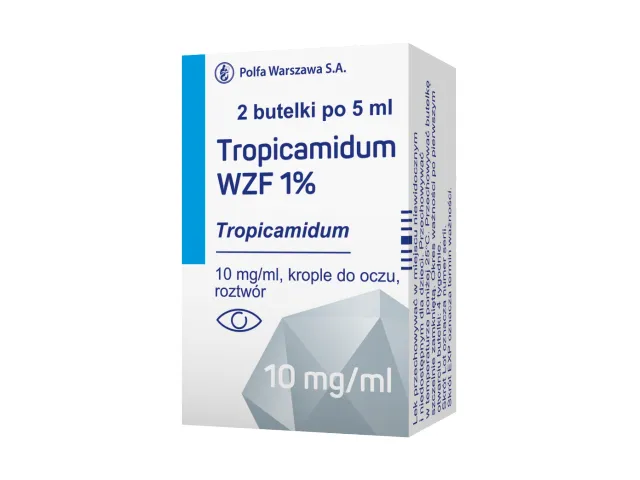
Table of Contents
- Package leaflet: information for the patient
- 1. What Tropicamidum WZF 1% is and what it is used for
- 2. Important information before using Tropicamidum WZF 1%
- 3. How to use Tropicamidum WZF 1%
- 4. Possible adverse reactions
- 5. How to store Tropicamidum WZF 1%
- 6. Contents of the package and other information
Package leaflet: information for the patient
TROPICAMIDUM WZF 1%, 10 mg/ml, eye drops, solution
Tropicamidum
Please read carefully the entire leaflet before using the medicine, as it contains
important information for the patient.
- Keep this leaflet, so that you can read it again if necessary.
- If you have any questions, please consult your doctor or pharmacist.
- This medicine has been prescribed for a specific individual. Do not pass it on to others. The medicine may harm another person, even if their symptoms are the same.
- If the patient experiences any adverse reactions, including any adverse reactions not listed in this leaflet, inform the doctor or pharmacist. See section 4.
Table of contents of the leaflet
- What Tropicamidum WZF 1% is and what it is used for
- Important information before using Tropicamidum WZF 1%
- How to use Tropicamidum WZF 1%
- Possible side effects
- How to store Tropicamidum WZF 1%
- Contents of the pack and other information
1. What Tropicamidum WZF 1% is and what it is used for
The medicine contains tropicamide, which, when applied locally to the eye, dilates the pupil and paralyzes accommodation of the eye (the eye's ability to adjust for clear vision of objects at varying distances).
The medicine is used:
- in ophthalmic diagnostics – to paralyze accommodation;
- in preoperative and postoperative conditions requiring the use of a short-acting pupil-dilating agent.
2. Important information before using Tropicamidum WZF 1%
When not to use Tropicamidum WZF 1%
- if the patient is allergic to tropicamide or to any of the other ingredients of this medicine (listed in section 6);
- if the patient has primary glaucoma (increased pressure in the eye) with a tendency to angle closure;
- if the patient has narrow-angle glaucoma;
- in the case of wearing soft contact lenses due to the presence of benzalkonium chloride in the formulation.
Warnings and precautions
Before starting to use Tropicamidum WZF 1%, you should discuss this with your doctor or
pharmacist.
- Before administering the medicine to dilate the pupil for fundus examination, the doctor will perform diagnostic tests to rule out narrow-angle glaucoma, in order to prevent a possible acute glaucoma attack after tropicamide administration.
- Special caution is required in patients hypersensitive to substances known as belladonna alkaloids (deadly nightshade).
- In patients with increased sensitivity to anticholinergic drugs, psychotic reactions and behavioral disturbances may occur after instillation of tropicamide.
- Hands should be washed after each instillation of the medicine to remove any residual tropicamide.
Children
Particular caution is recommended when administering the medicine to children, as adverse reactions may occur (see section 4 of the leaflet). Tropicamide may cause central nervous system disturbances, which may be dangerous for infants and children.
Accidental ingestion of the medicine by a child may lead to toxic effects; therefore, as with all other medicines, it should be stored out of reach of children.
Tropicamidum WZF 1% and other medicines
You should inform your doctor or pharmacist about all medicines currently used or recently used, as well as any medicines you plan to use.
The effect of tropicamide may be enhanced by drugs used in Parkinson's disease (e.g. amantadine), certain antihistamines of the first generation (e.g. clemastine), drugs used in psychiatric disorders (e.g. chlorpromazine and haloperidol), and tricyclic antidepressants (e.g. imipramine, amitriptyline).
Pregnancy, breastfeeding and fertility
If the patient is pregnant or breastfeeding, suspects she may be pregnant, or is planning to become pregnant, she should consult a doctor before using this medicine.
The medicine may be used during pregnancy only if, in the opinion of the physician, its use is necessary.
A risk to the breastfed infant cannot be excluded.
The decision on continuing or discontinuing breastfeeding or on continuing or discontinuing the use of tropicamide will be made by the physician after weighing the benefits of breastfeeding for the child against the benefits of using tropicamide in the mother.
There are no data on the effect of the medicine on fertility.
Driving and operating machinery
After using the medicine, disturbances in vision and photophobia may occur. Driving and operating machinery should be avoided until normal vision returns, which usually occurs approximately 6 hours after administration of the medicine.
Tropicamidum WZF 1% contains benzalkonium chloride
The medicine contains 0.1 mg of benzalkonium chloride per ml of solution. Benzalkonium chloride may be absorbed by soft contact lenses and may change their color. Contact lenses should be removed before instillation and at least 15 minutes should be waited before reinserting them.
Benzalkonium chloride may also cause eye irritation, especially in patients with dry eye syndrome or corneal disorders (the transparent layer at the front of the eye). If abnormal sensations in the eye, stinging, or pain occur after using the medicine, consult a doctor.
3. How to use Tropicamidum WZF 1%
This medicine should always be used according to the instructions given by your doctor or pharmacist. If you have any doubts,
you should consult your doctor or pharmacist.
Usually, the medicine is used as described below.
Adults and elderly patients
- For cycloplegia: instill 1 drop, repeated once after an interval of 5 minutes. The examination should preferably be carried out between 25 and 50 minutes after the last instillation. Note: in children, atropine should be used to induce cycloplegia.
Adults, elderly patients, and children
- For pupil dilation: 1 drop of Tropicamidum WZF 1%. If examination of the patient has not been possible within 15–30 minutes after administration, another drop may be instilled to prolong the pupil-dilating effect. Maximum dilation occurs approximately 15 minutes after administration. The effect of the medicine lasts up to 3 hours. Note: in infants and young children, tropicamide should be used only at a concentration of 0.5%.
Method of administration
Tropicamidum WZF 1% is intended for external use – apply locally to the eye(s).
Do not let the dropper tip touch the eye, eyelids, or any other surface, as this may contaminate the contents of the bottle. Use of contaminated drops may lead to dangerous complications, including loss of vision.
- Wash your hands thoroughly before instilling the medicine.
- Unscrew the cap from the bottle.
- Tilt your head backward and gently pull down the lower eyelid to create a small pocket between the eyelid and the eyeball.
- Invert the bottle and gently press with your thumb or index finger on the side of the bottle until one drop of the medicine is dispensed into the eye. Do not let the dropper tip touch the eye or eyelids. If the drop missed the eye, instill another drop.
- Immediately after instillation of Tropicamidum WZF 1%, gently press on the inner corner of the eye for about 1 minute. This helps reduce the risk of systemic adverse effects.
- If your doctor has instructed you to instill the medicine into the other eye as well, repeat steps 3, 4, and 5.
- The dropper is designed to accurately measure the drops; therefore, do not enlarge the opening of the dropper.
- After instillation, replace the cap on the bottle. Do not overtighten.
Use of a higher than recommended dose of Tropicamidum WZF 1%
If an excessive amount of tropicamide is absorbed into the systemic circulation, systemic toxic effects may occur (especially in children), characterized by: facial flushing, dryness of the oral mucous membranes (in children, rash may occur), visual disturbances, rapid and irregular heartbeat, fever, abdominal distension in infants, convulsions, hallucinations, and loss of neuromuscular coordination. If any of these symptoms occur or if the medicine has been used inappropriately (e.g. swallowed), seek immediate medical advice from a doctor or go to a hospital. In infants and young children, maintaining moist body surfaces is recommended. If the medicine has been ingested, vomiting may be induced.
4. Possible adverse reactions
Like all medicines, this medicinal product may cause adverse reactions, although not everyone experiences them.
If the patient develops allergic reactions, discontinue use of Tropicamidum WZF 1% immediately and contact a doctor without delay.
Local adverse reactions may occur:
Frequency unknown (frequency cannot be estimated from available data):
- Increased intraocular pressure;
- Transient stinging in the eye;
- Photophobia due to pupillary dilation.
Prolonged use of the medicine may cause local irritation, hyperaemia, swelling, and inflammation of the conjunctiva.
Systemic adverse reactions may occur:
Frequency unknown (frequency cannot be estimated from available data):
- Dryness of the oral mucosa;
- Skin redness and dryness;
- Irregular heartbeat;
- Sudden urge to urinate;
- Slowed gastrointestinal motility leading to constipation;
- Vomiting;
- Dizziness;
- Unsteady gait.
Additional adverse reactions in children
Frequency unknown (frequency cannot be estimated from available data): rash,
psychotic reactions (e.g. seeing, hearing things that do not exist, delusions), behavioural disturbances,
respiratory and circulatory failure, and abdominal distension in infants.
Tropicamide may cause central nervous system disturbances, which may be dangerous in infants and children.
If such symptoms occur during treatment, discontinue use of Tropicamidum WZF 1% immediately and contact a doctor or the nearest hospital emergency department without delay.
Reporting of adverse reactions
If any adverse reactions occur, including any not listed in this leaflet, inform a doctor or pharmacist.
Adverse reactions can be reported directly to the Department of Monitoring of Adverse Drug Reactions of the Office for Registration of Medicinal Products, Medical Devices and Biocidal Products:
Al. Jerozolimskie 181C
02-222 Warsaw
Phone: +48 22 49 21 301
Fax: +48 22 49 21 309
Website: https://smz.ezdrowie.gov.pl
Adverse reactions can also be reported to the marketing authorization holder.
Reporting adverse reactions contributes to the further enhancement of the safety profile of the medicine.
5. How to store Tropicamidum WZF 1%
Store below 25 °C.
Keep the bottle tightly closed.
Store the medicine in a place inaccessible and out of sight of children.
Shelf life after first opening the bottle: 4 weeks.
After this period, the bottle with any remaining medicine must be discarded.
Do not use this medicine after the expiry date stated on the carton and bottle.
The expiry date refers to the last day of the stated month.
The labelling on the packaging: EXP indicates the expiry date, and Lot indicates the batch number.
Medicines must not be disposed of via wastewater or household waste. Ask a pharmacist how to dispose of medicines no longer in use. Proper disposal helps protect the environment.
6. Contents of the package and other information
What Tropicamidum WZF 1% contains
- The active substance is tropicamide. Each ml of solution contains 10 mg of tropicamide.
- The other ingredients are: sodium chloride; disodium edetate; benzalkonium chloride, solution; hydrochloric acid, diluted (for pH adjustment); purified water.
What Tropicamidum WZF 1% looks like and contents of the pack
Tropicamidum WZF 1% is a sterile eye drop solution in the form of a colourless, transparent liquid.
The pack contains 2 polyethylene bottles with a capacity of 5 ml of solution, in a cardboard box.
Marketing Authorisation Holder
Zakłady Farmaceutyczne POLPHARMA S.A.
ul. Pelplińska 19, 83-200 Starogard Gdański
tel. + 48 22 364 61 01
Manufacturer
Jadran-Galenski Laboratorij d.d.
Svilno 20, 51000 Rijeka
Croatia