Trimesan
Poland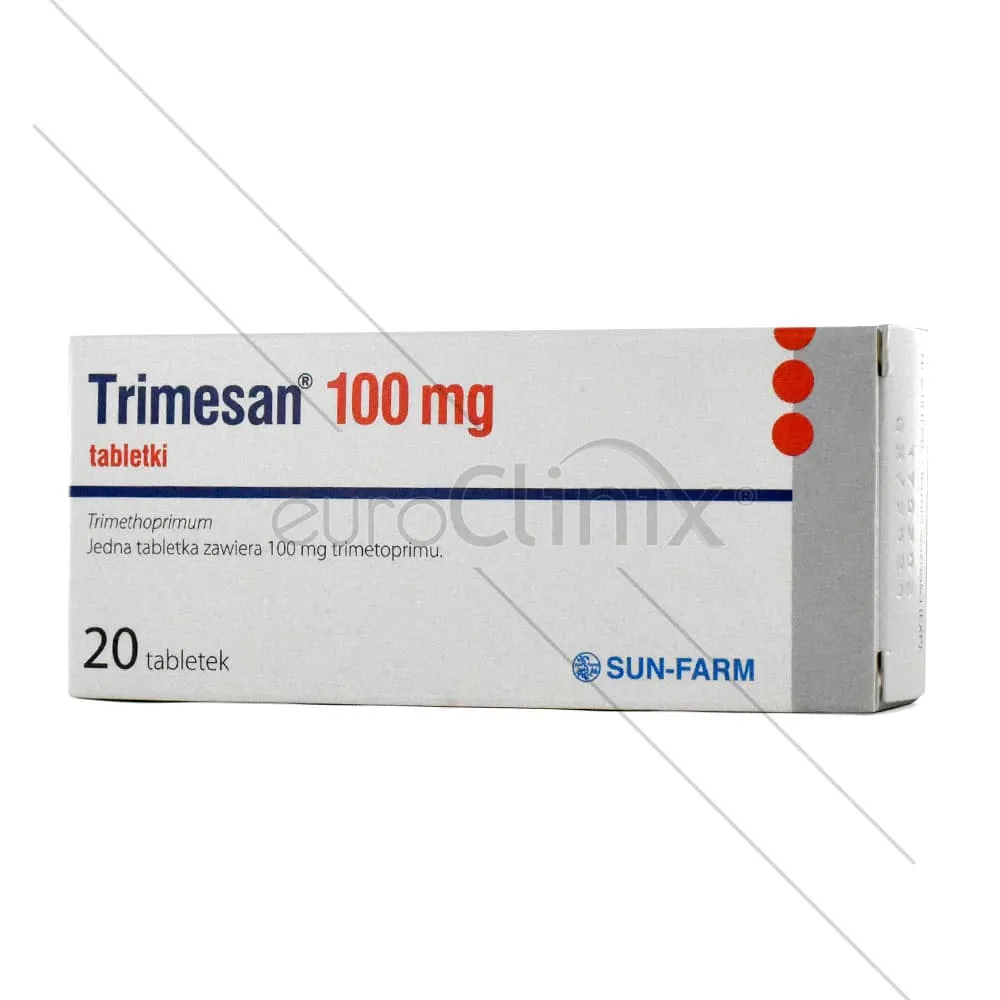
Table of Contents
Package leaflet: Information for the user
TRIMESAN, 100 mg, tablets
Trimethoprimum
Please read carefully the entire leaflet before using this medicine, as it contains
important information for the patient.
- Keep this leaflet, so that you can read it again if necessary.
- If you have any doubts, please consult your doctor or pharmacist.
- This medicine has been prescribed for a specific individual. Do not pass it on to others. This medicine may harm another person, even if their symptoms are identical.
- If you experience any adverse reactions, including any not listed in this leaflet, inform your doctor or pharmacist. See section 4.
Table of contents of the leaflet
- What Trimesan is and what it is used for
- Important information before taking Trimesan
- How to take Trimesan
- Possible side effects
- How to store Trimesan
- Contents of the pack and other information
1. What Trimesan is and what it is used for
Trimesan is an antibacterial medicine for oral use. The active substance is
trimethoprim, an inhibitor of dihydrofolate reductase, an enzyme involved in the conversion
of dihydrofolic acid to tetrahydrofolic acid. Trimethoprim selectively inhibits bacterial protein
synthesis, leading to bacterial death.
Trimethoprim is active against most strains of the following microorganisms:
Bordetella sp., Citrobacter sp., Enterobacter sp., Escherichia coli, Haemophilus influenzae, Hafnia sp.,
Klebsiella pneumoniae, Legionella sp., Pasteurella sp., Providencia sp., Serratia sp., Salmonella sp.,
Shigella sp., Staphylococcus aureus, Staphylococcus epidermidis, Staphylococcus saprophyticus,
Streptococcus pyogenes, Streptococcus pneumoniae, Streptococcus viridans, Streptococcus faecalis,
Vibrio sp., Yersinia sp.
Indications:
Urinary tract infections caused by susceptible strains of Escherichia coli, Proteus mirabilis,
Enterobacter sp., and staphylococci, including Staphylococcus saprophyticus.
Respiratory tract infections: pneumonia caused by Pneumocystis carinii (including as a
complication in acquired immunodeficiency syndrome, AIDS).
Gastrointestinal tract infections: typhoid fever, diarrhoea caused by E. coli (including traveller's diarrhoea).
Microorganism susceptibility should be confirmed by laboratory tests.
2. Important information before using Trimesan
When not to use Trimesan:
- if the patient is allergic to trimethoprim or to any of the other ingredients of this medicine (listed in section 6);
- if the patient is pregnant or suspects she may be pregnant;
- if the patient has blood disorders, including megaloblastic anaemia caused by folic acid deficiency;
- if the patient has severe renal impairment.
Warnings and precautions
BEFORE STARTING TO TAKE TRIMESAN, DISCUSS THIS WITH YOUR DOCTOR:
- if the patient has ever experienced severe skin rash, skin peeling, blisters and/or oral ulceration after taking trimethoprim.
Warnings and precautions – Special caution is required when using Trimesan:
Severe skin reactions have been reported with trimethoprim treatment, such as Stevens-Johnson syndrome (SJS), toxic epidermal necrolysis (TEN), and drug reaction with eosinophilia and systemic symptoms (DRESS). If any of the symptoms of severe skin reactions described in section 4 occur, trimethoprim should be discontinued immediately and medical help should be sought without delay.
Trimethoprim may suppress blood cell production. If during treatment sore throat, fever or petechiae occur, the patient should contact a doctor immediately, as these may be symptoms of bone marrow damage.
Inform the doctor about any pre-existing bone marrow disorders (haematopoietic disorders), including anaemia, as trimethoprim may worsen these conditions.
Trimethoprim may potentially cause hyperkalaemia (increased blood potassium levels).
Concomitant use of Trimesan with certain medicines (see "Trimesan and other medicines" below), potassium supplements, or a diet high in potassium may lead to severe hyperkalaemia. Symptoms of severe hyperkalaemia may include muscle cramps, irregular heartbeat, diarrhoea, nausea, dizziness or headache.
Inform the doctor about any previous liver or kidney diseases, as these may necessitate dose adjustment.
Trimesan and other medicines
Tell your doctor or pharmacist about all medicines the patient is currently taking or has recently taken, as well as any medicines the patient plans to take.
This is particularly important for:
- antibiotics such as rifampicin;
- anticoagulants such as warfarin;
- digoxin and procainamide – medicines used for heart conditions;
- phenytoin used in epilepsy;
- dapsone – a medicine used, among others, in the treatment of dermatitis herpetiformis or acne, Crohn's disease;
- medicines that suppress bone marrow function, such as methotrexate and phenytoin;
- spironolactone and similarly acting medicines (other potassium-sparing diuretics).
Trimesan with food and drink
See section 3.
Pregnancy and breastfeeding
If the patient is pregnant or breastfeeding, suspects she may be pregnant, or is planning to become pregnant, she should consult a doctor or pharmacist before using this medicine.
Pregnancy
This medicine should not be taken during pregnancy (see: "When not to use Trimesan"). Treatment with trimethoprim during the first trimester of pregnancy may increase the risk of miscarriage. Children born to mothers who were treated with trimethoprim during the first trimester of pregnancy may have an increased risk of congenital malformations, particularly neural tube defects (when the spine and spinal cord do not develop properly), cleft lip and palate (when the lip and palate do not form properly), and heart defects.
Breastfeeding
Trimethoprim passes into human milk. The use of trimethoprim during breastfeeding is not recommended.
Driving and operating machinery
There is no information indicating that the medicine affects the ability to drive or operate machinery.
3. How to use Trimesan
This medicine should always be used according to the doctor's instructions. If in doubt, consult your
doctor or pharmacist.
Typical dosage:
Adults and children over 12 years of age: usually 100 mg to 200 mg twice daily (1–2 tablets every 12 hours).
Children aged 6 to 12 years: approximately 2 mg to 4 mg per kg of body weight (i.e. half to 1 tablet), twice daily.
Children under 6 years of age: use of this medicine is not recommended in this age group.
Tablets may be divided.
It is best to take the medicine between meals, as food inhibits the absorption of trimethoprim.
Duration of treatment:
The medicine should be taken for at least 10 days. After symptoms have resolved, treatment should be
continued for another 2 to 3 days.
Renal impairment:
Dosage depends on measured creatinine clearance:
In case of creatinine clearance above 30 ml/min, the dose does not differ from the usual dose – i.e. 100 mg to 200 mg twice daily.
In case of creatinine clearance of 15–30 ml/min – the dose is 50 mg (half a tablet) every 12 hours.
In patients with creatinine clearance below 15 ml/min, use of this medicine is not recommended.
Special dosing:
Typhoid fever: initially 300 mg (3 tablets) every 12 hours (for 2 to 3 days), then 200 mg (2 tablets) every 12 hours.
Pneumocystis pneumonia: 5 mg per kg of body weight every 8 hours or 300 mg every 8 hours. In case of combination therapy with a medicine containing dapsone, the dose is 100 mg per day.
In patients who respond to treatment within the first 72 hours, treatment should be continued for 14 days.
Traveler's diarrhea: 200 mg (2 tablets) every 12 hours.
Taking more Trimesan than recommended
If more Trimesan is taken than recommended, consult a doctor or pharmacist immediately.
Missing a dose of Trimesan
If a dose of Trimesan is missed, take it as soon as possible. Do not take a double dose to make up for a missed dose.
If you have any further doubts regarding the use of this medicine, consult your doctor or pharmacist.
4. Possible adverse reactions
Like all medicines, this medicine can cause adverse reactions, although not everyone will experience them.
If any of the following severe, life-threatening adverse reactions occur,
discontinue use of the medicine immediately and seek medical help from a doctor or the nearest hospital:
- anaphylactic shock presenting with confusion, pale skin, low blood pressure, sweating, reduced urine output, rapid breathing, weakness, and fainting;
- red skin rashes, often with blisters in the center, peeling of the skin, and mucosal ulcers in the mouth, throat, nose, genital organs, and eyes. Such severe skin rashes may be preceded by fever and flu-like symptoms [Stevens-Johnson syndrome (SJS) and/or toxic epidermal necrolysis (TEN)];
- widespread rash, high fever, and swollen lymph nodes (DRESS syndrome or drug hypersensitivity syndrome).
Seek immediate medical advice if any of the following adverse reactions occur:
occurring with unknown frequency:
- frequent appearance of bruises and petechiae due to reduced platelet count;
- sore throat and infections, which may indicate reduced white blood cell count, granulocytes, or neutropenia;
- nosebleeds and other hemorrhages, anemia;
- skin cyanosis due to increased levels of deoxygenated hemoglobin in the blood (caused by elevated methemoglobin levels (abnormal hemoglobin)); occurring rarely (less than 1 in 1,000 patients):
- headache, nausea, vomiting, photophobia, neck stiffness (aseptic meningitis).
Other adverse reactions:
Rare (occurs in less than 1 in 1,000 patients):
increased blood potassium, urea, creatinine, bilirubin levels, increased liver enzyme activity, decreased blood sodium levels, fever.
Very rare (occurs in less than 1 in 10,000 patients):
hallucinations.
Frequency not known (cannot be estimated from available data): discomfort in the epigastrium, nausea, vomiting, glossitis; skin rashes, itching, and photosensitivity.
(The frequency of these changes depends on the dose. Rashes are often maculopapular and appear 10–14 days after starting treatment).
Reporting of adverse reactions
If any adverse reactions occur, including any not listed in this leaflet, inform your doctor or pharmacist. Adverse reactions can be reported directly to the Department of Monitoring Adverse Drug Reactions, Office for Registration of Medicinal Products, Medical Devices and Biocidal Products
Al. Jerozolimskie 181C
02-222 Warsaw
Phone: +48 22 49 21 301
Fax: +48 22 49 21 309
Website: https://smz.ezdrowie.gov.pl/
Adverse reactions can also be reported to the marketing authorization holder.
Reporting adverse reactions helps to provide more information on the safety of the medicine.
5. How to store Trimesan
Keep this medicine out of sight and reach of children.
There are no special requirements for storage of this medicinal product.
Do not use this medicine after the expiry date stated on the packaging. The expiry date refers to the last day of the stated month.
Medicines must not be disposed of via the sewage system or in household waste. Ask your pharmacist how to dispose of medicines you no longer use. This will help protect the environment.
6. Contents of the packaging and other information
What Trimesan contains
- The active substance is trimethoprim. One tablet contains 100 mg of trimethoprim.
- The other ingredients are: microcrystalline cellulose, sodium carboxymethyl starch type C, magnesium stearate.
What Trimesan looks like and contents of the pack
Trimesan is white, round, biconvex tablets with a score line on one side.
White, opaque PVC/PVDC/Aluminium blisters in a cardboard box.
Pack sizes: 20 or 40 tablets
Not all pack sizes may be marketed.
Marketing Authorisation Holder and Manufacturer
Marketing Authorisation Holder
SUN-FARM Sp. z o.o.
ul. Dolna 21
05-092 Łomianki
tel. +48 22 350 66 69
Manufacturer/Importer
mibe GmbH Arzneimittel
Münchener Straße 15
06796 Brehna
Germany