Trilac
Poland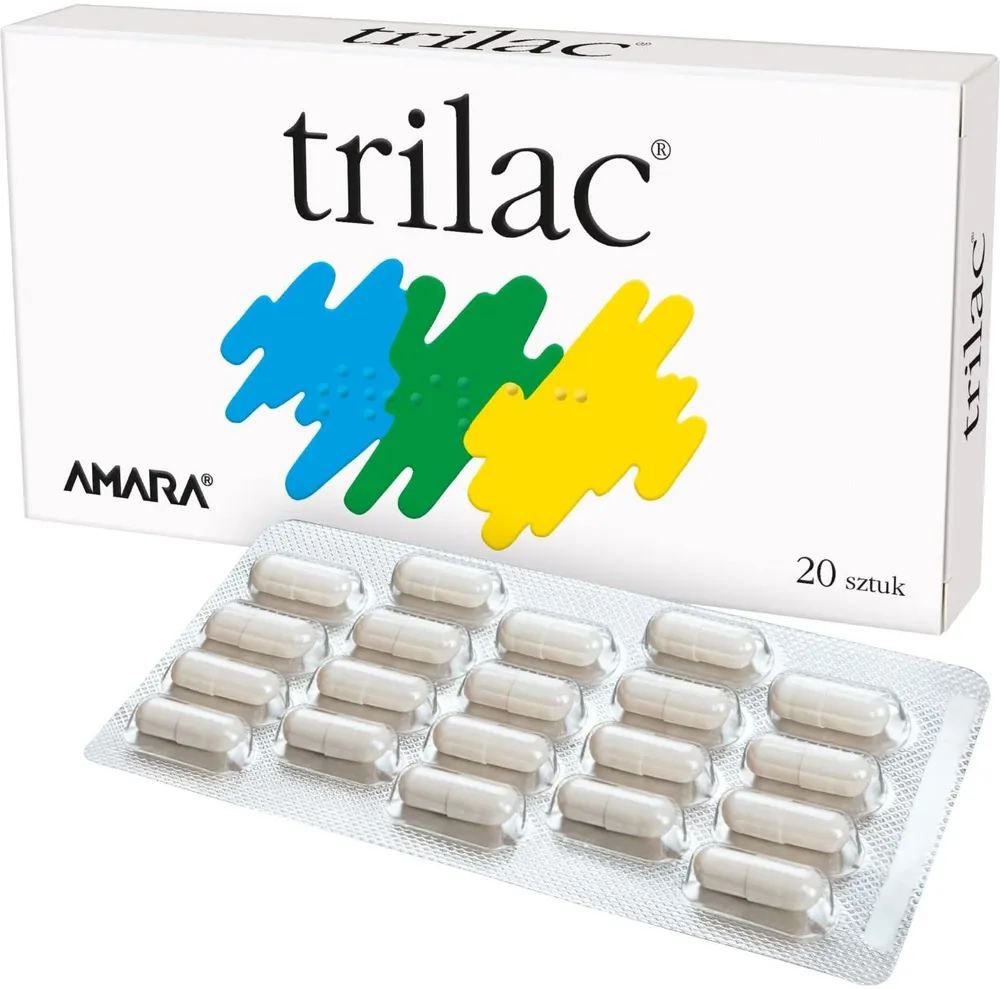
Table of Contents
Package leaflet: Information for the user
Trilac
1.6 x 10 CFU* lactic acid bacteria
hard capsules
combination product
Please read carefully the entire leaflet before taking this medicine, as it contains
important information for the patient.
- This medicine should always be taken exactly as described in this patient leaflet or as directed by the physician or pharmacist.
- Keep this leaflet, as you may need to read it again.
- If you need advice or further information, please consult your pharmacist.
- If you experience any adverse reactions, including any possible adverse reactions not listed in this leaflet, inform your doctor or pharmacist. See section 4.
- If there is no improvement or if you feel worse, consult your doctor.
Table of contents of the leaflet:
- What Trilac is and what it is used for
- Important information before taking Trilac
- How to take Trilac
- Possible side effects
- How to store Trilac
- Contents of the packaging and other information
1. What Trilac is and what it is used for
During antibiotic therapy, the natural gastrointestinal flora becomes significantly disturbed, which may consequently lead to infection by pathogenic microorganisms.
Trilac has a beneficial effect on the human gastrointestinal tract, as it contains lactic acid bacteria which, by lowering the pH in the gastrointestinal tract, promote the development of normal intestinal flora and prevent colonization and growth of pathogenic microorganisms.
The bacterial composition in Trilac is as follows:
- Lactobacillus acidophilus colonizes and multiplies in the small and large intestine. It creates favorable conditions for the development of Bifidobacterium animalis subsp. lactis, bacteria whose numbers in the gastrointestinal tract decrease in elderly individuals.
- Lactobacillus delbrueckii subsp. bulgaricus is not part of the natural, permanent intestinal flora, but is important for the gastrointestinal environment because it produces natural compounds with antibiotic properties.
Indications for use:
- Post-antibiotic enteritis, particularly as supportive treatment in pseudomembranous colitis, mainly in recurrent pseudomembranous colitis,
- Prevention of traveler's diarrhea,
- Supportive treatment following antibiotic therapy.
2. Important information before taking Trilac
When not to use Trilac
- if the patient is allergic to the active substances or to any of the other ingredients of this medicine (listed in section 6),
- if the patient is allergic to cow's milk protein.
Pregnancy and breastfeeding
If the patient is pregnant or breastfeeding, suspects she may be pregnant, or is planning to become pregnant, she should consult her doctor or pharmacist before using this medicine.
The safety of Trilac during pregnancy has not been studied.
Trilac may be used in women during breastfeeding according to the recommended dosage.
Consult a doctor before using this medicine.
Driving and operating machinery
Trilac has no influence on the ability to drive or operate machinery.
Trilac with other medicines
Concurrent use of Trilac with antibiotics may result in reduced probiotic efficacy.
3. How to take Trilac
This medicine should always be taken exactly as described in this patient leaflet or as directed by a doctor or pharmacist. If in doubt, consult your doctor or pharmacist.
Recommended dose
1-2 capsules orally 3 times daily for 2 weeks to 1 month, then maintenance dose of up to 2 capsules daily.
It is best to take with a large amount of fluid during a meal or one hour before a meal.
If you take more Trilac than you should:
There is no data available on overdose with this medicine.
If you forget to take a dose of Trilac:
Do not take a double dose to make up for the missed dose.
4. Possible adverse reactions
Like any medicinal product, this medicine may cause adverse reactions, although not everyone experiences them.
No adverse reactions have been identified to date.
If any adverse reactions occur, inform your doctor.
Reporting of adverse reactions
If any adverse reactions occur, including any adverse reactions not listed in this leaflet, inform your doctor or pharmacist. Adverse reactions can be reported directly to the Department of Monitoring Adverse Drug Reactions at the Office for Registration of Medicinal Products, Medical Devices and Biocidal Products
Al. Jerozolimskie 181C
02-222 Warsaw
Phone: +48 22 49 21 301
Fax: +48 22 49 21 309
Website: https://smz.ezdrowie.gov.pl
Adverse reactions can also be reported to the marketing authorization holder.
Reporting adverse reactions helps to provide more information on the safety of using this medicine.
5. How to store Trilac
Keep this medicine out of sight and reach of children.
Do not use this medicine after the expiry date stated on the packaging following: EXP.
The expiry date refers to the last day of the stated month.
Blister pack containing 20 capsules
Store at 2°C–8°C (in the refrigerator). During treatment, may be stored in a dry place at temperatures below 25°C.
Aluminium container for tablets containing 30 capsules or 90 capsules.
Store below 25°C.
Medicines must not be disposed of via the sewage system or household waste. Ask your pharmacist how to dispose of medicines no longer in use. This will help protect the environment.
6. Contents of the packaging and other information
What Trilac contains
The active substances in Trilac are lactic acid bacteria:
- Lactobacillus acidophilus (La-5) 37.5%
- Lactobacillus delbrueckii subsp. bulgaricus (Lb-Y27) 25%
- Bifidobacterium animalis subsp. lactis (Bb-12) 37.5%
Each capsule contains 1.6 x 10⁹ CFU* of lactic acid bacteria.
*CFU (colony forming unit) – colony forming unit.
Other ingredients: skimmed milk powder, yeast extract, sodium ascorbate, inositol, monosodium glutamate, sodium alginate, magnesium stearate, anhydrous glucose.
Capsule shell: titanium dioxide, gelatin.
What Trilac looks like and contents of the pack
Hard capsules
A white or white-cream-colored gelatin capsule filled with a powdery or rod-shaped core of friable consistency, ranging in color from light beige to salmon.
Packaging:
20 hard capsules packed in an aluminium/PVC/TE/PVDC blister, in a cardboard box.
30 and 90 hard capsules packed in an aluminium container closed with a polyethylene plug equipped with a moisture-absorbing agent, in a cardboard box.
Not all pack sizes may be marketed.
Marketing Authorization Holder
US Pharmacia Sp. z o.o.
ul. Ziębicka 40
50-507 Wrocław
Poland
Manufacturer
Farmina Sp. z o.o.
ul. Cegielskiego 2
32-400 Myślenice
Poland
Pharmaceutical Plant "Amara" sp. z o.o.
ul. Stacyjna 5
30-851 Kraków
Poland