Tribux
Poland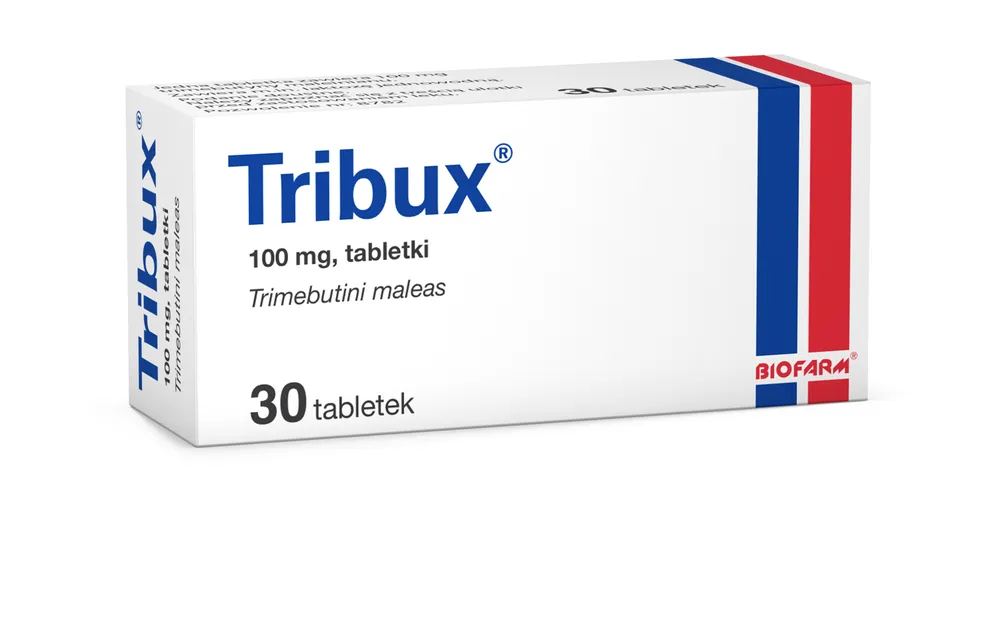
Table of Contents
Package leaflet: Information for the user
Tribux
100 mg, tablets
Trimebutini maleas
Please read the entire leaflet carefully before using the medicine, because
it contains important information for the patient.
- Keep this leaflet, so that you can read it again if necessary.
- If you have any doubts, please consult your doctor or pharmacist.
- This medicine has been prescribed for a specific individual. Do not pass it on to others. The medicine may harm another person, even if their symptoms appear identical.
- If any adverse reactions occur in the patient, including any adverse reactions not listed in this leaflet, inform your doctor or pharmacist. See section 4.
Table of contents:
- What Tribux is and what it is used for
- Important information before taking Tribux
- How to take Tribux
- Possible side effects
- How to store Tribux
- Contents of the pack and other information
1. What Tribux is and what it is used for
Tribux contains 100 mg of trimebutine per tablet. Trimebutine acts on the smooth muscles of the gastrointestinal tract, regulating gastrointestinal motility. It does not affect the central nervous system.
Indications
Tribux is used in the treatment of:
- Gastrointestinal motility disorders, known as irritable bowel syndrome,
- Functional gastrointestinal disorders: diarrhoea, constipation, abdominal pain, intestinal spasms.
2. Important information before using Tribux
When not to use Tribux
- if the patient is allergic to trimebutine or any of the other ingredients of this medicine (listed in section 6),
- if the patient is pregnant.
Warnings and precautions
Before starting to use Tribux, discuss this with your doctor or pharmacist.
Children and adolescents
Use of Tribux is not recommended in children under 12 years of age, as the available formulation (tablets) does not allow for appropriate dose adjustment.
Tribux and other medicines
Inform your doctor or pharmacist about all medicines the patient is currently taking or has recently taken, as well as any medicines the patient plans to take.
In particular, inform the doctor if the patient is taking any of the following medicines:
- zotepine (an antipsychotic medicine),
- d-tubocurarine (a muscle relaxant used in general anaesthesia),
- cisapride (a medicine used for gastrointestinal disorders),
- procainamide (a medicine used for heart rhythm disorders),
- calcium channel blockers (medicines used for hypertension and heart diseases),
- captopril (a medicine used for hypertension),
- reserpine (a medicine used for hypertension),
- midazolam (a medicine used for sleep disorders).
Tribux with food and drink
Take the medicine before meals, with a glass of boiled water.
Pregnancy and breastfeeding
If the patient is pregnant or breastfeeding, suspects she may be pregnant, or is planning to have a child, she should consult her doctor or pharmacist before using this medicine.
Pregnancy
There is insufficient data on the use of trimebutine during pregnancy; therefore, Tribux is not recommended during the first trimester of pregnancy. The medicine may be used during the second and third trimesters only if clearly necessary.
Breastfeeding
Tribux may be used by breastfeeding women only if clearly necessary.
Driving and operating machinery
Tribux, when used according to the recommended dosage, does not affect the ability to drive or operate machinery and does not impair psycho-physical performance.
Tribux contains monohydrate lactose. If the patient has previously been diagnosed with an intolerance to certain sugars, the patient should consult a doctor before taking this medicine.
3. How to use Tribux
Tribux should always be used as directed by the physician. In case of doubt, consult a doctor or pharmacist.
Dosage
Adults
1 tablet 3 times daily before meals.
In exceptional cases, the physician may increase the dose up to 6 tablets daily, given in divided doses.
Use in children and adolescents
Children above 12 years of age
Tribux may be used in children at a dose not exceeding 6 mg/kg body weight per day.
Children under 12 years of age
Use of Tribux is not recommended in this age group (see section "Important information before using Tribux").
Method of administration
Tablets should be swallowed whole with a glass of boiled water.
Overdose of Tribux
In case of overdose, seek immediate medical advice from a doctor or pharmacist, or go to the nearest hospital.
Missed dose of Tribux
Do not take a double dose to make up for a missed dose.
If a dose is missed, take the next dose at the scheduled time.
Discontinuation of Tribux
If you have any further doubts regarding the use of this medicine, consult your doctor or pharmacist.
4. Possible adverse reactions
Like all medicines, Tribux may cause adverse reactions, although not everyone will experience them.
The following adverse reactions may occur during treatment with Tribux:
Common (in 1 to 10 out of 100 people):
- drowsiness, somnolence,
- feeling of fatigue,
- dizziness,
- sensation of warmth or cold,
- headache,
- apathy,
- dryness in the mouth,
- taste disturbances,
- diarrhoea,
- indigestion,
- epigastric pain,
- oral numbness,
- nausea,
- vomiting,
- constipation,
- sensation of thirst.
Uncommon (in 1 to 10 out of 1,000 people):
- rash.
Rare (in 1 to 10 out of 10,000 people):
- irregular heartbeat,
- liver function disorders, including increased blood activity of liver enzymes AlAT and AspAT.
Very rare (less than 1 in 10,000 people, including single cases):
- anxiety,
- hearing impairment,
- hepatitis,
- skin reactions (itching, urticaria, erythema, blisters, nodules, exudation, flush),
- urinary retention,
- menstrual disorders,
- painful breast enlargement in women,
- breast enlargement in men (gynaecomastia),
- breast pain.
Reporting of adverse reactions
If any adverse reactions occur, including any adverse reactions not listed in this leaflet, inform your doctor or pharmacist. Adverse reactions can be reported directly to the Department of Monitoring Adverse Drug Reactions at the Office for Registration of Medicinal Products, Medical Devices and Biocidal Products
Al. Jerozolimskie 181C
02-222 Warsaw
Phone: +48 22 49 21 301
Fax: +48 22 49 21 309
Website: https://smz.ezdrowie.gov.pl
Adverse reactions can also be reported to the marketing authorization holder.
Reporting adverse reactions helps to provide more information on the safety of the medicine.
5. How to store Tribux
Keep out of the sight and reach of children.
Store below 25°C.
Store in the original packaging to protect from moisture.
Do not use after the expiry date stated on the carton and blister. The expiry date refers to the last day of the specified month.
Medicines should not be disposed of via wastewater or household waste. Ask your pharmacist how to dispose of medicines no longer required. This will help protect the environment.
6. Contents of the package and other information
What Tribux contains
- The active substance is 100 mg trimethobutine maleate.
- The other ingredients are: lactose monohydrate, microcrystalline cellulose, povidone K30, crospovidone (type A), magnesium stearate.
What Tribux looks like and contents of the pack
Round, biconvex, smooth tablets, white to cream in colour, without spots or crumbling, with a diameter of 8.0 mm ± 0.2 mm.
The tablets are packed in PVC/PVDC/Aluminium foil blisters placed in a cardboard box.
Pack sizes contain 20, 30, 60, 90, 100 or 120 tablets.
Not all pack sizes may be marketed.
Marketing Authorisation Holder and Manufacturer:
Biofarm Sp. z o.o.
ul. Wałbrzyska 13
60-198 Poznań