Traumon
Poland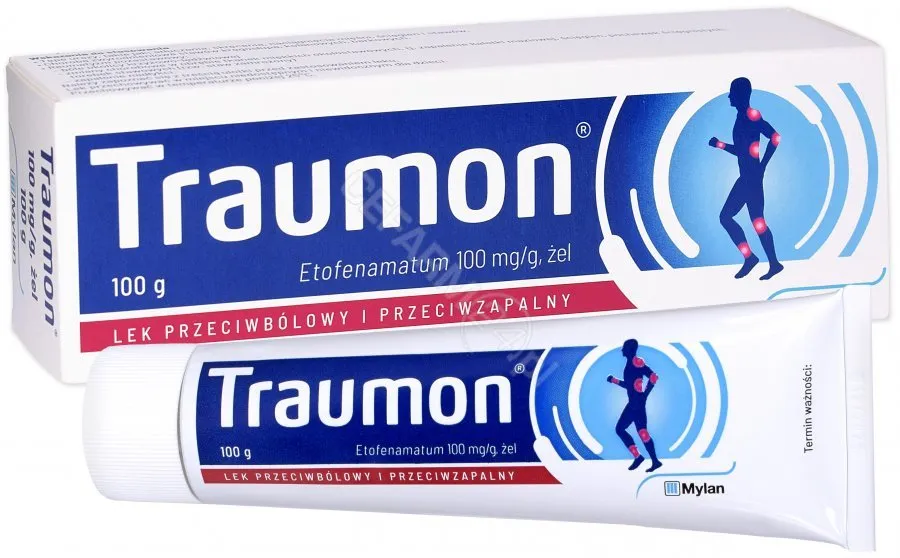
Table of Contents
Patient Information Leaflet
TRAUMON, 100 mg/g, gel
Etofenamate
Please read the entire leaflet carefully before using this medicine, as it contains
important information for the patient.
This medicine should always be used exactly as described in the patient leaflet or as directed
by the physician or pharmacist.
- Keep this leaflet for future reference.
- If advice or further information is needed, please consult your pharmacist.
- If the patient experiences any adverse reactions, including any possible adverse reactions not listed in this leaflet, inform a doctor or pharmacist. See section 4.
- If there is no improvement or if the patient feels worse, consult a doctor.
Table of Contents
- What is Traumon and what is it used for
- Important information before using Traumon
- How to use Traumon
- Possible side effects
- How to store Traumon
- Contents of the pack and other information
1. What is Traumon and what is it used for
Etofenamate – the active substance in Traumon – has anti-inflammatory and analgesic properties. Etofenamate belongs to the group of non-steroidal anti-inflammatory drugs (NSAIDs). When applied locally, it penetrates through the skin and accumulates in inflamed tissues.
Topical application reduces the risk of adverse effects typical of orally administered NSAIDs.
Traumon does not leave an oily residue on the skin.
Indications:
- Blunt injuries such as bruises, sprains, strains of muscles, tendons and joints
- Degenerative joint disease of the spine, knees, shoulders
- Extra-articular rheumatism:
- Lumbosacral pain
- Pathological changes in periarticular soft tissues, i.e. bursitis, tendinitis, tenosynovitis, synovitis (so-called frozen shoulder)
- Epicondylitis
2. Important information before using Traumon
When not to use Traumon
- if the patient is allergic (hypersensitive) to etofenamate, flufenamic acid, other non-steroidal anti-inflammatory drugs, or any of the other ingredients of this medicine (listed in section 6),
- during the third trimester of pregnancy,
- in children and adolescents.
Warnings and precautions
- Do not apply Traumon to damaged skin or inflammatory skin eruptions, and avoid contact with mucous membranes or eyes. Therefore, hands should be washed after application or contact with these body areas should be avoided.
- During treatment and for two weeks after treatment, treated areas should not be exposed to sunlight or solarium.
- Patients suffering from asthma, chronic obstructive pulmonary disease, hay fever, chronic nasal mucosa swelling (so-called nasal polyps), or chronic respiratory tract infections—especially when associated with hay fever-like symptoms—may use Traumon only under strict medical supervision and with appropriate precautions.
- Systemic absorption may increase if the medicine is used for prolonged periods and/or over large areas of the body. Therefore, such use should be avoided.
- Children should not come into contact with skin areas treated with this medicine.
Traumon gel and other medicines
Inform your doctor or pharmacist about all medicines currently used, recently used, or planned for use.
No interactions have been reported when Traumon is used as directed.
Pregnancy and breastfeeding
If the patient is pregnant or breastfeeding, suspects she may be pregnant, or is planning to become pregnant, she should consult a doctor before using this medicine.
Traumon should be used during the first and second trimesters of pregnancy only after a physician has evaluated the benefit-risk ratio. The recommended daily dose must not be exceeded.
Traumon must not be used in women during the third trimester of pregnancy.
Since etofenamate passes into breast milk in small amounts, breastfeeding mothers should avoid prolonged use of Traumon and must not exceed the recommended daily dose.
Do not apply the medicine to the breast area.
Driving and operating machinery
No studies have been conducted on the influence of this medicine on the ability to drive mechanical vehicles or operate machinery.
Traumon gel contains propylene glycol
This medicine contains 51–99 mg of propylene glycol (E 1520) in a gel strip 5 to 10 cm long, equivalent to 30 mg of propylene glycol per 1 g of gel.
Propylene glycol may cause skin irritation.
Due to the presence of propylene glycol, this medicine should not be applied to open wounds or large areas of injured or damaged skin (e.g., burns) without consulting a doctor or pharmacist.
3. How to use Traumon
This medicine should always be used exactly as described in this patient leaflet, or as directed by a physician or pharmacist. If in doubt, consult a physician or pharmacist.
Unless otherwise advised by a physician, apply a strip of Traumon gel 5 to 10 cm long to the skin over the painful area, covering a slightly larger surface than the painful region, and rub in until completely absorbed. Repeat 3 to 4 times daily.
Treatment of rheumatic conditions usually lasts 3 to 4 weeks, while treatment of blunt injuries (e.g. sports injuries) should last up to 2 weeks.
If you feel the effect of the medicine is too strong or too weak, consult your physician.
Use of a higher than recommended dose of Traumon
There are no known cases of overdose with Traumon when used as recommended.
However, if the entire contents of a tube of Traumon are applied and the whole body is covered within a short time, symptoms such as headache, dizziness, and epigastric discomfort may occur. In such a case, wash the medicine off the skin with water.
If the medicine is accidentally ingested by a patient or child, seek medical advice immediately.
Missed dose of Traumon
Do not use a double dose to make up for a missed dose.
If you have any further doubts concerning the use of this medicine, consult your physician or pharmacist.
4. Possible adverse reactions
Like all medicines, this medicine can cause adverse reactions, although not everybody will experience them.
Skin and subcutaneous tissue disorders
Uncommon adverse reactions (may occur in fewer than 1 in 100 people but more than 1 in 1000 people):
- erythema, burning sensation of the skin.
Very rare adverse reactions (may occur in fewer than 1 in 10,000 people):
- dermatitis, e.g. severe itching, rash, swelling, blistering rash.
Frequency not known (frequency cannot be estimated from the available data):
- photosensitivity reaction.
The adverse reactions listed above usually resolve after discontinuation of the medicine.
Immune system disorders:
Frequency not known (frequency cannot be estimated from the available data):
- hypersensitivity (non-specific allergic reaction and anaphylaxis, increased respiratory reactivity leading to asthma, worsening of asthma, bronchospasm or dyspnoea, various skin disorders including rash, pruritus, urticaria, angioedema, less frequently exfoliative and bullous skin lesions (including epidermal necrolysis and erythema multiforme)).
If any of these symptoms occur, which may happen even after the first dose of the medicine, the patient should immediately seek medical assistance.
Reporting of adverse reactions
If any adverse symptoms occur, including any adverse effects not listed in this leaflet, inform a doctor or pharmacist. Adverse reactions can be reported directly to the Department of Monitoring Adverse Drug Reactions of the Office for Registration of Medicinal Products, Medical Devices and Biocidal Products, Al. Jerozolimskie 181C, 02-222 Warsaw, tel.: +48 22 49 21 301, fax: +48 22 49 21 309, website: https://smz.ezdrowie.gov.pl
Adverse reactions can also be reported to the marketing authorization holder.
Reporting adverse reactions enables further collection of information on the safety of the medicine.
5. How to store Traumon
Keep out of the reach and sight of children.
Store below 25°C.
Do not use Traumon after the expiry date stated on the cardboard package.
The expiry date refers to the last day of the specified month.
Medicines should not be disposed of via wastewater or household waste. Ask your pharmacist
how to dispose of medicines no longer required. This will help protect the environment.
6. Contents of the pack and other information
What Traumon medicine contains
- The active substance is etofenamate (Etofenamatum).
- The other ingredients are: carbomer, oleoyl macrogol ether (Emulgin M8 Deo), sodium hydroxide, isopropyl alcohol, macrogol 400, propylene glycol, purified water. The medicine contains 30 mg of propylene glycol (E 1520) in 1 g of gel. See also "Traumon gel contains propylene glycol" in section 2.
What Traumon looks like and contents of the pack
The pack contains an aluminium tube with a membrane and a PE cap in a cardboard box.
Pack sizes: 20 g, 50 g, 100 g or 150 g.
Marketing Authorisation Holder:
Cooper Consumer Health B.V.
Verrijn Stuartweg 60
1112AX Diemen
The Netherlands
Manufacturer:
Madaus GmbH
51101 Köln
Germany
[logo of the marketing authorisation holder]