Tranxene 20
Poland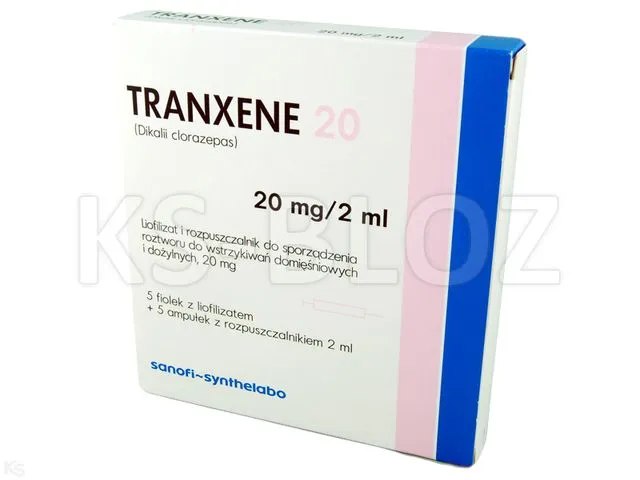
Table of Contents
Package leaflet: Information for the patient
TRANXENE 20, 20 mg, powder and solvent for solution for injection
Diclazepam potassium
Please read all of this leaflet carefully before using this medicine, because it contains
important information for the patient.
- Keep this leaflet so that you can read it again if necessary.
- If you have any questions, please consult your doctor or pharmacist.
- This medicine has been prescribed for a specific individual. Do not pass it on to others. This medicine may harm someone else, even if their symptoms are the same.
- If you experience any adverse reactions, including any adverse reactions not listed in this leaflet, inform your doctor or pharmacist. See section 4.
Table of contents of the leaflet:
- What Tranxene 20 is and what it is used for
- Important information before using Tranxene 20
- How to use Tranxene 20
- Possible side effects
- How to store Tranxene 20
- Contents of the pack and other information
1. What Tranxene 20 is and what it is used for
Tranxene 20 is available as a powder together with a solvent for preparing a solution for intramuscular and intravenous injection.
Tranxene 20 contains the active substance clorazepate. Clorazepate belongs to a group of medicines called benzodiazepines. It has anxiolytic, muscle relaxant, sedative, hypnotic, and anticonvulsant properties.
Tranxene 20 is indicated for:
- Treatment of anxiety attacks and anxiety disorders,
- Treatment of episodes of psychomotor agitation and aggression,
- Prevention and (or) treatment of delirium tremens and other symptoms of alcohol withdrawal syndrome.
This medicine is also used as an adjunctive treatment in tetanus.
2. Important information before using Tranxene 20
When not to use Tranxene 20
- if the patient is allergic to the active substance or any of the other ingredients of this medicine (listed in section 6)
- if the patient has severe respiratory insufficiency
- if the patient suffers from sleep apnoea syndrome
- if the patient has severe, acute or chronic liver dysfunction (risk of encephalopathy)
- if the patient suffers from myasthenia (a disease characterized by rapid fatigue and muscle weakness)
- use of Tranxene 20 in children is contraindicated
Warnings and precautions
Special caution is required when using Tranxene 20.
The effectiveness of benzodiazepines may change during long-term treatment due to the possible development of tolerance.
As with other benzodiazepines, prolonged use may lead to physical and psychological dependence on this medicine.
Certain factors such as duration of treatment, dose used, history of dependence on other drugs or alcohol may increase the risk of dependence.
Dependence may also occur after discontinuation of the drug. The following symptoms may then commonly occur: insomnia, headache, increased anxiety, muscle pain, muscle tension, irritability. Other symptoms occur less frequently: agitation, or even episodes of confusion, increased sensitivity to stimuli (noise, light), depersonalization, loss of sense of reality, hallucinations, seizures.
Withdrawal symptoms may appear several days after stopping treatment.
The use of multiple benzodiazepines, regardless of indication (for anxiety relief or sedative effect), may increase the risk of developing drug dependence.
A temporary worsening of anxiety disorders, which were the indication for benzodiazepine treatment, may occur (so-called rebound phenomenon).
Memory disturbances may occur within a few hours after taking a dose of the medicine. This may happen when a benzodiazepine-containing medicine is taken before going to bed and sleep is interrupted too early. To minimize the risk of memory disturbances, it is recommended to ensure conditions for continuous, uninterrupted sleep of 7–8 hours.
In some individuals, benzodiazepines and similar medicines may cause paradoxical reactions such as:
- worsening of insomnia, nightmares;
- agitation, nervousness, irritability, anger attacks, emergence of aggressive behavior;
- hallucinations, dream-like state, psychotic symptoms, abnormal behavior, and other behavioral disturbances.
Concomitant use of benzodiazepines, including chlordiazepoxide, and opioids may cause sedation, respiratory depression, coma, and death. Due to these risks, a doctor will prescribe opioids and benzodiazepines together only to patients for whom other treatment options are insufficient.
If a decision is made to use chlordiazepoxide together with opioids, both medicines will be prescribed at the lowest effective dose and for the shortest possible duration of concomitant use.
Some studies have shown an increased risk of suicidal thoughts, suicide attempts, and suicides in patients taking certain sedative and hypnotic medicines, including this one. However, it has not been established whether this is caused by taking this medicine or whether there are other contributing factors. If the patient has suicidal thoughts, they should contact their doctor as soon as possible to obtain further medical advice.
Benzodiazepines and similar substances should not be used as the sole treatment for depression or anxiety associated with depression, as they may increase the risk of suicide.
The medicine should be used with great caution in patients with alcoholism or other addictions.
In elderly patients, or in patients with renal or hepatic impairment, dosage reduction is recommended, for example by half.
In patients with respiratory insufficiency, the use of benzodiazepines may cause breathing problems.
Elderly patients are more susceptible to adverse effects such as drowsiness, dizziness, muscle weakness, which may lead to falls and consequently to serious injuries. Dose reduction is recommended.
Tranxene 20 with food, drink, and alcohol
This medicine is for intravenous and intramuscular use.
During treatment with Tranxene 20, consumption of alcohol and use of medicines containing alcohol should be avoided.
Alcohol enhances the sedative effect of benzodiazepines, which may affect the ability to drive or operate machinery.
Pregnancy, breastfeeding, and fertility
Data on the use of chlordiazepoxide in pregnant women are limited. Therefore, the use of this medicine during pregnancy and in women of childbearing potential not using contraception is not recommended.
If the patient is pregnant, suspects she may be pregnant, or is planning to become pregnant, she should consult her doctor to reassess the need for treatment.
If the patient takes chlordiazepoxide in high doses during the last three months of pregnancy or during delivery, the newborn may experience drowsiness (sedation), breathing problems (respiratory depression), muscle weakness (hypotonia), low body temperature (hypothermia), and feeding difficulties (poor sucking leading to poor weight gain).
If the patient regularly takes chlordiazepoxide towards the end of pregnancy, the newborn may develop withdrawal syndrome. In such cases, the newborn should be closely monitored during the postnatal period.
Tranxene 20 should not be used during breastfeeding.
Driving and operating machinery
Patients should not drive or operate machinery while taking this medicine. Tranxene 20 may cause drowsiness, dizziness, and reduced concentration, which may impair the ability to drive or operate machinery during treatment. Concomitant use of other medicines may enhance the sedative effect of chlordiazepoxide potassium (see section Tranxene 20 and other medicines).
Tranxene 20 and other medicines
Inform your doctor about all medicines currently or recently taken, as well as any medicines planned for future use.
The risk of withdrawal symptoms increases when other anxiolytic and hypnotic benzodiazepines are used concomitantly.
During treatment, consumption of alcohol and medicines containing alcohol should be avoided. Alcohol enhances the sedative effect of benzodiazepines.
Caution is advised when using Tranxene 20 concomitantly with:
- medicines with central nervous system depressant effects, such as: opioids, morphine derivatives including buprenorphine (analgesics, antitussives, and medicines used in other therapies), neuroleptics, barbiturates, non-benzodiazepine sedatives, certain antidepressants, sedating antihistamines (antiallergic medicines), clonidine, and medicines with similar effects;
- cisapride (a prokinetic agent) due to the potential for increased sedative effect of benzodiazepines;
- clozapine (a neuroleptic) due to increased risk of collapse with respiratory and/or cardiac arrest;
- curare and its derivatives (muscle relaxants reducing skeletal muscle tone) due to additive effects.
Concomitant use of benzodiazepines and opioids increases the risk of sedation, respiratory depression, coma, and death due to enhanced central nervous system depression.
Concomitant use of benzodiazepines and sodium oxybate should be avoided due to increased risk of respiratory depression.
3. How to use Tranxene 20
This medicine should always be taken exactly as prescribed by your doctor. If in doubt, consult your doctor.
Recommended dosage:
- In acute anxiety attacks, psychomotor agitation, or aggression: a daily dose of 20 to 200 mg administered intramuscularly or intravenously, followed, if necessary, by continuation of treatment in oral form.
- In alcohol withdrawal syndrome: 50 to 100 mg daily, administered intramuscularly or intravenously. If continued injections are required, after 2–3 days the doctor will reduce the dose by half; any further treatment may be continued in oral form.
- In tetanus: in cases not requiring tracheotomy – 120 to 500 mg daily administered as intravenous infusions; in severe tetanus with assisted respiration – 500 to 2000 mg daily as intravenous infusion.
In elderly patients and in patients with impaired kidney or liver function, the dose should be reduced. Sometimes a dose half the average may be sufficient.
Use in children and adolescents
The use of Tranxene 20 in children is contraindicated.
Method of administration
This medicine can be administered intramuscularly or by slow intravenous injection or slow intravenous infusion.
Due to the risk of apnea with rapid intravenous injection, the medicine should be administered by slow intravenous injection into a large vein (see section 4. Possible side effects).
When administered intramuscularly, the medicine should be injected deeply into the muscle.
The facility where the medicine is administered should be equipped with equipment for intensive respiratory therapy.
Avoid mixing medicines in the same syringe.
Use only the solvent provided in the medicine package.
Duration of treatment
Treatment should be as short as possible. When switching from injectable to oral form, the continued need for treatment should be regularly reviewed.
If you feel that the effect of Tranxene 20 is too strong or too weak, consult your doctor.
Use of a higher than recommended dose of Tranxene 20
Symptoms of overdose are primarily deep sleep, which may progress to coma depending on the dose administered. In mild cases, symptoms such as confusion and lethargy may occur. In more severe cases, incontinence, decreased muscle tone, hypotension, and respiratory depression may occur. In rare cases, death may occur.
The prognosis is favorable if the patient has not simultaneously ingested other psychotropic drugs and has received appropriate treatment.
Flumazenil may be useful in the diagnosis and/or treatment of intentional or accidental benzodiazepine overdose.
If a higher than recommended dose of the medicine has been taken, seek immediate medical advice from a doctor or pharmacist.
Missed dose of Tranxene 20
If you miss a dose, take it as soon as possible, except when the time for the next dose is approaching. Do not take a double dose to make up for a missed dose. If in doubt, consult your doctor.
4. Possible adverse effects
Like any medicine, Tranxene 20 may cause adverse effects, although not everyone experiences them.
The frequency and severity of adverse effects depend on the individual patient's sensitivity and the dose administered.
The following adverse effects may occur:
Very common (may occur in more than 1 in 10 patients):
- drowsiness (especially in elderly patients)
Common (may occur in up to 1 in 10 patients):
- dizziness
- weakness
Uncommon (may occur in up to 1 in 100 patients):
- hypersensitivity reactions
- irritability, restlessness, confusion
- reduced muscle tone
- maculopapular and itchy skin rashes
Frequency not known (frequency cannot be estimated from available data):
- slowing of mental processes
- paradoxical reactions (especially in children and elderly patients)
- aggression, hallucinations
- so-called rebound syndrome with increased anxiety compared to the anxiety that was the indication for treatment
- physical dependence in case of long-term treatment (especially with high doses), and withdrawal symptoms after discontinuation of the drug*
- cognitive disturbances such as memory impairment (anterograde amnesia*), attention disorders, and speech disturbances
- falls*
*see section: Warnings and precautions
Additionally, the following adverse effects have been reported during benzodiazepine use in general:
- emotional blunting, reduced vigilance,
- headache,
- impaired coordination of body movements,
- double vision,
- gastrointestinal disturbances,
- libido disorders,
- occurrence of memory loss (amnesia), which may be associated with unusual behaviour,
- psychiatric and paradoxical reactions with anxiety, delusions, anger outbursts, nightmares, psychoses, unusual behaviour, and other behavioural disturbances.
During benzodiazepine use, previously existing undiagnosed depression may emerge.
Psychological dependence may occur. Cases of benzodiazepine abuse have been reported.
Reporting of adverse effects
If any adverse effects occur, including any adverse effects not listed in this leaflet, inform your doctor or pharmacist. Adverse effects can be reported directly to the Department of Monitoring Adverse Drug Reactions of the Office for Registration of Medicinal Products, Medical Devices and Biocidal Products:
Al. Jerozolimskie 181C, 02-222 Warsaw, tel.: +48 22 49-21-301, fax: +48 22 49-21-309,
Website: https://smz.ezdrowie.gov.pl
Adverse effects can also be reported to the marketing authorization holder or its representative in Poland.
Reporting adverse effects helps to provide more information on the safety of the medicine.
5. How to store Tranxene 20
Store below 25°C.
Keep the medicine in a place out of sight and reach of children.
Do not use this medicine after the expiry date stated on the packaging. The expiry date refers to the last day of the stated month.
6. Contents of the package and other information
What Tranxene 20 contains
- The active substance is dipotassium clorazepate. Each vial of powder contains 20 mg of dipotassium clorazepate.
- Excipients:
Powder: mannitol, potassium carbonate;
Solvent: potassium dihydrogen phosphate, potassium hydrogen phosphate, water for injections.
What Tranxene 20 looks like and contents of the pack
Brown glass vials containing powder, with stopper and cap, and ampoules with solvent made of colourless glass, packed in a cardboard box.
Pack contents:
5 vials of powder + 5 ampoules of solvent (2 ml each).
Marketing Authorisation Holder
neuraxpharm Arzneimittel GmbH
Elisabeth-Selbert Str. 23
40764 Langenfeld
Germany
Manufacturer
Sanofi S.r.l.
Via Valcanello 4
03012 Anagni (FR)
Italy
Famar Health Care Services Madrid, S.A.U.
Avda. Leganés, 62
Alcorcón, 28923 Madrid
Spain
Neuraxpharm Pharmaceuticals, S.L.
Avda. Barcelona 69
08970 Sant Joan Despí – Barcelona
Spain
For further information about this medicinal product, please contact the local representative of the Marketing Authorisation Holder:
Neuraxpharm Polska Sp. z o.o.
ul. Poleczki 35
02-822 Warsaw
[email protected]