Tranexamic acid tillomed
Poland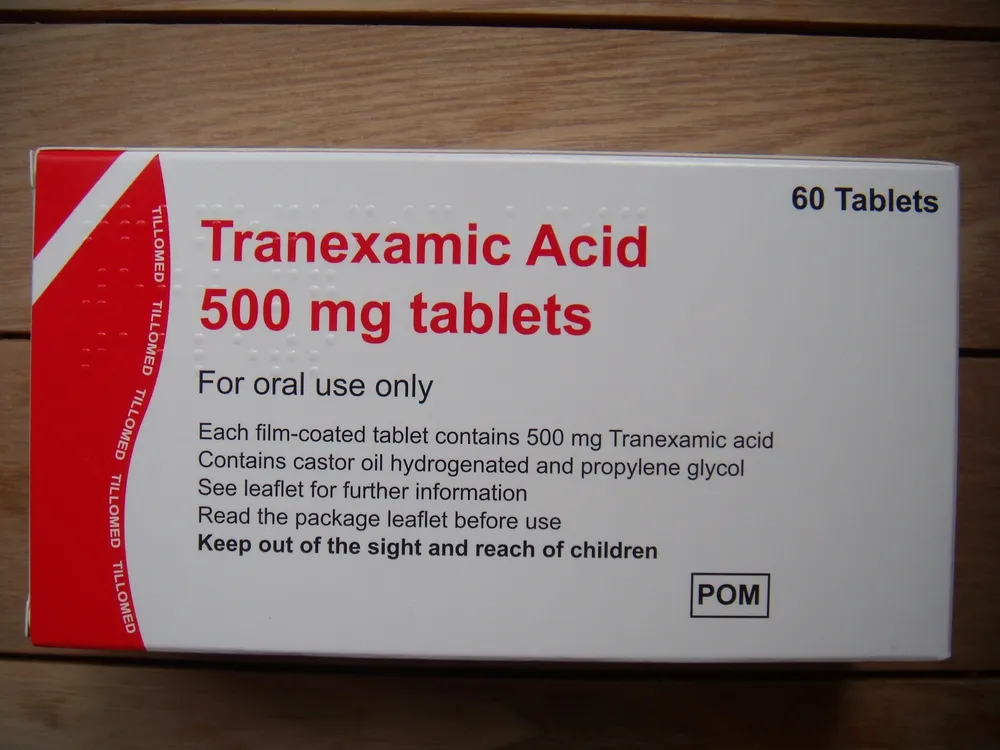
Table of Contents
- Package leaflet: Information for the patient
- 1. What Tranexamic Acid Tillomed is and what it is used for
- 2. Important information before taking Tranexamic Acid Tillomed
- 3. How to take Tranexamic Acid Tillomed
- 4. Possible adverse reactions
- 5. How to store Tranexamic Acid Tillomed
- 6. Contents of the pack and other information
Package leaflet: Information for the patient
Tranexamic Acid Tillomed, 500 mg, coated tablets
Acidum tranexamicum
Please read this leaflet carefully before taking this medicine, as it contains
important information for you.
- Keep this leaflet, as you may need to read it again.
- If you have any further questions, please consult your doctor or pharmacist.
- This medicine has been prescribed for a specific individual. Do not pass it on to others. This medicine may harm someone else, even if their symptoms are the same.
- If you experience any adverse effects, including any not listed in this leaflet, inform your doctor or pharmacist. See section 4.
Leaflet contents
- What Tranexamic Acid Tillomed is and what it is used for
- Important information before taking Tranexamic Acid Tillomed
- How to take Tranexamic Acid Tillomed
- Possible side effects
- How to store Tranexamic Acid Tillomed
- Contents of the pack and other information
1. What Tranexamic Acid Tillomed is and what it is used for
Tranexamic acid belongs to a group of medicines called antifibrinolytic agents. These are used to stop or reduce unwanted bleeding. During bleeding, the body forms blood clots to stop the bleeding. In some people, these clots break down, leading to excessive bleeding. Tranexamic acid inhibits the breakdown of clots and thus helps reduce unwanted bleeding.
Tranexamic Acid Tillomed is used for the prevention or reduction of short-term bleeding in various medical conditions. This medicine may have been prescribed for one of the following reasons:
- After prostate surgery (after prostatectomy);
- After bladder surgery;
- Heavy menstrual bleeding (menorrhagia);
- Severe nosebleeds;
- Cervical conization (surgical removal of a piece of tissue from the cervix);
- Bleeding inside the eye (prophylaxis of recurrent haemorrhage following traumatic hyphema);
- Tooth extraction in patients with haemophilia (people who are more prone to bleeding). You will be informed by your doctor if this applies to you;
- Hereditary angioedema (HANO). Your doctor will inform you if you have this condition.
2. Important information before taking Tranexamic Acid Tillomed
When not to take Tranexamic Acid Tillomed
- if the patient is allergic to tranexamic acid or to any of the other ingredients of this medicine (listed in section 6),
- if the patient has severe kidney disease (risk of drug accumulation in the body),
- if the patient has ever had a blood clot in blood vessels (a condition called thrombosis),
- if the patient has a history of seizures,
- if the patient is at risk of excessive bleeding due to a blood clotting disorder known as consumption coagulopathy.
If any of the above situations apply, the patient should talk to a doctor or pharmacist.
Warnings and precautions
Before starting Tranexamic Acid Tillomed, discuss with a doctor or pharmacist:
- if the patient has experienced seizures;
- if the patient has visual disturbances or blurred vision. Regular eye examinations may be necessary, especially in patients with retinal disorders;
- if the patient has blood in the urine, which may lead to urinary tract obstruction;
- if the patient is at risk of developing blood clots. The risk of thrombotic events may be increased in women taking oral contraceptives;
- if the patient has hereditary angioedema, a genetic disorder causing swelling of deeper layers of the skin due to fluid accumulation;
- if the patient has disseminated intravascular coagulation (DIC), a condition in which blood clots form throughout the body;
- if the patient has irregular menstruation;
- if the patient has kidney disease.
Children and adolescents
There is lack of clinical experience with the use of tranexamic acid in children under 15 years of age with heavy menstrual bleeding.
Tranexamic Acid Tillomed and other medicines
Tell your doctor or pharmacist if the patient is taking, has recently taken or might take any other medicines (including those available without a prescription). In particular, inform about the use of:
- Other medicines that help dissolve blood clots, known as fibrinolytic agents.
- Medicines that prevent blood clotting, known as thrombolytic agents.
- Oral contraceptives. These may increase the risk of developing blood clots.
Pregnancy, breastfeeding and fertility
If the patient is pregnant, breastfeeding, thinks she might be pregnant or is planning to have a baby, she should consult a doctor or pharmacist before using this medicine.
Pregnancy
There are insufficient clinical data on the use of tranexamic acid in pregnant women. As a precautionary measure, the use of tranexamic acid is not recommended during the first trimester of pregnancy. Tranexamic acid may be used throughout pregnancy only if the expected benefit outweighs the potential risk.
Breastfeeding
Tranexamic acid passes into human milk. Due to the lack of experience with treatment lasting several days in breastfeeding women and their infants, the doctor should prescribe Tranexamic Acid Tillomed 500 mg coated tablets only after careful assessment of benefit versus risk.
Tranexamic Acid Tillomed coated tablets contain sodium
The medicine contains less than 1 mmol (23 mg) of sodium per coated tablet, i.e. the medicine is considered "sodium-free".
3. How to take Tranexamic Acid Tillomed
This medicine should always be taken as directed by a doctor or pharmacist.
If in doubt, consult a doctor or pharmacist.
Important:
The correct dose will be determined by the doctor. The dose will be clearly indicated on the medicine packaging.
Otherwise, consult a doctor or pharmacist.
Note: This medicine should always be taken with a glass of water. Tablets should be swallowed whole.
Do not crush or chew the tablets.
Use in adults and elderly patients
- The usual recommended dose is 2 or 3 tablets two to three times daily.
- The appropriate dose will depend on the reason for which this medicine was prescribed.
- Always follow the doctor's instructions regarding the number of tablets, the time of day to take them, and the duration of treatment.
Use in children and adolescents
The doctor will inform you about the appropriate dose for a child. The dose will be determined based on the child's body weight.
Patients with kidney function disorders
The treating doctor will advise on the appropriate dose. The dose may be lower than that normally taken by adults.
Accidental overdose of Tranexamic Acid Tillomed
If an excessive dose is taken, contact a doctor immediately or go to the nearest hospital emergency department.
Taking too high a dose of Tranexamic Acid Tillomed may cause nausea, vomiting, diarrhoea, headache or dizziness, a feeling of faintness upon standing, and/or low blood pressure, muscle weakness, or may trigger seizures (seizures are more likely with higher doses of tranexamic acid). In some patients, there is a risk of developing blood clots.
Treatment of overdose:
There is no specific antidote. Consider treatment with anticoagulant medicines. In cases of ingestion of large doses of tranexamic acid in tablet form, the following measures may be helpful: inducing vomiting, gastric lavage, or treatment with activated charcoal.
Missed dose of Tranexamic Acid Tillomed
Do not take a double dose to make up for a missed dose. Take the next dose according to the prescribed schedule.
If you have any further doubts about using this medicine, consult your doctor or pharmacist.
4. Possible adverse reactions
Like all medicines, this medicine can cause adverse reactions, although not everyone will experience them.
You should contact your doctor immediately if any of the following symptoms occur:
- if the patient experiences an allergic reaction, such as sudden, severe allergic reactions causing breathing difficulties or dizziness (anaphylaxis).
Common adverse reactions (may occur in less than 1 in 10 people)
- headache
- dizziness
- nausea or vomiting. These are usually mild and pass very quickly, but if they persist, inform your doctor or pharmacist
- diarrhoea. This is usually mild and passes very quickly, but if it persists, inform your doctor or pharmacist.
Uncommon adverse reactions (may occur in less than 1 in 100 people)
- itching, redness or swelling of the skin (skin allergic reactions).
Rare adverse reactions (may occur in less than 1 in 1,000 people)
- visual disturbances, especially related to colour vision
- blood clot in blood vessels (a condition called thrombosis).
Very rare adverse reactions (may occur in less than 1 in 10,000 people)
- arterial or venous thrombosis
- decreased number of platelets (thrombocytopenia), prolonged bleeding time
- general malaise with low blood pressure, with or without loss of consciousness.
Frequency not known (frequency cannot be estimated from available data)
- seizures, especially in case of incorrect use of the medicine.
Reporting of adverse reactions
If any adverse symptoms occur, including any adverse effects not listed in this leaflet, inform your doctor or pharmacist. Adverse reactions can be reported directly to the Department of Monitoring Adverse Drug Reactions of the Office for Registration of Medicinal Products, Medical Devices and Biocidal Products, Al. Jerozolimskie 181C, 02-222 Warsaw, phone: +48 22 4921301, fax: +48 22 4921309, website: https://smz.ezdrowie.gov.pl .
Adverse reactions can also be reported to the marketing authorization holder.
By reporting adverse reactions, additional information on the safety of the medicine can be collected.
5. How to store Tranexamic Acid Tillomed
Keep this medicine out of sight and reach of children.
Do not use this medicine after the expiry date stated on the packaging. The expiry date refers to the last day of the stated month.
There are no special storage instructions for this medicinal product.
After first opening the HDPE bottle, the medicine should be used within 25 days.
Medicines must not be disposed of via wastewater or household waste. Ask your pharmacist how to dispose of medicines no longer in use. This will help protect the environment.
6. Contents of the pack and other information
What Tranexamic Acid Tillomed contains
The active substance is tranexamic acid. One tablet contains 500 mg of tranexamic acid.
The other ingredients are: microcrystalline cellulose PH 102, pregelatinized corn starch, low-substituted hydroxypropylcellulose (LH11), colloidal anhydrous silica, povidone (PVP K-30), talc, hydrogenated castor oil, magnesium stearate.
Coating Opadry White OY-IN-58910: hypromellose 6 mPas, hypromellose 15 mPas, titanium dioxide (E 171), macrogol, propylene glycol, sodium lauryl sulfate.
What Tranexamic Acid Tillomed looks like and contents of the pack
Tranexamic Acid Tillomed 500 mg film-coated tablets are white to slightly yellowish, oval, film-coated tablets, smooth on both sides.
Tranexamic Acid Tillomed 500 mg film-coated tablets are supplied in:
Blisters (OPA/Aluminium/PVC/Aluminium) containing 10, 20, 30, 50, 60 and 100 tablets, packed in a cardboard box.
HDPE (high-density polyethylene) bottles containing 100 tablets, packed in a cardboard box.
Not all pack sizes may be marketed.
Marketing Authorisation Holder and Manufacturer
Marketing Authorisation Holder
Laboratorios Tillomed Spain S.L.U.
Calle Marcelo Spinola 8, planta 1,
Puerta F, 28016, Madrid,
Spain
Tel: +48 509 368 531
E-mail: [email protected]
Manufacturer/Importer
Tillomed Malta Limited,
Malta Life Sciences Park,
LS2.01.06 Industrial Estate,
San Gwann, SGN 3000, Malta
SGS Pharma Magyarorszag Kft.
Derkovits Gyula Utca 53,
Budapest XIX, 1193,
Hungary
This medicinal product is authorised in the European Economic Area under the following names:
Austria Tranexamsäure Tillomed 500 mg Filmtabletten
Germany Tranexamsäure Tillomed 500 mg Filmtabletten
Spain Acido tranexamico Tillomed 500 mg comprimidos recubiertos con pelicula EFG
Netherlands Tranexaminezuur Tillomed 500 mg filmomhulde tabletten
Poland Tranexamic Acid Tillomed
Northern Ireland Tranexamic Acid 500 mg film-coated tablets
(United Kingdom)