Tranexamic acid eugia
Poland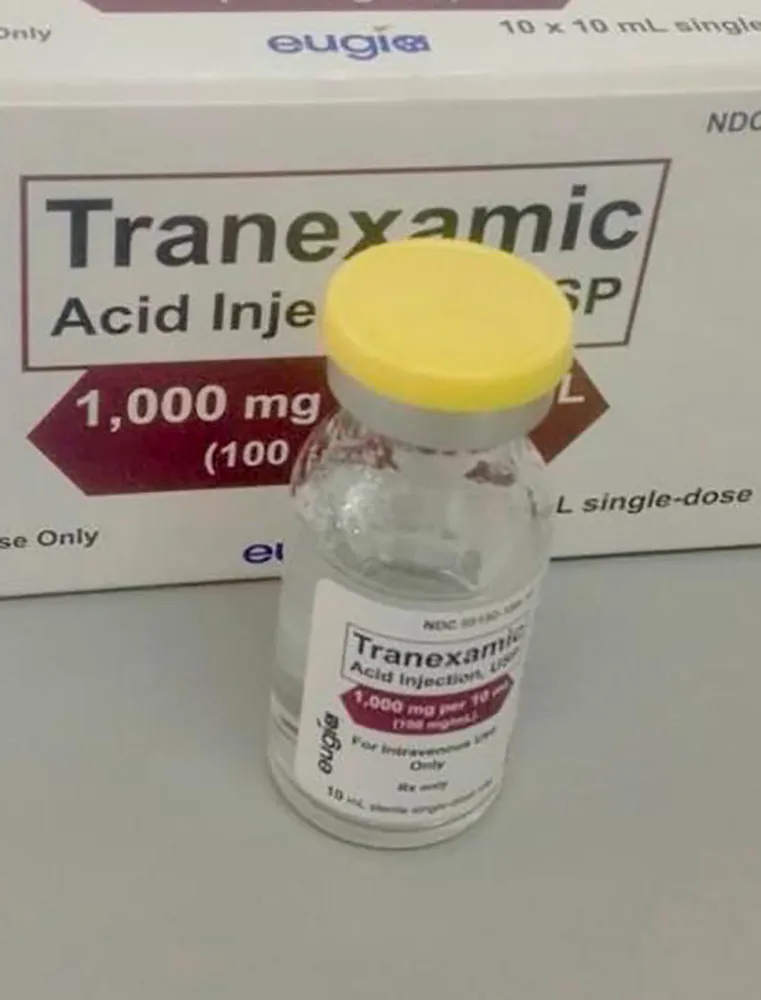
Table of Contents
- Package leaflet: Information for the user
- 1. What Tranexamic Acid Eugia is and what it is used for
- 2. Important information before using Tranexamic Acid Eugia
- 3. How to use Tranexamic Acid Eugia
- 4. Possible adverse reactions
- 5. How to store Tranexamic Acid Eugia
- 6. Package contents and other information
Package leaflet: Information for the user
Tranexamic Acid Eugia, 100 mg/mL, solution for injection
Acidum tranexamicum
Please read all of this leaflet carefully before using this medicine, because it contains
important information for the patient.
Keep this leaflet, as you may need to read it again.
If you have any further questions, please ask your doctor or nurse.
If you experience any adverse reactions, including any not listed in this leaflet, inform your doctor or nurse. See section 4.
Contents of the leaflet
- What Tranexamic Acid Eugia is and what it is used for
- Important information before using Tranexamic Acid Eugia
- How to use Tranexamic Acid Eugia
- Possible side effects
- How to store Tranexamic Acid Eugia
- Contents of the pack and other information
1. What Tranexamic Acid Eugia is and what it is used for
Tranexamic Acid Eugia contains the active substance tranexamic acid, which belongs to a group of medicines known as haemostatic agents, antifibrinolytics, and amino acids.
This medicine is used in adults and children over 1 year of age to prevent and treat bleeding caused by a process that inhibits blood clotting, called fibrinolysis.
Specific indications include:
- Heavy menstrual bleeding in women
- Gastrointestinal bleeding
- Haemorrhagic disorders of the urinary system following prostate surgery or urological surgical procedures
- Surgical procedures involving the ear, nose, and throat
- Cardiac, abdominal, or gynaecological surgical procedures
- Bleeding following the use of other medicines that dissolve blood clots.
2. Important information before using Tranexamic Acid Eugia
When not to use Tranexamic Acid Eugia
- if the patient is allergic to tranexamic acid or any of the other ingredients of this medicine (listed in section 6)
- if the patient currently has a disease that causes blood clots
- if the patient has a condition called "disseminated intravascular coagulation" (DIC), which causes blood to clot throughout the body
- if the patient has kidney function disorders
- if the patient has a history of seizures.
Due to the risk of seizures and cerebral edema, Tranexamic Acid Eugia must not be administered into the spine,
epidurally (around the spinal cord), or into the brain.
If any of the above apply to the patient, or if there are any doubts, the patient should inform their doctor before
using this medicine.
Warnings and precautions:
Before starting treatment with tranexamic acid, discuss with a doctor or nurse if the patient has any of the following conditions. This will help them decide whether this medicine is suitable for the patient:
- If the patient has had blood in the urine, this may lead to obstruction of the urinary tract.
- If the patient is at risk of developing blood clots.
- If the patient has excessive blood clotting or bleeding throughout the body (disseminated intravascular coagulation), this medicine may not be suitable, except in cases of acute, severe bleeding when blood tests have confirmed activation of the process that prevents blood clotting, known as fibrinolysis.
- If the patient has a history of seizures, this medicine should not be used. The doctor will use the lowest possible dose to minimize the risk of seizures occurring after administration of this medicine.
- If the patient is receiving long-term treatment with this medicine, possible disturbances in color vision should be monitored and, if necessary, treatment should be discontinued. During prolonged use of tranexamic acid, regular ophthalmological examinations (eye examinations, including visual acuity, color vision, fundoscopy, visual field testing, etc.) are recommended. In the event of pathological ophthalmological findings, particularly retinal disorders, the doctor must consult a specialist to determine whether continued long-term use of this medicine is justified.
- This medicine must be administered intravenously only, either as an intravenous infusion (drip) or intravenous injection (injection). Do not administer this medicine into the spine, epidurally (around the spinal cord), or into the brain. Serious neurological damage has been observed when the medicine was administered into the spine (via intrathecal route). If the patient experiences back or leg pain during or shortly after administration of the medicine, the doctor or nurse should be informed immediately.
Tranexamic Acid Eugia and other medicines
Inform the doctor, nurse, or pharmacist about all medicines currently used, recently used, or planned for use by the patient.
In particular, inform about the use of:
- other medicines that promote blood clotting, known as antifibrinolytic agents
- medicines that prevent blood clotting, known as thrombolytic agents
- oral contraceptives.
Pregnancy, breastfeeding, and fertility
If the patient is pregnant, breastfeeding, suspects she may be pregnant, or plans to become pregnant, she should consult a doctor or pharmacist before using this medicine.
Tranexamic acid passes into human milk. Therefore, use of this medicine during breastfeeding is not recommended.
Driving and operating machinery
No studies have been conducted on the effects of this medicine on the ability to drive vehicles or operate machinery.
3. How to use Tranexamic Acid Eugia
This medicine is administered as a slow intravenous injection.
Your doctor will decide the appropriate dose and duration of treatment.
Use in children
If this medicine is given to a child aged one year or older, the dose will be calculated based on the child's body weight. Your doctor will determine the appropriate dose for the child and how long it should be administered.
Use in elderly patients
Dose reduction is not necessary unless there is evidence of renal impairment.
Use in patients with renal function disorders
If the patient has impaired kidney function, the dose of tranexamic acid will be reduced according to the results of a blood test (serum creatinine concentration).
Use in patients with hepatic function disorders
Dose reduction is not necessary.
Method of administration
This medicine must be given exclusively by slow intravenous injection.
Tranexamic Acid Eugia must not be administered intramuscularly, intraspinally, epidurally (around the spinal cord), or intracerebrally (into the brain).
Overdose of Tranexamic Acid Eugia
If a higher than recommended dose of tranexamic acid is administered, transient hypotension (low blood pressure) may occur. In such a case, contact your doctor or pharmacist immediately.
If you have any further questions regarding the use of this medicine, consult your doctor or nurse.
4. Possible adverse reactions
Like all medicines, this medicine can cause adverse reactions, although not everyone will experience them.
Adverse reactions reported after use of this medicine:
The following adverse reactions have been observed during the use of this medicine:
Common (may occur in up to 1 in 10 people)
- gastrointestinal symptoms: nausea, vomiting, diarrhoea
Uncommon (may occur in up to 1 in 100 people)
- skin reactions: rash
Frequency not known (frequency cannot be estimated from the available data)
- malaise with hypotension (low blood pressure), usually after too rapid intravenous injection
- blood clots
- nervous system disorders: seizures
- eye disorders: visual disturbances, including colour vision disturbances
- immune system disorders: allergic reactions
- sudden onset of kidney-related problems caused by tissue death in the outer part of the kidney (acute tubular necrosis)
- allergic reaction which usually recurs at the same site(s) upon re-administration of the medicine and may manifest as round or oval red and swollen skin lesions, blisters and itching (erythema multiforme-like reaction). After healing, skin pigmentation changes may also occur at the site of lesions, which may persist for some time.
Reporting of adverse reactions
If any adverse reactions occur, including any not listed in this leaflet, inform a doctor or nurse. Adverse reactions can be reported directly to the Department of Monitoring Adverse Drug Reactions of the Office for Registration of Medicinal Products, Medical Devices and Biocidal Products, Al. Jerozolimskie 181C, 02-222 Warsaw, phone: +48 22 49 21 301, fax: +48 22 49 21 309, website: https://smz.ezdrowie.gov.pl
Adverse reactions can also be reported to the marketing authorization holder.
Reporting adverse reactions helps provide more information on the safety of this medicine.
5. How to store Tranexamic Acid Eugia
Keep this medicine out of the sight and reach of children.
Do not use this medicine after the expiry date stated on the cardboard box or label following: EXP. The expiry date refers to the last day of the stated month.
There are no special storage requirements for this medicine.
After opening: Use immediately. Any unused portion of the medicine should be discarded.
Medicines must not be disposed of via wastewater or household waste. Ask your pharmacist how to dispose of medicines no longer required. Such measures will help protect the environment.
6. Package contents and other information
What Tranexamic Acid Eugia contains
- The active substance is tranexamic acid. Each mL of solution contains 100 mg of tranexamic acid. Each 5 mL ampoule of solution contains 500 mg of tranexamic acid. Each 10 mL ampoule of solution contains 1000 mg of tranexamic acid.
The other ingredient is water for injections.
What Tranexamic Acid Eugia looks like and contents of the pack
Injection solution.
Ampoule made of clear type I glass containing 5 mL or 10 mL of injection solution. For easier breaking, ampoules may have a "one-point cut (OPC)" or may be scored. Ampoules are packed in a cardboard box with printed information.
Pack sizes:
5 mL capacity: 1, 5, 6, 10 and 100 ampoules per cardboard box.
10 mL capacity: 5 and 10 ampoules per cardboard box.
Not all pack sizes may be marketed.
Marketing Authorisation Holder and Manufacturer/Importer
Marketing Authorisation Holder:
Eugia Pharma (Malta) Limited
Vault 14, level 2
Valletta Waterfront
Floriana, FRN 1914
Malta
e-mail: [email protected]
Manufacturer/Importer:
APL Swift Services (Malta) Ltd
HF26, Hal Far Industrial Estate, Hal Far
Birzebbugia, BBG 3000
Malta
Generis Farmacêutica, S.A.
Rua João de Deus N 19, Venda Nova
2700-487 Amadora
Portugal
This medicinal product is authorised in the European Economic Area under the following names:
Belgium: Tranexaminezuur AB 100 mg/ml oplossing voor injectie
Italy: Acido tranexamico Aurobindo
Germany: Tranexamsäure PUREN 100 mg/ml Injektionslösung
Portugal: Ácido Tranexâmico Generis
Poland: Tranexamic Acid Eugia
……………………………………………………………………………………………………………
INFORMATION INTENDED FOR MEDICAL PROFESSIONALS ONLY:
Dosage in adults
Unless otherwise directed, the following doses are recommended:
- Standard treatment of local fibrinolysis:
0.5 g (1 ampoule containing 5 mL) to 1 g (1 ampoule containing 10 mL or 2 ampoules containing 5 mL each) of tranexamic acid administered by slow intravenous injection (= 1 mL/minute), two to three times daily.
- Standard treatment of generalised fibrinolysis:
1 g (1 ampoule containing 10 mL or 2 ampoules containing 5 mL each) of tranexamic acid administered by slow intravenous injection (= 1 mL/minute) every 6 to 8 hours, corresponding to 15 mg/kg body weight.
Use in children
If Tranexamic Acid Eugia 100 mg/mL injection solution is administered to a child aged one year or older, the dose will be determined based on the child's body weight. The physician will decide the appropriate dose and duration of treatment.
In children aged one year and older, for currently approved indications, the dosage is approximately 20 mg/kg body weight per day.
Use in elderly patients
Dose reduction is not necessary unless there is evidence of renal impairment.
Use in patients with renal impairment
In renal failure leading to risk of accumulation, the use of tranexamic acid is contraindicated in patients with severe renal impairment.
In patients with mild to moderate renal impairment, the dosage of tranexamic acid should be reduced according to serum creatinine levels:
| Serum creatinine concentration | Intravenous dose | Administration | |
| μmol/L | mg/10 mL | ||
| 120 to 249 | 1.35 to 2.82 | 10 mg/kg body weight | Every 12 hours |
| 250 to 500 | 2.82 to 5.65 | 10 mg/kg body weight | Every 24 hours |
| > 500 | > 5.65 | 5 mg/kg body weight | Every 24 hours |
Use in patients with hepatic impairment
Dose reduction is not necessary.
Method of administration
Tranexamic Acid Eugia 100 mg/mL solution for injection must be administered intravenously only, slowly (= 1 mL/minute).
Tranexamic Acid Eugia 100 mg/mL solution for injection must not be administered intramuscularly, intraspinally, epidurally (around the spinal cord), or intracerebrally.