Topotecan medac
Poland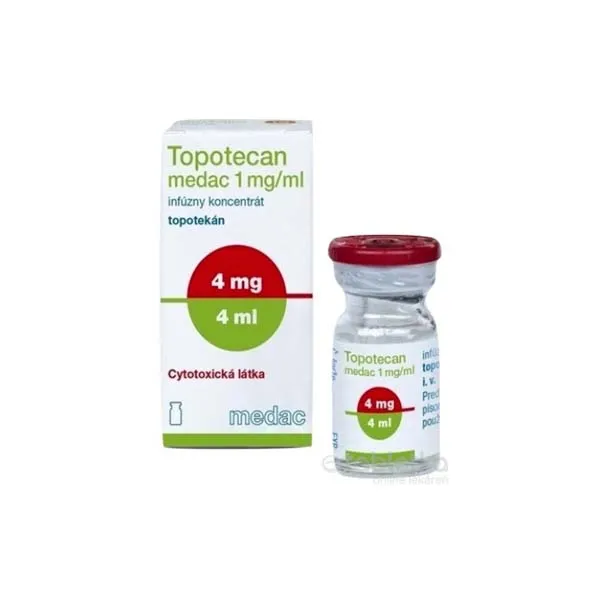
Table of Contents
- Package leaflet: Information for the user
- 1. What Topotecan medac is and what it is used for
- 2. Important information before administration of Topotecan medac
- 3. How Topotecan medac is administered
- 4. Possible adverse reactions
- 5. How to store Topotecan medac
- 6. Contents of the pack and other information
- Information intended exclusively for medical professionals:
Package leaflet: Information for the user
Topotecan medac, 1 mg/ml, concentrate for solution for infusion
Topotecanum
Please read all of this leaflet carefully before being given the medicine because it contains
important information for you.
- Keep this leaflet so that you can read it again if necessary.
- If you have any questions, please consult your doctor.
- If you experience any adverse reactions, including any not listed in this leaflet, tell your doctor. See section 4.
Contents of the leaflet
- What Topotecan medac is and what it is used for
- Important information before receiving Topotecan medac
- How Topotecan medac is given
- Possible side effects
- How to store Topotecan medac
- Contents of the pack and other information
1. What Topotecan medac is and what it is used for
Topotecan medac helps destroy tumours. It is administered in hospital by a doctor or nurse as an intravenous infusion.
Topotecan medac is used to treat:
- Ovarian cancer and small cell lung cancer that has recurred after chemotherapy
- Advanced cervical cancer, when surgery and/or radiotherapy are not possible. In the treatment of cervical cancer, Topotecan medac is used in combination with another medicine called cisplatin.
Your doctor will decide together with you whether it is better to use Topotecan medac or continue with the initial chemotherapy.
2. Important information before administration of Topotecan medac
When not to administer Topotecan medac:
- if the patient is allergic to topotecan or to any of the other ingredients of this medicine (listed in section 6),
- if the patient is breastfeeding,
- if the blood cell count is too low. Your doctor will provide information on this based on the results of the most recent blood test. Inform your doctor if any of these situations apply to the patient.
Warnings and precautions
Discuss the following with your doctor before starting treatment with Topotecan medac:
- if the patient has any kidney or liver function disorders. A dose adjustment of Topotecan medac may be necessary.
- if the patient is pregnant or planning to become pregnant. See section below, "Pregnancy, breastfeeding and fertility".
- if the patient plans to father a child. See section below, "Pregnancy, breastfeeding and fertility". Inform your doctor if any of these situations apply to the patient.
Topotecan medac and other medicines
Tell your doctor about all medicines the patient is currently taking or has recently taken,
as well as any medicines the patient plans to take, including herbal preparations or
medicines available without a prescription. Remember to inform your doctor if the patient
starts taking any other medicines while receiving Topotecan medac.
Pregnancy, breastfeeding and fertility
Topotecan medac is not recommended for use in pregnant women. It may harm the unborn child
conceived before, during, or shortly after completion of treatment.
An effective method of contraception should be used. Consult your doctor for advice.
Women should use appropriate contraceptive methods to avoid becoming pregnant
during treatment and for at least 6 months after completion of treatment.
Men should ensure their partners do not become pregnant during treatment and for
at least 3 months after its completion.
Genetic counselling is recommended for patients who wish to have children after treatment.
If a man plans to father a child, he should consult his doctor regarding family planning and
the possibility of sperm preservation before starting treatment.
If a patient's partner becomes pregnant while he is receiving topotecan, this should be
reported to the doctor immediately.
Breastfeeding must not be performed during treatment with Topotecan medac. Breastfeeding
should not be resumed until the doctor confirms it is safe to do so.
Driving and operating machinery
Topotecan medac may cause fatigue. If fatigue or weakness occurs, the patient should not
drive or operate machinery.
Topotecan medac contains sodium
The medicine contains less than 1 mmol (23 mg) of sodium per vial (1 ml/2 ml/4 ml), meaning
the medicine is considered "sodium-free".
3. How Topotecan medac is administered
The dose of Topotecan medac is determined by the physician based on:
- the patient's body size (body surface area measured in square meters),
- results of blood tests performed before starting treatment,
- the disease being treated.
Recommended dose:
- Ovarian cancer and small cell lung cancer: 1.5 mg per square meter of body surface area per day. The medicine is given once daily for 5 days. This treatment schedule is usually repeated every 3 weeks.
- Cervical cancer: 0.75 mg per square meter of body surface area per day. The medicine is given once daily for 3 days. This treatment schedule is usually repeated every 3 weeks. During treatment of cervical cancer, Topotecan medac is used in combination with another medicine called cisplatin. Your doctor will recommend the appropriate dose of cisplatin. The treatment regimen may be adjusted depending on the results of regular blood tests.
How Topotecan medac is administered
Your doctor or nurse will administer Topotecan medac as an intravenous infusion into a vein in the arm over approximately 30 minutes.
4. Possible adverse reactions
Like all medicines, this medicine can cause adverse reactions, although not everyone will experience them.
Serious adverse reactions: contact your doctor
The following very common adverse reactions may occur in more than 1 in 10 patients
receiving Topotecan medac:
- Signs of infection: Topotecan medac may reduce the number of white blood cells and decrease resistance to infections. This may even lead to life-threatening conditions. Symptoms include:
- fever.
- severe deterioration in general health.
- local symptoms such as sore throat or urinary tract problems (e.g. burning sensation during urination, which may indicate a urinary tract infection).
- Occasionally severe abdominal pain, fever and possibly diarrhoea (rarely bloody), which may be symptoms of intestinal inflammation (colitis).
The following rare adverse reactions may occur in not more than 1 in 1,000 patients
receiving Topotecan medac:
- Pneumonitis (interstitial lung disease): The greatest risk applies to patients with pre-existing lung disease, who have previously undergone radiotherapy to the lungs or who have been treated with medicines that have caused lung damage. Symptoms include:
- difficulty breathing.
- cough.
- fever.
Contact your treating doctor immediately if any of the symptoms described above occur, as hospital treatment may be necessary.
Very common adverse reactions: may occur in more than 1 in 10 patients
- General weakness and fatigue (transient anaemia). In some cases, blood transfusion may be required.
- Unusual bruising or bleeding due to reduced number of blood cells responsible for clotting. This may lead to increased bleeding after relatively minor injuries, such as small cuts. Rarely, more severe bleeding (haemorrhage) may occur. Consult your doctor on how to minimize the risk of bleeding.
- Weight loss and loss of appetite (anorexia); fatigue; weakness.
- Nausea, vomiting, diarrhoea, abdominal pain, constipation.
- Inflammation and ulceration of the mouth, tongue or gums.
- Elevated body temperature (fever).
- Hair loss.
Common adverse reactions: may occur in not more than 1 in 10 patients
- Allergic or hypersensitivity reactions (including rash).
- Yellowing of the skin.
- Malaise.
- Itching.
Rare adverse reactions: may occur in not more than 1 in 1,000 patients
- Severe allergic reactions or anaphylactic reactions.
- Swelling due to fluid accumulation (angioedema).
- Mild pain and inflammation at the injection site.
- Itchy rash (or urticaria).
Adverse reactions with unknown frequency: frequency cannot be estimated from the available data
- Acute stomach pain, nausea, vomiting blood, black or bloody stools (possible symptoms of gastrointestinal perforation).
- Oral mucositis, difficulty swallowing, abdominal pain, nausea, vomiting, diarrhoea, bloody stools (possible symptoms of inflammation of the mucous membranes of the mouth, stomach and/or intestines).
During treatment of cervical cancer, adverse reactions of another medicine (cisplatin) used concomitantly with Topotecan medac may occur. These adverse reactions are described in the patient leaflet for cisplatin.
Reporting of adverse reactions
If any adverse reactions occur, including any not listed in this leaflet, inform your doctor, pharmacist or nurse. Adverse reactions can be reported directly to the Department of Monitoring Adverse Drug Reactions of the Office for Registration of Medicinal Products, Medical Devices and Biocidal Products:
Al. Jerozolimskie 181C, PL-02-222 Warsaw, tel.: +48 22 49-21-301, fax: +48 22 49-21-309, website: https://smz.ezdrowie.gov.pl
Adverse reactions can also be reported to the marketing authorization holder.
Reporting adverse reactions helps to provide more information on the safety of the medicine.
5. How to store Topotecan medac
Keep the medicine out of the sight and reach of children.
Do not use this medicine after the expiry date stated on the carton.
Store the vial in the outer packaging to protect it from light.
Store in a refrigerator (2°C – 8°C).
6. Contents of the pack and other information
What Topotecan medac contains
- The active substance is topotecan. Each vial contains topotecan hydrochloride equivalent to 1 mg, 2 mg, or 4 mg of topotecan.
- The other ingredients are: water for injections, hydrochloric acid, and sodium hydroxide.
What Topotecan medac looks like and contents of the pack
Topotecan medac is a concentrate for solution for infusion.
The medicine is available in packs containing 1 vial or 5 vials; each vial contains 1 mg,
2 mg, or 4 mg of topotecan.
The concentrate must be diluted before starting the infusion.
The concentrate in the vial provides 1 mg of active substance in 1 ml.
Marketing Authorisation Holder and Manufacturer
medac
Gesellschaft für klinische
Spezialpräparate mbH
Theaterstr. 6
22880 Wedel
Germany
Tel.: +49 4103 8006-0
Fax: +49 4103 8006-100
Information intended exclusively for medical professionals:
Instructions for dilution, storage, and disposal of Topotecan medac
Dilution
The concentrate must be further diluted with either 0.9% sodium chloride solution for intravenous infusion or 5% glucose solution for intravenous infusion to achieve a final drug concentration between 25 and 50 micrograms/mL.
Shelf life after first opening of the container
Chemical and physical stability has been demonstrated for up to 48 hours under storage conditions of 2 °C – 8 °C or at room temperature. From a microbiological standpoint, the product should be used immediately, unless the method of opening excludes the risk of microbiological contamination. If the product is not used immediately, the user is responsible for the storage duration and conditions.
Shelf life of the ready-to-use infusion solution
Chemical and physical stability has been demonstrated for up to 96 hours at 2 °C – 8 °C and up to 48 hours at room temperature. From a microbiological standpoint, the product should be used immediately. If not used immediately, the user is responsible for the storage duration and conditions prior to use. Typically, storage should not exceed 24 hours at 2 °C – 8 °C, unless dilution was performed under controlled and validated aseptic conditions.
Handling and disposal of unused product and waste
Appropriate procedures for the safe use of cytotoxic medicinal products must be followed, namely:
- Pregnant women should not be involved in handling this medicinal product.
- Personnel handling the product during dilution must wear appropriate protective clothing, including a mask, protective eyewear, and gloves.
- All administration and cleaning materials, including gloves, must be placed in high-risk waste bags for incineration at high temperatures.
- Any unused residues or waste of the product must be disposed of in accordance with local regulations.
- In case of accidental contact of the drug with skin or eyes, immediately rinse thoroughly with plenty of water.