Tobrex
Poland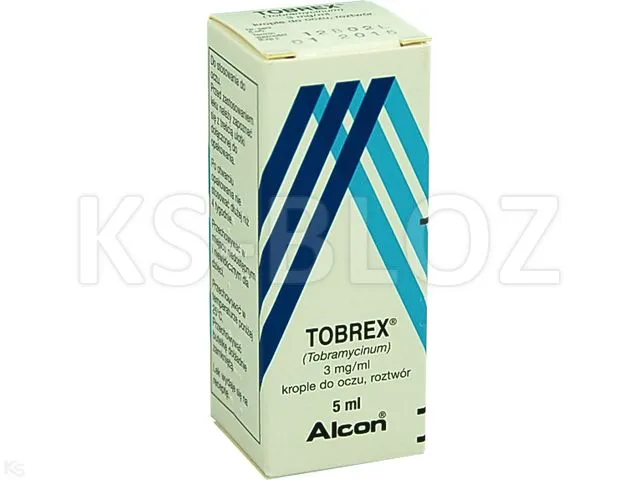
Instructions for Use
Package leaflet: Information for the patient
Warning! Keep this leaflet! Information on the immediate packaging in a foreign language.
Tobrex
3 mg/ml, eye drops, solution
Tobramycinum
Please read carefully all the information in this leaflet before using the medicine, as it contains
important information for the patient.
- Keep this leaflet so that you can read it again if necessary.
- If you have any doubts, consult your doctor or pharmacist.
- This medicine has been prescribed for a specific individual. Do not pass it on to others. The medicine may harm another person, even if their symptoms are identical.
- If the patient experiences any adverse reactions, including any not listed in this leaflet, inform the doctor or pharmacist. See section 4.
Table of contents of the leaflet:
- What Tobrex is and what it is used for
- Important information before using Tobrex
- How to use Tobrex
- Possible side effects
- How to store Tobrex
- Contents of the pack and other information
1. What Tobrex is and what it is used for
Tobrex is an antibiotic effective against many microorganisms that may infect the eye.
Tobrex is indicated for the treatment of external eye and periocular infections in adults and children aged 1 year and above, caused by bacteria sensitive to its active substance – tobramycin.
2. Important information before using Tobrex
When not to use Tobrex:
- if the patient is allergic to tobramycin or to any of the other ingredients of this medicine (listed in section 6).
Warnings and precautions
Before starting to use Tobrex, discuss with a doctor or pharmacist:
- if the patient experiences allergic reactions after using Tobrex, treatment should be discontinued and immediate medical advice sought (see section 4). Hypersensitivity reactions may vary in severity: from local itching or skin redness to severe allergic reactions (anaphylactic reaction) or serious skin reactions. Such allergic reactions may occur when using other locally or systemically acting antibiotics from the same group (aminoglycosides);
- if the patient is receiving other antibiotic therapy during treatment with Tobrex, medical advice should be sought;
- if the patient has or is suspected of having myasthenia gravis or Parkinson's disease, medical advice should be sought. Antibiotics from this group may worsen muscle weakness;
- if the patient experiences worsening or recurrence of symptoms, medical advice should be sought. Prolonged use of Tobrex may increase susceptibility to eye infections;
- if persistent corneal ulceration occurs during treatment with Tobrex, the patient should seek medical advice promptly, as this may indicate a fungal eye infection.
Tobrex with other medicines
Inform the doctor or pharmacist about all medicines currently used, recently used, or planned to be used.
If the patient is using other eye drops or ointments simultaneously, at least 5 minutes should be left between the administration of each product. Eye ointments should be applied last.
Pregnancy and breastfeeding
If the patient is pregnant or breastfeeding, suspects she may be pregnant, or is planning to have a child, she should consult a doctor before using this medicine.
Pregnancy
Tobrex may be used during pregnancy only if absolutely necessary.
Breastfeeding
Use of Tobrex is not recommended during breastfeeding. The doctor will decide whether to continue or discontinue breastfeeding or to continue or discontinue treatment, taking into account the benefits of breastfeeding for the child and the benefits of treatment for the mother.
Driving and operating machinery
Tobrex eye drops have no effect or only a minor effect on the ability to drive and operate machinery.
For a short period after instillation of Tobrex eye drops, vision may be blurred. Driving and operating machinery should be avoided until this symptom resolves.
Tobrex eye drops contain benzalkonium chloride
The medicine contains 0.1 mg of benzalkonium chloride per millilitre (0.1 mg/ml).
Benzalkonium chloride may be absorbed by soft contact lenses and may change their colour. Contact lenses should be removed before instillation and at least 15 minutes should be waited before reinsertion.
Benzalkonium chloride may also cause eye irritation, especially in individuals with dry eye syndrome or corneal disorders (the transparent layer at the front of the eye). If abnormal sensations, stinging, or pain in the eye occur after using the medicine, medical advice should be sought.
3. How to use Tobrex
This medicine should always be used exactly as directed by your doctor. If in doubt, consult your doctor or pharmacist.
In mild to moderate conditions, instill one to two drops into the conjunctival sac (sacs) of the infected eye(s) every four hours.
In severe cases, instill one to two drops into the conjunctival sac (sacs) of the infected eye(s) every hour until improvement occurs. After improvement, gradually reduce the frequency of administration until treatment is completed.
The medicine is usually used for 7 to 10 days. Continue using the medicine for as long as your doctor has instructed.
After instilling the drops, gently close the eyelid and press on the corner of the eye near the nose. This helps reduce absorption of the ophthalmic medication into the systemic circulation and minimizes systemic effects.
Use in children
Tobrex eye drops may be used in children aged 1 year and older at the same dosage as adults. The maximum number of drops that can be administered per day is 14 drops for children aged 1 to <2 years and 46 drops for children aged 2 to <12 years. If in doubt, consult your doctor. The safety and efficacy of Tobrex in children under 1 year of age have not been established, and no data are available for use in this age group.
Use in elderly patients
The same dosage as in adults should be used in elderly patients.
Use in patients with hepatic or renal impairment
The safety and efficacy of Tobrex in patients with liver or kidney disorders have not been established.
Instructions for use
Tobrex is intended exclusively for instillation into the eyes.
Instructions for use
- Prepare the Tobrex bottle and a mirror.
- Wash your hands.
- Unscrew the cap. If the safety collar is loose after removing the cap, discard it before using the medicine.
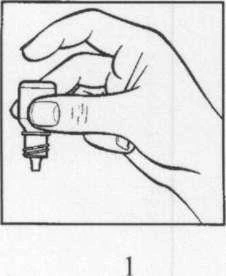
- Hold the bottle in your hand with the bottom facing upwards, using your thumb and middle finger (Figure 1).
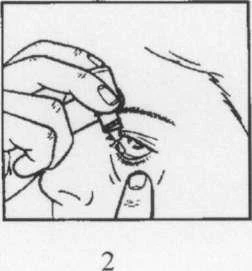
- Tilt your head backward. Gently pull down the lower eyelid with a clean finger to create a "pocket" between the eyeball and the eyelid, into which the drop should fall (Figure 2).
- Bring the tip of the bottle close to the eye. A mirror may be used to assist.
- Do not touch the dropper tip to the eye, eyelid, surrounding area, or any other surface. This may contaminate the drops. Using contaminated drops may lead to serious complications, including loss of vision.
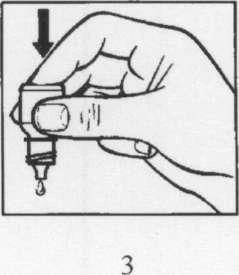
- To release a single drop of Tobrex, gently squeeze the bottom of the bottle (Figure 3). If the drop does not enter the eye, repeat the instillation.
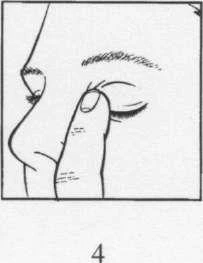
- After instilling Tobrex, gently close the eye and press with your finger on the corner of the eye near the nose (Figure 4). This helps prevent the medicine from draining into the rest of the body.
- If treating both eyes, repeat the above steps for the second eye.
- Immediately after use, replace the cap on the bottle.
- Only one bottle should be used at a time.
Use of more than the recommended dose of Tobrex
In case of overdose, excess medicine can be rinsed from the eye with lukewarm water. No adverse effects are expected. Do not instill additional drops. Administer the next dose at the usual time.
Missed dose of Tobrex
If the patient forgets to use Tobrex eye drops, treatment should be continued by administering the next dose according to the prescribed schedule. If the next dose is due shortly, the missed dose should be skipped and treatment continued as prescribed. Do not use a double dose to make up for a missed dose.
If the patient is using other eye drops or ointments simultaneously, wait at least 5 minutes between administering each medicine. Eye ointments should be used last.
If you have any further questions about the use of this medicine, consult your doctor or pharmacist.
4. Possible adverse reactions
Like any medicine, this medicine can cause adverse reactions, although not everyone will experience them.
If the patient experiences allergic reactions, including rash, swelling of the face, lips, tongue and/or
throat, which may cause difficulty in breathing or swallowing, or if other serious adverse reactions occur,
treatment with Tobrex eye drops should be discontinued immediately and medical advice should be sought
immediately from a doctor or the nearest hospital Emergency Department.
The following adverse reactions have been observed during the use of Tobrex eye drops:
Common adverse reactions (may occur in 1 to 10 patients out of 100)
Ocular symptoms: eye discomfort, eye redness.
Uncommon adverse reactions (may occur in 1 to 10 patients out of 1,000)
Ocular symptoms: inflammation of the eye surface, corneal damage, visual disturbances, blurred vision, eyelid redness, eye and eyelid swelling, eye pain, dry eye, eye discharge, eye itching, increased tear production.
General symptoms: allergy (hypersensitivity), headache, urticaria, skin inflammation, decreased growth or loss of eyelashes, loss of skin pigmentation, skin itching and dryness.
Frequency not known (cannot be estimated from available data)
Ocular symptoms: eye allergy, eye irritation, eyelid itching.
General symptoms: severe allergic reactions, severe skin reactions (Stevens-Johnson syndrome, erythema multiforme), rash.
Reporting of adverse reactions
If any adverse reactions occur, including any not listed in this leaflet, inform a doctor or pharmacist. Adverse reactions can be reported directly to the Department of Monitoring Adverse Drug Reactions at the Office for Registration of Medicinal Products, Medical Devices and Biocidal Products, Al. Jerozolimskie 181C, 02-222 Warsaw, phone: +48 22 49 21 301, fax: +48 22 49 21 309, website: https://smz.ezdrowie.gov.pl.
Reporting adverse reactions helps provide more information on the safety of this medicine.
5. How to store Tobrex
To prevent infection, do not use the drops more than 4 weeks after first opening the bottle.
Enter the date of first opening in the space below.
Date of first opening: …………….
Keep the medicine out of the sight and reach of children.
Do not store above 25°C.
Keep the bottle tightly closed.
Do not use this medicine after the expiry date stated on the packaging.
The expiry date refers to the last day of the stated month.
Medicines must not be disposed of via wastewater or household waste. Ask your pharmacist how to dispose of medicines no longer required. These measures help protect the environment.
6. Contents of the pack and other information
What Tobrex contains
- The active substance is tobramycin 3 mg/ml.
- The other ingredients are: boric acid, anhydrous sodium sulfate, sodium chloride, tyloxapol, benzalkonium chloride, purified water. Minimal amounts of sulfuric acid and/or sodium hydroxide are added to adjust the pH.
What Tobrex looks like and contents of the pack
A 5 ml bottle, type DROPTAINER, with dropper and cap, in a cardboard box.
For more detailed information, please contact the responsible party or parallel importer.
Marketing Authorisation Holder in Belgium, country of export:
Novartis Pharma NV
Medialaan 40
B-1800 Vilvoorde
Belgium
Manufacturers:
Novartis Farmacéutica, S.A.
Gran Via de les Corts Catalanes, 764
08013 Barcelona
Spain
ALCON-COUVREUR NV
Rijksweg 14
B-2870 Puurs
Belgium
Siegfried El Masnou SA
Camil Fabra 58
08320 El Masnou
Barcelona, Spain
Parallel Importer:
InPharm Sp. z o.o.
ul. Strumykowa 28/11
03-138 Warsaw
Poland
Repackaged in:
InPharm Sp. z o.o. Services sp. k.
ul. Chełmżyńska 249
04-458 Warsaw
Poland
Marketing Authorisation Number in Belgium, country of export: BE125176
Parallel Import Licence Number: 335/22
Similar Medications
-
Tobrex
Form: drops, ophthalmic solution
Active substance Dosage tobramycin 3 mg/ml Manufacturer: Novartis s.r.o.
-
Tobrex
Form: drops, ophthalmic solution
Active substance Dosage tobramycin 3 mg/ml Manufacturer: Novartis Hungária Ltd.
-
Tobrex
Form: drops, ophthalmic solution
Active substance Dosage Tobramycin 3 mg/ml Manufacturer: Novartis s.r.o.
-
Tobrex
Form: drops, ophthalmic solution
Active substance Dosage Tobramycin 3 mg/ml Manufacturer: Novartis Hungária Ltd.
-
Tobrex
Form: drops, ophthalmic solution
Active substance Dosage Tobramycin 3 mg/ml Manufacturer: Novartis Farma - Produtos Farmacêuticos, S.A.
-
Tobrex
Form: drops, ophthalmic solution
Active substance Dosage Tobramycin 3 mg/ml Manufacturer: Novartis Hungaria Ltd.
-
Tobrex
Form: drops, ophthalmic solution
Active substance Dosage tobramycin 3 mg/ml Manufacturer: Novartis Croatia d.o.o.
-
Tobrex
Form: drops, ophthalmic solution
Active substance Dosage tobramycin 3 mg/ml Manufacturer: Novartis Croatia d.o.o.
-
Tobrosopt 0.3 %
Form: drops, ophthalmic solution
Active substance Dosage Tobramycin 3 mg Manufacturer: Warsaw Pharmaceutical Works POLFA S.A.
This page has been machine-translated and may contain inaccuracies. The original data is available in the manufacturing country's language.
Last data check: June 04, 2026 · Data source: Rejestr Produktów Leczniczych (URPL)