Oxygen medical messer
PolandTable of Contents
- Package leaflet: Information for the patient
- 1. What Medical Oxygen Messer is and what it is used for
- 2. Important information before using the medicinal product Tlen medyczny Messer
- 3. How to use Tlen medyczny Messer
- 4. Possible adverse reactions
- 5. How to store Tlen medyczny Messer
- 6. Contents of the pack and other information
- INFORMATION INTENDED EXCLUSIVELY FOR PROFESSIONAL MEDICAL PERSONNEL:
Package leaflet: Information for the patient
MEDICAL OXYGEN MESSER, not less than 99.5% (V/V),
liquefied medical gas, compressed medical gas
Oxygenium
Please read all of this leaflet carefully before using this medicine, because it contains
important information for you.
- Keep this leaflet, as you may need to read it again.
- Consult your doctor or nurse if you have any doubts.
- This medicine has been prescribed for a specific individual. Do not pass it on to others. It may harm other people, even if their symptoms are the same.
- If any adverse reactions occur, including any possible adverse reactions not listed in this leaflet, inform your doctor or nurse. See section 4.
Contents of the leaflet
- What Medical Oxygen Messer is and what it is used for
- Important information before using Medical Oxygen Messer
- How to use Medical Oxygen Messer
- Possible side effects
- How to store Medical Oxygen Messer
- Contents of the pack and other information
1. What Medical Oxygen Messer is and what it is used for
Medical Oxygen Messer (chemical formula: O₂) is a colourless and odourless gas. The indication for oxygen therapy includes most forms of hypoxia. Oxygen therapy is particularly beneficial in patients with normal oxygen consumption in whom reduced partial pressure of oxygen in mixed venous blood is observed during breathing of ambient air.
2. Important information before using the medicinal product Tlen medyczny Messer
When not to use Tlen medyczny Messer
- if the patient's arterial carbon dioxide tension (CO₂) exceeds 9.3 kPa (more than 75% above normal), as this may lead to carbon dioxide narcosis with loss of consciousness, followed by death;
- if the patient is using or has used any of the following medicinal products:
- adriamycin (a chemotherapeutic agent used in cancer treatment);
- disulfiram (a medicinal product used in the treatment of alcoholism);
- cisplatin (a chemotherapeutic agent used in cancer treatment);
- sulfamylon (a medicinal product used in the treatment of wound infections in patients with severe burns).
Warnings and precautions
Before starting treatment with Tlen medyczny Messer, consult a physician or
nurse.
- The physician should exercise particular caution when administering oxygen at concentrations above 60% (above 40% in neonates) and during hyperbaric therapy (a treatment method for various diseases and injuries involving breathing pure oxygen under increased pressure).
Page 1 of 7
- Oxygen therapy significantly enriches the surrounding air with oxygen and increases the risk of fire. The use of open flames or other sources of ignition is strictly prohibited during oxygen therapy.
Medical personnel must exercise particular caution in cases of paraquat poisoning (a highly toxic chemical pesticide), as high oxygen concentrations may exacerbate lung damage.
Tlen medyczny Messer and other medicinal products
Inform the physician about all medicinal products the patient is currently taking or
has recently taken, as well as any medicinal products the patient intends to use.
- Tlen medyczny Messer must not be used concomitantly with the medicinal products listed in the section "When not to use Tlen medyczny Messer".
- Administration of high oxygen concentrations during treatment with bleomycin (an anticancer agent used in oncology, belonging to the group of drugs known as cytostatics) may intensify the adverse effects of bleomycin (pulmonary fibrosis).
Pregnancy and breastfeeding
During pregnancy, breastfeeding, or if pregnancy is suspected, or when planning a pregnancy, consult a physician before using this medicinal product.
The decision on the use of this medicinal product during pregnancy and breastfeeding is made by a physician.
Driving and operating machinery
After oxygen therapy, patients must not drive vehicles or operate machinery.
3. How to use Tlen medyczny Messer
Tlen medyczny Messer is always administered by trained personnel familiar with this medicinal product. During administration of Tlen medyczny Messer, both the patient and the delivery of the gas must be monitored to ensure safe use. Tlen medyczny Messer must always be used in accordance with the physician's instructions. The physician should explain to the patient how Tlen medyczny Messer is to be used, how it works, and what its effects are.
- Tlen medyczny Messer is administered by inhalation – the patient inhales the gas via a nasal cannula or a face mask.
- Tlen medyczny Messer is administered at a concentration ranging from 21% to 100%. The dose and duration of administration are determined by the physician.
- Oxygen should be administered continuously. Interrupted oxygen administration is particularly dangerous because an increase in the partial pressure of carbon dioxide (CO₂) in the lung alveoli may lead to further reduction in oxygen concentration when the patient breathes ambient air.
Use of a higher than recommended dose of Tlen medyczny Messer
Overdose leads to adverse effects primarily affecting the respiratory system, central nervous system, and cardiovascular system (reduced cardiac output, hemolysis), and in premature infants may cause bronchopulmonary dysplasia (retinopathy of prematurity leading to retinal damage) and blindness.
Page 2 of 7
If administration of a higher than recommended dose is observed, medical personnel must immediately reduce the concentration of administered oxygen or its flow rate.
4. Possible adverse reactions
Like all medicines, Tlen medyczny Messer may cause adverse reactions, although not
everyone will experience them.
- Oxygen may cause adverse reactions such as: hypercapnic narcosis with loss of consciousness and (or) secondary hypoxia caused by administration of pure oxygen.
- In newborns (especially premature infants), retrolental fibroplasia (retinopathy, i.e. damage to the retina of the eye) may occur – oxygen concentration in the incubator should not exceed 40%.
- When using Tlen medyczny Messer at concentrations above 70%, oxygen toxicity (Paul Bert effect) may occur.
- In addition, the following may occur:
- atelectasis (collapse of lung alveoli) – symptoms may include, among others, mild cough, chest pain, breathing difficulties, rapid heartbeat;
- bronchitis;
- substernal pain (pain and pressure in the chest);
- joint pain;
- loss of appetite;
- nausea, vomiting;
- reduced vital lung capacity (the amount of air that can be inhaled into the lungs after maximal exhalation);
- reduced visual field;
- hyperesthesia (increased sensitivity to various stimuli);
- mental changes.
Reporting of adverse reactions
If any adverse symptoms occur, including any adverse symptoms not listed in this leaflet, inform your doctor or nurse. Adverse reactions can be reported directly to the Department of Monitoring Adverse Reactions of Medicinal Products, Medical Devices and Biocidal Products
Al. Jerozolimskie 181C, 02-222 Warsaw
Phone: +48 22 49 21 301, Fax: +48 22 49 21 309
Website: https://smz.ezdrowie.gov.pl
Reporting adverse reactions helps to collect further information on the safety of using this medicine.
5. How to store Tlen medyczny Messer
Tlen medyczny Messer should be stored in a place inaccessible to children.
Do not use Tlen medyczny Messer after the expiry date stated on the label following: "Expiry date".
Persons handling oxygen containers and cylinders must be adequately trained and aware of the hazards arising from the product's physicochemical properties.
Page 3 of 7
6. Contents of the pack and other information
What Tlen medyczny Messer contains
- The active substance is oxygen. Oxygen content not less than 99.5% by volume.
- The medicinal product contains no other ingredients.
What Tlen medyczny Messer looks like and contents of the pack
Tlen medyczny Messer is available as:
- liquefied medical gas – in cryogenic containers containing from 50 kg to 70,000 kg of oxygen
- compressed medical gas – in steel, aluminium and composite cylinders with capacity: below 10 l, 10 l, 20 l, 40 l, 50 l, and in seamless steel cylinder bundles with capacity of 320–900 l (4–18 cylinders with capacity of 40–150 l).
Tlen medyczny Messer is a colourless, odourless gas.
Marketing Authorisation Holder:
Messer Polska Sp. z o.o.
ul. Maciejkowicka 30
41-503 Chorzów
Manufacturer:
Messer Polska Sp. z o.o.
ul. Maciejkowicka 30
41-503 Chorzów
MG Odra Gas spol. s r.o.
Na Popinci 1088
739 32 Vratimov
Czech Republic
Eloros Sp. z o.o.
ul. Strefowa 22
44-207 Rybnik
For further information, please contact the marketing authorisation holder.
Messer Polska Sp. z o.o.
ul. Maciejkowicka 30
41-503 Chorzów
tel. (32) 77 26 000
fax. (32) 77 26 115
Page 4 of 7
INFORMATION INTENDED EXCLUSIVELY FOR PROFESSIONAL MEDICAL PERSONNEL:
MEDICAL OXYGEN MESSER, not less than 99.5% (V/V),
liquefied medical gas, compressed medical gas
Special warnings and precautions for use
Treatment with Medical Oxygen Messer must be closely monitored. Oxygen should be administered in such a way as to reduce hypoxia, but without suppressing the respiratory center. Oxygen therapy should always be used when there is a risk of hypoxia in patients with chronic lung disease. Before initiating oxygen therapy, arterial CO₂ tension should be assessed by blood gasometry or by the method of reverse breathing. If CO₂ tension exceeds 6.6 kPa, 25% oxygen should be administered and its concentration gradually increased if respiratory depression does not occur.
Medical Oxygen Messer should be administered continuously. Intermittent oxygen administration is particularly dangerous because an increase in alveolar CO₂ tension may lead to further reduction of oxygen concentration at the moment when the patient breathes ambient air.
Extreme caution must be exercised when administering oxygen at concentrations above 60% (above 40% in neonates) and during hyperbaric therapy.
Instructions for preparing the medicinal product for use and for disposal of residues:
- Prior to use, place the cylinder at a temperature of 15–20°C for at least 6 hours.
- Before screwing the threaded connector of the reducer onto the cylinder, briefly open the valve to remove any dust particles.
- Before mounting the reducer on the cylinder, check the sealing ring of the threaded connector.
- Mount the reducer onto the cylinder. Slowly open the cylinder valve.
- Check the manometer to confirm sufficient gas quantity in the cylinder.
- Set the flow rate as prescribed by medical personnel using the flowmeter.
Page 5 of 7
Operating instructions for cylinders with integrated MediVital GCE valves
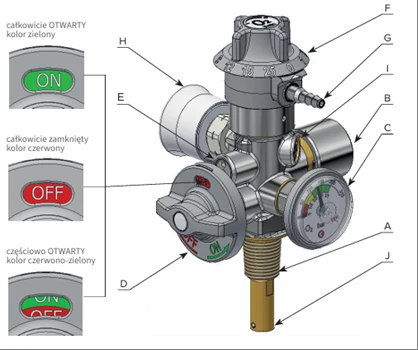
Keep the valve clean.
Maintain the valve free from oils and greases.
Smoking and use of open flames are prohibited during cylinder use.
How to use the flow outlet (G) and flow rate adjustment (F)
- Ensure that the flow control knob (F) is in the "0" position.
- Ensure that the tubing/cannula is compatible with the flow outlet (G) and is securely attached.
- Connect the associated equipment to the flow outlet (G).
- Slowly open the shut-off valve knob (D) (counterclockwise) until fully open—approximately one turn at a time.
- Adjust the flow control knob to the desired flow rate corresponding to the value indicated by the triangular pointer. Ensure that the knob is properly seated.
How to use the quick connector (H)
- Ensure that the flow control knob (F) is in the "0" position.
- Ensure that the associated medical device is NOT connected to the pressure outlet (H).
- Slowly open the shut-off valve knob (D) (counterclockwise) until fully open—approximately one turn at a time.
- Ensure that the medical quick connector of the associated device is compatible with the pressure outlet (H).
- Connect the medical quick connector of the associated device to the pressure outlet.
- Ensure that the quick connector of the associated device is securely locked. Confirm that oxygen is being delivered to the patient.
After use
- Close the shut-off valve (D) (clockwise direction). Do not apply excessive force (maximum recommended torque is 5 Nm).
- Release gas pressure from the connected equipment.
- Disconnect all connected devices from the user outlets (G, H).
- Set the flow control knob (F) to "0".
Page 6 of 7
! Opening too quickly may cause fire or explosion hazard due to sudden pressure change of oxygen. Incomplete opening of the shut-off valve may reduce the actual flow rate.
! Always ensure that the control knob is properly positioned at a defined setting and not between two values; otherwise, the integrated valve will not provide proper medical gas flow.
Special precautions related to storage of containers:
Medical Oxygen Messer in the form of compressed medical gas may be stored only in cylinders meeting Technical Supervision requirements.
- Oxygen cylinders must be stored in a well-ventilated area, away from heat sources, flammable gases, and other combustible materials.
- Cylinders must be stored and transported at temperatures below 50°C.
- Cylinders secured against tipping must be stored in an upright position.
- Warehouse organization should allow separation of different types of gases, as well as empty and full cylinders.
- A cylinder should be considered empty when cylinder pressure at room temperature drops to 2 bar.
- Personnel handling oxygen containers and cylinders must be adequately trained and aware of hazards associated with the physicochemical properties of the product.
Medical Oxygen Messer in the form of liquefied medical gas is stored exclusively in cryogenic vessels meeting Technical Supervision requirements.
- Portable cryogenic containers must be stored in a well-ventilated area, away from heat sources, flammable gases, and other combustible materials.
- Outdoor storage under cover is recommended.
- It is prohibited to place containers indoors due to the possibility of gas release through the container's safety valves.
The warehouse layout should allow separation of different types of gases and of empty and full containers.
Page 7 of 7