Oxygen medical
Poland
Table of Contents
Package leaflet: Information for the user
Medical Oxygen
Oxygenium
99.5% (V/V), gas
Please read the entire leaflet carefully before use, as it contains
important information for the patient.
This medicine should always be used exactly as described in the patient leaflet or as directed by a physician or pharmacist.
- Keep this leaflet, as you may need to read it again.
- Consult your doctor or pharmacist if you need advice or further information.
- If any adverse reactions occur, including any possible adverse reactions not listed in this leaflet, inform your doctor or pharmacist.
Table of contents of the leaflet:
- What medical oxygen is and what it is used for
- Important information before using medical oxygen
- How to use medical oxygen
- Possible side effects
- How to store medical oxygen
- Contents of the pack and other information
1. WHAT MEDICAL OXYGEN IS AND WHAT IT IS USED FOR
Medical oxygen is a compressed gas containing not less than 99.5% oxygen by volume (V/V). Medical oxygen is indicated in all forms of hypoxia. Oxygen therapy is particularly beneficial in patients with normal oxygen consumption in whom decreased partial pressure of oxygen in mixed venous blood is observed during breathing of ambient air.
2. IMPORTANT INFORMATION BEFORE USING MEDICAL OXYGEN
When not to use the medicine Medical Oxygen
Medical oxygen under pressure higher than atmospheric pressure (hyperbaric oxygen therapy)
must not be used in cases of untreated pneumothorax. Pneumothorax is
caused by accumulation of air in the pleural cavity between the two pleural membranes. If the patient has ever had pneumothorax, inform the doctor.
Warnings and precautions
Before using Medical Oxygen, talk to your doctor or pharmacist.
Before starting oxygen therapy, you should be aware that:
- oxygen at higher concentrations may be harmful. It may cause lung damage (collapse of pulmonary alveoli), leading to impaired oxygen exchange with blood;
- if the patient suffers from severe chronic obstructive pulmonary disease (COPD) with subsequent oxygen deficiency in blood, the oxygen flow rate will be low. The doctor will adjust the appropriate oxygen flow rate;
- caution must be exercised in newborns and premature infants to avoid adverse events such as eye damage. If a child requires oxygen therapy, administer only the amount of Medical Oxygen prescribed by the doctor.
Hyperbaric oxygen therapy requires precautions in the following cases:
- chronic obstructive pulmonary disease (COPD);
- pulmonary emphysema: lung disorders caused by loss of elasticity of lung tissue, associated with (severe) shortness of breath;
- upper respiratory tract infections;
- inadequately treated asthma;
- recent middle ear surgery;
- recent thoracic surgery;
- uncontrolled high fever;
- if the patient has previously experienced seizures or convulsions;
- if the patient has fear of enclosed spaces (claustrophobia);
- if the patient has ever had pneumothorax, i.e. presence of air or gas in the pleural cavity;
- heart disorders.
Information regarding increased risk of fire in an oxygen-enriched atmosphere
- Oxygen is an element with oxidizing properties that supports combustion. Open flames (e.g. pilot lights, ovens, gas stoves, sparks, candles, etc.) must not be used in rooms where Medical Oxygen is being used, as this increases the risk of fire.
- Smoking cigarettes or using e-cigarettes is prohibited throughout the entire duration of oxygen treatment.
- During therapy with Medical Oxygen, toasters, hair dryers, and similar electrical appliances must not be used.
- Greasy substances must not be applied to surfaces coming into contact with Medical Oxygen (e.g. oils, creams, ointments). Only water-based products may be used on hands, face, or inside the nose.
- The pressure regulator valve must be opened slowly and carefully to prevent ignition. Due to accidental fires in the presence of oxygen, burns have occurred.
User instructions:
- Handle the cylinder carefully. Do not allow the cylinder to fall or be subjected to impact.
- Damage to the valve may cause outlet obstruction and (or) incorrect readings on the pressure gauge regarding remaining oxygen content and flow, resulting in lack of or insufficient oxygen delivery.
- Oxygen liquefies at -183°C. At such low temperatures, there is a risk of frostbite. Always wear protective gloves and safety goggles when handling liquefied oxygen for medical purposes.
Children
Oxygen therapy in premature infants and newborns may cause eye damage
(premature retinopathy, retinopathy of prematurity). The doctor may reduce the risk of eye damage by selecting an appropriate oxygen concentration.
Medical Oxygen and other medicines
Inform your doctor or pharmacist about all other medicines currently being taken or recently taken.
If the patient is taking or has been prescribed bleomycin (for cancer treatment), amiodarone (coronary artery disease), nitrofurantoin or other antibiotics (for infections), or nitric oxide (for pulmonary hypertension), consult a doctor before using oxygen, as there is a risk of pulmonary toxicity.
Lung damage caused by the herbicide paraquat may worsen during oxygen therapy. In cases of paraquat poisoning, oxygen administration should be avoided if possible.
Pregnancy, breastfeeding, and effects on fertility
Medical Oxygen may be used during pregnancy when necessary.
Medical Oxygen may be used during breastfeeding.
Always inform the doctor about pregnancy or suspected pregnancy.
Patients who are pregnant, breastfeeding, suspect they may be pregnant, or are planning pregnancy should consult a doctor or pharmacist before using Medical Oxygen.
Driving and operating machinery
During treatment with Medical Oxygen, driving and operating machinery is permitted if the doctor considers the patient capable of doing so.
3. HOW TO USE THE MEDICINAL PRODUCT OXYGEN MEDICAL
Use of a higher than recommended dose of Oxygen Medical
In certain cases, excessive amounts of Oxygen Medical may negatively affect
respiratory function, and in exceptional cases may cause adverse neurological
effects, which in extreme situations may lead to loss of consciousness.
Prolonged use of excessive amounts of Oxygen Medical may cause respiratory pain,
dry cough, or even shortness of breath. If symptoms of overdose occur, contact a physician or the nearest medical facility immediately.
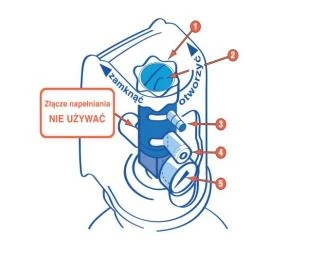
If the cylinder is equipped with a built-in pressure regulator, use:
- a hose with a clamp connected at a special connector with a locking safety device, connected from the dosing valve;
- a flowmeter equipped with a locking safety device.
Before connecting:
- verify the identity of the medicinal product and the filling indicator (5).
Connectors:
- adjustable flow connector for attaching an elastic hose (3);
- standard quick-connect coupling (4).
Opening the cylinder:
- open the shut-off valve (1);
- regulate the flow: use knob (2) if connector (3) is being used.
After each use:
- set the flow to 0 L/min using knob (2);
- disconnect the hose or quick-connect coupling, if necessary;
- close the cylinder by turning the shut-off valve (1) clockwise.
Note: gas supply through the connector is cut off if the flow control knob (2)
is positioned between two flow values
Valve maintenance:
- the valve requires regular inspections carried out by trained personnel authorized by the valve manufacturer;
- if the valve is used under extreme conditions (marine transport, long-term storage under high humidity, etc.), the valve operation should be checked every 6 months.
Cleaning and disinfection of the valve:
- the user may clean only the collar and the manometer (glass), which are accessible;
- clean the valve with the cylinder closed (full or empty) using a slightly damp cloth; do not use abrasive powders, pure alcohol, acetone, or other flammable solvents;
- after cleaning, the valve may be disinfected using a cloth moistened with aqueous alcohol solution.
Persons handling oxygen cylinders must be adequately trained and aware of the hazards associated with the physicochemical properties of the product.
Medical oxygen is administered at concentrations ranging from 21% to 100%. Oxygen should be administered continuously. Separate devices should be used for administering oxygen at high and low concentrations. High-concentration oxygen may be delivered via nasal cannulas or facial masks to patients who do not have suppressed respiration.
Use of a higher than recommended dose of medical oxygen
The concentration of administered oxygen should be immediately reduced or oxygen therapy discontinued.
If there are any further doubts regarding the use of this medicinal product, consult a physician or pharmacist.
4. POSSIBLE ADVERSE REACTIONS
Like all medicines, this medicine can cause adverse reactions, although not everyone experiences them.
Adverse reactions usually occur with prolonged use of high concentrations.
Very common (affects more than 1 in 10 patients):
In newborns undergoing high-concentration oxygen therapy: eye damage leading to vision disorders.
In hyperbaric therapy: eye pain, myopia, barotrauma (physical damage to body tissues or organs caused by pressure differences).
Common (may affect 1 in 10 people):
In hyperbaric therapy: seizures.
Uncommon (may affect 1 in 100 people):
Lung collapse.
In hyperbaric therapy: rupture of the eardrum.
Rare (may affect 1 in 1,000 people):
In hyperbaric therapy: dyspnoea, abnormally low blood sugar levels in diabetic patients.
Frequency not known (based on available data, frequency cannot be estimated):
Lung disorders, dryness of mucous membranes, burns.
In hyperbaric therapy: breathing difficulties, involuntary muscle spasms, dizziness, hearing loss, acute serous otitis media, nausea, behavioural disturbances, peripheral vision disturbances, lens clouding (cataract).
Tissue damage due to frostbite caused by liquid oxygen.
Reporting of adverse reactions
If any adverse symptoms occur, including any adverse effects not listed in this leaflet, inform a doctor, pharmacist, or nurse.
Adverse reactions can be reported directly to the Department of Monitoring Adverse Drug Reactions at the Office for Registration of Medicinal Products, Medical Devices and Biocidal Products:
Al. Jerozolimskie 181 C,
02-222 Warsaw,
Tel.: +48 22 49 21 301
Fax: +48 22 49 21 309
Website: https://smz.ezdrowie.gov.pl
Adverse reactions can also be reported to the responsible entity.
Reporting adverse reactions helps to provide more information on the safety of using this medicine.
5. HOW TO STORE MEDICAL OXYGEN
Store in well-ventilated areas, away from sources of heat. Avoid contact with flammable materials, fats, and oils. Protect from heating.
Store in a place inaccessible and not visible to children.
Do not use oxygen after the expiry date indicated on the packaging.
Oxygen shall be stored exclusively in steel or aluminium cylinders, cylinder bundles, cryogenic containers, cryogenic tanks, or tanks complying with the requirements of the Technical Supervision Authority.
Cylinders must be stored in an upright position and secured against falling.
The warehouse layout should allow for the separation of different types of medical gases, as well as empty and full cylinders, cylinder bundles, cryogenic containers, and cryogenic tanks, to prevent incorrect use of gases. Valves and regulators must be strictly protected from contamination by fats or greases.
6. PACK CONTENTS AND OTHER INFORMATION
What Tlen medyczny contains
Tlen medyczny is a colourless, odourless gas containing at least 99.5% (V/V) oxygen.
What Tlen medyczny looks like and contents of the packaging
Available pack sizes:
- Steel cylinders with a capacity from 1 l to 50 l, equipped with RPV valve or integrated G2 valve.
- Aluminium cylinders with a capacity from 0.1 l to 50 l, equipped with integrated Compact G2 valve (with or without TIPI function).
- Cylinder bundles consisting of 8–16 cylinders with a total capacity of 400 l–800 l, filled at a pressure of 200 bar, fitted with an oxygen valve with RPV function.
- Cryogenic containers with a capacity from 1 l to 1000 l.
- Tanker with a capacity exceeding 800 kg.
- Cryogenic storage tanks with a capacity from 2 t to 2356 t.
Steel and aluminium cylinders contain compressed gas with oxygen content not less than 99.5% (V/V), filled at a pressure of 150 or 200 bar.
Cryogenic containers, cryogenic storage tanks, and tankers contain liquefied gas with oxygen content not less than 99.5% (V/V).
Marketing Authorisation Holder
Air Liquide Polska Sp. z o.o.
Ul. Jasnogórska 9
31-358 Kraków
Tel: 12 627 93 00
[email protected]
Manufacturer
ALKAT Sp. z o.o.
Al. J. Piłsudskiego 92
41-308 Dąbrowa Górnicza
Tel: 32 790 81 11
[email protected]