Tigecycline fresenius kabi
Poland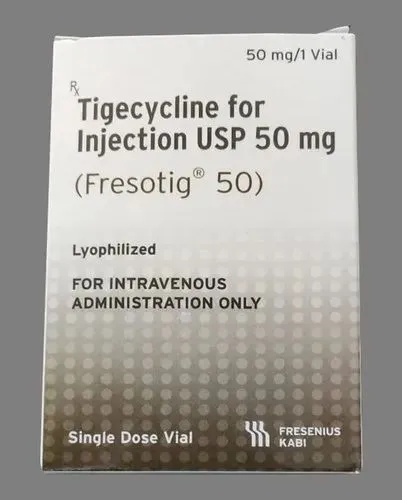
Table of Contents
- Package leaflet: Information for the user
- 1. What Tigecycline Fresenius Kabi is and what it is used for
- 3. How to use Tigecycline Fresenius Kabi
- 4. Possible adverse reactions
- 5. How to store Tigecycline Fresenius Kabi
- 6. Contents of the package and other information
- Information intended exclusively for medical professionals:
Package leaflet: Information for the user
Tigecycline Fresenius Kabi, 50 mg, powder for solution for infusion
Tigecyclinum
Please read all of this leaflet carefully before this medicine is administered, because it contains
important information for you.
- Keep this leaflet, as you may need to read it again.
- If you have any further questions, please ask your doctor or nurse.
- If you experience any side effects, including any not listed in this leaflet, tell your doctor or nurse. See section 4.
Leaflet contents
- What Tigecycline Fresenius Kabi is and what it is used for
- Important information before receiving Tigecycline Fresenius Kabi
- How to use Tigecycline Fresenius Kabi
- Possible side effects
- How to store Tigecycline Fresenius Kabi
- Contents of the pack and other information
1. What Tigecycline Fresenius Kabi is and what it is used for
Tigecycline Fresenius Kabi is an antibiotic belonging to the glycylcycline group, which works by inhibiting the growth of bacteria causing infections.
Your doctor has prescribed Tigecycline Fresenius Kabi for an adult patient or a child aged at least 8 years to treat one of the following serious infections:
- Complicated skin and soft tissue infections (tissue beneath the skin), excluding diabetic foot infections;
- Complicated intra-abdominal infections.
Tigecycline Fresenius Kabi is used only when your doctor considers other antibiotics inappropriate.
2. Important information before receiving Tigecycline Fresenius Kabi
When not to use Tigecycline Fresenius Kabi
- If you are allergic to tigecycline or any of the other ingredients of this medicine (listed in section 6).
- If you have previously had an allergic reaction to tetracycline antibiotics (e.g. minocycline, doxycycline, etc.), you may also be allergic to tigecycline.
Warnings and precautions
Before receiving Tigecycline Fresenius Kabi, discuss with your doctor or nurse if:
-
You have wounds that are healing poorly or slowly.
-
You have had diarrhoea before starting treatment with Tigecycline Fresenius Kabi. If diarrhoea occurs during or after treatment, inform your doctor immediately.
Do not take any anti-diarrhoeal medicines without first consulting your doctor. -
You have ever experienced side effects from tetracycline antibiotics (e.g. photosensitivity, tooth discolouration during tooth development, pancreatitis, or changes in certain laboratory test results used to assess blood coagulation).
-
You currently have or have previously had liver disease. Depending on the severity of liver impairment, your doctor may reduce the dose to avoid side effects.
-
You have biliary obstruction (blockage of the bile ducts).
-
You have blood clotting disorders or are taking anticoagulant medicines, as this medicine may affect blood coagulation.
While being treated with Tigecycline Fresenius Kabi
- Contact your doctor immediately if you experience symptoms of an allergic reaction.
- Contact your doctor immediately if you develop severe abdominal pain, nausea, or vomiting. These may be symptoms of acute pancreatitis (inflammation of the pancreas, which may cause severe abdominal pain, nausea, and vomiting).
- For certain serious infections, your doctor may consider administering Tigecycline Fresenius Kabi together with other antibiotics.
- Your doctor will closely monitor you for the development of any additional bacterial infection. If another bacterial infection occurs, your doctor may prescribe a different antibiotic specific to that infection.
- Although Tigecycline Fresenius Kabi kills certain types of bacteria, other types of bacteria and fungi may continue to grow. This is known as superinfection. Your doctor will monitor you for signs of superinfection and treat it if necessary.
Children
Tigecycline Fresenius Kabi must not be used in children under 8 years of age due to insufficient data on safety and efficacy in this age group, and because it may cause permanent tooth damage, such as discolouration during tooth development.
Tigecycline Fresenius Kabi and other medicines
Tell your doctor about all medicines you are currently taking, have recently taken, or plan to take.
Tigecycline Fresenius Kabi may increase certain laboratory values used to assess blood coagulation. It is important to inform your doctor if you are taking anticoagulant medicines (blood thinners). In such cases, your doctor will closely monitor your health.
Tigecycline Fresenius Kabi may reduce the effectiveness of oral contraceptives ("the pill"). You should discuss with your doctor whether you need to use an additional method of contraception while receiving Tigecycline Fresenius Kabi.
Tigecycline Fresenius Kabi may increase the effects of immunosuppressive medicines (such as tacrolimus or cyclosporine). It is important to inform your doctor if you are taking these medicines so that you can be closely monitored.
Pregnancy and breastfeeding
If you are pregnant or breastfeeding, think you may be pregnant, or are planning to have a baby, consult your doctor before receiving Tigecycline Fresenius Kabi.
Tigecycline Fresenius Kabi may be harmful to the unborn baby.
It is not known whether Tigecycline Fresenius Kabi passes into human milk. Consult your doctor before breastfeeding.
Driving and using machines
Tigecycline Fresenius Kabi may cause side effects such as dizziness, which could impair your ability to drive or operate machinery.
Tigecycline Fresenius Kabi contains sodium
This medicine contains less than 1 mmol (23 mg) of sodium per vial, i.e. it is considered "sodium-free".
3. How to use Tigecycline Fresenius Kabi
Tigecycline Fresenius Kabi is administered by a doctor or nurse.
The recommended initial dose in adults is 100 mg, followed by 50 mg every 12 hours. The medicine is given intravenously (directly into the bloodstream) over a period of 30 to 60 minutes.
Use in children and adolescents
The recommended dose for children aged 8 to <12 years is 1.2 mg/kg body weight, administered intravenously every 12 hours, up to a maximum dose of 50 mg every 12 hours.
The recommended dose for adolescents aged 12 to <18 years is 50 mg every 12 hours.
Treatment usually lasts between 5 and 14 days. The duration of treatment will be determined by the doctor.
Use of a higher than recommended dose of Tigecycline Fresenius Kabi
If the patient is concerned that they have received too high a dose of Tigecycline Fresenius Kabi, they should immediately inform the doctor or nurse.
Missed dose of Tigecycline Fresenius Kabi
If the patient is concerned that a dose of Tigecycline Fresenius Kabi has been missed, they should immediately inform the doctor or nurse.
If in doubt about any aspect of use, consult the doctor, pharmacist, or nurse.
4. Possible adverse reactions
Like all medicines, this medicine can cause adverse reactions, although they do not occur in everyone.
During treatment with most antibiotics, including Tigecycline Fresenius Kabi,
pseudomembranous colitis may occur. It manifests as severe, persistent,
or bloody diarrhoea accompanied by abdominal pain or fever, which may indicate a serious
intestinal inflammation that can occur during or after treatment.
Very common (may affect more than 1 in 10 people):
- nausea, vomiting, diarrhoea.
Common (may affect up to 1 in 10 people):
- abscess (collection of pus), infections;
- laboratory test results indicating reduced blood coagulation;
- dizziness;
- phlebitis (vein irritation) after injection, which may cause pain, inflammation, swelling, and blood clots;
- abdominal pain, dyspepsia (stomach discomfort), anorexia (loss of appetite);
- increased liver enzyme activity, hyperbilirubinaemia (excess bile pigment in the blood);
- itching, rash;
- poor or slow wound healing;
- headache;
- increased amylase activity (an enzyme found in salivary glands and pancreas), increased blood urea nitrogen;
- pneumonia;
- low blood sugar levels;
- sepsis (severe infection of the body and blood) or septic shock (a severe condition resulting from sepsis, which may lead to multi-organ dysfunction and death);
- injection site reaction (pain, redness, inflammation);
- low levels of proteins in the blood.
Uncommon (may affect up to 1 in 100 people):
- acute pancreatitis (inflammation of the pancreas, which may cause severe abdominal pain, nausea, and vomiting);
- jaundice (yellowing of the skin), hepatitis (liver inflammation);
- low platelet count (which may lead to increased tendency to bleed and bruising or haemorrhages).
Rare (may affect up to 1 in 1,000 people):
- low fibrinogen levels in the blood (a protein involved in blood coagulation).
Frequency not known (frequency cannot be estimated from available data):
- anaphylactic or anaphylactoid reactions (ranging from mild to severe, including sudden, generalized allergic reactions which may lead to life-threatening shock [e.g. breathing difficulties, drop in blood pressure, rapid pulse]);
- liver failure;
- skin rash which may lead to formation of extensive blisters and skin peeling (Stevens-Johnson syndrome).
Reporting of adverse reactions
If any adverse reactions occur, including any not listed in this leaflet, inform your doctor, pharmacist, or nurse. Adverse reactions can be reported directly to the Department of Monitoring of Adverse Drug Reactions of the Office for Registration of Medicinal Products, Medical Devices and Biocidal Products
Al. Jerozolimskie 181C, 02-222 Warsaw
Tel.: +48 22 49 21 301, Fax: +48 22 49 21 309
Website: https://smz.ezdrowie.gov.pl
Adverse reactions can also be reported to the marketing authorisation holder.
Reporting adverse reactions helps to provide more information on the safety of the medicine.
5. How to store Tigecycline Fresenius Kabi
Keep the medicine out of the sight and reach of children.
Do not use this medicine after the expiry date stated on the vial. The expiry date refers to the last day of the stated month.
Unopened vial: do not store above 30°C.
Storage after solution preparation
Tigecycline Fresenius Kabi should be used immediately after reconstitution and dilution; however, if necessary, it may be stored for up to 48 hours at 2°C to 8°C (when reconstituted and diluted in 0.9% sodium chloride solution or 5% glucose solution), or for up to 24 hours at room temperature (up to 25°C) (when reconstituted and diluted in 0.9% sodium chloride solution).
The diluted solution of Tigecycline Fresenius Kabi should be yellow to orange in colour; if not, it should be discarded.
Medicines must not be disposed of via the sewage system or household waste. Ask your pharmacist how to dispose of medicines no longer required. Such measures help protect the environment.
6. Contents of the package and other information
What Tigecycline Fresenius Kabi contains
- The active substance is tigecycline.
- The other components are: monohydrate maltose, hydrochloric acid concentrated (for pH adjustment), and sodium hydroxide (for pH adjustment).
What Tigecycline Fresenius Kabi looks like and contents of the pack
Tigecycline Fresenius Kabi is supplied as a powder for solution for infusion in a vial, the content of which appears as an orange powder or disk before reconstitution. Vials are supplied to hospitals in packs containing 10 vials. The powder in the vial should be mixed with a small amount of solvent. Gently rotate the vial until the drug is completely dissolved. Then, the solution should be promptly withdrawn from the vial and added to 100 mL of an intravenous infusion bag or other container used in hospitals.
Marketing Authorisation Holder and Manufacturer/Importer
Marketing Authorisation Holder
Fresenius Kabi Polska Sp. z o.o.
Al. Jerozolimskie 134
02-305 Warsaw
Poland
Manufacturer/Importer
Laboratori FUNDACIO DAU
C/ De la letra C, 12-14, Polígono Industrial de la Zona Franca
08040 Barcelona
Spain
For further information, please contact the Marketing Authorisation Holder:
Fresenius Kabi Polska Sp. z o.o.
Al. Jerozolimskie 134
02-305 Warsaw
Poland
Tel.: +48 22 345 67 89
This medicinal product is authorised in the European Economic Area and the United Kingdom (Northern Ireland) under the following names:
| Member State | Medicinal product name |
| Austria | Tigecyclin Fresenius Kabi 50 mg Powder for solution for infusion |
| Czech Republic | Tigecycline Fresenius Kabi |
| France | TIGECYCLINE FRESENIUS KABI 50 mg powder for solution for infusion |
| Germany | Tigecyclin Fresenius Kabi 50 mg Powder for solution for infusion |
| Hungary | Tigecycline Fresenius Kabi 50 mg powder for infusion solution |
| Ireland | Tigecycline 50 mg powder for solution for infusion |
| Italy | Tigeciclina Fresenius Kabi |
| Poland | Tigecycline Fresenius Kabi |
| Portugal | Tigeciclina Fresenius Kabi |
| Romania | Tigeciclină Fresenius Kabi 50 mg powder for perfusion solution |
| Slovakia | Tigecycline Fresenius Kabi 50 mg |
| Slovenia | Tigeciklin Fresenius Kabi 50 mg powder for solution for infusion |
| Spain | Tigeciclina Fresenius Kabi 50 mg powder for solution for infusion EFG |
| United Kingdom (Northern Ireland) | Tigecycline Fresenius Kabi 50 mg powder for solution for infusion |
Information intended exclusively for medical professionals:
Instructions for use and handling of the medicinal product (see also section 3. How to use Tigecycline Fresenius Kabi in this leaflet)
To obtain a tigecycline solution at a concentration of 10 mg/ml, the powder should be dissolved in 5.3 ml of 0.9% (9 mg/ml) sodium chloride injection solution, 5% (50 mg/ml) glucose injection solution, or sodium lactate Ringer's injection solution. The vial should be gently swirled until the medicinal product is completely dissolved. Then, 5 ml of the prepared solution should be promptly withdrawn from the vial and added to 100 ml of an intravenous infusion bag or another suitable container (e.g. a glass bottle).
To prepare a 100 mg dose, solutions from two vials should be prepared and combined into 100 ml of an intravenous infusion bag or another suitable container (e.g. a glass bottle).
Note: The vial contains 6% overage of active substance; therefore, 5 ml of the prepared solution corresponds to 50 mg of active substance. After preparation, the solution should be yellow to orange in color; if not, it should be discarded. Prior to administration of parenteral products, inspect visually for particulate matter and check for any discoloration (e.g. to green or black).
Tigecycline should be administered intravenously through a separate infusion line or via a Y-type connector. If multiple active substances are administered sequentially through the same intravenous infusion line, the line should be flushed before initiating and after completing the tigecycline infusion with either 0.9% (9 mg/ml) sodium chloride injection solution or 5% (50 mg/ml) glucose injection solution. Only infusion solutions compatible with tigecycline and other medicinal products should be administered through a common line.
Pharmaceutically compatible intravenous infusion solutions include: 0.9% (9 mg/ml) sodium chloride injection solution, 5% (50 mg/ml) glucose injection solution, and sodium lactate Ringer's injection solution.
Compatibility of tigecycline solution administered via a Y-type connector, after dilution in 0.9% sodium chloride injection solution, has been demonstrated with the following medicinal products or solvents: amikacin, dobutamine, dopamine hydrochloride, gentamicin, haloperidol, sodium lactate Ringer's solution, lidocaine hydrochloride, metoclopramide, morphine, noradrenaline, piperacillin with tazobactam (EDTA-containing formulation), potassium chloride, propofol, ranitidine hydrochloride, theophylline, and tobramycin.
Tigecycline Fresenius Kabi must not be mixed with other medicinal products for which compatibility data are not available.
Reconstitution and dilution in 0.9% sodium chloride solution: Chemical and physical stability of the reconstituted and diluted medicinal product has been demonstrated for 48 hours when stored at 2°C to 8°C, and for 24 hours at room temperature (up to 25°C).
Reconstitution and dilution in 5% glucose solution: Chemical and physical stability of the reconstituted and diluted medicinal product has been demonstrated for 48 hours when stored at 2°C to 8°C.
From a microbiological standpoint, the reconstituted and diluted medicinal product should be used immediately. If not used immediately, the responsibility for storage conditions and duration prior to use lies with the user. It should not be stored for longer than 24 hours at 2°C to 8°C (refrigerated), unless reconstitution and dilution took place under controlled and validated aseptic conditions.
For single use only. Any unused solution should be discarded.