Thromboreductin
Poland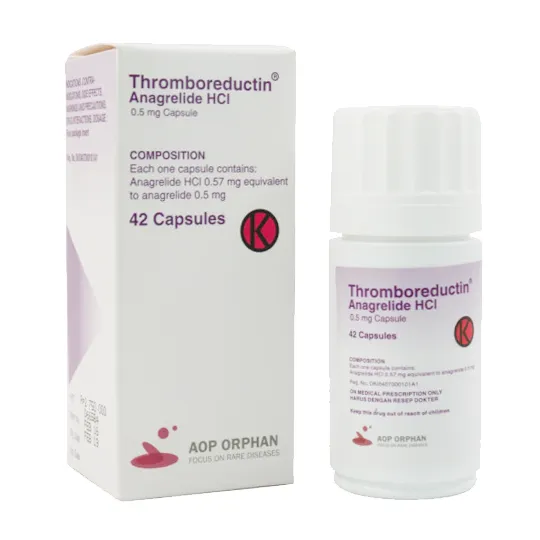
Table of Contents
Package leaflet: Information for the user
Thromboreductin, 0.5 mg hard capsules
Anagrelide
Please read all of this leaflet carefully before taking this medicine, because it contains
important information for you.
- Keep this leaflet as you may need to read it again.
- If you have any questions, please consult your doctor.
- This medicine has been prescribed for a specific individual. Do not share it with others. This medicine may harm others, even if their symptoms are the same.
- If you experience any adverse reactions, including any adverse reactions not listed in this leaflet, inform your doctor or pharmacist. See section 4.
Leaflet contents
- What Thromboreductin is and what it is used for
- Important information before taking Thromboreductin
- How to take Thromboreductin
- Possible side effects
- How to store Thromboreductin
- Contents of the pack and other information
1. What Thromboreductin is and what it is used for
Thromboreductin is indicated for the treatment of essential thrombocythaemia. The decision on treatment should be made individually for each patient, depending on platelet count, patient's age, clinical symptoms and medical history, rate of increase in platelet count after diagnosis, concomitant diseases and thrombotic risk factors, as well as current treatments, e.g. hydroxyurea or interferon α.
2. Important information before using Thromboreductin
When not to use Thromboreductin
- if the patient is allergic to anagrelide or any of the other ingredients of this medicine (listed in section 6)
- if the patient has grade 3 cardiovascular disorders with an unfavorable benefit-to-risk ratio or grade 4 (according to South West Oncology Group toxicity criteria)
- if the patient has severe renal impairment (creatinine clearance < 30 ml/min)
- if the patient has moderate or severe hepatic impairment.
Warnings and precautions
Before starting treatment with Thromboreductin, consult a doctor:
- If the patient has or is suspected of having a heart condition;
- If the patient has congenital or family history of prolonged QT interval (visible on ECG, the recording of the heart's electrical activity), or if the patient is taking other medicines that may cause ECG changes, or if the patient has low levels of electrolytes such as potassium, magnesium or calcium (see section "Thromboreductin with other medicines");
- If the patient has liver or kidney problems.
Thromboreductin should be taken exactly at the dose prescribed by the doctor.
Do not stop taking this medicine without first consulting your doctor. Do not abruptly
discontinue this medicine without consulting your doctor. Sudden discontinuation of the medicine may
increase the risk of stroke or heart attack.
Symptoms of stroke may include sudden numbness or weakness of the face, arm or leg, especially on one side of the body; sudden confusion, difficulty speaking or understanding speech; sudden vision problems in one or both eyes; sudden difficulty walking, dizziness, loss of balance or lack of coordination; and sudden severe headache with no known cause. Seek immediate medical help.
Symptoms of heart attack may include pain or discomfort in the chest, feeling of weakness, dizziness or fainting, pain or discomfort in the jaw, neck, back, one or both arms or shoulders, shortness of breath. Seek immediate medical help.
Elderly patients
Exercise caution in elderly patients with cardiovascular disorders.
Children and adolescents
Anagrelide has been administered to a small number of children under 16 years of age. It appears that there are no major differences in dosing compared to treatment in adults.
Thromboreductin with other medicines
Inform your doctor about all medicines currently used, recently used, or planned to be used.
The following medicines have been used concomitantly with Thromboreductin:
acetylsalicylic acid – used to treat pain and fever, also as an anti-inflammatory
acetaminophen, also known as paracetamol – used as an analgesic and antipyretic
beta-blockers – used, among others, in the treatment of arterial hypertension
angiotensin-converting enzyme (ACE) inhibitors – used in the treatment of arterial hypertension
clopidogrel – used as an antithrombotic agent
coumarin – used as an anticoagulant
folic acid, a vitamin of the B group
amlodipine – used in the treatment of arterial hypertension
carbamazepine – used in the treatment of epilepsy
hydrochlorothiazide – a diuretic used in the treatment of arterial hypertension
indapamide – a diuretic used in the treatment of arterial hypertension
furosemide – a diuretic used in the treatment of arterial hypertension
iron preparations – used in case of deficiency of this element
isosorbide mononitrate – used in coronary artery disease to terminate angina attacks
L-thyroxine – used in the treatment of hypothyroidism
simvastatin – a lipid-regulating medicine
ticlopidine – an antiplatelet agent
ranitidine – used in the treatment of gastric and duodenal ulcers
hydroxyurea – used in the treatment of blood disorders such as polycythemia vera
allopurinol – used in the treatment of gout
digoxin – used in the treatment of heart failure.
Except for acetylsalicylic acid (increased risk of bleeding), no significant interactions have been observed.
Inform your doctor if you are taking medicines that may affect heart rhythm.
Theoretically, medicines such as fluvoxamine (used in the treatment of depression) and omeprazole (used in the treatment of gastric and duodenal ulcers) could adversely affect the elimination of anagrelide from the body. Anagrelide exhibits some limited inhibitory activity against the CYP1A2 enzyme, which theoretically may pose a risk of interaction with other concomitantly administered medicines that use the same elimination pathway, e.g. theophylline (used in the treatment of asthma).
Anagrelide may enhance the effects of medicines with similar properties, such as inotropic agents (stimulating heart function): milrinone, enoximone, amrinone, olprinone or cilostazol – a medicine used in the treatment of peripheral arterial disease.
Anagrelide may cause gastrointestinal disturbances in some patients and may reduce the absorption of oral hormonal contraceptives.
Thromboreductin with food and drink
Food delays the absorption of anagrelide, but does not significantly alter its overall effect on the body.
Grapefruit juice has been shown to delay the elimination of anagrelide from the body.
Pregnancy and breastfeeding
There are insufficient data on the use of anagrelide in pregnant women. Animal studies, in which very high doses of the medicine were administered, showed harmful effects on reproduction.
Therefore, the use of Thromboreductin during pregnancy is not recommended. If Thromboreductin is used during pregnancy or if pregnancy is diagnosed during treatment, the patient should be informed of the potential risk to the fetus.
Women of childbearing potential should use effective contraceptive methods during treatment with Thromboreductin.
It is unknown whether anagrelide passes into human breast milk. Given that many medicines pass into human milk and the possibility of adverse effects in breastfed infants, patients should discontinue breastfeeding during treatment with Thromboreductin.
Driving and operating machinery
Patients should be advised not to drive or operate machinery if dizziness occurs during treatment with this medicine.
Thromboreductin contains lactose
If the patient has previously been diagnosed with an intolerance to certain sugars, the patient should contact the doctor before taking this medicine.
3. How to use Thromboreductin
Treatment with anagrelide should be initiated by physicians experienced in the management of
essential thrombocythemia.
Thromboreductin is individually dosed for each patient. The physician will start treatment with a dose of 0.5 mg per day during the first week, then increase the dose weekly by 0.5 mg per day until the desired therapeutic response is achieved.
Usually, the response to treatment occurs within 2 weeks of using doses ranging from 1 mg to 3 mg per day. The total daily dose should be administered in two divided doses (every 12 hours) or three divided doses (every 8 hours).
The total daily dose must not exceed 5 mg.
The physician will systematically monitor treatment outcomes. During initiation of therapy, platelet counts will be monitored weekly until optimal response is achieved (normalization of platelet count or reduction to < 600,000/microL, or a 50% reduction); thereafter, platelet counts will be monitored at regular intervals.
When switching from previously used medications (e.g., hydroxyurea or interferon \α) to anagrelide, or when combining anagrelide with other agents, the physician will initiate the new medication(s) before discontinuing the previously used therapy.
Anagrelide is intended for long-term use.
After discontinuation of the drug, platelet counts return to pre-treatment levels within a few days.
If resistance to anagrelide therapy occurs, the physician will consider alternative treatment approaches. Platelet counts should be monitored regularly during treatment.
Caution is advised in patients with cardiovascular disorders.
Limited data are available in patients with renal or hepatic impairment; therefore, the physician will use anagrelide only after careful assessment of the risk-benefit ratio.
Use in elderly patients
Anagrelide has been used in a limited number of elderly patients. The physician will use anagrelide with caution in elderly patients, particularly those with cardiovascular disorders.
Use in children and adolescents
Use in children: Anagrelide has been used in a limited number of children under 16 years of age. There appear to be no major differences in dosing compared to adult patients.
Overdose of Thromboreductin
In case of overdose, close clinical monitoring is required, including monitoring of blood platelet counts to detect thrombocytopenia. The dose should be reduced or the drug discontinued, depending on the clinical situation, until platelet counts return to normal.
Missed dose of Thromboreductin
Do not take a double dose to make up for a missed dose.
Discontinuation of Thromboreductin
Platelet counts return to pre-treatment levels within a few days.
If you feel the effect of the medicine is too strong or too weak, consult your physician.
4. Possible adverse reactions
Like all medicines, this medicine can cause adverse reactions, although not everyone will experience them.
If you experience any worrying symptoms, consult your doctor.
Seek immediate medical advice from your doctor or go to the nearest hospital emergency department
if any of the following symptoms occur:
Uncommon (may occur in up to 1 in 100 people):
- heart failure (symptoms include severe chest pain and shortness of breath);
- ventricular tachycardia (symptoms include very rapid heartbeat and severe chest pain accompanied by shortness of breath);
- pulmonary hypertension (symptoms include shortness of breath, swelling of legs or ankles, lips and skin may turn blue).
Rare (may occur in up to 1 in 1000 people):
- heart attack (symptoms include severe chest pain or discomfort and shortness of breath; see section 2);
- atrial fibrillation (symptoms include very rapid heartbeat and severe chest pain accompanied by shortness of breath);
- angina pectoris (symptoms include severe chest pain due to insufficient blood flow to the heart).
Other adverse reactions that may occur
Very common (may occur in more than 1 in 10 people):
headache.
Common (may occur in up to 1 in 10 people):
anaemia (slight decrease in red blood cells and iron deficiency), petechiae;
localized swelling with fluid (oedema);
dizziness (rarely when getting up or standing from bed), numbness or tingling
in fingers of hands and feet, insomnia;
palpitations (awareness of strong heartbeats, which may be fast or irregular),
tachycardia, arterial hypertension;
nosebleeds;
nausea, diarrhoea, dyspepsia;
rash;
back pain, fatigue.
Uncommon (may occur in up to 1 in 100 people):
decreased platelet count, haemorrhage, subcutaneous haemorrhages;
weight gain;
depression; anxiety, dryness of oral mucous membranes, migraine;
visual disturbances, conjunctivitis;
tinnitus;
heart failure (including congestive heart failure), irregular heartbeat, supraventricular tachycardia, ventricular tachycardia, fainting;
shortness of breath, respiratory tract infection, pulmonary hypertension (symptoms include shortness of breath, swelling of legs or ankles, possible bluish discoloration of lips and skin);
vomiting, bloating, constipation, abdominal pain;
alopecia, pruritus;
muscle pain, joint pain;
renal failure, urinary tract infection;
pain, weakness.
Rare (may occur in up to 1 in 1000 people):
atrial fibrillation, angina pectoris, myocardial infarction, orthostatic hypotension, chest pain at rest (Prinzmetal's angina);
pleural effusion, pneumonia, asthma;
gastritis, loss of appetite;
rash;
nocturia;
increased liver enzyme activity;
influenza-like symptoms, chills, malaise.
Frequency not known (cannot be estimated from available data):
torsade de pointes (a potentially life-threatening condition with rapid, irregular heartbeat);
pulmonary fibrosis;
tubulointerstitial nephritis;
reduced sensation and touch perception (hypoesthesia);
stroke (see section 2).
Reporting of adverse reactions
If any adverse reactions occur, including any adverse reactions not listed in this leaflet, inform your doctor. Adverse reactions can be reported directly to the Department of Monitoring Adverse Drug Reactions at the Office for Registration of Medicinal Products, Medical Devices and Biocidal Products, Al. Jerozolimskie 181C, 02-222 Warsaw, phone: +48 22 49 21 301, fax: +48 22 49 21 309, website: https://smz.ezdrowie.gov.pl
Adverse reactions may also be reported to the marketing authorization holder.
Reporting adverse reactions helps to provide more information on the safety of the medicine.
5. How to store Thromboreductin
Keep the medicine out of sight and reach of children.
Do not use this medicine after the expiry date stated on the packaging.
Do not store above 30°C.
Store in the original packaging to protect from light.
6. Contents of the pack and other information
What Thromboreductin contains
- The active substance is anagrelide in the form of anagrelide hydrochloride. One hard capsule contains 0.5 mg of anagrelide.
- Other components of the medicine are: monohydrate lactose, povidone, crospovidone (type A), microcrystalline cellulose (type 102), magnesium stearate, coating: titanium dioxide (E 171), indigo carmine (E 132), gelatin, purified water.
What Thromboreductin looks like and contents of the pack
Blue hard capsules filled with white powder.
The container with a screw cap contains 100 capsules, in a cardboard box.
Marketing Authorisation Holder and Manufacturer
AOP Orphan Pharmaceuticals GmbH
Leopold-Ungar-Platz 2
1190 Vienna, Austria
For further information, please contact the representative of the Marketing Authorisation Holder:
AOP Orphan Pharmaceuticals Poland Sp. z o.o.
Olkuska 7 Street
02-604 Warsaw, Poland