Thiopental vuab
Poland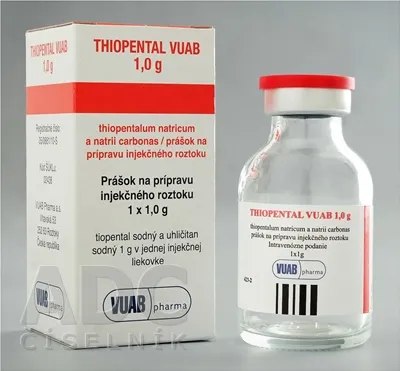
Table of Contents
- Package leaflet: Information for the patient
- 2. Important information before use of Thiopental VUAB
- 3. How to use Thiopental VUAB
- 4. Possible adverse reactions
- 5. How to store Thiopental VUAB
- 6. Contents of the packaging and other information
- Information intended exclusively for medical professionals:
Package leaflet: Information for the patient
Thiopental VUAB 0.5 g, powder for solution for injection
Thiopental VUAB 1.0 g, powder for solution for injection
Sodium thiopental
Please read all of this leaflet carefully before the medicine is administered.
- Keep this leaflet. You may need to read it again.
- If you have any further questions, ask your doctor or pharmacist.
- This medicine has been prescribed for a specific individual. Do not pass it on to others. It may harm someone else, even if their symptoms are the same.
- If you experience any side effects, including any not listed in this leaflet, tell your doctor. See section 4.
Contents of the leaflet:
- What Thiopental VUAB is and what it is used for
- Important information before use of Thiopental VUAB
- How to use Thiopental VUAB
- Possible side effects
- How to store Thiopental VUAB
- Contents of the pack and other information
1. What Thiopental VUAB is and what it is used for
Thiopental VUAB is a medicine in the form of a powder for solution for injection, containing as the active substance sodium thiopental in a quantity of 500 mg or 1000 mg.
Thiopental VUAB is an anaesthetic agent belonging to the barbiturate group and is used:
- as a single anaesthetic agent for short surgical procedures,
- for induction of general anaesthesia prior to the use of other anaesthetic agents,
- as an adjunct to local anaesthesia,
- to provide hypnotic effect during balanced anaesthesia with other agents used to achieve analgesia or muscle relaxation,
- to control convulsive states occurring during or after inhalational anaesthesia, local anaesthesia, or due to other causes,
- in patients after neurosurgical procedures with increased intracranial pressure, provided adequate ventilation is ensured.
Thiopental VUAB should be used only by specialists in the field of anaesthesiology.
2. Important information before use of Thiopental VUAB
When not to use Thiopental VUAB
Do not use Thiopental VUAB if the patient has any of the following conditions:
- hypersensitivity to sodium thiopental or to other barbiturates (medicines used in patients with convulsions and for anaesthesia), or to any of the other components of this medicine (listed in section 6);
- porphyria (a severe disease caused by a disorder in haemoglobin synthesis);
- anticipated difficulties in maintaining airway patency and lack of equipment for immediate resuscitation;
- asthmatic state (life-threatening breathing difficulties due to airway constriction);
- history of difficult emergence from anaesthesia.
In case of rectal administration:
- intestinal tumours and inflammatory bowel diseases;
- local inflammatory conditions or irritation of the anus;
- severe thrombocytopenia (markedly reduced platelet count).
Warnings and precautions
Before starting treatment with Thiopental VUAB, discuss it with your doctor.
During administration of Thiopental VUAB, equipment and medicines for resuscitation, endotracheal intubation, and oxygen must be readily available, and airway patency must be maintained throughout.
Thiopental VUAB may be used only with special caution in the following cases:
- hypovolemia (low circulating blood volume due to blood or fluid loss);
- cardiovascular diseases (heart muscle disease, valvular stenosis, pericarditis, cardiac tamponade, congestive heart failure, ischemic heart disease, QT prolongation and heart block, high resting potential or myocardial ischemia), and other circulatory disorders (malignant hypertension);
- hypotension (low blood pressure) or shock (sudden circulatory failure);
- obstructive respiratory disease (breathing difficulties due to airway narrowing, e.g. in bronchial asthma or obstructive lung disease);
- impaired respiratory function, airway obstruction;
- liver or kidney disease;
- muscle weakness or degeneration (myasthenia gravis, myotonic dystrophy);
- metabolic disorders (myxoedema, adrenal insufficiency);
- endocrine disorders (including hyperfunction of the pituitary, thyroid, adrenal glands, or pancreas);
- paralysis or weakness of the eye muscles;
- sublingual abscess, sepsis (systemic infection);
- obesity.
Before administering Thiopental VUAB, inform the doctor if any of the above conditions apply to the patient, as dose adjustment may be necessary.
In such cases, Thiopental VUAB may be used only if all prerequisites are met, including availability of personnel and equipment to manage possible emergencies such as respiratory failure and respiratory arrest.
Particular caution is required when using Thiopental VUAB in clinical conditions where prolongation or intensification of the hypnotic effect may occur (e.g. excessive premedication, Addison's disease, elevated blood urea levels, severe anaemia).
If injection is accidentally administered intra-arterially or extravascularly, tissue necrosis (tissue death) or severe painful neuritis may occur.
Use of Thiopental VUAB may lead to dependence.
Thiopental VUAB and other medicines
Tell your doctor, pharmacist, or nurse about all medicines currently taken or recently taken by the patient, including those available without a prescription.
The following medicines affect the action of Thiopental VUAB or are affected by Thiopental VUAB:
- aminophylline (a medicine used in bronchial asthma),
- diazoxide (a medicine used in pancreatic disorders),
- midazolam (a sedative),
- opioid analgesics (used for severe pain),
- probenecid (a medicine used in gout),
- metoclopramide (an antiemetic).
Taking Thiopental VUAB with food, drink and alcohol
Before and after anaesthesia, under no circumstances should any food or drink containing alcohol be consumed.
Pregnancy and breast-feeding
Pregnancy
Thiopental VUAB crosses the placenta. Therefore, Thiopental VUAB should not be administered to pregnant women except when the physician determines that the expected benefit to the mother outweighs the potential risk to the foetus.
Breast-feeding
Thiopental VUAB is excreted in human milk; therefore, breast-feeding should be avoided for 24 hours after administration of this medicine.
Driving and using machines
Thiopental VUAB has a major influence on the ability to drive and use machines; therefore, patients must not perform these activities. Ask your doctor how long these precautions should be maintained.
Thiopental VUAB contains sodium
Thiopental VUAB 0.5 g contains 43.51 mg of sodium (main component of table salt) per vial. This corresponds to 2.2% of the maximum recommended daily dietary sodium intake for adults.
Thiopental VUAB 1 g contains 87.02 mg of sodium (main component of table salt) per vial. This corresponds to 4.4% of the maximum recommended daily dietary sodium intake for adults.
The medicine may be dissolved in 0.9% sodium chloride solution. The sodium content from the solvent should be taken into account when calculating the total sodium content in the prepared medicine solution. For precise information on the sodium content in the solvent used to prepare the medicine, refer to the patient leaflet of the solvent used.
3. How to use Thiopental VUAB
Thiopental VUAB is administered by a physician in a hospital setting. The medicine should be used according to the dosage recommendations provided below or as directed by the physician.
The dose of Thiopental VUAB should be individually adjusted for each patient depending on age, sex, body weight, and the desired depth of anesthesia.
Concentrations of the medicine used for intravenous administration range from 2.5% to 5.0%. The most commonly used concentration is 2.5% (500 mg in 20 mL). The 5% solution (500 mg in 10 mL) is used only in exceptional circumstances.
Use in anesthesia
Healthy adults: 4 – 6 mg/kg body weight
Infants and children: 5 – 7 mg/kg body weight
Elderly patients: 2 – 3 mg/kg body weight
Use in convulsive states
Immediately after the onset of convulsions, administer 75 mg to 125 mg (3 mL to 5 mL of 2.5% solution).
Use in patients following neurosurgical procedures with increased intracranial pressure
Thiopental VUAB is administered in interrupted bolus doses of 1.5 to 3 mg/kg body weight.
The maximum single dose is 1 g.
The maximum daily dose is 2 g.
It is recommended to administer intravenously a small test dose of 25 to 75 mg (1 to 3 mL of 2.5% solution) to assess tolerance or to check whether the patient shows hypersensitivity to thiopental, followed by a pause in administration to observe the patient's reaction for approximately 60 seconds.
Thiopental VUAB is administered exclusively by intravenous route in adult patients, and additionally by rectal route in children. Thiopental VUAB should be used only by anesthesia specialists.
The medicine is administered by slow injection to minimize respiratory depression and the risk of overdose.
Administration of a higher than recommended dose of Thiopental VUAB
Thiopental VUAB is administered by a physician or under medical supervision, so it is unlikely that a patient would receive an excessive dose. Nevertheless, if a patient receives a higher dose of Thiopental VUAB than recommended, a sudden drop in blood pressure may occur, potentially leading to shock. In addition, overdose may cause breathing difficulties (respiratory arrest), which may be life-threatening unless the patient is connected to artificial ventilation.
If you have any further questions about the use of this medicine, consult your physician.
4. Possible adverse reactions
Like all medicines, this medicine can cause adverse reactions, although not everybody will experience them.
Common (may occur in up to 1 in 10 patients):
- slow heart rate, low blood pressure, heart rhythm disorders;
- shallow breathing with reduced respiratory rate, leading to respiratory arrest, difficult breathing (bronchospasm), laryngospasm, cough;
- sensation of coldness/trembling.
Frequency unknown (frequency cannot be estimated from available data):
- sudden, life-threatening, whole-body allergic reactions (anaphylactic reactions);
- low blood potassium levels during drug administration and high blood potassium levels after discontinuation of the drug.
Following rectal administration of the medicine, the following adverse reactions may occur:
irritation of the rectum, involuntary defecation, prolonged drowsiness, nausea, vomiting, motor incoordination.
Reporting of adverse reactions
If any adverse reactions occur, including any adverse reactions not listed in this leaflet, inform your doctor, pharmacist, or nurse.
Adverse reactions can be reported directly to the Department of Monitoring Adverse Drug Reactions, Office for Registration of Medicinal Products, Medical Devices and Biocidal Products, Al. Jerozolimskie 181C, 02-222 Warsaw, phone: (22) 49 21 301, fax: (22) 49 21 309, website: https://smz.ezdrowie.gov.pl
Adverse reactions can also be reported to the marketing authorization holder.
Reporting adverse reactions helps to provide more information on the safety of the medicine.
5. How to store Thiopental VUAB
Keep this medicine out of the sight and reach of children.
Do not use Thiopental VUAB after the expiry date stated on the packaging after EXP.
The expiry date refers to the last day of the stated month.
No special storage conditions apply for this medicine.
For single use only after reconstitution.
After reconstitution:
The medicine should be used immediately after preparation. If not used immediately,
the user is responsible for the storage time and conditions prior to administration,
which must not exceed 24 hours at a temperature of 2°C to 8°C.
Any unused solution must be discarded after 24 hours. Prepared solutions must not be sterilized by steam.
Solutions that may be used as solvents are water for injections or 0.9% sodium chloride solution.
After reconstitution, the medicine is a clear, yellowish solution and practically free of undissolved particles. The powder dissolves within a few seconds after adding the appropriate solvent.
Medicines must not be disposed of via wastewater or household waste. Unused medicines will be properly disposed of by healthcare professionals. This helps protect the environment.
6. Contents of the packaging and other information
What Thiopental VUAB contains
The active substance is sodium thiopental.
One vial of Thiopental VUAB 0.5 g contains 530 mg of sodium thiopental and sodium carbonate,
equivalent to 500 mg of sodium thiopental.
One vial of Thiopental VUAB 1.0 g contains 1060 mg of sodium thiopental and sodium carbonate,
equivalent to 1000 mg of sodium thiopental.
The other ingredient is: sodium carbonate.
What Thiopental VUAB looks like and contents of the pack
Thiopental VUAB is a yellowish-white powder.
The vial is made of colourless glass (Type II class) with a bromobutyl rubber stopper and an aluminium seal or aluminium cap, with a plastic "tear-off" cap, packed in a cardboard box.
Thiopental VUAB 0.5 g: the pack contains 1 vial with a grey closure.
Thiopental VUAB 1.0 g: the pack contains 1 vial with a red closure.
Marketing Authorisation Holder:
VUAB Pharma a.s.
Vltavska 53
252 63 Roztoky
Czech Republic
Manufacturer:
VUAB Pharma a.s.
Vltavská 53
252 63 Roztoky
Czech Republic
Information intended exclusively for medical professionals:
Special precautions regarding preparation of the medicinal product for use
The following solutions may be used as solvents: water for injections or 0.9% sodium chloride solution.
Thiopental VUAB does not contain a bacteriostatic agent; therefore, particular care must be taken during preparation and handling of the solution to prevent microbial contamination.
After reconstitution, the product is a clear, yellowish solution, practically free from undissolved particles. The powder dissolves within a few seconds after adding the appropriate solvent.
The solution for administration to the patient is prepared by adding the solvent, according to the information contained in the tables below, followed by shaking to dissolve the contents of the vial.
CALCULATIONS FOR DIFFERENT CONCENTRATIONS FOR INTRAVENOUS ADMINISTRATION
| Concentration (%) | Amount to be administered (mg thiopental) | mL of solvent |
| 2.5 | 500 | 20 |
| 5.0 | 500 | 10 |
| 5.0 | 1000 | 20 |
Rectal administration (in children)
A 5% or 10% solution of thiopental at a dose of 25–40 mg/kg body weight is administered rectally
to induce general anesthesia in children.
Special precautions during storage
Original packaging: no special recommendations for storage of the medicinal product.
Fresh solutions of Thiopental VUAB should be prepared and used immediately.
Unused solution must be discarded within 24 hours. Prepared solutions must not be sterilized by steam.
Stability after reconstitution
Chemical and physical stability of reconstituted solutions has been demonstrated for 24 hours at
2°C–8°C.
From a microbiological point of view, the product should be used immediately. If not used
immediately, the user is responsible for the storage time and conditions prior to use, which should
not exceed 24 hours at 2°C–8°C, unless the preparation was carried out under controlled
aseptic conditions.
Overdose
Overdose may occur due to too rapid injection or repeated injections. This may result in:
sudden drop in blood pressure, apnea, sporadic laryngospasm, cough, and other respiratory
disturbances, including respiratory depression. Cardiovascular collapse may also occur; treatment
should aim at restoring normal blood volume through appropriate measures: increasing fluid
volume and/or administering vasoconstrictors.
In case of suspected or evident overdose, administration of the medicinal product should be
discontinued, airways should be cleared (intubation if necessary), or their patency maintained as
needed, and oxygen should be administered using assisted ventilation.