Thiogamma turbo-set
Poland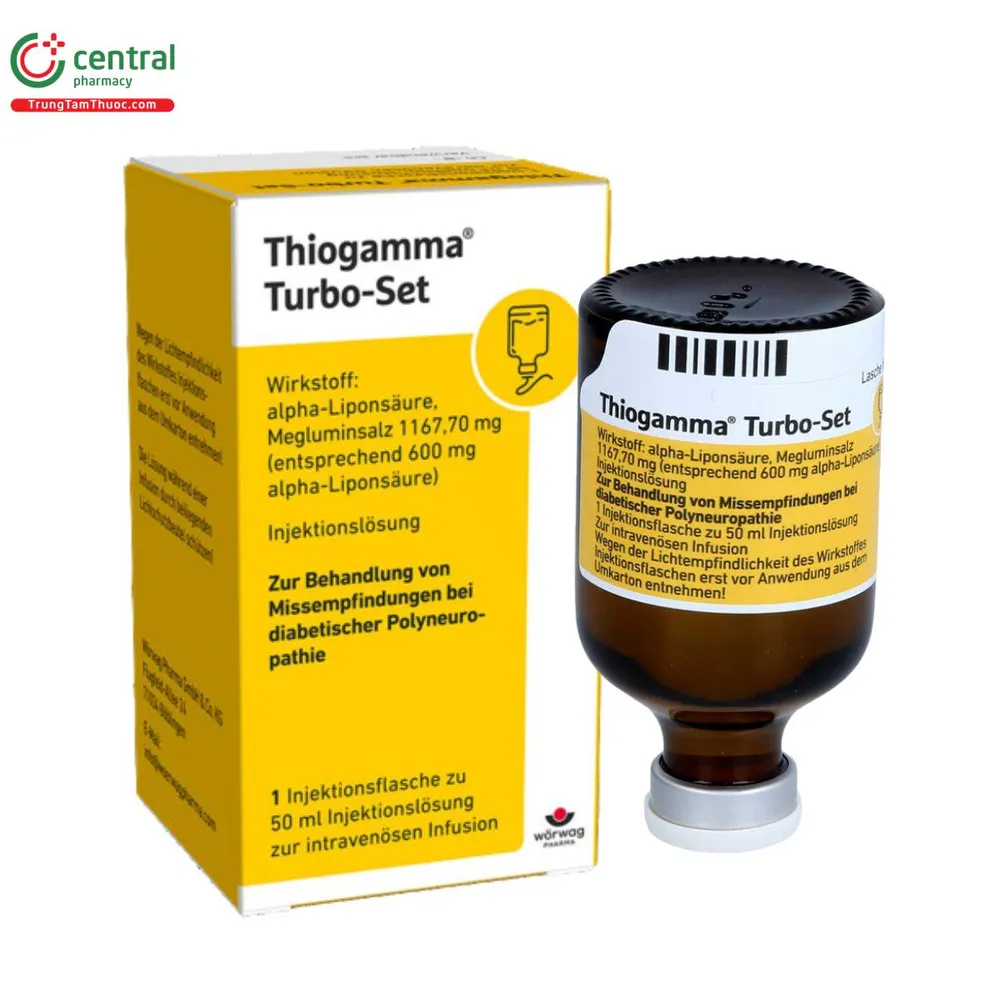
Table of Contents
- Package leaflet: Information for the patient
- 1. What Thiogamma Turbo-Set is and what it is used for
- 2. Important information before using Thiogamma Turbo-Set
- 3. How to use Thiogamma Turbo-Set
- 4. Possible adverse reactions
- 5. How to store Thiogamma Turbo-Set
- 6. Contents of the pack and other information
- Information intended exclusively for healthcare professionals:
Package leaflet: Information for the patient
Thiogamma Turbo-Set,
600 mg/50 ml, infusion solution
(Acidum thiocticum)
Please read all of this leaflet carefully before starting treatment, because it contains
important information for the patient.
- Keep this leaflet for future reference.
- Consult your doctor, pharmacist, or nurse if you have any questions.
- This medicine has been prescribed for a specific individual. Do not pass it on to others.
- It may harm other people, even if their symptoms are the same.
- If any adverse reactions occur, including any possible adverse reactions not listed in this leaflet, inform your doctor or nurse immediately. See section 4.
Table of contents:
- What Thiogamma Turbo-Set is and what it is used for
- Important information before using Thiogamma Turbo-Set
- How to use Thiogamma Turbo-Set
- Possible side effects
- How to store Thiogamma Turbo-Set
- Contents of the pack and other information
1. What Thiogamma Turbo-Set is and what it is used for
The active substance in Thiogamma Turbo-Set is thioctic acid. This substance is naturally produced
in the human and animal body. Thioctic acid influences many metabolic processes. In addition,
thioctic acid acts as an antioxidant.
Thiogamma Turbo-Set is used in the treatment of pain and paraesthesia (sensory symptoms such as
burning, prickling, itching, or tingling) associated with diabetic neuropathy (nerve damage due to diabetes).
2. Important information before using Thiogamma Turbo-Set
When not to use Thiogamma Turbo-Set
- if the patient is allergic to thioctic acid or any of the other ingredients of this medicine (listed in section 6).
- if the patient has liver or kidney failure.
- in children and adolescents.
Warnings and precautions
- Hypersensitivity reactions, including anaphylactic shock, have occurred during parenteral administration of Thiogamma Turbo-Set. For this reason, the physician will order appropriate monitoring of the patient. If early symptoms occur (e.g. itching, nausea, malaise), the physician will order discontinuation of treatment and, if indicated, initiation of alternative therapy.
- Thioctic acid may cause hypoglycemia. In diabetic patients, the physician will order monitoring of blood glucose levels.
- In patients with unbalanced or poorly controlled diabetes and in those in poor general condition, severe anaphylactic reactions may occur in individual cases during treatment with this medicine.
- Thioctic acid may induce autoimmune insulin syndrome and may cause cholestatic hepatitis.
- Patients with a specific human leukocyte antigen genotype (more common in patients from Japan and Korea, but also found in Caucasian individuals) are more susceptible to developing autoimmune insulin syndrome (a disorder affecting hormones regulating blood glucose levels, with visible reduction in glucose levels) during treatment with thioctic acid.
Children and adolescents
Thiogamma Turbo-Set should not be used in children and adolescents due to lack of clinical data in this patient group.
Other medicines and Thiogamma Turbo-Set
Inform your physician about all medicines currently used or recently taken, as well as any medicines planned for future use.
Exercise particular caution when using any of the following medicines:
- Cisplatin (a drug used in anticancer chemotherapy) – concomitant use of Thiogamma Turbo-Set with cisplatin may reduce the efficacy of cisplatin.
- Insulin and other oral antidiabetic drugs – the glucose-lowering effect of antidiabetic agents may be enhanced. Close monitoring of blood glucose levels is recommended, especially at the beginning of treatment with Thiogamma Turbo-Set. In individual cases, to avoid symptoms of excessive reduction in blood glucose levels, it may be necessary to reduce the dose of insulin or other oral antidiabetic agent.
Thiogamma Turbo-Set with food, drink, and alcohol
Alcohol consumption must be strictly avoided during treatment with Thiogamma Turbo-Set. Alcohol increases the risk of disease development and progression, may cause nerve damage, and may weaken the effect of the medicine. This also applies to periods between treatments.
Pregnancy, breastfeeding, and fertility
There are no data on the use of thioctic acid in pregnant women. Use of Thiogamma Turbo-Set is not recommended in pregnant women or in women of childbearing potential who are not using effective contraception.
It is unknown whether thioctic acid passes into breast milk. Thiogamma Turbo-Set should not be used during breastfeeding.
Driving and operating machinery
No studies have been conducted on the effects of thioctic acid on the ability to drive vehicles or operate mechanical equipment.
3. How to use Thiogamma Turbo-Set
This medicine should always be used as directed by the physician. The physician determines the dosage and treatment regimen appropriate for the individual patient. In case of doubt, consult the physician.
Treatment of diabetic polyneuropathy should be initiated and supervised by experienced specialist physicians skilled in the diagnosis and treatment of neuropathy, according to current standards.
Detailed dosage instructions, as well as directions for use and preparation of the medicine for administration, are provided at the end of this leaflet under the section "Information intended exclusively for healthcare professionals".
Optimal metabolic control of diabetes is a fundamental requirement in the treatment of diabetic polyneuropathy.
If the effect of Thiogamma Turbo-Set is too strong or too weak, consult your physician or pharmacist.
Use of a higher than recommended dose of Thiogamma Turbo-Set
If the patient suspects having received an excessive dose of the medicine, the physician should be informed immediately.
In cases of overdose, nausea, vomiting, and headache may occur.
After significant overdose of thioctic acid, particularly when combined with alcohol, severe poisonings have been observed, some of which were fatal. Clinical symptoms of poisoning initially include psychomotor agitation or disturbances of consciousness, followed by generalized seizures and lactic acidosis. As a consequence of poisoning with high doses of thioctic acid, cases of hypoglycemia, shock, rhabdomyolysis, hemolysis, disseminated intravascular coagulation (DIC), bone marrow dysfunction, and multi-organ failure have also been observed.
Management in case of poisoning
Even if there is only suspicion of a significant overdose of thioctic acid, immediate hospitalization is required, where general procedures for managing poisoning will be implemented.
Detailed information on management in case of poisoning is provided at the end of this leaflet under the section "Information intended exclusively for healthcare professionals".
Missed dose of Thiogamma Turbo-Set
If the patient suspects that a dose of Thiogamma Turbo-Set has been missed, inform the physician as soon as possible.
Do not take a double dose to make up for a missed dose.
In case of any further doubts regarding the use of this medicine, consult the physician.
Discontinuation of Thiogamma Turbo-Set
Do not discontinue using Thiogamma Turbo-Set without consulting your physician.
In case of any further doubts regarding the use of this medicine, consult your physician or pharmacist.
4. Possible adverse reactions
Like all medicines, this medicine can cause adverse reactions, although not everybody will experience them.
The following adverse reactions may occur after intravenous administration of thioctic acid:
Very rare adverse reactions (occurring in fewer than 1 in 10,000 patients):
- coagulation disorders,
- excessive decrease in blood glucose concentration (hypoglycaemia) (symptoms described include dizziness, profuse sweating, headache, visual disturbances),
- taste disturbances or changes,
- seizures,
- double vision,
- purpura,
- reactions at the site of administration.
Adverse reactions with unknown frequency:
- systemic allergic reactions including anaphylactic shock,
- sensation of pressure in the head (after rapid intravenous administration),
- autoimmune insulin syndrome,
- allergic skin reactions with urticaria, pruritus, eruptions and rashes,
- respiratory failure (after rapid intravenous administration),
- dizziness,
- disturbances of hormones regulating blood glucose concentration with a noticeable decrease in these concentrations in blood (autoimmune insulin syndrome).
Cases of autoimmune insulin syndrome and cholestatic hepatitis have been reported during the use of products containing thioctic acid.
Reporting of adverse reactions
If any adverse reactions occur, including any adverse reactions not listed in this leaflet, inform your doctor, pharmacist, or nurse. Adverse reactions can be reported directly to the Department of Monitoring of Adverse Drug Reactions, Office for Registration of Medicinal Products, Medical Devices and Biocidal Products
Al. Jerozolimskie 181 C
02-222 Warsaw
tel.: +48 22 49 21 301
fax: +48 22 49 21 309
e-mail: [email protected]
Adverse reactions can also be reported to the marketing authorization holder.
Reporting adverse reactions helps to provide more information on the safety of the medicine.
5. How to store Thiogamma Turbo-Set
No special temperature storage requirements.
The medicine should be stored in a place invisible and inaccessible to children.
Due to the high sensitivity to light, the infusion solution must be protected by
storage in the original packaging!
Because of the high sensitivity to light, thioctic acid vials should be removed from the carton
immediately before use! After removal, the vial should be immediately placed into a protective bag!
Do not use this medicine after the expiry date stated on the vial label and carton after:
Exp. The expiry date refers to the last day of the stated month.
Medicines must not be disposed of via wastewater or household waste. Ask your
pharmacist how to dispose of medicines no longer in use. Such measures will help protect
the environment.
6. Contents of the pack and other information
What Thiogamma Turbo-Set contains
- The active substance is thioctic acid. One 50 ml vial of infusion solution contains: 1167.70 mg of thioctic acid with meglumine, corresponding to 600 mg of thioctic acid.
- Other components: meglumine, Macrogol 300, water for injections.
What Thiogamma Turbo-Set looks like and contents of the pack
A 50 ml amber glass vial, closed with a bromobutyl stopper and sealed with a "flip-off cap"
(aluminum part + polypropylene part). The pack consists of a cardboard box containing 1
or 10 vials and 1 or 10 polyurethane bags protecting the vial from light during administration.
Not all pack sizes may be marketed.
Marketing Authorisation Holder and Manufacturer
Marketing Authorisation Holder
Wörwag Pharma GmbH & Co. KG
Flugfeld-Allee 24
71034 Böblingen
Germany
Manufacturer
Solupharm Pharmazeutische Erzeugnisse GmbH
Industriestrasse 3
34212 Melsungen
Germany
Wörwag Pharma GmbH & Co. KG
Flugfeld-Allee 24
71034 Böblingen
Germany
For further information, please contact the representative of the Marketing Authorisation Holder:
Wörwag Pharma Polska sp. z o.o.
ul. Józefa Piusa Dziekońskiego 1
00-728 Warsaw
tel. (+48) 22 863 72 81
fax (+48) 22 877 13 70
Information intended exclusively for healthcare professionals:
Detailed information is provided in the Summary of Product Characteristics.
Thiogamma Turbo-Set,
600 mg/50 ml, solution for infusion
(Acidum thiocticum)
Dosage and method of administration
Treatment of diabetic polyneuropathy should be initiated and supervised by specialists experienced in the diagnosis and treatment of neuropathy, in accordance with current standards.
Dosage
Adults: In severe sensory disturbances associated with diabetic polyneuropathy, the recommended dose is 600 mg of alpha-lipoic acid per day (corresponding to 1 vial of Thiogamma Turbo-Set).
Children and adolescents: Due to lack of clinical experience in this age group, Thiogamma Turbo-Set should not be used.
Renal impairment: Due to lack of clinical data, Thiogamma Turbo-Set should not be used in patients with renal impairment.
Hepatic impairment: Due to lack of clinical data, Thiogamma Turbo-Set should not be used in patients with hepatic impairment.
Method of administration and duration of treatment
Thiogamma Turbo-Set is administered intravenously.
Its use is recommended for 2 to 4 weeks during the initial phase of treatment.
The intravenous solution should be administered slowly as a short infusion over at least 30 minutes. The medicinal product should be administered directly from the vial, using standard infusion equipment and the light-protective bag provided. If necessary, the solution may be diluted with sodium chloride 0.9% before administration. Due to the photosensitivity of the active substance, vials should be removed from the carton immediately before use and protected from light thereafter. A minimum infusion time of 30 minutes should be ensured.
Treatment should be continued with alpha-lipoic acid in tablet form for oral administration.
Optimal metabolic control of diabetes is a fundamental requirement in the treatment of diabetic polyneuropathy.
Overdose
In cases of overdose, nausea, vomiting, and headache may occur. Severe intoxications (some resulting in fatal outcomes) have been observed following oral administration of 10 to 40 grams of alpha-lipoic acid in combination with alcohol. Symptoms of intoxication may include initial psychomotor agitation or disturbances of consciousness, followed by generalized seizures and the development of lactic acidosis. There have been reports of hypoglycemia, shock, rhabdomyolysis, hemolysis, disseminated intravascular coagulation (DIC), bone marrow dysfunction, and multi-organ failure as consequences of alpha-lipoic acid overdose.
Management in case of overdose
Even in cases of suspected alpha-lipoic acid intoxication, immediate hospitalization is recommended, along with implementation of standard procedures for managing poisoning.
Treatment of generalized seizures, lactic acidosis, and all life-threatening consequences of intoxication must be initiated immediately in an intensive care unit and tailored to the patient's symptoms. To date, no established benefit has been demonstrated for hemodialysis, hemoperfusion, or filtration techniques as methods for enhanced elimination of alpha-lipoic acid.
Pharmaceutical incompatibilities
Alpha-lipoic acid reacts in vitro with metal ion complexes (e.g., cisplatin). It forms poorly soluble complexes with sugar molecules (e.g., fructose solution).
Thiogamma Turbo-Set is incompatible with glucose solutions, Ringer's solution, and solutions reacting with SH groups and disulfide bridges.
Thiogamma Turbo-Set is compatible with sodium chloride 0.9% solution.
Special precautions during storage
Due to the high photosensitivity of the drug, Thiogamma Turbo-Set must be protected by storage in the original packaging!
Because of the pronounced photosensitivity of alpha-lipoic acid, vials should be removed from the carton immediately before use! The vial must be immediately placed into the protective bag after removal!
No special temperature storage requirements apply.