Thiogamma
Poland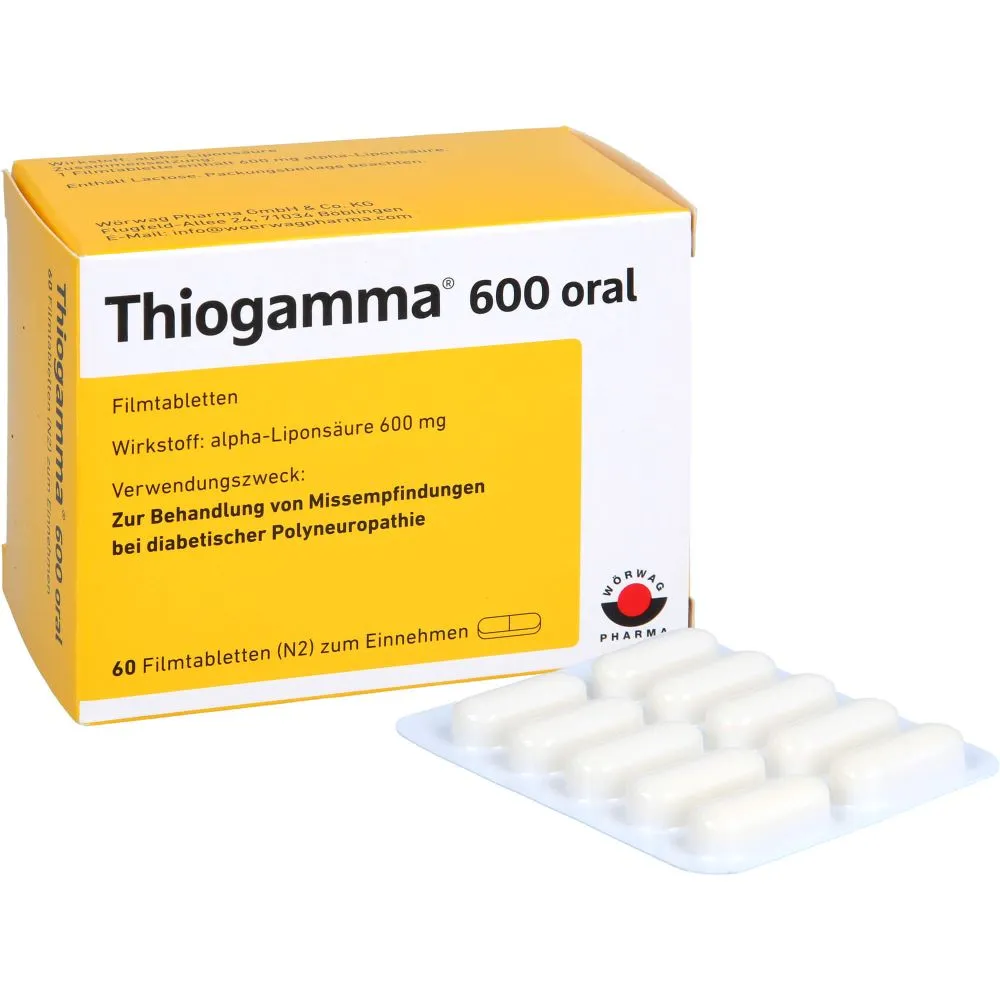
Table of Contents
Package leaflet: Information for the patient
Thiogamma, 600 mg, coated tablets
(Acidum thiocticum)
Please read all of this leaflet carefully before taking this medicine, because it contains
important information for you.
- Keep this leaflet, as you may need to read it again.
- Consult your doctor or pharmacist if you have any doubts.
- This medicine has been prescribed for a specific individual. Do not pass it on to others. The medicine may harm another person, even if their symptoms are the same.
- If any adverse reactions occur, including any possible adverse reactions not listed in this leaflet, inform your doctor or pharmacist. See section 4.
Leaflet contents:
- What Thiogamma is and what it is used for
- Important information before taking Thiogamma
- How to take Thiogamma
- Possible side effects
- How to store Thiogamma
- Contents of the pack and other information
1. What Thiogamma is and what it is used for
The active substance of Thiogamma is thioctic acid. This substance is naturally produced in
the human and animal body. Thioctic acid influences many metabolic processes.
Furthermore, thioctic acid acts as an antioxidant.
Thiogamma is used in the treatment of pain and paresthesia (sensory symptoms such as burning,
pricking, itching, or tingling) associated with diabetic neuropathy (nerve damage due to diabetes).
2. Important information before using Thiogamma
When not to use Thiogamma
Do not use Thiogamma if you are allergic (hypersensitive) to thioctic acid or any of the other
ingredients of this medicine.
Children and adolescents:
Thiogamma should not be given to children and adolescents due to lack of data on the use of
thioctic acid in this age group.
Patients with renal impairment:
Do not use Thiogamma due to insufficient data on the use of this medicine in patients with
renal impairment.
Patients with hepatic impairment:
Do not use Thiogamma due to lack of data on the use of thioctic acid in patients with hepatic
impairment.
Warnings and precautions
Patients with a particular genotype of human leukocyte antigens (more common in patients from
Japan and Korea, but also observed in Caucasian individuals) are more susceptible to developing
autoimmune insulin syndrome (disorders affecting hormones regulating blood glucose levels, with
noticeable reduction in glucose concentrations) during treatment with thioctic acid.
Other medicines and Thiogamma
Tell your doctor or pharmacist about all medicines you are currently taking or have recently taken,
as well as any medicines you plan to take.
Concomitant use of Thiogamma with cisplatin (a drug used in anticancer chemotherapy) reduces
the effectiveness of cisplatin.
Thioctic acid, the active substance in Thiogamma, readily forms chemical complexes with metals;
therefore, it should not be used simultaneously with dairy products (which contain calcium) or
preparations containing metal compounds (such as iron or magnesium supplements), as their
effectiveness may be impaired. If Thiogamma is taken 30 minutes before breakfast, iron and
magnesium supplements may be administered at lunchtime or in the evening.
The effect of antidiabetic medicines (insulin and other oral antidiabetic drugs) that lower blood
glucose levels may be enhanced. Close monitoring of blood glucose levels is recommended,
especially at the beginning of treatment with Thiogamma. To avoid symptoms of hypoglycaemia,
in individual cases it may be necessary to reduce the dose of insulin or other antidiabetic agent.
Thiogamma with food, drink, and alcohol
Thiogamma should be taken approximately 30 minutes before the first meal of the day.
Tablets should be taken with sufficient liquid on an empty stomach (see section 3).
During treatment with Thiogamma, alcohol consumption must be strictly avoided.
Alcohol increases the risk of disease progression, may cause nerve damage, and may reduce the
effectiveness of Thiogamma. This also applies to periods between treatments.
Pregnancy, breastfeeding, and fertility
There are no data on the use of thioctic acid in pregnant women. The use of Thiogamma is not
recommended in pregnant women or in women of childbearing potential who are not using an
effective method of contraception.
It is unknown whether thioctic acid passes into breast milk. Thiogamma should not be used
during breastfeeding.
Children and adolescents
Since clinical study data are not available in children and adolescents, Thiogamma should not be
used in this patient group.
Driving and using machines
No studies on the effect of thioctic acid on the ability to drive vehicles or operate machinery have
been conducted.
Thiogamma contains lactose and sodium
This medicine contains lactose. If you have an intolerance to certain sugars, consult your doctor
before taking this medicine.
The medicine contains less than 1 mmol of sodium (23 mg) per tablet, meaning that the medicine
is considered "sodium-free".
3. How to use Thiogamma
This medicine should always be taken according to the instructions given by your doctor or pharmacist. If in
doubt, consult your doctor or pharmacist.
Treatment of diabetic polyneuropathy should be initiated and supervised by experienced specialist
physicians skilled in the diagnosis and treatment of neuropathy, in accordance with current
standards.
Unless otherwise prescribed by your doctor, the usual daily dose is 1 coated tablet of Thiogamma
(corresponding to 600 mg of thioctic acid) taken approximately 30 minutes before the
first meal of the day. Concomitant food intake may impair the absorption of
thioctic acid into the bloodstream.
The tablet should be taken on an empty stomach. Swallow whole with water.
Optimal metabolic control of diabetes is a fundamental requirement in the treatment of diabetic
polyneuropathy.
Duration of treatment
Since diabetic polyneuropathy is a chronic disease, treatment with Thiogamma may be prescribed
indefinitely. Your doctor will decide how long you should continue taking the medicine.
Use of higher than recommended dose of Thiogamma
If an overdose of Thiogamma is accidentally taken, contact your doctor immediately or go to a
hospital. In case of overdose, nausea, vomiting, and headache may occur.
Severe poisonings have been observed following significant overdoses of thioctic acid, particularly when combined with alcohol, some resulting in death. Clinical symptoms of poisoning include initially psychomotor restlessness or disturbances of consciousness, followed by generalized seizures and lactic acidosis. As a consequence of poisoning with high doses of thioctic acid, cases of hypoglycemia, shock, rhabdomyolysis, hemolysis, disseminated intravascular coagulation (DIC), bone marrow dysfunction, and multi-organ failure have also been observed.
Management in case of poisoning
Even if there is only suspicion of a significant overdose of thioctic acid, immediate hospitalization is required, where general procedures for managing poisoning will be implemented.
Missed dose of Thiogamma
If a dose of the medicine is missed, do not take a double dose to make up for the missed dose.
If you have any further questions about the use of this medicine, consult your doctor or pharmacist.
4. Possible adverse reactions
Like any medicine, this product may cause adverse reactions, although not everyone experiences them.
If any of the adverse reactions listed below occur, discontinue use of
the medicine Thiogamma and consult a doctor. This is very rare, but may require
medical attention.
Adverse reactions can be classified according to the following frequency categories:
| Very common | Occurring in more than 1 in 10 patients |
| Common | Occurring in less than 1 in 10, but more than 1 in 100 patients |
| Uncommon | Occurring in less than 1 in 100, but more than 1 in 1,000 patients |
| Rare | Occurring in less than 1 in 1,000, but more than 1 in 10,000 patients |
| Very rare | Occurring in less than 1 in 10,000 patients, including single cases |
Frequent:
- dizziness
- nausea
Very rare:
- taste disturbances
- vomiting, stomach and intestinal pain, diarrhoea
- allergic reactions such as skin rash, urticaria and itching
- excessive reduction in blood glucose concentration (hypoglycaemia), with the following symptoms described: dizziness, profuse sweating, headache, visual disturbances.
Frequency not known:
- shock
- disorders related to hormones regulating blood glucose concentration, with a visible decrease in these concentrations in blood (autoimmune insulin syndrome)
During the use of products containing intravenous thioctic acid, the following additional adverse reactions have occurred:
double vision, convulsions, thrombopathy, purpura, breathing disorders.
During the use of products containing thioctic acid, cases of autoimmune insulin syndrome and cholestatic hepatitis have been reported.
Reporting of adverse reactions
If any adverse reactions occur, including any adverse reactions not listed in the leaflet, inform your doctor, pharmacist or nurse. Adverse reactions can be reported directly to the Department of Monitoring Adverse Drug Reactions of the Office for Registration of Medicinal Products, Medical Devices and Biocidal Products
Al. Jerozolimskie 181 C
02-222 Warsaw
tel.: + 48 22 49 21 301
fax: + 48 22 49 21 309
e-mail: [email protected]
Adverse reactions can also be reported to the marketing authorisation holder.
Reporting adverse reactions allows the collection of further information on the safety of the medicinal product.
5. How to store Thiogamma
Keep this medicine out of the sight and reach of children.
Do not use this medicine after the expiry date stated on the carton after: Exp.
The expiry date refers to the last day of the stated month.
Store below 25°C. Store in the original packaging.
Medicines must not be disposed of via wastewater or household waste. Ask your pharmacist how to dispose of medicines no longer required. This will help protect the environment.
6. Contents of the pack and other information
What Thiogamma contains
The active substance is thioctic acid.
Each coated tablet contains 600 mg of thioctic acid.
Excipients:
Tablet core: hypromellose, anhydrous colloidal silicon dioxide, microcrystalline cellulose, lactose monohydrate, sodium croscarmellose, talc, dimethicon (viscosity n=350), magnesium stearate;
Coating: macrogol 6000, hypromellose, talc, sodium lauryl sulfate.
Note for diabetics:
1 coated tablet contains less than 0.0041 bread units.
What Thiogamma looks like and contents of the pack
Yellow coated tablets with a division line on both sides.
The medicine is available in packs containing 30, 60 or 100 coated tablets.
Not all pack sizes may be marketed.
Marketing Authorisation Holder
Wörwag Pharma GmbH & Co. KG
Flugfeld-Allee 24
71034 Böblingen
Germany
Manufacturer
Dragenopharm Apotheker Püschl GmbH
Göllstr. 1
84529 Tittmoning
Germany
Wörwag Pharma GmbH & Co. KG
Flugfeld-Allee 24
71034 Böblingen
Germany
Wörwag Pharma Operations Sp. z o.o.
ul. Gen. Mariana Langiewicza 58
95-050 Konstantynów Łódzki
Poland
For further information, please contact the marketing authorisation holder's representative:
Woerwag Pharma Polska sp. z o.o.
ul. Józefa Piusa Dziekońskiego 1
00-728 Warsaw
tel. (+48) 22 863 72 81
fax (+48) 22 877 13 70