Thioctic acid zentiva
Poland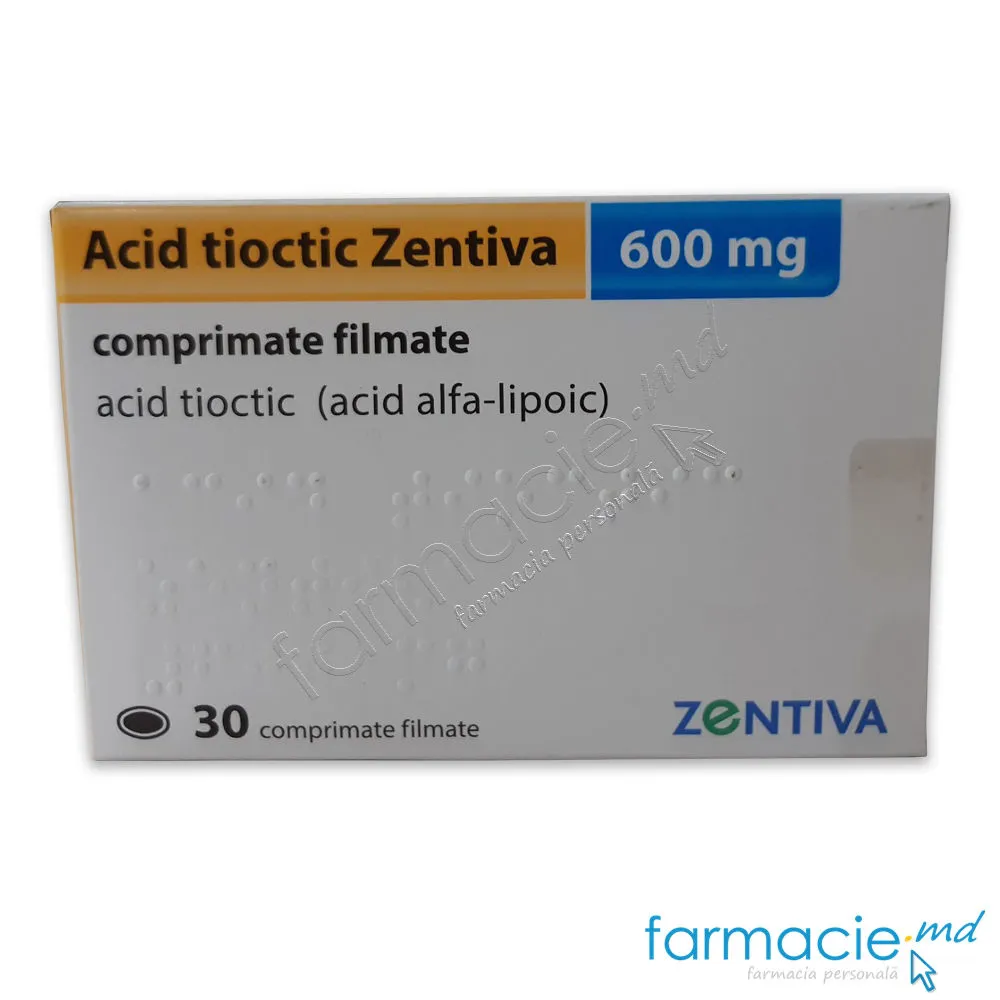
Table of Contents
- Package leaflet: Information for the patient
- 1. What Thioctic acid Zentiva is and what it is used for
- 2. Important information before using Thioctic acid Zentiva
- 3. How to use Thioctic acid Zentiva
- 4. Possible adverse reactions
- 5. How to store Thioctic acid Zentiva
- 6. Contents of the pack and other information
Package leaflet: Information for the patient
Thioctic acid Zentiva, 600 mg, coated tablets
Acidum thiocticum
Please read all of this leaflet carefully before taking this medicine because it contains
important information for you.
- Keep this leaflet. You may need to read it again.
- If you have any further questions, ask your doctor or pharmacist.
- This medicine has been prescribed for you personally. Do not pass it on to others. It may harm them, even if their symptoms are the same as yours.
- If you experience any side effects, including any not listed in this leaflet, tell your doctor or pharmacist. See section 4.
Contents of the leaflet
- What Thioctic acid Zentiva is and what it is used for
- Important information before taking Thioctic acid Zentiva
- How to take Thioctic acid Zentiva
- Possible side effects
- How to store Thioctic acid Zentiva
- Contents of the pack and other information
1. What Thioctic acid Zentiva is and what it is used for
Alpha-lipoic acid, the active substance in Thioctic acid Zentiva, is a substance produced by the body and influences certain metabolic processes. Alpha-lipoic acid has antioxidant properties that protect nerve cells from breakdown products.
Thioctic acid Zentiva is used in the treatment of symptoms of peripheral (sensory-motor) diabetic neuropathy.
2. Important information before using Thioctic acid Zentiva
When not to use Thioctic acid Zentiva
- if the patient is allergic to thioctic acid or any of the other ingredients of this medicine (listed in section 6).
Warnings and precautions
Before starting treatment with Thioctic acid Zentiva, please discuss this with your doctor or
pharmacist.
Patients with a certain human leukocyte antigen genotype (which is more common in Japanese and Korean populations, but also occurs in Caucasian populations) are more susceptible to developing autoimmune insulin syndrome (a disorder affecting hormones regulating serum glucose levels, leading to a marked decrease in blood sugar levels) during treatment with thioctic acid.
The patient may notice a different odour of urine after taking thioctic acid; however, this has no clinical significance.
Children and adolescents
Thioctic acid Zentiva must not be used in children and adolescents due to lack of sufficient clinical data in this age group.
Thioctic acid Zentiva and other medicines
Please inform your doctor or pharmacist about any medicines you are currently taking or have recently taken, as well as any medicines you may take in the future.
Treatment with Thioctic acid Zentiva may neutralize the effect of cisplatin (an anticancer medicine). Alpha-lipoic acid, the active substance in Thioctic acid Zentiva, chemically interacts with metal ions; therefore, it must not be administered simultaneously with substances containing these metals (e.g., iron-containing products, magnesium-containing products, dairy products due to their calcium content). If the patient takes the medicine 30 minutes before breakfast, iron- and magnesium-containing products may be taken at lunchtime or in the evening.
Thioctic acid Zentiva enhances the effect of antidiabetic medicines (insulin and/or other oral antidiabetic medicines) that lower blood serum glucose levels; therefore, regular monitoring of blood glucose levels is required, especially after starting treatment with Thioctic acid Zentiva. In individual cases, it may be necessary to reduce the dose of insulin and/or other oral antidiabetic medicine to avoid symptoms of hypoglycaemia.
Taking Thioctic acid Zentiva with food and drink
Regular alcohol consumption is an important risk factor for the development and progression of neuropathy and therefore also negatively affects the outcome of treatment with Thioctic acid Zentiva. For this reason, patients with diabetes are generally advised to avoid alcohol consumption as much as possible, including during treatment breaks.
Pregnancy and breastfeeding
If the patient is pregnant or breastfeeding, suspects she may be pregnant, or is planning to have a baby, she should consult her doctor or pharmacist before using this medicine.
Pregnancy
Animal studies have not shown any direct or indirect toxic effects on reproduction. Thioctic acid Zentiva should be used during pregnancy only after careful assessment of the benefit-risk ratio of the treatment. Treatment with Thioctic acid Zentiva in pregnant women should be considered only in exceptional cases and under strict medical supervision.
Breastfeeding
It is unknown whether thioctic acid or its metabolites pass into human milk. A decision should be made whether to discontinue breastfeeding or to discontinue therapy with Thioctic acid Zentiva, taking into account the benefits of breastfeeding for the child and the benefits of therapy for the mother.
Fertility
Reproductive toxicity studies have not indicated any risk to fertility.
Driving and operating machinery
There are no data indicating that Thioctic acid Zentiva may impair the ability to drive or operate machinery.
Thioctic acid Zentiva contains lactose
Thioctic acid Zentiva contains lactose (3.125 mg per tablet) as an excipient. If the patient has been diagnosed by a doctor as having an intolerance to certain sugars, he or she should consult the doctor before starting treatment with this medicine.
3. How to use Thioctic acid Zentiva
This medicine should always be used as directed by a physician or pharmacist. If in doubt,
consult a doctor or pharmacist.
The recommended dose is 1 coated tablet of Thioctic acid Zentiva (600 mg of alpha-lipoic acid)
per day. Thioctic acid Zentiva should be taken whole, with liquid, on an empty stomach.
Taking the medicine with food may reduce the absorption of alpha-lipoic acid.
Therefore, it is recommended that the total daily dose be taken half an hour before breakfast,
especially in patients with prolonged digestion.
Since peripheral neuropathy is a chronic condition, long-term treatment with Thioctic acid Zentiva
is required.
The physician will determine the treatment individually.
If the patient feels that the effect of Thioctic acid Zentiva is too weak or too strong,
consult a doctor or pharmacist.
Taking more than the recommended dose of Thioctic acid Zentiva
If an excessive dose is taken, nausea, vomiting, and headache may occur.
In isolated cases, serious, partly life-threatening symptoms of poisoning (including generalized
seizure, acid-base imbalance with accompanying acidosis, and/or severe coagulation disorders)
have been observed after ingestion of more than 10 g of alpha-lipoic acid, particularly when
combined with alcohol.
In case of any suspicion of overdose of Thioctic acid Zentiva (e.g.: >10 tablets of 600 mg in adult
patients and >50 mg/kg body weight in children), the patient should be immediately referred to
hospital and standard treatment procedures for poisoning should be initiated (induction of
vomiting, gastric lavage, activated charcoal administration).
Seizures, acid-base imbalance, and other life-threatening symptoms require intensive therapy.
Missed dose of Thioctic acid Zentiva
Do not take a double dose to make up for a missed dose. Take the next dose at the usual time and
continue treatment as directed by the physician.
Stopping treatment with Thioctic acid Zentiva
Consult a doctor before deciding to discontinue treatment, otherwise symptoms may worsen.
If there are any further doubts regarding the use of this medicine, consult a doctor or pharmacist.
4. Possible adverse reactions
Like all medicines, this medicine can cause adverse reactions, although not everybody will experience them.
Common ( may affect up to 1 in 10 people): nausea, dizziness.
Very rare (may affect up to 1 in 10,000 people): vomiting, abdominal pain, diarrhoea, taste disturbances, headache, sweating, visual disturbances, allergic skin reactions (including skin rash, urticaria and itching).
In very rare cases, blood glucose concentration may decrease due to improved glucose utilization. In such cases, symptoms similar to hypoglycaemia have been observed, including dizziness, sweating, headache and visual disturbances.
Frequency not known: endocrine disorders affecting hormones regulating serum glucose concentration, with a marked decrease in these concentrations (autoimmune insulin syndrome).
If any of the adverse reactions listed above occur, treatment with Thioctic acid Zentiva should be discontinued.
Inform your doctor, who will assess their severity and take appropriate further actions.
If the first signs of an allergic reaction occur, stop taking the medicine and contact your doctor immediately.
If you notice any adverse reaction becoming severe or not listed in this leaflet, inform your doctor or pharmacist.
Reporting of adverse reactions
If any adverse reactions occur, including any not listed in this leaflet, inform your doctor or pharmacist. Adverse reactions can be reported directly to the Department of Monitoring of Adverse Drug Reactions of the Office for Registration of Medicinal Products, Medical Devices and Biocidal Products:
Al. Jerozolimskie 181C,
02-222 Warsaw,
tel.: +48 22 49 21 301,
fax: +48 22 49 21 309,
website: https://smz.ezdrowie.gov.pl
Adverse reactions can also be reported to the marketing authorization holder.
Reporting adverse reactions helps to provide more information on the safety of the medicine.
5. How to store Thioctic acid Zentiva
Keep this medicine out of sight and reach of children.
Do not use this medicine after the expiry date stated on the cardboard box or
blister pack following: EXP. The expiry date refers to the last day of the stated month.
Do not store above 25°C.
Store in the original packaging to protect from light.
Medicines must not be disposed of via wastewater or household waste. Ask your
pharmacist how to dispose of medicines no longer required. These measures will help
protect the environment.
6. Contents of the pack and other information
What Thioctic acid Zentiva contains
- The active substance is alpha-lipoic acid (thioctic acid) at a dose of 600 mg per tablet.
- The other ingredients are: tablet core: microcrystalline cellulose, low-substituted hydroxypropyl cellulose, magnesium stearate, colloidal anhydrous silica, talc.
tablet coating (Insta coat aqua III IA-III 40382 yellow): hypromellose 2910, polyethylene glycol 6000, lactose monohydrate, titanium dioxide (E171), talc, quinoline yellow (E104).
What Thioctic acid Zentiva looks like and contents of the pack
Yellow, oval, biconvex film-coated tablet, smooth on both sides.
Tablets are packed in 3 or 6 transparent PVC/PVDC/Aluminium blisters, each containing 10 tablets, placed in a cardboard box of appropriate size, with an enclosed patient leaflet.
Pack sizes: 30, 60, 90 tablets.
Not all pack sizes may be marketed.
Marketing Authorisation Holder
Marketing Authorisation Holder:
Zentiva k.s.
U kabelovny 130
Dolní Měcholupy
102 37 Prague 10
Czech Republic
Manufacturer/Importer
S.C. Labormed Pharma S.A.
44B Theodor Pallady Blvd., 3rd district
032266 Bucharest
Romania
This medicinal product is authorised in the European Economic Area countries under the following names:
Bulgaria: Тиоктик ацид Зентива 600 mg филмирани таблетки
Poland: Thioctic acid Zentiva
Portugal: Ácido lipoico Zentiva
Romania: Thioctic acid Zentiva 600 mg comprimate filmate
Hungary: Thioctic acid Zentiva 600 mg filmtabletta
For further information on this medicinal product, please contact the local representative of the Marketing Authorisation Holder in Poland:
Zentiva Polska Sp. z o.o.
ul. Bonifraterska 17
00-203 Warsaw
tel: +48 22 375 92 00