Thiocodin
Poland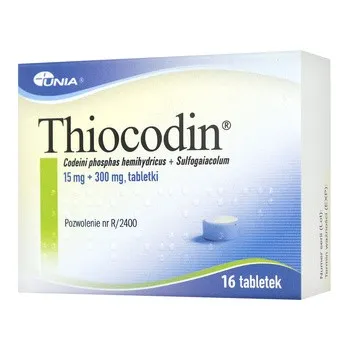
Table of Contents
Patient Information Leaflet
Thiocodin
15 mg + 300 mg, tablets
Codeini phosphas hemihydricus + Sulfogaiacolum
Please read the entire leaflet carefully before taking this medicine, as it contains
important information for the patient.
This medicine should always be taken exactly as described in this patient leaflet or as directed by
your doctor or pharmacist.
- Keep this leaflet, as you may need to read it again.
- If you need advice or further information, please consult your pharmacist.
- If you experience any adverse reactions, including any possible side effects not listed in this leaflet, inform your doctor or pharmacist. See section 4.
- If there is no improvement after 3 days, or if your condition worsens, you should contact your doctor.
Table of Contents:
- What Thiocodin is and what it is used for
- Important information before taking Thiocodin
- How to take Thiocodin
- Possible side effects
- How to store Thiocodin
- Contents of the pack and other information
1. What Thiocodin is and what it is used for
Thiocodin tablets contain two active substances: codeini phosphas hemihydricus and sulfogaiacolum.
Codeini phosphas hemihydricus acts as an antitussive, suppressing the cough reflex and reducing the frequency of coughing episodes.
Sulfogaiacolum acts as an expectorant, facilitating the movement of liquefied respiratory secretions in the airways and aiding in their expulsion.
Thiocodin tablets are for oral use only.
Indications for Thiocodin:
treatment of dry, persistent cough without sputum production.
2. Important information before taking Thiocodin

When not to take Thiocodin
if the patient is allergic to codeine phosphate hemihydrate, sulfoguaiacol, or any of the other
components of this medicine (listed in section 6),
if the patient has bronchial asthma,
if the patient has respiratory insufficiency (breathing difficulties, e.g.: shallow breathing,
slower and/or irregular breathing, emphysema),
if the patient is in a coma,
if the patient has cystic fibrosis (a genetic disorder characterized by production of abnormally thick mucus),
if the patient has bronchiectasis (chronic bronchial inflammation causing cough with large amounts of sputum),
if the patient is alcohol-dependent,
if the patient is dependent on opioids (morphine, heroin),
if the patient is under 12 years of age,
if it is known that the patient metabolizes codeine to morphine very rapidly,
if the patient is pregnant,
if the patient is breastfeeding,
if the patient is expectorating phlegm (because this medicine suppresses the cough reflex and may lead to excessive accumulation of secretions in the airways),
if the patient is currently taking monoamine oxidase inhibitors (MAOIs) or has taken such medicines within the last 14 days.

Warnings and precautions
Before starting to take Thiocodin, discuss with your doctor or pharmacist:
if the patient has impaired respiratory function (difficulty breathing, e.g.: shallow, slower, irregular breathing, chronic lung disease),
if the patient has reduced blood volume,
if the patient has increased intracranial pressure or head injury, because codeine may increase intracranial pressure,
if the patient has renal insufficiency,
if the patient has impaired liver function,
if the patient has arterial hypertension,
if the patient has diabetes,
if the patient has peripheral vascular diseases (e.g.: thromboangiitis obliterans, peripheral venous disorders),
if the patient has hypothyroidism,
if the patient has adrenal insufficiency,
if the patient has glaucoma (optic nerve and retinal damage leading to worsening or loss of vision due to excessive intraocular pressure),
if the patient has inflammatory or obstructive intestinal diseases (e.g.: bloody diarrhea in pseudomembranous colitis or intestinal obstruction, presenting as acute constipation, bloating, nausea, stomach pain or cramps, vomiting),
if the patient has biliary tract diseases (e.g. gallstones), because codeine may trigger biliary colic,
if the patient has recently undergone surgery on the biliary tract (e.g. cholecystectomy),
if the patient has benign prostatic hyperplasia and difficulty urinating (frequent urge to urinate, difficulty or pain during urination, urinary retention),
if the patient has kidney stones, because codeine may trigger renal colic,
if the patient is elderly (over 65 years of age), because the risk of adverse effects is increased,
if the patient is currently taking another medicine containing codeine, because of the risk of codeine overdose.
Do not take this medicine if any of the above warnings apply or have applied to the patient in the past. If in doubt, consult your doctor or pharmacist before taking this medicine.
Codeine is metabolized to morphine in the liver by an enzyme. Morphine is the substance responsible for codeine's effects. Some individuals have a genetic variation of this enzyme, which may lead to different responses. In some people, morphine is not formed or is formed in very small amounts, resulting in lack of antitussive effect. In others, there is a higher likelihood of severe adverse effects due to excessive morphine production. If the patient experiences any of the following adverse symptoms, discontinue use of this medicine and seek immediate medical advice:
slow or shallow breathing, disorientation, drowsiness, pinpoint pupils, nausea or vomiting, constipation, loss of appetite.

- If cough persists beyond 3 days of treatment or if high fever, skin rash, or headache occur, contact a doctor.
- Misuse of Thiocodin (i.e., use longer than recommended and/or in higher doses than recommended) may lead to dependence.
- In cases of misuse of this medicine and sudden discontinuation, withdrawal symptoms may occur (see section: Discontinuing Thiocodin).
- In athletes, Thiocodin may cause a positive result in anti-doping tests.
Children
Do not use in children under 12 years of age.
Adolescents over 12 years of age
Use of Thiocodin is not recommended in adolescents with impaired respiratory function for the treatment of cough.

Thiocodin and other medicines
Inform your doctor or pharmacist about all medicines currently or recently taken, as well as any medicines planned for future use.
Do not use Thiocodin with the following medicines:
- anxiolytics (e.g. chlorpromazine, diazepam, temazepam),
- antidepressants (e.g. monoamine oxidase inhibitors such as moklobemide, or tricyclic antidepressants such as amitriptyline), and within 14 days after discontinuation of these medicines,
- antihistamines (medicines used, among others, in allergic conditions),
- hypnotics (e.g. diazepam, temazepam),
- cytostatics (medicines used in cancer treatment),
- opioid analgesics (morphine, heroin),
- skeletal muscle relaxants (e.g.: diazepam, tetrazepam and temazepam – medicines used to reduce increased muscle tone),
- clonidine (a medicine used in the treatment of hypertension),
- medicines used in Parkinson's disease (e.g. levodopa, selegiline),
- metoclopramide (a medicine with antiemetic and prokinetic effects, i.e. stimulating intestinal peristalsis),
- quinidine (a medicine used in cardiac arrhythmias),
- the antibiotic rifampicin,
- medicines containing alcohol (see section: Thiocodin and alcohol).
Thiocodin and alcohol
Do not drink alcohol while taking this medicine. Alcohol may enhance the effects of codeine.
Note that alcohol may be present in certain foods and medicines.
Pregnancy and breastfeeding
If the patient is pregnant or breastfeeding, suspects she may be pregnant, or plans to become pregnant, she should consult a doctor or pharmacist before taking this medicine.
Do not use in pregnant women. Do not take Thiocodin during breastfeeding.
Codeine and morphine pass into breast milk.
Taking codeine-containing medicines by breastfeeding mothers is not safe due to the risk of life-threatening poisoning in the infant from codeine's metabolite – morphine. Cases have been reported of feeding difficulties, apathy (reduced responsiveness), lethargy, respiratory depression, coma, and stroke in infants breastfed by mothers taking codeine-containing medicines.

Driving and operating machinery
Do not drive, operate machinery, or handle moving equipment while taking this medicine. It may cause dizziness and drowsiness, impairing psycho-physical performance required for these activities.
3. How to take Thiocodin
This medicine should always be taken exactly as described in the patient leaflet or as directed by a doctor or pharmacist. If in doubt, consult a doctor or pharmacist.
Recommended dosage
Adults and adolescents over 12 years of age:
1 tablet 3 times daily, no more frequently than every 4 to 6 hours.
Use of Thiocodin is not recommended in adolescents aged 12 to 18 years with respiratory function disorders for the treatment of cough.
Do not use in children under 12 years of age.
Method of administration
The medicine should be taken orally during meals. The tablet should be swallowed whole with a glass of water.
Drink at least 2 litres of fluids per day. This will help facilitate expectoration of secretions.

- Do not use doses higher than recommended.
- Do not use the medicine for longer than 3 days without medical advice. Any extension of treatment should be decided by a doctor.
Overdose of Thiocodin
In case of taking more than the recommended dose, seek immediate medical advice from a doctor or pharmacist.
Symptoms of overdose may include:
- nausea, vomiting,
- irritability,
- breathing difficulties (slowed and shallow breathing, irregular breathing, bluish skin and mucous membranes),
- drowsiness progressing to coma,
- pinpoint pupils,
- muscle weakness,
- low blood pressure, very slow heartbeat,
- cold and clammy skin.
In severe cases of overdose, loss of consciousness, seizures, respiratory arrest, or cardiac arrest may occur.
Missed dose of Thiocodin
If a dose is missed, take it as soon as possible.
However, if it is almost time for the next scheduled dose, do not take the missed dose. Maintain a 4–6 hour interval between doses.
Do not take a double dose to make up for a missed dose.
Stopping Thiocodin
Sudden discontinuation of this medicine after the recommended 3-day period does not cause withdrawal symptoms.
However, misuse of Thiocodin carries a risk of dependence and withdrawal symptoms following abrupt discontinuation.
Withdrawal symptoms may include:
- anxiety, sudden mood changes (euphoria or sadness),
- insomnia, difficulty falling asleep,
- irritability, restlessness, difficulty concentrating,
- muscle tremors, muscle and joint pain,
- tearing, dilated pupils, yawning,
- sweating, pallor of skin and mucous membranes, palpitations, headache,
- nausea, vomiting, diarrhoea, loss of appetite.
If you have any further questions about the use of this medicine, consult your doctor or pharmacist.
4. Possible adverse reactions
Like all medicines, this medicine can cause adverse reactions, although not everyone experiences them.
Very common adverse reactions (occur in more than 1 in 10 patients):
- nausea and vomiting,
- constipation,
- dizziness,
- sedation.
Uncommon adverse reactions (occur in less than 1 in 100 patients):
- allergic reactions (itching, urticaria, rash, skin eruptions),
- sudden mood changes (excessive happiness or sadness),
- respiratory disorders (reduced breathing rate and shallow, irregular breathing),
- bronchospasm,
- palpitations,
- drop in blood pressure and fainting,
- drowsiness,
- miosis (pupil constriction),
- urinary retention,
- headache,
- acute abdominal pain (mainly in patients after gallbladder removal),
- decreased appetite,
- excessive sweating,
- hallucinations (perceiving non-existent objects),
- disturbances in vision and hearing,
- irritation of the gastrointestinal mucosa, which may manifest as, among others, stomach pain (after taking high doses of the medicine).
Reporting of adverse reactions
If any adverse symptoms occur, including any adverse reactions not listed in this leaflet, inform your doctor, pharmacist, or nurse. Adverse reactions can be reported directly to the Department of Monitoring Adverse Drug Reactions of the Office for Registration of Medicinal Products, Medical Devices and Biocidal Products
Al. Jerozolimskie 181C, 02-222 Warsaw
Tel.: +48 22 49 21 301, Fax: +48 22 49 21 309
Website: https://smz.ezdrowie.gov.pl
Adverse reactions can also be reported to the marketing authorization holder.
Reporting adverse reactions helps to obtain more information on the safety of using the medicine.
5. How to store Thiocodin
Keep the medicine out of the sight and reach of children.
Store below 25 °C. Keep in the original packaging.
Do not use this medicine after the expiry date stated on the packaging. The expiry date refers to the last day of the stated month.
Medicines must not be disposed of via wastewater or household waste. Ask your pharmacist how to dispose of medicines no longer required. This will help protect the environment.
6. Contents of the packaging and other information
What Thiocodin contains
- The active substances are: codeine phosphate hemihydrate and sulfoguaiacol.
Each tablet contains 15 mg of codeine phosphate hemihydrate and 300 mg of sulfoguaiacol. - Other components: talc, potato starch, magnesium stearate.
What Thiocodin looks like and contents of the pack
The medicine is in the form of almost white tablets.
The tablets are packed in PCW/Aluminum blisters. The pack contains 10 tablets (1 blister), 16
tablets (2 blisters) or 20 tablets (2 blisters), together with the patient information leaflet, in a
cardboard box. Not all pack sizes may be marketed.
Marketing Authorisation Holder and Manufacturer
Zakłady Farmaceutyczne „UNIA” Spółdzielnia Pracy
ul. Chłodna 56/60, 00-872 Warsaw
tel.: 22 620 90 81 ext. 190, fax: 22 654 92 40
e-mail: [email protected]
The package leaflet of Thiocodin is available in the Audio Leaflet system via a nationwide, free telephone number: 800 706 848.