Tezeo
Poland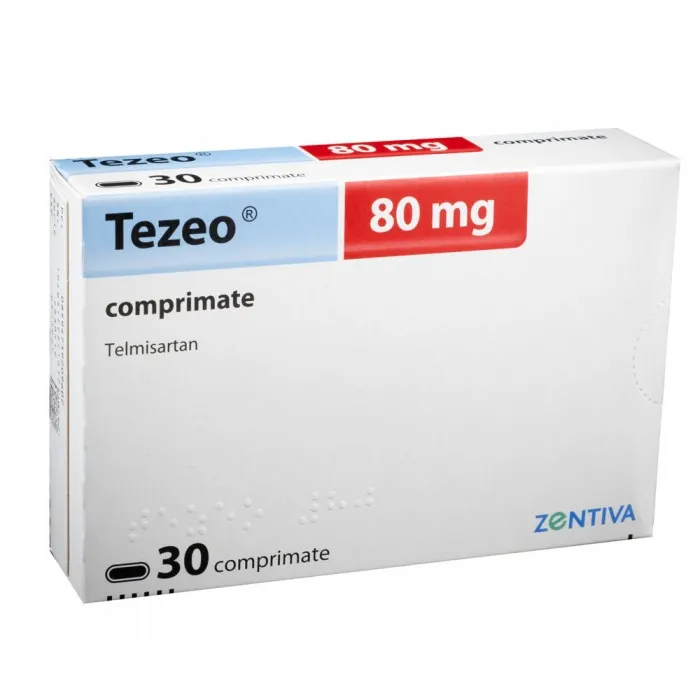
Table of Contents
Package leaflet: Information for the patient
Warning! Keep this leaflet! The information on the immediate packaging is in a foreign language.
Tezeo, 80 mg, tablets
Telmisartanum
Please read this leaflet carefully before taking the medicine, as it contains
important information for the patient.
- Keep the leaflet so that you can read it again if necessary.
- If you have any doubts, consult your doctor or pharmacist.
- This medicine has been prescribed for a specific individual. Do not pass it on to others. This medicine may harm other people, even if their symptoms are the same.
- If you experience any adverse effects, including any possible adverse effects not listed in this leaflet, inform your doctor or pharmacist. See section 4.
Table of contents of the leaflet
- What is Tezeo and what is it used for
- Important information before taking Tezeo
- How to take Tezeo
- Possible side effects
- How to store Tezeo
- Contents of the pack and other information
1. What is Tezeo and what is it used for
Tezeo belongs to a group of medicines called angiotensin II receptor antagonists. Angiotensin II
is a substance produced by the body that causes blood vessels to narrow, leading to increased
arterial pressure. Tezeo blocks the action of angiotensin II, allowing blood vessels to relax and
arterial pressure to decrease.
Tezeo is used in the treatment of essential hypertension (high blood pressure) in adults. The term
"essential" means that high blood pressure is not caused by another disease.
Untreated high blood pressure may lead to damage of blood vessels in various organs, which in
some cases may result in heart attack, heart or kidney failure, stroke, or loss of vision. High blood
pressure usually does not cause any symptoms before such disorders occur. Therefore, it is important
to measure blood pressure regularly to determine whether it is within the normal range.
Tezeo is also used to reduce the frequency of cardiovascular events (such as heart attack or
stroke) in adults at risk, i.e. those who have had reduced blood flow to the heart or legs, who have
had a stroke, or who have been diagnosed with diabetes.
Your doctor will inform you whether you belong to the risk group for the above-mentioned disorders.
2. Information before using Tezeo
When not to take Tezeo
- if the patient is allergic to telmisartan or any of the other ingredients of this medicine (listed in section 6)
- during the third month of pregnancy and later (Tezeo should also be avoided in early pregnancy; see section "Pregnancy")
- if the patient has severe liver problems such as cholestasis or biliary obstruction (impaired bile flow from the liver and gallbladder) or any other severe liver disease
- if the patient has diabetes or kidney problems and is being treated with a blood pressure-lowering medicine containing aliskiren. If any of the above situations apply, inform your doctor or pharmacist before taking Tezeo.
Warnings and precautions
Before starting Tezeo, discuss this with your doctor or pharmacist. Inform your doctor if the patient has or has previously had any of the following conditions or diseases:
- kidney disease or status post kidney transplant
- renal artery stenosis (narrowing of the blood vessels supplying one or both kidneys)
- liver disease
- heart disease
- increased aldosterone levels (retention of water and salt in the body associated with disturbances in the balance of various blood minerals)
- low blood pressure (hypotension), especially if the patient is dehydrated (excessive loss of body water) or has salt depletion due to: diuretic (water pill) therapy, low-salt diet, diarrhoea or vomiting
- increased potassium levels in the blood
- diabetes
Before starting Tezeo, inform your doctor:
- if the patient is taking digoxin
- if the patient is taking any of the following medicines used to treat high blood pressure:
- angiotensin-converting enzyme (ACE) inhibitors (e.g. enalapril, lisinopril, ramipril), particularly if the patient has kidney problems related to diabetes
- aliskiren. Your doctor may monitor kidney function, blood pressure and blood electrolyte levels (e.g. potassium) at regular intervals. See also information under the heading "When not to take Tezeo".
Female patients must inform their doctor if they suspect they are pregnant (or could become pregnant).
Tezeo is not recommended during early pregnancy and must not be used after the third month of pregnancy, as it may be highly harmful to the unborn child (see section "Pregnancy").
If undergoing surgery or anaesthesia, inform the doctor that you are taking Tezeo.
Tezeo may be less effective in lowering blood pressure in black patients.
Children and adolescents
Tezeo is not recommended for use in children and adolescents under 18 years of age.
Tezeo with other medicines
Tell your doctor or pharmacist about all medicines the patient is currently taking, has recently taken or might take in the future. Your doctor may decide to adjust the dose and/or take other necessary precautions. In some cases, it may be necessary to discontinue one of the medicines. This particularly applies when taking any of the following medicines together with Tezeo:
- lithium preparations, used in the treatment of certain types of depression
- medicines that may increase potassium levels in the blood, such as potassium-containing salt substitutes, potassium-sparing diuretics (certain diuretics), angiotensin II receptor antagonists, NSAIDs (non-steroidal anti-inflammatory drugs, e.g. acetylsalicylic acid or ibuprofen), heparin, immunosuppressive medicines (e.g. cyclosporine or tacrolimus), and an antibiotic called trimethoprim
- diuretics (water pills), especially when taken in high doses together with Tezeo, as they may lead to significant fluid loss and low blood pressure (hypotension)
- ACE inhibitors or aliskiren (used to treat high blood pressure) (see also information under the headings "When not to take Tezeo" and "Warnings and precautions")
- digoxin
The effect of Tezeo may be reduced when taken with NSAIDs (non-steroidal anti-inflammatory drugs, e.g. acetylsalicylic acid or ibuprofen) or corticosteroids.
Tezeo may enhance the blood pressure-lowering effect of other medicines used to treat high blood pressure or medicines that may cause low blood pressure (e.g. baclofen, amifostine). Additionally, alcohol, barbiturates, narcotics or antidepressants may further lower blood pressure. Symptoms of low blood pressure may include dizziness upon standing. If dose adjustment of other medicines taken concomitantly with Tezeo is required, consult your doctor.
Pregnancy, breastfeeding and fertility
If the patient is pregnant or breastfeeding, suspects she may be pregnant, or is planning to have a child, she should consult her doctor or pharmacist before taking this medicine.
Pregnancy
Inform your doctor if you suspect (or are planning) pregnancy. Your doctor will usually advise stopping Tezeo before planned pregnancy or immediately after pregnancy is confirmed and will recommend an alternative medicine. Tezeo is not recommended during early pregnancy and must not be used after the third month of pregnancy, as it may seriously harm the unborn child.
Breastfeeding
Inform your doctor if you are breastfeeding or intend to breastfeed. Tezeo is not recommended during breastfeeding, especially when breastfeeding a newborn or premature infant. Your doctor may recommend an alternative medicine.
Driving and using machines
Some patients taking Tezeo may experience dizziness or fatigue. If dizziness or fatigue occurs, do not drive or operate machinery.
Tezeo contains sodium and sorbitol (E 420)
This medicine contains less than 1 mmol of sodium (23 mg) per tablet, i.e. the medicine is considered "sodium-free".
This medicine contains 324.4 mg of sorbitol (E 420) per tablet.
Sorbitol is a source of fructose. If the patient has previously been diagnosed with intolerance to certain sugars or hereditary fructose intolerance, a rare genetic disorder in which the patient's body cannot break down fructose, the patient should consult their doctor before taking this medicine.
3. How to use Tezeo
This medicine should always be used exactly as directed by your doctor or pharmacist. If in doubt,
you should consult your doctor or pharmacist.
Tezeo is available in the following strengths: 40 mg, 80 mg.
The recommended dose of Tezeo is one tablet per day. It is advisable to take the tablet at the same
time each day. Tezeo may be taken with or without food.
Tablets should be swallowed with water or another non-alcoholic drink. It is important to take Tezeo
every day, unless your doctor advises otherwise. If you feel that the effect of Tezeo is too strong or
too weak, you should consult your doctor or pharmacist.
For the treatment of hypertension, the usual dose of Tezeo for most patients is one 40 mg tablet
once daily to ensure blood pressure control over 24 hours. However, your doctor may sometimes
recommend a lower dose of 20 mg or a higher dose of 80 mg. The 20 mg dose can be obtained by
splitting a 40 mg tablet along the break line.
Alternatively, your doctor may recommend using Tezeo together with diuretics (water pills), such as
hydrochlorothiazide, which have an additive blood pressure-lowering effect with telmisartan.
To reduce the risk of cardiovascular events, the usual dose of Tezeo is one 80 mg tablet once daily.
When starting treatment with the 80 mg dose, blood pressure should be monitored frequently.
In patients with impaired liver function, the usual dose must not exceed 40 mg once daily.
Taking more Tezeo than recommended
If you accidentally take too many tablets, contact your doctor or pharmacist immediately, or go to
the nearest hospital emergency department.
Missing a dose of Tezeo
If you miss a dose, take it as soon as you remember, then continue taking the medicine as
previously scheduled. If you do not take the dose on that day, take the next dose the following day
at your usual time.
Do not take a double dose to make up for a missed dose.
If you have any further questions about the use of this medicine, consult your doctor or pharmacist.
4. Possible adverse reactions
Like all medicines, this medicine can cause adverse reactions, although not everyone will experience them.
Some adverse reactions may be serious and require immediate medical attention.
If any of the following symptoms occur, contact your doctor immediately:
Sepsis* (commonly known as "blood poisoning", a severe infection causing systemic inflammatory response), sudden swelling of the skin and mucous membranes (angioedema). These adverse reactions are rare (may occur in up to 1 in 1,000 patients), but extremely serious. In such cases, discontinue the medicine and contact your doctor immediately. If left untreated, these symptoms may result in death.
Possible adverse reactions of Tezeo
Frequent adverse reactions (may occur in up to 1 in 10 patients):
Low blood pressure (hypotension) in patients treated to reduce the occurrence of cardiovascular events.
Uncommon adverse reactions (may occur in up to 1 in 100 patients):
Urinary tract infections, upper respiratory tract infections (e.g. sore throat, sinusitis, common cold), reduced number of red blood cells (anaemia), high potassium levels, difficulty falling asleep, low mood (depression), fainting, sensation of spinning (vertigo), slow heart rate (bradycardia), low blood pressure (hypotension) in patients treated for hypertension, dizziness upon standing (orthostatic hypotension), shortness of breath, cough, abdominal pain, diarrhoea, abdominal discomfort, bloating, vomiting, itching, excessive sweating, drug rash, back pain, muscle cramps, muscle pain (myalgia), kidney function disorders, including acute kidney failure, chest pain, feeling of weakness, and increased blood creatinine levels.
Rare adverse reactions (may occur in up to 1 in 1,000 patients):
Increased number of certain white blood cells (eosinophilia), low platelet count (thrombocytopenia), severe allergic reaction (anaphylactic reaction), allergic reactions (e.g. rash, itching, breathing difficulties, wheezing, facial swelling, or low blood pressure), low blood sugar levels (in patients with diabetes), feeling of restlessness, drowsiness, visual disturbances, rapid heart rate (tachycardia), dryness of the oral mucosa, gastritis, taste disturbances, liver function disorders (more frequently observed in patients of Japanese origin), sudden swelling of the skin and mucous membranes which may also lead to death (angioedema resulting in death), skin eruption (skin disorder), redness of the skin, urticaria, severe drug rash, joint pain, limb pain, tendon pain, influenza-like symptoms, decreased haemoglobin concentration (a blood protein), increased uric acid levels, increased activity of liver enzymes or creatine kinase in blood.
Very rare adverse reactions (may occur in up to 1 in 10,000 patients):
Progressive lung tissue fibrosis (interstitial lung disease)**
* The event may be coincidental or related to a currently unknown mechanism.
** Cases of progressive lung tissue fibrosis have been reported during telmisartan treatment. However, it has not been established whether this is caused by telmisartan use.
Reporting of adverse reactions
If any adverse reactions occur, including any not listed in this leaflet, inform your doctor or pharmacist. Adverse reactions can be reported directly to the Department of Monitoring Adverse Drug Reactions, Office for Registration of Medicinal Products, Medical Devices and Biocidal Products, Al. Jerozolimskie 181C, 02-222 Warsaw, phone: +48 22 49 21 301, fax: +48 22 49 21 309, website: https://smz.ezdrowie.gov.pl.
Reporting adverse reactions helps to provide more information on the safety of this medicine.
5. How to store Tezeo
Keep this medicine out of sight and reach of children.
Do not use this medicine after the expiry date stated on the packaging. The expiry date refers to the last day of the stated month.
Store below 30°C.
Keep in the original packaging to protect from moisture.
Medicines must not be disposed of via wastewater or household waste. Ask your pharmacist how to dispose of medicines no longer required. This will help protect the environment.
6. Contents of the pack and other information
What Tezeo contains
The active substance is telmisartan. Each tablet contains 80 mg of telmisartan.
The other ingredients are: meglumine, sorbitol (E 420), sodium hydroxide, povidone 25, magnesium stearate.
What Tezeo looks like and contents of the pack
Tezeo 80 mg tablets are white to yellowish, oblong, biconvex tablets with an embossed "80" on one side, approximately 16 mm in length, 8 mm in width and 4.2 – 4.8 mm thick.
Pack sizes: 30, 60 or 90 tablets.
For more detailed information, please contact the responsible entity or the parallel importer.
Marketing Authorisation Holder in Romania, the country of export:
Zentiva, k. s., U kabelovny 130, Dolní Měcholupy, 102 37 Prague 10, Czech Republic
Manufacturer:
Zentiva, k.s., U kabelovny 130, Dolní Měcholupy, 102 37, Prague 10, Czech Republic
Zentiva S.A., B-dul Theodor Pallady, no. 50, sector 3, 032266, Bucharest, Romania
Parallel importer:
InPharm Sp. z o.o.
ul. Strumykowa 28/11
03-138 Warsaw, Poland
Repackaged in:
InPharm Sp. z o.o. Services sp. k.
ul. Chełmżyńska 249
04-458 Warsaw, Poland
Marketing Authorisation Number in Romania, the country of export: 9443/2016/02
Parallel Import Authorisation Number: 342/22