Tetana
Poland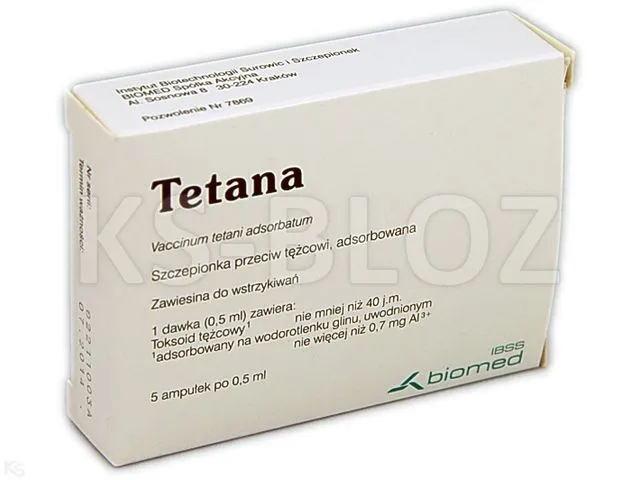
Table of Contents
- Package leaflet: Information for the user
- 1. What Tetana vaccine is and what it is used for
- 2. Important information before administering Tetana vaccine
- 3. How to use Tetana vaccine
- 4. Possible adverse reactions
- 5. How to store the Tetana vaccine
- 6. Contents of the packaging and other information
- Information intended exclusively for healthcare professionals:
Package leaflet: Information for the user
Tetana, suspension for injection
Tetanus vaccine, adsorbed
Not less than 40 I.U. of tetanus toxoid/0.5 ml; 1 dose (0.5 ml)
Please read all of this leaflet carefully before the vaccine is administered, because it
contains important information for you.
- Keep this leaflet, as you may need to read it again.
- If you have any further questions, ask your doctor, pharmacist, or nurse.
- This vaccine has been prescribed for a specific individual only. Do not pass it on to others.
- If you experience any adverse reactions, including any not listed in this leaflet, inform your doctor, pharmacist, or nurse. See section 4.
Contents of the leaflet
- What Tetana vaccine is and what it is used for
- Important information before using Tetana vaccine
- How to use Tetana vaccine
- Possible side effects
- How to store Tetana vaccine
- Contents of the pack and other information
1. What Tetana vaccine is and what it is used for
Tetana is a vaccine that protects against tetanus, a disease caused by Clostridium tetani. The active substance of the vaccine is tetanus toxoid (a non-infectious component derived from the bacteria). After administration, the body produces antibodies that protect against the disease. The vaccine is used for active immunization of children, adolescents, and adults against tetanus, in accordance with the National Immunization Programme.
Primary vaccination
- when there are contraindications to the use of combination vaccines containing, in addition to the tetanus component, diphtheria component or diphtheria and pertussis components.
Booster vaccination
- for individuals who have completed the primary vaccination series against tetanus.
Primary and booster vaccinations may also be administered to pregnant women who are expected to give birth under unhygienic conditions.
Tetanus vaccination in injured individuals
Tetana vaccine is used for tetanus prophylaxis in individuals with contaminated wounds, when there is a high probability of Clostridium tetani presence in the wound.
A single dose of Tetana vaccine does not provide protection against tetanus. Adequate immunity, protective against infection, is achieved only after administration of all doses of the primary vaccination course against tetanus, according to the National Immunization Programme, which provides information on these vaccinations. Each subsequent booster dose provides long-lasting protection against tetanus, lasting approximately 10 years.
Tetana vaccine meets the requirements of the European Pharmacopoeia and the World Health Organization (WHO).
Patients with AIDS or HIV carriers should be vaccinated according to the standard schedule, and in case of injury, should always receive human tetanus immunoglobulin (immunoglobulin with high titer of tetanus antibodies), regardless of their history of tetanus vaccination.
2. Important information before administering Tetana vaccine
When not to use Tetana vaccine:
- if the patient is allergic to tetanus toxoid or to any of the other components of this medicine (listed in section 6). Symptoms of allergy may include: itchy rash, difficulty breathing, swelling of the face and tongue,
- if the patient has acute illness with fever. A mild infection, such as a common cold, should not prevent vaccination, but the doctor should be informed about it first,
- if the patient has chronic diseases during an exacerbation period. In such cases, vaccination should be performed after the exacerbation has subsided,
- if there is suspicion of another infection (other than tetanus) during its incubation period,
- if the patient experienced a reduced platelet count leading to increased risk of bleeding and bruising, or neurological disorders after previous administration of tetanus vaccine.
If any contraindications to vaccination with Tetana vaccine exist, the doctor should
assess the risk of administering the vaccine against the risk of contracting tetanus infection.
Warnings and precautions
Before starting vaccination with Tetana vaccine, discuss with your doctor or nurse
if any adverse reactions described in section 4 occurred after a previous dose of the vaccine
or if any other concerning reactions occurred.
Vaccination should be preceded by a medical examination and history taking regarding the general
health status and previously administered and documented vaccinations. This procedure helps
predict the risk of adverse reactions following vaccination.
For safety reasons, remain under medical supervision for 30 minutes after vaccination.
Tetana vaccine and other medicines
Tetana vaccine may be administered simultaneously with other vaccines, as indicated
by the National Immunization Program, and with immunoglobulins if necessary.
Different vaccines and immunoglobulins administered at the same time should be injected
at different sites of the body using separate syringes and needles.
In patients receiving immunosuppressive treatment (which suppresses immune system activity)
or in patients with immune deficiencies, the response to the vaccine may be reduced.
In such cases, the doctor may decide to postpone vaccination until the end of therapy
and may measure antibody levels after vaccination.
Inform the doctor about all medicines currently or recently taken by the patient,
as well as any medicines the patient plans to take.
Pregnancy and breastfeeding
The vaccine may be administered during pregnancy if clinically indicated. In such cases,
the decision is made by the doctor. Dosing during pregnancy is described in section 3.
There are no data on administration of the vaccine during breastfeeding.
If the patient is pregnant or breastfeeding, suspects she may be pregnant, or is planning to have
a child, she should consult a doctor before using this medicine.
Driving and operating machinery
The vaccine has no effect or a negligible effect on the ability to drive
and operate machinery.
3. How to use Tetana vaccine
The Tetana vaccine will be administered by a doctor or nurse as a deep subcutaneous injection. The vaccine must never be given intravenously.
Dosage for primary and booster vaccination
Primary vaccination
The primary vaccination consists of three doses of the vaccine:
- two doses given 4–6 weeks apart (primary immunization)
- a third dose administered 6–12 months after the second dose (complementary immunization). This dose ensures the development of immunity lasting from 5 to 10 years.
Booster vaccination
One dose of vaccine 10 years after the last tetanus vaccination.
Dosage in case of injury
In case of injury, the decision on whether to administer the vaccine and the dosage regimen will be made by a physician.
Detailed information is provided at the end of the leaflet in the section “Information intended exclusively for healthcare professionals”.
Use during pregnancy
Unvaccinated women or those with incomplete primary vaccination who are at risk of giving birth under unhygienic conditions should be vaccinated during the second trimester of pregnancy.
Women who received one or two doses of the vaccine before pregnancy should complete the vaccination schedule during pregnancy. Pregnant women who were vaccinated more than 10 years ago should receive a booster dose during the second trimester of pregnancy.
Administration of a higher than recommended dose of Tetana vaccine
Overdose is unlikely due to the single-dose packaging.
In case of doubt, consult a doctor.
Interrupting the use of Tetana vaccine
If you have any further questions regarding the use of this vaccine, consult your doctor, pharmacist, or nurse.
4. Possible adverse reactions
Like any vaccine, this vaccine may cause adverse reactions, although they do not occur
in everyone.
Frequency unknown (frequency cannot be estimated from available data):
- decreased platelet count, leading to increased risk of bleeding and bruising; enlarged and/or painful lymph nodes
- allergic reactions (including urticaria, rash, e.g. nodular, eyelid swelling, facial swelling, submandibular swelling, lip swelling, forehead swelling), up to and including anaphylactic shock
- headache, dizziness, fainting, loss of consciousness
- hypotonic-hyporesponsive episode, characterized by limpness or reduced muscle tone, skin discoloration (pallor or cyanosis), decreased responsiveness to external stimuli, occurring in children under 10 years of age within 48 hours after vaccination
- nervous system disorders, tremors
- lacrimation (tearing)
- hearing impairment
- low blood pressure, pallor
- gastrointestinal disorders (nausea, vomiting, dry mouth)
- petechiae (small subcutaneous bleeding), erythema nodosum (painful, bright red nodules most commonly located on the anterior surface of the lower legs, resolving spontaneously)
- pain in the limb into which the vaccine was injected, shoulder pain at the injection site, joint pain
- kidney failure
- decreased body temperature
- systemic reactions: feverish state, fever, chills, feeling cold, excessive sweating, weakness, malaise. These symptoms usually resolve within 24–48 hours
- local reactions: redness, erythema, pain, swelling, swelling of the entire limb, limited mobility of the limb, rash, itching, burning sensation, inflammation, bruising, hematoma (possibly due to incorrect administration of the vaccine), induration, warmth at the injection site. Itching lymphatic infiltration may also occur. Such reactions are most common in individuals who have been vaccinated multiple times. Subcutaneous nodules (granulomas) may develop, sometimes progressing to aseptic abscesses (1:100,000). Granulomas that do not resolve within a 6-week period may result from hypersensitivity to aluminium.
Reporting of adverse reactions
If any adverse reactions occur, including those not listed in this leaflet, inform a doctor,
pharmacist, or nurse. Adverse reactions can be reported directly to the Department of Monitoring Adverse Drug Reactions of the Office for Registration of Medicinal Products, Medical Devices and Biocidal Products, Al. Jerozolimskie 181C, 02-222 Warsaw, phone: +48 22 49-21-301, fax: +48 22 49-21-309, website: https://smz.ezdrowie.gov.pl.
Adverse reactions can also be reported to the marketing authorization holder.
Reporting adverse reactions helps provide more information on the safety of the medicinal product.
5. How to store the Tetana vaccine
Store upright in a refrigerator (2°C - 8°C). Do not freeze; if frozen,
destroy the vaccine.
The vaccine should be stored out of sight and reach of children.
Do not use this vaccine after the expiry date stated on the carton. The expiry date refers to the last day of the stated month.
Medicines must not be disposed of via wastewater or household waste. Ask your pharmacist how to dispose of medicines no longer required. Such measures will help protect the environment.
6. Contents of the packaging and other information
What Tetana vaccine contains
The active substance in the vaccine is:
Tetanus toxoid, not less than 40 I.U.,
adsorbed on aluminium hydroxide hydrate containing not more than 0.7 milligrams of Al.
The other ingredients are: sodium chloride and water for injections.
What Tetana vaccine looks like and contents of the pack
After shaking, the vaccine is a white or almost white, homogeneous suspension in glass
vials.
During storage, a white sediment forms at the bottom of the vial, with a clear supernatant (liquid) above it.
The pack contains 1, 5 or 10 vials of 0.5 ml each, packed in a cardboard box.
Not all pack sizes may be marketed.
Marketing Authorisation Holder and Manufacturer
Institute of Biotechnology of Sera and Vaccines BIOMED Joint Stock Company
Al. Sosnowa 8
30-224 Kraków
Tel.: +48 12 37 69 200
Fax: +48 12 37 69 205
e-mail: [email protected]
Information intended exclusively for healthcare professionals:
Administration of Tetana vaccine
Shake well before use to obtain a homogeneous suspension. Visually inspect
the vaccine for any foreign particles and/or changes in appearance. Do not use
the vaccine if any changes are observed.
Measure a 0.5 ml dose and administer deep subcutaneously.
The deltoid muscle or the anterolateral thigh area is recommended as the injection site.
Do not administer intravenously! Ensure that the needle has not entered a blood vessel.
Warning: Due to the risk of anaphylactic shock associated with vaccine administration,
the vaccination room should be equipped with standard resuscitation equipment.
Guidelines for specific prophylaxis of tetanus in injured persons
| Patient's vaccination history | Risk of tetanus occurrence | |
| Low | High | |
| Unvaccinated or incompletely vaccinated or uncertain vaccination history | Tetanus-diphtheria or tetanus vaccine, then continue subsequent doses of primary vaccination according to the schedule: 0; 1; 6 months | Tetanus-diphtheria or tetanus vaccine and antitoxin (LIT* – specific immunoglobulin 250/500 IU), then continue subsequent doses of primary vaccination according to the schedule: 0; 1; 6 months |
| Primary or booster vaccination – last dose more than 10 years ago | Tetanus-diphtheria or tetanus vaccine
| Tetanus-diphtheria or tetanus vaccine
|
| Primary or booster vaccination – last dose 5–10 years ago | Tetanus-diphtheria or tetanus vaccine
| Tetanus-diphtheria or tetanus vaccine
|
| Primary or booster vaccination – last dose less than 5 years ago | Not required | Not required, however, if particularly high risk, consider vaccination with tetanus-diphtheria or tetanus vaccine
|
*LIT- Human Anti-Tetanus Immunoglobulin
In case of injury and existing contraindications to vaccination with tetanus vaccine,
anti-tetanus immunoglobulin should be administered immediately.