Testosteronum prolongatum jelfa
Poland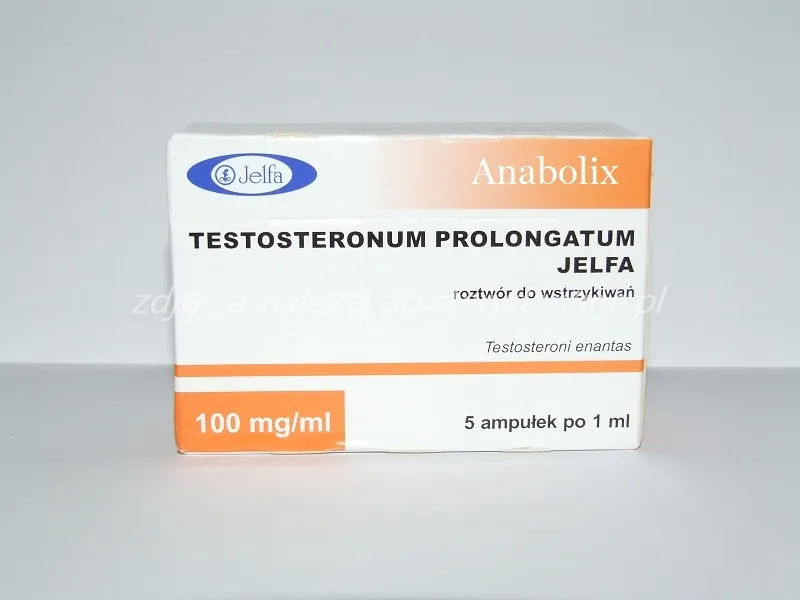
Table of Contents
- Package leaflet: Information for the patient
- 1. What Testosteronum Prolongatum Jelfa is and what it is used for
- 2. Important information before using Testosteronum Prolongatum Jelfa
- 3. How to use Testosteronum Prolongatum Jelfa
- 4. Possible adverse effects
- 5. How to store Testosteronum Prolongatum Jelfa
- 6. Contents of the pack and other information
Package leaflet: Information for the patient
TESTOSTERONUM PROLONGATUM JELFA, 100 mg/ml, solution for injection
Testosteroni enantas
Please read all of this leaflet carefully before using this medicine, because it contains
important information for the patient.
- Keep this leaflet, as you may need to read it again.
- If you have any further questions, please consult your doctor or pharmacist.
- This medicine has been prescribed for a specific individual. Do not pass it on to others. This medicine may harm others, even if their symptoms are the same.
- If you experience any adverse reactions, including any not listed in this leaflet, inform your doctor or pharmacist. See section 4.
Contents of the leaflet:
- What Testosteronum Prolongatum Jelfa is and what it is used for
- Important information before using Testosteronum Prolongatum Jelfa
- How to use Testosteronum Prolongatum Jelfa
- Possible side effects
- How to store Testosteronum Prolongatum Jelfa
- Contents of the package and other information
1. What Testosteronum Prolongatum Jelfa is and what it is used for
Testosteronum Prolongatum Jelfa contains a synthetic derivative of testosterone, the male sex hormone (androgen). Testosterone plays a key role in stimulating and maintaining male sexual function. It causes growth of the testes, prostate gland, and seminal vesicles, influences spermatogenesis (the process of sperm formation and maturation), and initiates the development of secondary and tertiary sexual characteristics.
Testosterone has anabolic effects, promoting skeletal muscle growth, increasing bone mineral density, stimulating erythropoietin production (a hormone affecting red blood cell formation) in the kidneys, and increasing hemoglobin concentration (the red pigment in blood).
Indications
Testosteronum Prolongatum Jelfa is used in adult men as testosterone replacement therapy for the treatment of various conditions resulting from testosterone deficiency (male hypogonadism). Diagnosis of the condition requires two independent measurements of blood testosterone levels, together with the following clinical symptoms:
- impotence
- infertility
- reduced sexual desire
- fatigue
- depressive mood
- loss of bone mass due to low hormone levels
2. Important information before using Testosteronum Prolongatum Jelfa
When not to use Testosteronum Prolongatum Jelfa:
- if the patient is allergic to testosterone enanthate or any of the other ingredients of this medicine (listed in section 6);
- if the patient is allergic to peanuts or soya;
- if the patient has nephrotic syndrome;
- if the patient has or is suspected of having androgen-dependent prostate cancer;
- if the patient has breast cancer;
- if the patient has or has had liver cancer;
- in pregnant and breastfeeding women.
Warnings and precautions
Before starting treatment with Testosteronum Prolongatum Jelfa, discuss this with your doctor or pharmacist.
Inform your doctor and exercise particular caution:
- if the patient has cancer, especially with bone metastases – due to increased risk of hypercalcaemia (elevated calcium levels in the blood); the doctor should order additional blood tests; if necessary, the doctor may decide to discontinue treatment;
- if the patient has severe heart, liver or kidney disease – treatment with Testosteronum Prolongatum Jelfa may cause serious complications, such as fluid retention, and sometimes congestive heart failure;
- if the patient has impaired kidney or liver function;
- if the patient has high blood pressure or is taking antihypertensive medications, because testosterone may increase blood pressure;
- if the patient has acquired or congenital coagulation disorders;
- thrombophilia (abnormalities in blood clotting, increasing the risk of thrombosis – formation of blood clots in blood vessels);
- factors increasing the risk of venous thrombosis: previous history of venous blood clots; smoking; obesity; cancer; immobilization; family history of blood clots in leg, lung or other organs at a young age (e.g. under 50 years); advanced age of the patient.
How to recognize a blood clot: painful swelling in one leg or sudden skin colour change, e.g. pallor, redness or cyanosis; sudden shortness of breath; sudden unexplained cough, possibly with coughing up blood; sudden chest pain; severe dizziness or vertigo; severe abdominal pain; sudden loss of vision. If any of these symptoms occur, seek immediate medical help.
- if the patient has epilepsy or migraine – Testosteronum Prolongatum Jelfa may worsen symptoms.
Medical and laboratory examinations
Before starting treatment, the doctor will order tests to exclude the presence of prostate cancer. During ongoing therapy, the doctor will regularly order additional tests, especially in elderly patients (over 65 years of age). The following blood tests should be ordered by the doctor before and during treatment: blood testosterone concentration and complete blood count.
If necessary, the doctor may consider adjusting the dose and administration schedule.
Due to variability in laboratory results, all testosterone concentration measurements should be performed in the same laboratory.
Misuse and dependence on Testosteronum Prolongatum Jelfa
This medicine should always be used according to the doctor’s or pharmacist’s instructions. Misuse of testosterone and other anabolic-androgenic steroids may lead to serious adverse effects, including those affecting the heart and blood vessels (which may lead to death), mental health and (or) the liver. Individuals who misuse testosterone may become dependent and may experience withdrawal symptoms following a significant dose reduction or abrupt discontinuation of the drug. Do not misuse this medicine, either alone or in combination with other anabolic-androgenic steroids, as this poses serious health risks (see “Possible side effects”).
Other warnings and precautions
Testosteronum Prolongatum Jelfa may accelerate the development of asymptomatic prostate cancer and benign prostatic hyperplasia.
Rare cases of benign and malignant liver tumours have been reported in patients receiving testosterone replacement therapy.
Some clinical symptoms such as irritability, nervousness, weight gain, prolonged or frequent erections may indicate excessive testosterone dosage. The doctor should consider adjusting the dose. If symptoms of androgen excess persist or recur during treatment with recommended doses, the doctor may decide to discontinue Testosteronum Prolongatum Jelfa.
During treatment, pre-existing sleep apnoea may worsen.
In athletes, doping tests may yield positive results during testosterone treatment.
Using testosterone as a doping agent may lead to serious adverse effects.
Androgens are not appropriate for accelerating muscle development in healthy individuals or for enhancing physical performance.
Children and adolescents
Testosteronum Prolongatum Jelfa is not recommended for use in children and adolescents under 18 years of age.
The efficacy and safety of this medicine in children and adolescents have not been adequately established.
Androgen therapy should be used with particular caution in patients with delayed puberty. The doctor should monitor treatment by assessing bone age every 6 months.
Testosteronum Prolongatum Jelfa with other medicines
Inform your doctor or pharmacist about all medicines currently used, recently used or planned for use.
Inform your doctor if the patient is taking any of the following medicines:
- oral anticoagulants – the doctor should order additional blood tests to assess the coagulation system, especially when starting or stopping treatment with Testosteronum Prolongatum Jelfa;
- insulin or other antidiabetic drugs – concomitant use of Testosteronum Prolongatum Jelfa may lower blood glucose (sugar) levels and reduce insulin requirements. Dose adjustment of glucose-lowering drugs may be necessary. Concomitant use with SGLT-2 inhibitors (such as empagliflozin, dapagliflozin or canagliflozin) may increase red blood cell count. The doctor may need to order blood tests more frequently;
- adrenocorticotropic hormone (ACTH, a pituitary hormone) or corticosteroids – concomitant use with Testosteronum Prolongatum Jelfa increases the risk of oedema, especially in patients with heart or liver disease or predisposition to oedema;
- oxyphenbutazone (an analgesic and anti-inflammatory drug) – concomitant use with Testosteronum Prolongatum Jelfa may increase oxyphenbutazone levels.
Pregnancy, breastfeeding and effects on fertility
Testosteronum Prolongatum Jelfa is contraindicated in women and must not be used during pregnancy or breastfeeding.
Testosteronum Prolongatum Jelfa, especially when administered in high doses, suppresses spermatogenesis (see section 4).
Driving and operating machinery
This medicine does not affect psycho-physical performance, ability to drive or operate machinery.
Testosteronum Prolongatum Jelfa contains benzyl alcohol and arachis (peanut) oil.
Testosteronum Prolongatum Jelfa contains 50 mg of benzyl alcohol in each 1 ml, equivalent to 50 mg/ml.
Benzyl alcohol may cause allergic reactions.
Patients with liver or kidney disease should consult their doctor before using this medicine, as large amounts of benzyl alcohol may accumulate in their body and cause adverse effects (so-called metabolic acidosis).
The medicine may cause mild local irritation.
The medicine contains arachis (peanut) oil. Do not use if hypersensitivity to peanuts or soya has been diagnosed.
3. How to use Testosteronum Prolongatum Jelfa
This medicine should always be used exactly as directed by the physician. If in doubt, consult your
doctor or pharmacist.
Intramuscular administration.
Dosage is determined by the physician.
Dosage must be individually adjusted according to the response to treatment, taking into account
measurements of testosterone concentration in plasma.
The usual dose of testosterone is 100 mg to 200 mg, administered at intervals depending on the individual
response to treatment and (as an auxiliary measure) on plasma testosterone concentration, most commonly
every 1 to 2 weeks. In justified cases, a dose up to 300 mg may be used, maintaining an individual approach
to the frequency of administration. After improvement occurs, individual modification of the dose and (or)
frequency of administration may be considered.
Method of administration
This medicine is intended exclusively for intramuscular injection. Injections should be administered deeply
into the gluteal muscle.
Experience indicates that transient reactions (cough reflex, coughing episodes, breathing difficulties), which
rarely occur during or immediately after injection of oily solutions, can be avoided by injecting the solution
very slowly.
Use in children and adolescents
Use of Testosteronum Prolongatum Jelfa is not recommended in children and adolescents under 18 years of age.
The efficacy and safety of this medicine in children and adolescents have not been adequately established.
Use of a higher than recommended dose of Testosteronum Prolongatum Jelfa
Overdose is unlikely when the medicine is used as recommended.
Symptoms of overdose due to administration of too high a dose or administration more frequently than once
per week may lead to persistent erection (priapism) in males.
In such a case, administration of the medicine should be discontinued.
Missed dose of Testosteronum Prolongatum Jelfa
Failure to administer the medicine at the scheduled time (a 1- or 2-day gap) should not affect the course of
treatment. The medicine should be administered as soon as possible. Subsequent doses should be given
according to the physician's instructions. Do not use a double dose to make up for a missed dose.
If you have any further doubts regarding the use of this medicine, consult your doctor or pharmacist.
4. Possible adverse effects
Like all medicines, this medicine can cause adverse effects, although not everyone will experience them.
Common adverse effects (may occur in up to 1 in 10 people):
- Blood and lymphatic system disorders: increased red blood cell count, haematocrit (percentage of red blood cells in the blood), and haemoglobin concentration (a component of red blood cells that carries oxygen), identified during periodic blood tests.
- Metabolism and nutrition disorders: weight gain.
- Investigations: increased haemoglobin levels, increased haematocrit, increased red blood cell count, increased prostate-specific antigen (PSA) measurement.
Uncommon adverse effects (may occur in less than 1 in 1,000 patients):
- Respiratory, thoracic and mediastinal disorders: pulmonary oil microembolism. The oil-based solution of Testosteronum Prolongatum Jelfa may enter the lungs (pulmonary oil microembolism), which rarely may lead to symptoms such as cough, dyspnoea (shortness of breath), general malaise, excessive sweating, chest pain, dizziness, tingling or prickling sensations, or fainting. These reactions may occur during or immediately after the injection and are transient. Each patient should be observed during and immediately after each injection to allow early detection of subjective and objective symptoms that may indicate pulmonary oil microembolism.
Adverse effects with unknown frequency (frequency cannot be estimated from the available data):
- Benign, malignant and unspecified tumours (including cysts and polyps): liver tumour.
- Reproductive system and breast disorders: gynaecomastia (enlargement of breasts in males), priapism (prolonged, painful erection), oligospermia (low sperm count in semen) when high doses are used.
- Skin and subcutaneous tissue disorders: male-pattern baldness, hirsutism (excessive hair growth in a male pattern in women), acne.
- Investigations: retention of sodium, chloride, water, potassium, calcium, and inorganic phosphates.
- Gastrointestinal disorders: nausea.
- Hepatobiliary disorders: cholestatic jaundice, liver function abnormalities, peliosis hepatis, or hepatic neoplasms. Long-term use of high doses may lead to peliosis hepatis or hepatic neoplasms. Hepatitis, if it occurs, is a reason to discontinue androgen administration and to determine the cause of the changes. The doctor will monitor liver function.
- Blood and lymphatic system disorders: inhibition of clotting factors II, V, VII and X, bleeding in patients treated with oral anticoagulants, polycythaemia.
- Nervous system disorders: changes in libido, headache, anxiety, paraesthesia (tingling sensations).
- Vascular disorders: deep vein thrombosis, arterial hypertension.
- Respiratory, thoracic and mediastinal disorders: pulmonary embolism.
- General disorders and administration site conditions: inflammation and pain at the injection site (the most commonly observed adverse effect).
Reporting of adverse effects
If any adverse effects occur, including any adverse effects not listed in this leaflet, inform your doctor or pharmacist. Adverse effects can be reported directly to the Department of Monitoring of Adverse Drug Reactions, Office for Registration of Medicinal Products, Medical Devices and Biocidal Products,
Al. Jerozolimskie 181 C,
02-222 Warsaw,
Phone: +48 22 49 21 301,
Fax: +48 22 49 21 309,
Website: https://smz.ezdrowie.gov.pl
Adverse effects can also be reported to the marketing authorisation holder.
Reporting adverse effects helps to provide more information on the safety of the medicine.
5. How to store Testosteronum Prolongatum Jelfa
Keep the medicine out of the sight and reach of children.
Store below 25°C. Do not freeze. Keep in the original packaging to protect from light.
Do not use this medicine after the expiry date stated on the vials and carton. The expiry date refers to the last day of the stated month. Reduced clarity of the solution or the appearance of "needles" (crystals) does not indicate that the medicine is out of date. Cloudiness may be removed by warming the vial in warm water.
Medicines must not be disposed of via wastewater or household waste. Ask your pharmacist how to dispose of medicines no longer required. This will help protect the environment.
6. Contents of the pack and other information
What Testosteronum Prolongatum Jelfa contains
- The active substance is testosterone enanthate. 1 ml of solution for injection contains 100 mg of testosterone enanthate.
- Other ingredients of the medicine are: benzyl alcohol 50 mg and arachis oil up to 1 ml.
What Testosteronum Prolongatum Jelfa looks like and contents of the pack
Testosteronum Prolongatum Jelfa is a clear yellow oily solution.
It is packed in vials and cardboard boxes.
5 vials of 1 ml each
Marketing Authorisation Holder
Bausch Health Ireland Limited
3013 Lake Drive
Citywest Business Campus
Dublin 24, D24PPT3
Ireland
Tel.: + 48 17 865 51 00
Manufacturer
Przedsiębiorstwo Farmaceutyczne Jelfa SA
ul. Wincentego Pola 21,
58-500 Jelenia Góra