Terlipressin acetate ever pharma
Poland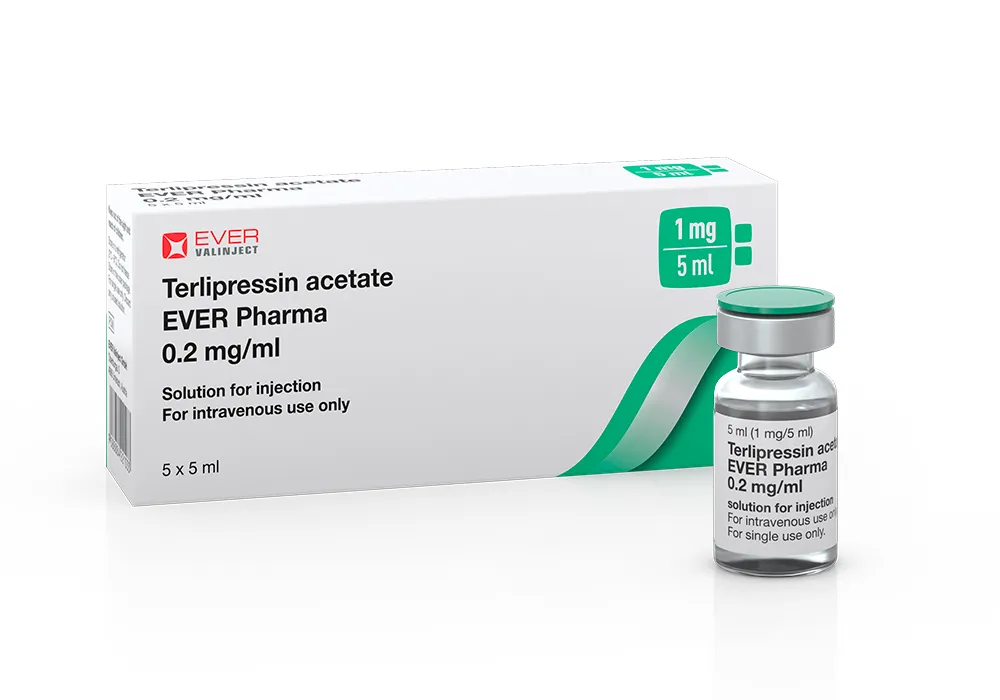
Table of Contents
- Package leaflet: Information for the user
- 1. What Terlipressini acetas EVER Pharma is and what it is used for
- 2. Important information before using Terlipressini acetas EVER Pharma
- 4. Possible adverse reactions
- 5. How to store Terlipressini acetas EVER Pharma
- 6. Contents of the package and other information
- Information intended exclusively for healthcare professionals:
Package leaflet: Information for the user
Terlipressini acetas EVER Pharma, 0.2 mg/mL, solution for injection
Terlipressini acetas
Please read all of this leaflet carefully before the medicine is administered, because it contains
important information for the patient.
- Keep this leaflet, as you may need to read it again.
- If you have any further questions, ask your doctor or pharmacist.
- If you experience any side effects, including any not listed in this leaflet, tell your doctor, pharmacist or nurse. See section 4.
Leaflet contents
- What Terlipressini acetas EVER Pharma is and what it is used for
- What you need to know before using Terlipressini acetas EVER Pharma
- How to use Terlipressini acetas EVER Pharma
- Possible side effects
- How to store Terlipressini acetas EVER Pharma
- Contents of the pack and other information
1. What Terlipressini acetas EVER Pharma is and what it is used for
Terlipressini acetas EVER Pharma contains the active substance terlipressin, which is a synthetic
pituitary hormone (this hormone is normally produced by the pituitary gland located in the brain).
This medicine will be administered to the patient as an intravenous injection.
Terlipressini acetas EVER Pharma is used in the treatment of:
- Bleeding from enlarged veins in the upper gastrointestinal tract leading to the stomach (known as oesophageal variceal bleeding);
- Acute episodes of hepatorenal syndrome type 1 (rapidly progressive kidney failure) in patients with liver cirrhosis (liver fibrosis) and ascites (abdominal swelling).
2. Important information before using Terlipressini acetas EVER Pharma
When not to use Terlipressini acetas EVER Pharma:
- if the patient is allergic to terlipressin or any of the other ingredients of this medicine (listed in section 6);
- if the patient is pregnant.
Warnings and precautions
Before starting treatment with Terlipressini acetas EVER Pharma, discuss this with your doctor,
pharmacist, or nurse:
- if the patient has a severe infection called septic shock;
- if the patient has asthma or other breathing disorders;
- if the patient has untreated high blood pressure or poor blood circulation in the blood vessels of the heart (e.g. angina pectoris);
- if the patient has previously had a heart attack (myocardial infarction) or has narrowing of blood vessels (atherosclerosis);
- if the patient has seizures (convulsions);
- if the patient has an irregular heartbeat (arrhythmia) or a history of QT prolongation (a heart rhythm disorder);
- if the patient has poor blood circulation in the brain (e.g. stroke) or in the limbs (peripheral vascular disease);
- if the patient has impaired kidney function (renal failure);
- if the patient has electrolyte imbalances in the blood;
- if the patient has reduced fluid volume in the circulatory system or has lost a large amount of blood;
- if the patient is over 70 years of age.
If any of these conditions apply (or if the patient is uncertain), discuss them with a doctor, pharmacist, or nurse before starting treatment with Terlipressini acetas EVER Pharma.
During treatment with Terlipressini acetas EVER Pharma, heart function and fluid and electrolyte balance must be continuously monitored.
Terlipressini acetas EVER Pharma may increase the risk of developing respiratory failure (severe breathing difficulties), which may be life-threatening. If breathing difficulties or symptoms of fluid overload occur before or during treatment, inform the doctor immediately.
If the patient is being treated for severe liver and kidney disease (hepatorenal syndrome type 1), the doctor should ensure that heart function and fluid-electrolyte balance are monitored during treatment.
Particular caution is required in patients with a history of heart or lung disease, as Terlipressini acetas EVER Pharma may cause myocardial ischaemia (reduced blood flow to the heart) and respiratory failure.
Treatment with Terlipressini acetas EVER Pharma should be avoided if the patient has liver failure with multi-organ failure and/or kidney failure with very high serum creatinine levels (a metabolic by-product), as this increases the risk of adverse effects.
If the patient is being treated for severe liver and kidney disease, Terlipressini acetas EVER Pharma may increase the risk of developing sepsis (bacteria in the blood and an extreme systemic response to infection) and septic shock (a serious condition occurring when a severe infection leads to low blood pressure and poor blood flow). If any of these situations apply, the doctor will take additional precautions.
Children and adolescents
Terlipressini acetas EVER Pharma is not recommended for use in children and adolescents due to lack of experience in this age group.
Terlipressini acetas EVER Pharma and other medicines
Tell your doctor or pharmacist about all medicines the patient is currently taking, has recently taken, or plans to take.
Inform the doctor immediately if the patient is taking any of the following medicines:
- medicines affecting heart rhythm (e.g. beta-blockers, sufentanil, or propofol);
- medicines that may cause irregular heart rhythm (arrhythmias), such as:
- Class IA antiarrhythmics (quinidine, procainamide, disopyramide) and Class III antiarrhythmics (amiodarone, sotalol, ibutilide, dofetilide);
- erythromycin (an antibiotic);
- antihistamines (mainly used to treat allergies, but also found in some cough medicines and cold remedies);
- tricyclic antidepressants used to treat depression;
- medicines that may cause electrolyte imbalances in the blood, particularly diuretics (water tablets used to treat high blood pressure and heart failure).
Pregnancy and breastfeeding
If the patient is pregnant, breastfeeding, suspects she may be pregnant, or is planning to become pregnant, she should consult a doctor before using this medicine.
Terlipressini acetas EVER Pharma must not be used during pregnancy.
It is not known whether Terlipressini acetas EVER Pharma passes into breast milk, so the potential effect on the infant is unknown. Discuss possible risks to the infant with your doctor.
Driving and operating machinery
Studies on the effect of this medicine on the ability to drive or operate machinery have not been conducted. However, if the patient feels unwell after receiving the injection, she/he should not drive or operate machinery.
Terlipressini acetas EVER Pharma contains sodium
This medicine contains 3.68 mg of sodium (the main component of table salt) in each mL. This corresponds to 0.18% of the maximum recommended daily intake of sodium in the diet for adults.
3. How to use Terlipressini acetas EVER Pharma
This medicine is administered by intravenous injection or infusion by a doctor. The doctor will determine the most appropriate dose for the patient. During administration, the doctor will continuously monitor the patient's heart and circulation. For further information on how to use this medicine, consult your doctor.
Use in adults
- Short-term treatment of bleeding from oesophageal varices:
Initially, 1 to 2 mg of terlipressin acetate (5 to 10 mL of Terlipressini acetas EVER Pharma) administered as a slow intravenous injection. The dose depends on the patient's body weight.
After the initial injection, the dose may be reduced to 1 mg of terlipressin acetate (5 mL) every 4 to 6 hours.
- Hepatorenal syndrome type 1:
For slow intravenous injection, the usual dose is 1 mg of terlipressin acetate every 6 hours for at least 3 days. If after 3 days of treatment serum creatinine has decreased by less than 30% from baseline, the doctor may consider increasing the dose to 2 mg every 6 hours.
Terlipressini acetas EVER Pharma may also be administered to the patient via continuous intravenous infusion (drip), usually starting at an initial dose of 2 mg of terlipressin acetate per day, gradually increased up to a maximum dose of 12 mg of terlipressin acetate per day.
If there is no response to treatment with Terlipressini acetas EVER Pharma or the response is incomplete, treatment should be discontinued.
If serum creatinine levels have decreased, treatment with Terlipressini acetas EVER Pharma may be continued for up to 14 days.
Use in elderly patients
If the patient is over 70 years of age, he or she should consult the doctor before using Terlipressini acetas EVER Pharma.
Use in patients with renal impairment
Terlipressini acetas EVER Pharma should be used with caution in patients with chronic renal failure.
Use in patients with hepatic impairment
Dose adjustment is not required in patients with liver failure.
Use in children and adolescents
Terlipressini acetas EVER Pharma is not recommended for use in children and adolescents due to insufficient experience in this age group.
Duration of treatment
Use of this medicine is limited to 2–3 days for short-term treatment of bleeding from oesophageal varices and up to a maximum of 14 days for treatment of hepatorenal syndrome, depending on disease progression.
Overdose of Terlipressini acetas EVER Pharma
Since this medicine will be administered by qualified medical personnel, it is unlikely that the patient will receive more than the recommended dose. However, if an excessive dose is administered, a sudden increase in blood pressure may occur (detected during continuous monitoring), especially in patients with pre-existing hypertension. In such cases, the patient will be given another medicine called an alpha-blocker (e.g. clonidine) to reduce blood pressure.
Inform the doctor if dizziness, lightheadedness, or fainting sensations occur, as these may be symptoms of bradycardia (slow heart rate). Bradycardia can be treated with another medicine called atropine.
Discontinuation of Terlipressini acetas EVER Pharma
The doctor will inform the patient when treatment can be discontinued.
If you have any further questions about the use of this medicine, consult your doctor, pharmacist, or nurse.
4. Possible adverse reactions
Like all medicines, this medicine can cause adverse reactions, although they do not occur in everyone.
Serious adverse reactions requiring immediate medical attention:
Serious adverse reactions may rarely occur during treatment with Terlipressini acetas EVER Pharma.
Immediate medical advice must be sought, if possible, if any of the following symptoms occur in the patient.
The doctor should advise discontinuation of Terlipressini acetas EVER Pharma.
- severe shortness of breath due to an asthma attack
- severe chest pain (angina pectoris)
- severe and persistent cardiac arrhythmias
- skin necrosis around the injection site
- seizures (convulsive fits)
Immediately inform the doctor or another healthcare professional:
-
if the patient develops difficulty breathing or worsening of breathing (signs or symptoms of respiratory failure). These adverse reactions occur very frequently in patients treated for hepatorenal syndrome type 1 – affecting more than 1 in 10 people;
-
if the patient develops signs or symptoms of blood infection (sepsis and (or) septic shock), which may include fever and chills or very low body temperature, pallor and (or) cyanosis of the skin, severe shortness of breath, reduced urine output, rapid heartbeat, nausea and vomiting, diarrhoea, fatigue and weakness, and dizziness. These adverse reactions occur frequently in patients treated for hepatorenal syndrome type 1 – affecting up to 1 in 10 people.
Other adverse reactions which may occur with varying frequency depending on the patient's condition.
Very common (may affect more than 1 in 10 people)
If the patient has hepatorenal syndrome type 1:
- shortness of breath (dyspnoea)
Common (may affect up to 1 in 10 people)
- very slow heart rate
- signs of inadequate blood circulation in the heart vessels, visible on ECG
- high or low arterial blood pressure
- poor blood circulation in the hands, feet and skin
- pallor of the face
- pallor of the skin
- headache
- transient abdominal cramps
- transient diarrhoea
- abdominal cramps (in women)
Immediately inform the doctor or another healthcare professional:
If the patient has hepatorenal syndrome type 1:
- presence of fluid in the lungs (pulmonary oedema)
- breathing difficulties (acute respiratory exhaustion)
Uncommon (may affect up to 1 in 100 people)
- chest pain
- sudden increase in arterial blood pressure
- myocardial infarction
- abnormally fast heart rate (palpitations)
- tissue oedema or presence of fluid in the lungs
- cyanosis of the skin or lips
- hot flushes
- transient nausea
- transient vomiting
- reduced blood flow to the gastrointestinal tract
- lymphangitis – visible as small red streaks under the skin extending from the affected area to the armpit or groin, accompanied by fever, chills, headache and muscle pain
- low sodium concentration in the blood (hyponatraemia)
Immediately inform the doctor or another healthcare professional:
If the patient has oesophageal varices:
- presence of fluid in the lungs (pulmonary oedema)
- breathing difficulties (acute respiratory exhaustion)
Rare (may affect up to 1 in 1000 people)
- stroke
- high blood sugar levels (hyperglycaemia)
Immediately inform the doctor or another healthcare professional:
If the patient has oesophageal varices:
- shortness of breath (dyspnoea)
Frequency not known: frequency cannot be estimated from available data
- heart failure
- cardiac arrhythmias of the torsade de pointes type
- skin necrosis in areas other than the injection site
- reduced blood flow to the uterus
- uterine contractions
Reporting of adverse reactions
If any adverse reactions occur, including any adverse reactions not listed in this leaflet, inform the doctor, pharmacist or nurse. Adverse reactions can be reported directly to the Department of Monitoring Adverse Drug Reactions of the Office for Registration of Medicinal Products, Medical Devices and Biocidal Products.
Al. Jerozolimskie 181 C, 02-222 Warsaw
Tel.: +48 22 49 21 301, Fax: +48 22 49 21 309
Website: https://smz.ezdrowie.gov.pl
Adverse reactions can also be reported to the marketing authorisation holder.
Reporting adverse reactions helps provide more information on the safety of this medicine.
5. How to store Terlipressini acetas EVER Pharma
Keep the medicine out of sight and reach of children.
Do not use this medicine after the expiry date stated on the carton and vial after: "Expiry date (EXP)". The expiry date refers to the last day of the specified month.
Store in a refrigerator (2°C – 8°C). Do not freeze.
Before administration, inspect the solution to ensure it contains no solid particles and that there is no change in colour. Do not use this medicine if any change in colour is observed.
Medicines must not be disposed of via sewage systems or household waste. Your doctor will dispose of any remaining medicine. This will help protect the environment.
6. Contents of the package and other information
What Terlipressini acetas EVER Pharma contains
- The active substance is terlipressin acetate. 5 mL of injection solution contains 1 mg of terlipressin acetate, equivalent to 0.85 mg of terlipressin. 10 mL of injection solution contains 2 mg of terlipressin acetate, equivalent to 1.7 mg of terlipressin. This corresponds to 0.2 mg of terlipressin acetate per mL, equivalent to 0.17 mg of terlipressin per mL.
- Other ingredients: sodium chloride, acetic acid, sodium hydroxide (for pH adjustment), hydrochloric acid (for pH adjustment) and water for injections.
What Terlipressini acetas EVER Pharma looks like and contents of the pack
This medicine is supplied in clear glass vials containing 5 mL or 10 mL of clear, colourless solution.
The medicine is available in the following pack sizes: 5 x 5 mL, 5 x 10 mL.
Not all pack sizes may be marketed.
Marketing Authorisation Holder
EVER Valinject GmbH
Oberburgau 3
4866 Unterach am Attersee
Austria
Manufacturer
| EVER Pharma Jena GmbH | ||||
| Otto-Schott-Strasse 15 | ||||
| 07745 Jena | ||||
| Germany | ||||
| EVER Pharma Jena GmbH | ||||
| Brüsseler Str. 18 | ||||
| 07747 Jena | ||||
| Germany | ||||
This medicinal product is authorised in the Member States of the European Economic Area and in the United Kingdom (Northern Ireland) under the following names:
AT Terlipressinacetat EVER Pharma 0,2 mg/ml Injektionslösung
BG Терлипресин ацетат EVER Pharma 0,2 mg/ml инжекционен разтвор
CZ Terlipresin acetát EVER Pharma
DE Terlipressinacetat EVER Pharma 0,2 mg/ml Injektionslösung
ES Terlipresina acetato EVER Pharma 1 mg solución inyectable
Terlipresina acetato EVER Pharma 2 mg solución inyectable
FR ACETATE DE TERLIPRESSINE EVER PHARMA 0,2 mg/ml, solution injectable
IE Terlipressin acetate EVER Pharma 0.2 mg/ml solution for injection
IT Terlipressina acetato EVER Pharma
PL Terlipressini acetas EVER Pharma
PT Terlipressina EVER Pharma, 0,2 mg/ml, Solução injetável
RO Acetat de Terlipresină EVER Pharma 0,2 mg/ml soluţie injectabilă
SK Terlipresín EVER Pharma 0,2 mg/ml injekčný roztok
UK Terlipressin acetate EVER Pharma 0.2 mg/ml solution for injection
Information intended exclusively for healthcare professionals:
Dosage
- Short-term treatment of bleeding from esophageal varices:
Initial dose: the recommended initial dose is 1 to 2 mg of terlipressin acetate *
(corresponding to 5 to 10 mL of solution), administered as a slow intravenous bolus injection over
one minute.
Depending on the patient's body weight, the dose may be adjusted as follows:
| 1 mg of terlipressin acetate (5 mL) |
| 1.5 mg of terlipressin acetate (7.5 mL) |
| 2 mg of terlipressin acetate (10 mL) |
Maintenance dose: after the initial injection, the dose of terlipressin acetate may be
reduced to 1 mg every 4 to 6 hours.
* 1 to 2 mg of terlipressin acetate corresponds to 0.85 mg to 1.7 mg of terlipressin.
The approximate maximum daily dose of the medicinal product Terlipressini acetas EVER
Pharma is 120 micrograms of terlipressin acetate per kg of body weight.
Treatment should be limited to 2 to 3 days, depending on the course of the disease.
The medicinal product Terlipressini acetas EVER Pharma is administered intravenously; the intravenous
injection should be given over one minute.
- Hepatorenal syndrome type 1:
1 mg of terlipressin acetate as an intravenous injection every 6 hours for at least 3 days. If after
3 days of treatment serum creatinine concentration has decreased by less than 30% compared to
baseline value, increasing the dose to 2 mg every 6 hours should be considered.
As an alternative to slow intravenous injection (bolus), terlipressin may be administered as a continuous intravenous infusion (iv.), starting at a dose of 2 mg of terlipressin acetate over 24 hours and increasing up to a maximum dose of 12 mg of terlipressin acetate over 24 hours. Administration of terlipressin as a continuous intravenous infusion may be associated with a lower frequency of severe adverse reactions compared to administration as a slow intravenous injection (bolus).
Terlipressin treatment should be discontinued in cases of non-response to treatment (defined as a reduction in serum creatinine concentration on day 7 of less than 30% compared to baseline), or in patients achieving a complete response (serum creatinine concentration less than 1.5 mg/dL for at least two consecutive days). In patients showing an incomplete response (a reduction in serum creatinine concentration of at least 30% compared to baseline, but without achieving a value below 1.5 mg/dL on day 7), terlipressin treatment may be continued for up to 14 days.
In most clinical trials supporting the use of terlipressin in the treatment of hepatorenal syndrome, human albumin was administered concomitantly at a dose of 1 g/kg body weight on the first day, followed by 20–40 g/day.
Typically, the duration of treatment for hepatorenal syndrome is 7 days; the maximum recommended treatment duration is 14 days.
The medicinal product Terlipressini acetas EVER Pharma should be used with caution in patients over 70 years of age and in patients with chronic renal failure.
Hepatorenal syndrome type 1
Terlipressin should be avoided in patients with advanced renal dysfunction, i.e., with a baseline serum creatinine concentration ≥ 442 µmol/L (5.0 mg/dL), unless the anticipated benefits outweigh the risks.
The use of the medicinal product Terlipressini acetas EVER Pharma is not recommended in children and adolescents due to lack of data on safety and efficacy.
Dose adjustment is not required in patients with hepatic impairment.
Hepatorenal syndrome type 1
Terlipressin should be avoided in patients with severe liver disease, defined as acute-on-chronic liver failure (ACLF) grade 3 and/or a Model for End-stage Liver Disease (MELD) score ≥ 39, unless the anticipated benefits outweigh the risks.
Preparation of injection or intravenous infusion
The required volume for administration should be withdrawn from the vial using a syringe.
Store in a refrigerator (2°C – 8°C). Do not freeze.
For single use only. Any unused portions of the solution must be discarded.