Taptiqom
Poland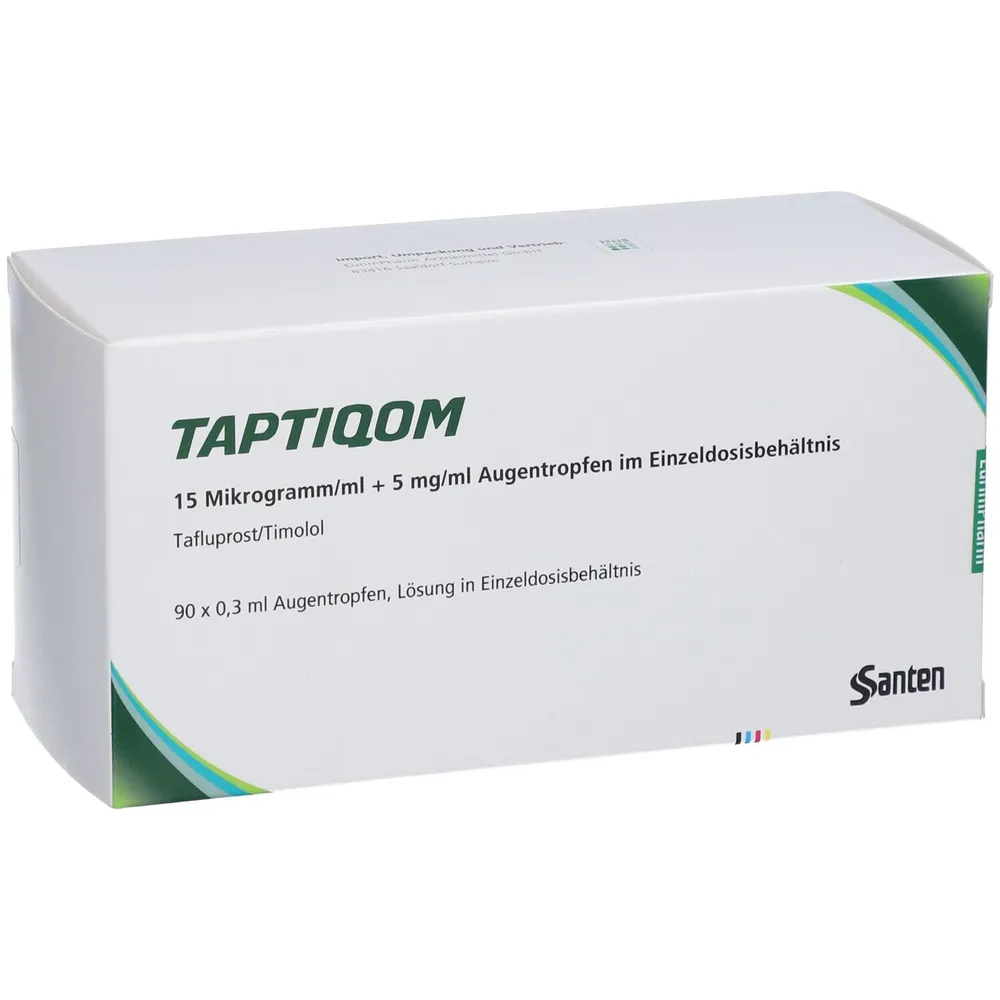
Table of Contents
Patient Information Leaflet
Taptiqom, 15 micrograms/ml + 5 mg/ml,
ophthalmic solution in single-dose container
Tafluprost + Timolol
Please read carefully the entire leaflet before using this medicine, as it contains
important information for the patient.
- Keep this leaflet for future reference.
- If you have any questions, consult your doctor, pharmacist, or nurse.
- This medicine has been prescribed for a specific individual. Do not share it with others. This medicine may harm others, even if their symptoms are the same.
- If you experience any adverse reactions, including any not listed in this leaflet, inform your doctor, pharmacist, or nurse. See section 4.
Table of Contents
- What Taptiqom is and what it is used for
- Important information before using Taptiqom
- How to use Taptiqom
- Possible side effects
- How to store Taptiqom
- Contents of the pack and other information
1. What Taptiqom is and what it is used for
What type of medicine is it and how does it work?
Taptiqom eye drops contain tafluprost and timolol. Tafluprost belongs to a group of medicines called prostaglandin analogues, and timolol belongs to a group of medicines called beta-blockers. Tafluprost and timolol work together to reduce intraocular pressure. Taptiqom is used when eye pressure is too high.
What is this medicine used for?
Taptiqom is used to treat a type of glaucoma called open-angle glaucoma, and a condition called ocular hypertension in adults. Both of these conditions are associated with increased pressure inside the eye and may lead to vision damage.
2. Information before using Taptiqom
When not to use Taptiqom:
- if the patient is allergic to tafluprost, timolol, beta-blockers, or any of the other ingredients of this medicine (listed in section 6);
- if the patient currently has or has previously had a respiratory disease, such as asthma, or severe chronic obstructive pulmonary disease (a serious lung condition that may cause wheezing, difficulty breathing, and/or long-term cough);
- if the patient has a slow heart rate, heart failure, or heart rhythm disorders (irregular heartbeat).
Warnings and precautions
Before starting treatment with Taptiqom, discuss this with a doctor, pharmacist, or nurse.
Before using this medicine, inform the doctor if the patient currently has or has previously had any of the following conditions:
- coronary heart disease (symptoms may include chest pain or tightness, shortness of breath, or breathlessness), heart failure, hypotension;
- heart rhythm disorders, such as slow heartbeat;
- breathing disorders, asthma, or chronic obstructive pulmonary disease;
- circulatory disorders (e.g. Raynaud's disease or Raynaud's phenomenon);
- diabetes, as timolol may mask the subjective and objective symptoms of low blood sugar;
- overactive thyroid gland, as timolol may mask the subjective and objective symptoms of hyperthyroidism;
- any allergy or anaphylactic reaction;
- myasthenia (a rare condition causing muscle weakness);
- other eye conditions, such as corneal disease (the transparent tissue covering the front of the eye) or an eye condition requiring eye surgery.
Inform the doctor if the patient has:
- kidney problems,
- liver problems.
It should be considered that Taptiqom may cause the following effects, some of which may be permanent:
- Taptiqom may increase the length, thickness, colour intensity, and/or number of eyelashes and may cause unusual hair growth on the eyelids.
- Taptiqom may darken the skin around the eyes. Excess solution should be wiped from the skin around the eye. This will help reduce the risk of skin darkening.
- Taptiqom may change the colour of the iris (the coloured part of the eye). If Taptiqom is used in only one eye, the treated eye may permanently change colour and differ from the other eye.
- Taptiqom may cause increased hair growth in areas where the solution repeatedly comes into contact with the skin.
Before undergoing surgery, inform the doctor about using Taptiqom, as timolol may affect the action of certain drugs used during anaesthesia.
Children and adolescents
Taptiqom is not recommended for children and adolescents under 18 years of age due to lack of data on efficacy and safety in this age group.
Taptiqom with other medicines
Tell the doctor or pharmacist about all medicines the patient is currently taking, has recently taken, or plans to take.
Other medicines may affect the action of Taptiqom, and Taptiqom may affect the action of other medicines.
In particular, inform the doctor if the patient is using or plans to use any of the following medicines:
- other eye drops for glaucoma treatment,
- medicines used to lower blood pressure,
- heart medications,
- medicines used in diabetes treatment,
- quinidine (a medicine used to treat heart conditions and certain types of malaria),
- antidepressants such as fluoxetine and paroxetine.
If the patient is also using other eye medicines, at least 5 minutes should be left between the administration of Taptiqom and the other medicine.
Contact lenses
Remove contact lenses before instilling the drops and wait at least 15 minutes before reinserting them.
Pregnancy, breastfeeding and fertility
If the patient can become pregnant, she must use an effective method of contraception during treatment with Taptiqom. Do not use Taptiqom during pregnancy. Do not use Taptiqom during breastfeeding. Consult a doctor.
Driving and using machines
Some side effects associated with the use of Taptiqom, such as blurred vision, may affect the ability to drive or operate machinery. Do not drive or operate machinery until vision and general well-being return to normal.
Taptiqom contains phosphate buffer
This medicine contains approximately 0.04 mg of phosphates per drop, equivalent to 1.3 mg/ml.
In patients with severe damage to the cornea (the transparent front part of the eye), phosphates may very rarely cause corneal calcification (clouding due to calcium accumulation) during treatment.
3. How to use Taptiqom
This medicine should always be used as directed by a doctor or pharmacist. If in doubt, consult a doctor or pharmacist.
The recommended dose is 1 drop of Taptiqom into one or both eyes once daily. Do not use more drops or use the medicine more often than prescribed by your doctor, as this may reduce the effectiveness of Taptiqom.
Use Taptiqom in both eyes only if instructed by your doctor. Immediately after use, discard the single-dose container with any unused solution.
For topical ophthalmic use only. Do not swallow.
Avoid contact between the single-dose container and the eye or surrounding area, as this may cause eye injury. It could also lead to bacterial contamination of the eye and subsequent eye infection, potentially resulting in serious damage or even loss of vision. To prevent possible contamination of the single-dose container, do not allow the tip of the container to touch any surface.
Instructions for use:
When opening a new sachet:
Do not use single-dose containers if the sachet is damaged. Tear the sachet along the dotted line. Write the date of opening on the sachet in the space provided.
Each time Taptiqom is used:
- Wash your hands.
- Remove the strip of containers from the sachet.
- Separate one single-dose container from the strip.
- Return the remaining containers to the sachet and fold the edge to close it.
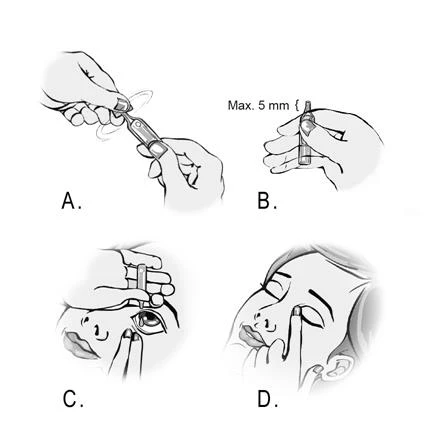
- Open the container by twisting the tab at the top. (Figure A)
- Hold the container between your thumb and index finger. Ensure the tip of the container does not extend more than 5 mm beyond the fingertip. (Figure B)
- Tilt your head backward or lie down. Rest your hand on your forehead. The index finger should be along the eyebrow line or resting on the bridge of the nose. Look upward. With the other hand, gently pull the lower eyelid downward. Do not allow any part of the single-dose container to touch the eye or surrounding area. Gently squeeze the container to release one drop into the space between the lower eyelid and the eye. (Figure C)
- Close the eye and press with a finger on the inner corner of the eye for about two minutes. This helps prevent the drop from draining into the tear duct. (Figure D)
- Wipe away any excess solution from the skin around the eye.
If the drop does not enter the eye, repeat the procedure.
If your doctor has prescribed drops for both eyes, repeat steps 7 to 9 for the second eye.
The contents of one single-dose container are sufficient for administration in both eyes. Immediately after use, discard the container with any remaining solution.
If you are using other eye medicines, wait at least 5 minutes between applying Taptiqom and the other eye medicine.
In case of overdose, the patient may experience dizziness, headache, cardiac symptoms, or breathing difficulties. Seek medical advice if necessary.
If Taptiqom is accidentally swallowed, contact a doctor.
If a dose of Taptiqom is missed, administer one drop as soon as you remember, then continue with the regular dosing schedule. However, if it is almost time for the next dose, do not administer the missed dose. Do not use a double dose to make up for a missed dose.
Do not stop using Taptiqom without consulting your doctor. Stopping treatment with Taptiqom may lead to a recurrence of increased intraocular pressure, which could cause permanent eye damage.
If you have any further questions about the use of this medicine, consult your doctor, pharmacist, or nurse.
4. Possible adverse effects
Like all medicines, this medicine can cause adverse effects, although not everyone will experience them.
Most adverse effects are not serious.
You can usually continue using the eye drops if the adverse effects are not serious. If you have any concerns, speak to your doctor or pharmacist.
The following are known adverse effects of Taptiqom:
Common adverse effects
The following effects may occur in up to 1 in 10 patients:
Eye disorders
itching of the eye, eye irritation, eye pain, eye redness, changes in length, thickness and number of eyelashes,
feeling of a foreign body in the eye, change in eyelash colour, light sensitivity, blurred vision.
Uncommon adverse effects
The following effects may occur in up to 1 in 100 patients:
Nervous system disorders
headache
Eye disorders
dry eye, eyelid redness, small pinpoint areas of inflammation on the surface of the eye, watery eyes,
eyelid swelling, eye fatigue, eyelid inflammation, internal eye inflammation, eye discomfort, eye allergy,
eye inflammation, abnormal sensations in the eye.
The following adverse effects have been observed with the active substances in Taptiqom
(tafluprost and timolol) and may therefore also occur with the use of Taptiqom:
The following adverse effects have been observed with tafluprost:
Eye disorders
reduced ability to see fine details, change in iris colour (which may be permanent), change in skin colour around the eyes, conjunctival oedema, eye discharge, conjunctival discolouration, nodules on the conjunctiva, sunken eye appearance, inflammation of the iris (coloured part of the eye)/uveitis.
Macular oedema/cystoid macular oedopenia (swelling of the retina of the eye leading to worsening of vision).
Skin disorders
unusual growth of eyelid hair.
Respiratory system disorders
worsening of asthma, shortness of breath.
The following adverse effects have been observed with timolol:
Immune system disorders
allergic reactions, including angioedema, rash and urticaria, severe sudden life-threatening allergic reaction, itching.
Metabolism and nutrition disorders
low blood sugar levels
Psychiatric disorders
depression, difficulty in sleeping, nightmares, memory loss, nervousness, hallucination.
Nervous system disorders
dizziness, fainting, unusual sensations (e.g. tingling and numbness), worsening of myasthenia symptoms (muscle disorders), stroke, reduced blood flow to the brain.
Eye disorders
corneal inflammation, reduced corneal sensitivity, visual disturbances, including refractive changes (sometimes due to discontinuation of miotic drugs), drooping of the upper eyelid, double vision, blurred vision and detachment of the layer behind the retina containing blood vessels after trabeculectomy surgery, which may lead to visual disturbances, corneal erosion.
Ear disorders
tinnitus.
Cardiac disorders
slow heart rate, chest pain, palpitations, oedema (fluid accumulation), changes in heart rhythm or rate, congestive heart failure (heart disease causing breathlessness and swelling of feet and legs due to fluid accumulation), certain types of heart rhythm disorders, heart attack, heart failure.
Vascular disorders
low blood pressure, cold extremities, Raynaud's phenomenon, cold feet and hands.
Respiratory system disorders
narrowing of the airways in the lungs (mainly in patients with pre-existing disease), breathing difficulties, cough.
Gastrointestinal disorders
nausea, indigestion, diarrhoea, dry mouth, taste disturbances, abdominal pain, vomiting.
Skin disorders
hair loss, skin rash with white-silver appearance (psoriasiform rash) or worsening of psoriasis, skin rash.
Musculoskeletal and connective tissue disorders
muscle pain not caused by physical exertion, joint pain.
Reproductive system and breast disorders
Peyronie's disease (which may cause penile curvature), sexual dysfunction, decreased libido.
General disorders
muscle weakness/fatigue, thirst.
Reporting of adverse effects
If any adverse effects occur, including any not listed in this leaflet, tell your doctor, pharmacist or nurse. Adverse effects can be reported directly to the Department of Monitoring Adverse Drug Reactions of the Office for Registration of Medicinal Products, Medical Devices and Biocidal Products, Al. Jerozolimskie 181C, 02-222 Warsaw, tel.: +48 22 49 21 301, fax: +48 22 49 21 309,
Website: https://smz.ezdrowie.gov.pl
Adverse effects can also be reported to the marketing authorisation holder.
Reporting adverse effects helps provide more information on the safety of the medicine.
5. How to store Taptiqom
Keep this medicine out of the sight and reach of children.
Do not use this medicine after the expiry date stated on the single-dose container,
sachet, and carton after "EXP". The expiry date refers to the last day of the stated month.
Unopened sachets should be stored in a refrigerator (2°C – 8°C). Open the sachet immediately before using
the eye drops, as unused containers from an opened sachet must be discarded 28 days after
the first opening of the sachet.
After first opening the sachet:
- Store the single-dose container inside the sachet to protect it from light.
- Do not store at temperatures above 25°C.
- Discard any unused single-dose containers 28 days after the first opening of the sachet.
- Immediately after use, dispose of the opened single-dose container, even if there is unused solution remaining.
Medicines should not be disposed of via the sewage system or in household waste. Ask your
pharmacist how to dispose of medicines no longer required. Such measures help protect the environment.
6. Contents of the pack and other information
What Taptiqom contains
- The active substances are tafluprost and timolol. 1 ml of solution contains 15 micrograms of tafluprost and 5 mg of timolol.
- The other ingredients are: glycerol, disodium phosphate dodecahydrate, disodium edetate, polysorbate 80, hydrochloric acid, concentrated and (or) sodium hydroxide (for pH adjustment), and water for injections.
What Taptiqom looks like and contents of the pack
Taptiqom is a clear, colourless liquid (solution) supplied in single-dose plastic containers, each containing 0.3 ml of solution. Each sachet contains ten single-dose containers. Taptiqom is available in packs containing 30 or 90 single-dose containers.
Not all pack sizes may be marketed.
Marketing Authorisation Holder
Santen Oy
Niittyhaankatu 20
33720 Tampere
Finland
Manufacturer
Santen Oy
Kelloportinkatu 1
33100 Tampere
Finland
This medicinal product is authorised in the European Economic Area and in the United Kingdom (Northern Ireland) under the following names:
Taptiqom: Austria, Belgium, Bulgaria, Croatia, Cyprus, Czech Republic, Denmark, Estonia, Finland, France, Greece, Spain, the Netherlands, Iceland, Ireland, Latvia, Lithuania, Luxembourg, Malta, Germany, Norway, Poland, Portugal, Romania, Slovakia, Slovenia, Sweden, Hungary, and the United Kingdom (Northern Ireland).
Loyada: Italy