Tantum rosa
Poland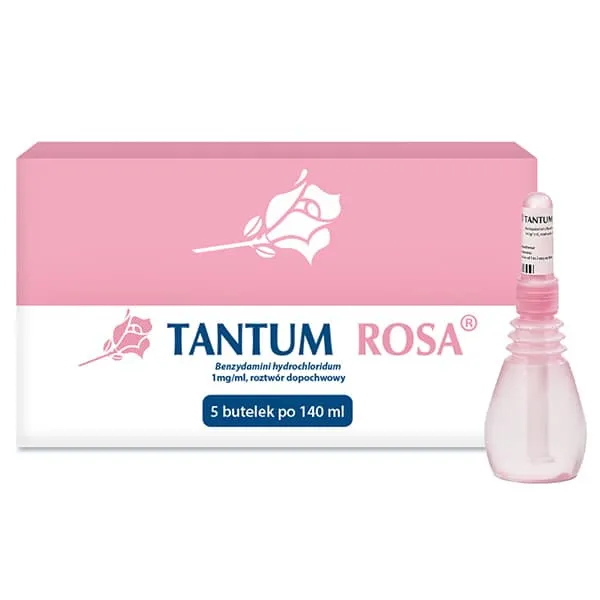
Table of Contents
Package leaflet: Information for the patient
TANTUM ROSA, 1 mg/ml, vaginal solution
Benzydamini hydrochloridum
Please read this leaflet carefully before using the medicine, as it contains
important information for the patient.
This medicine should always be used exactly as described in this patient leaflet or as directed by a
doctor, pharmacist, or nurse.
- Keep this leaflet for future reference.
- If you need advice or further information, consult your pharmacist.
- If you experience any adverse reactions, including any possible adverse reactions not listed in this leaflet, inform your doctor, pharmacist, or nurse. See section 4.
- If there is no improvement after 7 days, or if your condition worsens, consult your doctor.
Table of contents
- What Tantum Rosa is and what it is used for
- Important information before using Tantum Rosa
- How to use Tantum Rosa
- Possible side effects
- How to store Tantum Rosa
- Contents of the pack and other information
1. What Tantum Rosa is and what it is used for
Tantum Rosa contains the active substance benzydamine, which belongs to the group of non-steroidal anti-inflammatory drugs (NSAIDs).
Benzydamine has anti-inflammatory and analgesic properties and exerts local anaesthetic and antiseptic effects. The drug is well absorbed locally, achieving high concentrations in inflamed tissues. It is generally well tolerated. It is used for local treatment of inflammatory symptoms.
Tantum Rosa is administered vaginally for the treatment of discomforts and symptoms such as pain, burning, itching, redness, discharge, and swelling in the area of the external genital organs and the vagina.
These symptoms occur as a result of inflammation of the vulva and vagina (vulvovaginitis), cervicitis of various origins (e.g. infections, mechanical irritation), including after chemotherapy or radiotherapy. The drug is also used for prophylaxis before and after gynaecological surgery.
2. Important information before using Tantum Rosa
When not to use Tantum Rosa
If the patient is allergic to the active substance or to any of the other ingredients of this
medicine (listed in section 6).
Warnings and precautions
Before starting to use Tantum Rosa, discuss it with your doctor, pharmacist, or
nurse.
The use, especially prolonged use, of locally acting medicines may cause an allergic
reaction. In such a case, Tantum Rosa should be discontinued and medical advice should be sought, so that appropriate management can be recommended.
Patients with vaginal bleeding or abnormal vaginal discharge should contact their doctor before
using this medicine.
Tantum Rosa is intended for vaginal use only. It must not be taken orally.
Tantum Rosa and other medicines
Tell your doctor or pharmacist about all medicines you are currently taking, have recently taken, or plan to take.
No interactions between Tantum Rosa and other medicines used for the same indications are known.
Pregnancy and breastfeeding
If you are pregnant or breastfeeding, think you may be pregnant, or are planning to have a baby, you should consult your doctor or pharmacist before using this medicine.
Tantum Rosa should not be used during pregnancy unless absolutely necessary and recommended by a doctor. If use is necessary, the lowest possible dose should be used for the shortest possible duration.
Unless otherwise advised by a doctor, the medicine should be used according to the recommendations provided in this leaflet.
Driving and operating machinery
This medicine does not affect the ability to drive or operate machinery.
Tantum Rosa contains benzalkonium chloride and polysorbate 20 (E 432).
Benzalkonium chloride
The medicine contains 28 mg of benzalkonium chloride in each 140 ml of solution, equivalent to 0.2 mg/ml.
Benzalkonium chloride may cause local irritation.
Polysorbate 20 (E 432)
Polysorbates may cause allergic reactions.
The medicine contains a fragrance composed of: benzyl alcohol, benzyl benzoate, benzyl cinnamate, benzyl salicylate, citral, citronellol, eugenol, farnesol, geraniol, linalool, and limonene.
Benzyl alcohol, benzyl benzoate, benzyl cinnamate, benzyl salicylate, citral, citronellol, eugenol, farnesol, geraniol, linalool, and limonene may cause allergic reactions.
3. How to use Tantum Rosa
This medicine should always be used as described in the patient leaflet or as directed by a doctor, pharmacist, or nurse. If in doubt, consult a doctor, pharmacist, or nurse.
The recommended dosage is 1 to 2 irrigations per day, depending on the severity of symptoms.
Treatment of discomfort and symptoms of external genital inflammation (perineal and vulvar area) associated with vaginitis and/or cervicitis: irrigate the vagina once or twice daily with the solution, unless otherwise directed by a physician.
Preoperative and postoperative prophylaxis in gynecology: the appropriate use of the medicine will be determined by the physician.
If self-treating, do not use the medicine continuously for longer than 7 days unless advised by a doctor. The decision on any extension of treatment should be made by a doctor.
For effective treatment, therapy should not last less than 3 days.
This medicine is intended for vaginal irrigation. Each bottle is for single use only. The vaginal solution contained in the bottle is ready for use at room temperature. The solution may be warmed slightly by immersing the bottle in warm water for a few minutes.
Instructions for use:
- Hold the bottle by the ring and twist the cap to break the safety seal, then remove the cap. (Fig. 1)
Pull out the applicator tip fully until resistance is felt or a distinct click is heard.
Only complete extension of the applicator allows unlocking of the valve and enables irrigation. (Fig. 2)
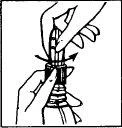
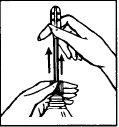
Fig. 1 Fig. 2
- The patient should assume a lying or semi-sitting position, insert the applicator tip into the vagina, and slowly squeeze the bottle until it is completely emptied.
After irrigation, remain in the lying position for several minutes to retain the solution in the vagina.
Use of a higher than recommended dose of Tantum Rosa
Overdose is unlikely due to the low concentration of the active substance and the local route of administration. No cases of overdose with Tantum Rosa vaginal solution have been reported to date.
In case of accidental ingestion, contact a doctor or pharmacist immediately.
If you have any further questions about the use of this medicine, consult your doctor, pharmacist, or nurse.
4. Possible adverse reactions
Like all medicines, this medicine can cause adverse reactions, although not everybody will experience them.
Adverse reactions of unknown frequency (frequency cannot be estimated from the available data):
burning sensation at the site of application, photoallergic rash, urticaria.
Reporting of adverse reactions
If any adverse reactions occur, including any adverse reactions not listed in this leaflet, inform your doctor or pharmacist. Adverse reactions can be reported directly to the Department of Monitoring of Adverse Drug Reactions of the Office for Registration of Medicinal Products, Medical Devices and Biocidal Products:
Al. Jerozolimskie 181C, 02-222 Warsaw, tel.: +48 22 49 21 301, fax: +48 22 49 21 309,
website: https://smz.ezdrowie.gov.pl
Adverse reactions can also be reported to the Marketing Authorisation Holder.
Reporting adverse reactions helps to provide more information on the safety of the medicine.
5. How to store Tantum Rosa
Keep the medicine out of sight and reach of children.
Store in an upright position.
Do not use this medicine after the expiry date stated on the packaging.
The expiry date refers to the last day of the stated month.
Medicines should not be disposed of via wastewater or household waste. Ask your
pharmacist how to dispose of medicines no longer required. Proper disposal helps protect
the environment.
6. Contents of the pack and other information
What Tantum Rosa contains
The active substance is benzydamine hydrochloride.
100 ml of solution contains 100 mg of benzydamine hydrochloride.
Other excipients: benzalkonium chloride solution, disodium edetate, ethanol 96%,
polysorbate 20 (E 432), rose oil (benzyl alcohol, benzyl benzoate, benzyl cinnamate,
benzyl salicylate, citral, citronellol, eugenol, farnesol, geraniol, linalool and limonene), purified water.
What Tantum Rosa looks like and contents of the pack
Tantum Rosa is a clear, colourless solution with a characteristic rose-like odour.
The immediate packaging consists of a pink plastic pear-shaped bottle fitted with a white plastic applicator with valve and closure, containing 140 ml of solution.
The applicator is protected by a pink plastic cap.
The outer packaging is a cardboard box containing 1 or 5 bottles.
Marketing Authorisation Holder and Manufacturer
Marketing Authorisation Holder:
Aziende Chimiche Riunite Angelini Francesco A.C.R.A.F. S.p.A.
Viale Amelia 70, 00181 Rome, Italy
Manufacturer:
Aziende Chimiche Riunite Angelini Francesco A.C.R.A.F. S.p.A.
Via Vecchia del Pinocchio 22
60131 Ancona, Italy
Representative of the Marketing Authorisation Holder
Angelini Pharma Polska Sp. z o.o.
Aleje Jerozolimskie 181B
02-222 Warsaw
tel.: (22) 70 28 200
e-mail: [email protected]
representative of the Marketing Authorisation Holder.