Tamoxifen sandoz
Poland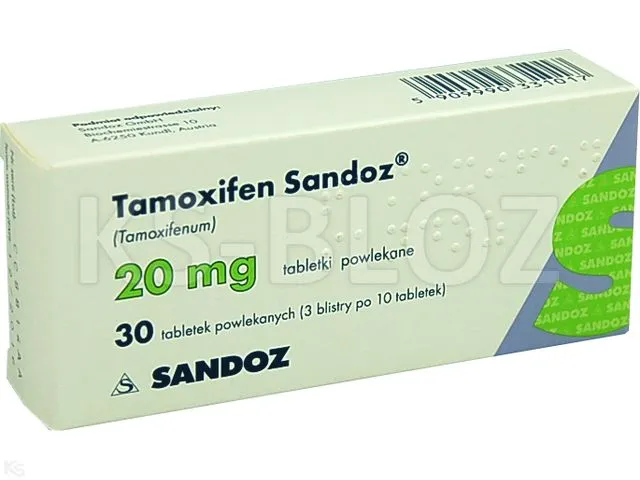
Table of Contents
Package leaflet: Information for the user
Tamoxifen Sandoz, 20 mg, film-coated tablets
Tamoxifenum
Please read all of this leaflet carefully before taking this medicine, because it contains
important information for you.
- Keep this leaflet so that you can read it again if necessary.
- If you have any further questions, please ask your doctor or pharmacist.
- This medicine has been prescribed for a specific individual. Do not pass it on to others. This medicine may harm other people, even if their symptoms are the same.
- If you experience any adverse reactions, including any not listed in this leaflet, inform your doctor or pharmacist. See section 4.
Contents of the leaflet:
- What Tamoxifen Sandoz is and what it is used for
- What you need to know before taking Tamoxifen Sandoz
- How to take Tamoxifen Sandoz
- Possible side effects
- How to store Tamoxifen Sandoz
- Contents of the pack and other information
1. What Tamoxifen Sandoz is and what it is used for
Tamoxifen Sandoz is a synthetic anti-estrogenic agent used in the treatment of advanced metastatic breast cancer or as adjuvant therapy following primary breast cancer treatment.
The direct anti-tumour action of the drug consists of inhibiting nuclear division in cells possessing oestrogen receptors and blocking the hormonal effect of endogenous estradiol.
2. Important information before using Tamoxifen Sandoz
When not to use Tamoxifen Sandoz
if the patient is allergic to tamoxifen or to any of the other ingredients of the medicine
(listed in section 6);
if the patient has:
- significant reduction in platelet count (severe thrombocytopenia),
- significant reduction in white blood cell count (severe leukopenia),
- increased calcium levels in the blood (hypercalcemia);
if the patient is pregnant.
Do not use this medicine in children.
Warnings and precautions
Before taking Tamoxifen Sandoz, discuss with your doctor or pharmacist:
- if the patient has ever had hereditary angioedema, because Tamoxifen Sandoz may cause or worsen symptoms of hereditary angioedema. If symptoms such as swelling of the face, lips, tongue and (or) throat, or difficulty swallowing or breathing occur, contact a doctor immediately. Any concerning symptoms occurring during treatment with this medicine should be reported to a doctor without delay. In particular, consult a doctor if:
- vaginal bleeding occurs in a postmenopausal woman;
- irregular bleeding occurs in a premenopausal woman;
- vaginal discharge;
a sensation of increased pressure in the pelvis or pelvic pain.
Your doctor will order appropriate examinations to determine the cause of these symptoms due to an increased risk of endometrial changes (in the lining of the uterus) associated with treatment.
In premenopausal women, tamoxifen treatment may suppress menstruation.
Women who still have their uterus should undergo annual gynecological examinations during tamoxifen treatment to monitor the endometrium.
At the beginning of tamoxifen treatment, your doctor will order ophthalmological examinations. If visual disturbances occur during treatment with Tamoxifen Sandoz, seek medical advice urgently, as some early-detected changes may resolve after discontinuation of treatment.
Tamoxifen treatment is associated with an increased risk of thromboembolic disease; therefore, your doctor will closely monitor patients with coexisting risk factors for venous thrombosis, such as obesity, advanced age, or concomitant chemotherapy.
In patients undergoing breast reconstruction using microsurgical techniques, tamoxifen may increase the risk of complications related to microcirculatory disturbances in the skin flap.
Patients treated with Tamoxifen Sandoz should undergo regular monitoring of blood counts, liver function, serum calcium levels, and serum triglyceride levels.
Serious skin reactions, including Stevens-Johnson syndrome and toxic epidermal necrolysis, have occurred during treatment with Tamoxifen Sandoz. If the patient notices any symptoms related to these serious skin reactions described in section 4, treatment with Tamoxifen Sandoz must be discontinued immediately and medical advice sought without delay.
Tamoxifen Sandoz and other medicines
Tell your doctor about all medicines the patient is currently taking or has recently taken, as well as any medicines the patient plans to take. This includes medicines obtained without a prescription.
In particular, inform about the use of the following medicines:
oral anticoagulants (blood thinners);
aminoglutethimide (a medicine belonging to the group of aromatase inhibitors used in the treatment of breast and ovarian cancer);
anticancer medicines;
rifampicin (an antibiotic used, among others, in the treatment of tuberculosis);
paroxetine, fluoxetine, bupropion (medicines used in the treatment of depression and certain psychiatric disorders);
quinidine (a medicine used for cardiac arrhythmias);
cinacalcet (a medicine used for parathyroid gland disorders);
oral contraceptives. Tamoxifen Sandoz may reduce the effectiveness of oral hormonal contraceptives.
Tamoxifen Sandoz with food and drink
Tamoxifen Sandoz should be taken during meals, swallowing the tablets whole with liquid.
Pregnancy and breastfeeding
If the patient is pregnant or breastfeeding, suspects she may be pregnant, or is planning to have a child, she should consult a doctor or pharmacist before using this medicine.
Pregnancy
Tamoxifen Sandoz must not be used during pregnancy. Before starting treatment, the doctor will confirm that the patient is not pregnant. Effective non-hormonal contraception must be used during treatment with Tamoxifen Sandoz and for 9 months after completion of treatment. Do not use oral hormonal contraceptives.
Breastfeeding
Use of this medicine is not recommended during breastfeeding. Discuss with your doctor whether breastfeeding should be discontinued or whether tamoxifen treatment should be avoided during breastfeeding.
Driving and operating machinery
Exercise caution, as visual disturbances, fatigue, and dizziness may occur during treatment with Tamoxifen Sandoz, which may impair the ability to drive or operate machinery.
Tamoxifen Sandoz contains lactose and sodium
If the patient has previously been diagnosed with intolerance to certain sugars, consult a doctor before taking this medicine.
The medicine contains less than 1 mmol (23 mg) of sodium per coated tablet, meaning the medicine is considered "sodium-free".
3. How to use Tamoxifen Sandoz
This medicine should always be used exactly as directed by the doctor. If in doubt, consult a doctor or pharmacist.
The usual dose of tamoxifen is 20 to 40 mg daily. A dose of 20 mg is usually sufficiently effective.
Duration of treatment
Your doctor will determine how long the treatment should continue. Treatment is usually long-term.
Taking more than the recommended dose of Tamoxifen Sandoz
If more than the recommended dose has been taken, seek immediate advice from a doctor or pharmacist. Treatment for overdose is symptomatic.
Missing a dose of Tamoxifen Sandoz
Do not take a double dose to make up for a missed dose.
Stopping Tamoxifen Sandoz
Do not stop taking Tamoxifen Sandoz without consulting your doctor.
If you have any further doubts concerning the use of this medicine, consult your doctor or pharmacist.
4. Possible adverse reactions
Like all medicines, this medicine can cause adverse reactions, although not everyone will experience them.
If you notice any of the following symptoms, stop taking Tamoxifen Sandoz immediately and contact your doctor:
Red, flat, disc-shaped or circular skin lesions on the trunk, often with central blisters, peeling of the skin, and ulceration of the mouth, throat, nose, genital organs, and eyes. Such severe skin rashes may be preceded by fever and flu-like symptoms (Stevens-Johnson syndrome, toxic epidermal necrolysis) – these adverse reactions are rare.
Stop taking Tamoxifen Sandoz and inform your doctor immediately if any of the following adverse reactions occur – urgent medical treatment may be necessary:
Swelling of the face, lips, tongue or throat, difficulty swallowing or breathing (angioedema). Tamoxifen Sandoz may cause or worsen symptoms of hereditary angioedema.
The adverse reactions listed below may occur during tamoxifen treatment.
Very common adverse reactions (may affect more than 1 in 10 people):
fluid retention (causing swelling), nausea, skin rash (including rarely severe reactions such as erythema multiforme or bullous eruption), hot flushes, vaginal discharge, irregular menstrual cycles (up to complete cessation of menstruation in premenopausal women), genital tract bleeding, feeling of fatigue.
Common adverse reactions (may affect up to 1 in 10 people):
transient decrease in red blood cells (anaemia), increased calcium levels in the blood (hypercalcaemia) in patients with bone metastases, increased serum triglyceride levels, dizziness, headache, sensory disturbances (including paraesthesia and taste disturbances), visual disturbances, cerebrovascular incidents, leg cramps, thromboembolic events (including deep vein thrombosis of the legs, microvascular thrombosis, and pulmonary embolism), vomiting, diarrhoea, constipation, changes in liver enzyme activity, fatty liver, alopecia, hypersensitivity reactions (including rarely angioedema), muscle pain, genital pruritus, uterine fibroids, changes in the endometrial mucosa.
Uncommon adverse reactions (may affect up to 1 in 100 people):
decreased white blood cell count (leukopenia), transient decrease in platelet count (thrombocytopenia), stroke, interstitial lung disease, liver cirrhosis, endometrial cancer.
Rare adverse reactions (may affect up to 1 in 1,000 people):
absence of granulocytes (agranulocytosis), decreased neutrophil count (neutropenia), optic neuropathy, optic neuritis (in rare cases leading to vision loss), cutaneous vasculitis, ovarian cysts, uterine sarcomas, endometrial polyps, bone pain and pain in the area of diseased tissue at the beginning of treatment.
Very rare adverse reactions (may affect up to 1 in 10,000 people):
severe neutropenia (life-threatening deficiency of neutrophils) and pancytopenia (decrease in white blood cells, red blood cells, and platelets), markedly increased serum triglyceride levels (severe hypertriglyceridaemia), sometimes associated with pancreatitis, cholestasis, hepatitis, jaundice, liver cell damage and necrosis, liver failure (sometimes life-threatening), cutaneous lupus erythematosus, late cutaneous porphyria, recurrence of radiation-induced symptoms.
Reporting of adverse reactions
If any adverse reactions occur, including any not listed in this leaflet, inform your doctor, pharmacist or nurse. Adverse reactions can be reported directly to the Department of Monitoring Adverse Drug Reactions of the Office for Registration of Medicinal Products, Medical Devices and Biocidal Products: Al. Jerozolimskie 181C, 02-222 Warsaw
Tel: +48 22 49 21 301 / Fax: +48 22 49 21 309 / Website: https://smz.ezdrowie.gov.pl
Adverse reactions can also be reported to the marketing authorization holder.
Reporting adverse reactions helps provide more information on the safety of the medicine.
5. How to store Tamoxifen Sandoz
Keep this medicine out of sight and reach of children.
Do not use this medicine after the expiry date stated on the pack after EXP. The expiry date refers to the last day of the stated month.
Store the medicine in a dry place, at a temperature below 25°C. Protect from light.
Medicines must not be disposed of via wastewater or household waste. Ask your pharmacist how to dispose of medicines no longer required. Such measures help protect the environment.
6. Contents of the pack and other information
What Tamoxifen Sandoz contains
The active substance is tamoxifen. One coated tablet contains 30.4 mg of tamoxifen citrate, equivalent to 20 mg of tamoxifen.
The other ingredients are: monohydrate lactose, sodium carboxymethyl starch, povidone (Kollidon 25), microcrystalline cellulose, magnesium stearate, titanium dioxide (E 171), hydroxypropylmethylcellulose, polyethylene glycol 4000.
What Tamoxifen Sandoz looks like and contents of the pack
Tamoxifen Sandoz tablets are white, smooth-surfaced, round, biconvex, with a break line on one side.
Blister packs in cardboard boxes contain 30 or 100 coated tablets.
Marketing Authorisation Holder
Sandoz GmbH
Biochemiestrasse 10
A-6250 Kundl, Austria
Manufacturer
Salutas Pharma GmbH
Otto-von-Guericke-Allee 1
39179 Barleben, Germany
For further information, please contact:
Sandoz Polska Sp. z o.o.
ul. Domaniewska 50 C
02-672 Warsaw
tel. 22 209 70 00