Tafen nasal
Poland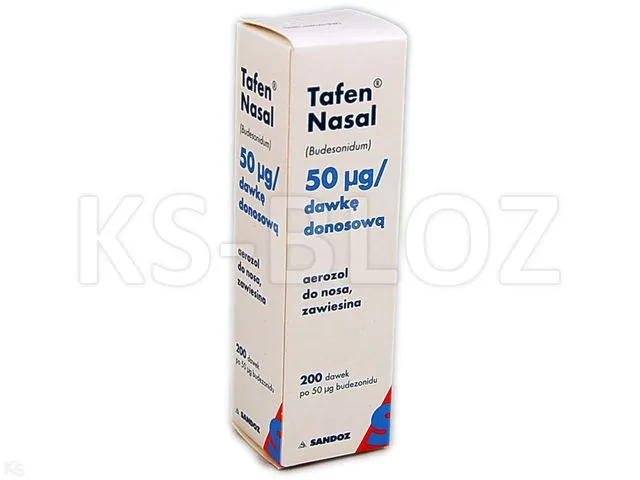
Table of Contents
Package leaflet: Information for the patient
Tafen Nasal, 50 µg/dose nasal spray, suspension
Budesonide
Please read all of this leaflet carefully before using this medicine, because it contains
important information for the patient.
- Keep this leaflet, as you may need to read it again.
- If you have any questions, please consult your doctor or pharmacist.
- This medicine has been prescribed for a specific individual. Do not pass it on to others. It may harm other people, even if their symptoms are similar.
- If you experience any adverse reactions, including any not listed in this leaflet, inform your doctor or pharmacist. See section 4.
Leaflet contents:
- What Tafen Nasal is and what it is used for
- Important information before using Tafen Nasal
- How to use Tafen Nasal
- Possible side effects
- How to store Tafen Nasal
- Contents of the pack and other information
1. What Tafen Nasal is and what it is used for
Tafen Nasal contains budesonide, a synthetic corticosteroid. Corticosteroids are a group of medicines that help prevent inflammation.
Tafen Nasal is used to treat:
- in adults and children over 6 years of age: symptoms of seasonal allergic rhinitis, commonly known as hay fever (e.g. caused by grass pollen); perennial allergic rhinitis caused by house dust mites; nasal polyps (overgrowth of nasal mucosa),
- in adults: symptoms of rhinitis caused, for example, by irritants in the air, infection, food or drinks (non-allergic rhinitis).
2. Important information before using Tafen Nasal
When not to use Tafen Nasal
- if the patient is allergic (hypersensitive) to budesonide or to any of the other ingredients of this medicine (listed in section 6).
Warnings and precautions
Before starting treatment with Tafen Nasal, discuss with your doctor or pharmacist if:
- the patient is a child and is receiving the medicine in high doses for a prolonged period, the doctor will regularly monitor the child's growth.
- the patient has taken higher than recommended doses of the medicine, the doctor may recommend taking steroid tablets during periods of stress (e.g. during infection) or before surgery.
- the patient has fungal, bacterial, or viral respiratory tract infections, which require appropriate treatment.
- the doctor has diagnosed tuberculosis (an infection that usually affects the lungs) in the patient.
- the patient has nasal mucosal ulceration.
- the patient has recently undergone nasal surgery or nasal trauma that has not fully healed.
- the patient has severe liver disease.
- the patient has previously been treated with systemic corticosteroids due to an increased risk of systemic side effects (such as Cushing's syndrome (a disorder caused by excess glucocorticoids), cushingoid features, adrenal suppression, growth retardation in children and adolescents, cataract, glaucoma, excessive psychomotor activity, sleep disturbances, anxiety, depression, and aggression, especially in children).
See section 4 for further information.
In patients with bronchial asthma, rapid reduction of systemic corticosteroid doses may lead to severe exacerbation of the disease. - Tafen Nasal does not provide immediate relief, as its effect may begin only after several days. The medicine should be used regularly.
- the patient experiences eye-related symptoms, which may sometimes require additional treatment.
- the patient has been using Tafen Nasal for a prolonged period, the doctor may recommend examination of the nasal mucosa once or twice a year.
If the patient experiences blurred vision or other visual disturbances, they should contact their doctor.
Tafen Nasal and other medicines
Inform your doctor or pharmacist about all medicines the patient is currently taking or has recently taken, including medicines available without a prescription, as well as any medicines the patient plans to use.
Especially inform the doctor if the patient is taking:
- ketoconazole or itraconazole (medicines used to treat fungal infections).
Some medicines may enhance the effect of Tafen Nasal, and the doctor may wish to closely monitor the patient taking such medicines (including certain HIV medications: ritonavir, cobicistat).
Pregnancy and breastfeeding
If the patient is pregnant or breastfeeding, suspects she may be pregnant, or is planning to become pregnant, she should consult her doctor before using this medicine.
Tafen Nasal may be used during pregnancy only on a doctor's advice.
Tafen Nasal may be used during breastfeeding if the doctor considers it appropriate.
Driving and operating machinery
Tafen Nasal has no influence on the ability to drive or operate machinery.
Tafen Nasal contains methyl parahydroxybenzoate, propyl parahydroxybenzoate, and propylene glycol
Methyl parahydroxybenzoate and propyl parahydroxybenzoate may cause allergic reactions (including delayed-type reactions) and, very rarely, bronchospasm.
The medicine contains 5 mg of propylene glycol in each nasal dose, equivalent to 1 g in 10 ml of suspension.
3. How to use Tafen Nasal
This medicine should always be used as directed by your doctor. If in doubt, consult your doctor or pharmacist.
Dosage
This medicine is intended for adults and children over 6 years of age.
Initially, the usual dose is 2 sprays (each 50 μg [micrograms]) into each nostril twice daily. Once symptoms improve, your doctor will recommend a maintenance dose, typically 1 spray into each nostril twice daily or 2 sprays into each nostril once daily in the morning. The maintenance dose will be the lowest effective dose that controls symptoms without side effects.
Tafen Nasal has an anti-inflammatory effect, so it is very important to use it regularly and continuously, even if symptoms improve.
It may take several days or even up to 2 weeks before the medicine starts to work. However, it should be used regularly even if immediate relief is not experienced.
For the treatment of seasonal allergic rhinitis, treatment with Tafen Nasal should begin before exposure to allergens.
Your doctor will determine how long you need to use Tafen Nasal. Treatment may last up to 3 months.
How to use Tafen Nasal
Proper use of Tafen Nasal reduces the risk of side effects and improves effectiveness.
- Gently clean the nasal passages, if possible, using 0.9% sodium chloride solution.

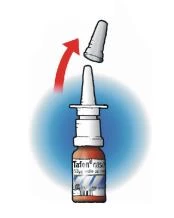
- Remove the cap from the bottle.
- Shake the bottle.
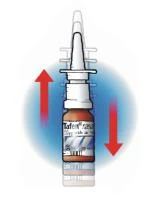
- If the bottle is being used for the first time, prime the pump by releasing a few sprays into the air until a fine mist appears. If Tafen Nasal has not been used for several consecutive days, repeat this step. If the nozzle is blocked, remove it carefully and clean it (see: Cleaning instructions).
- Tilt your head forward so you can see your feet. With your right hand, insert the applicator tip into the left nostril, directing it toward the outer wall of the nose.
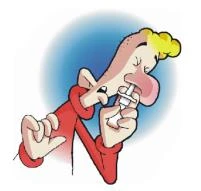
- Press the applicator to release one spray into the nose and inhale deeply through the nose.
- With your left hand, insert the applicator tip into the right nostril, directing it toward the outer wall of the nose. Release one spray into the nose and inhale deeply through the nose.
- After use, wipe the applicator with a clean tissue and replace the cap. When not in use, the applicator should remain covered with the cap. Store the bottle in an upright position.
Cleaning instructions
The applicator and cap should be cleaned regularly. Carefully remove them, wash with warm water, rinse with cold water, and allow to air dry. Carefully reinsert the applicator and replace the cap. If the applicator is blocked, soak it in warm water and then clean as described above. Do not use a needle or any sharp object.
Use of more than the recommended dose of Tafen Nasal
If more than the recommended dose of Tafen Nasal is used, return to the prescribed dosing schedule. Accidental overdosing is unlikely to cause medical problems. However, if large doses are used over a prolonged period, medical advice should be sought immediately.
Missed dose of Tafen Nasal
If a dose is missed, take it as soon as possible without altering the regular dosing schedule. Never use a double dose at the same time to make up for a missed dose.
Stopping Tafen Nasal
Do not stop using Tafen Nasal without consulting your doctor, even if symptoms improve. Your doctor will provide specific instructions on how to gradually reduce the dose to avoid corticosteroid withdrawal symptoms.
If you have any further questions about the use of this medicine, consult your doctor or pharmacist.
4. Possible adverse reactions
Like all medicines, this medicine can cause adverse reactions, although not everyone will experience them.
Severe adverse reactions occurring not very frequently (may occur in fewer than 1 in
100 people):
swelling of the lips, face, throat
If such a severe adverse reaction occurs, contact a doctor immediately.
These may be symptoms of an allergic reaction.
Other possible adverse reactions
Adverse reactions occurring frequently (may occur in fewer than 1 in 10 people):
sneezing, dryness of the nasal mucosa or nasal pricking
blood-tinged nasal discharge
nosebleeds (immediately after administration of the medicine)
cough
dry mouth
sore throat
Adverse reactions occurring not very frequently (may occur in fewer than 1 in
100 people):
urticaria (itchy rash)
rash
itching
skin inflammation with rash
angioedema (swelling of the skin, sometimes of mucous membranes, without itching, mainly affecting
the face)
muscle spasms
Adverse reactions occurring rarely (may occur in fewer than 1 in 1000 people):
systemic corticosteroid effects*
osteoporosis (in case of long-term treatment)
nasal mucosal ulceration (painful sores in the nose)
anaphylactic reaction (acute, generalized allergic reaction)
perforation (perforation) of the nasal septum
voice disorders
injuries
blurred vision
Adverse reactions occurring with unknown frequency (frequency cannot be estimated from
available data):
glaucoma and cataract (in case of long-term treatment)
* If the patient uses high doses of the medicine for a prolonged period, systemic effects may occur, including suppression of adrenal function (causing symptoms such as weight loss, dehydration, weakness, disorientation, low blood pressure, nausea, diarrhea, vomiting), slowed growth rate in children and adolescents (observed after administration of intranasal corticosteroids at recommended doses), bone fragility, excessive secretion of adrenal cortex hormones (with symptoms such as weight gain, moon-shaped face, skin changes, weakness, abdominal obesity – so-called cushingoid features). If any of the listed symptoms occur, contact a doctor immediately.
Reporting of adverse reactions
If any adverse symptoms occur, including any adverse symptoms not listed in this leaflet, inform a doctor, pharmacist, or nurse. Adverse reactions can be reported directly to the Department of Monitoring Adverse Drug Reactions of the Office for Registration of Medicinal Products, Medical Devices and Biocidal Products: Al. Jerozolimskie 181C, 02-222 Warsaw
tel.: + 48 22 49 21 301, fax: + 48 22 49 21 309, website: https://smz.ezdrowie.gov.pl
Adverse reactions can also be reported to the marketing authorization holder.
By reporting adverse reactions, more information on the safety of this medicine can be collected.
5. How to store Tafen Nasal
Keep the medicine out of the sight and reach of children.
Store below 25°C.
Do not use Tafen Nasal after the expiry date stated on the packaging after EXP. The expiry date refers to the last day of the specified month.
The batch number on the packaging is marked as "Lot".
Medicines should not be disposed of via wastewater or household waste. Ask your pharmacist how to dispose of medicines no longer in use. This will help protect the environment.
6. Contents of the package and other information
What Tafen Nasal contains
- The active substance is budesonide. Each nasal dose contains 50 micrograms (μg) of budesonide.
- The other ingredients are: microcrystalline cellulose and sodium carboxymethylcellulose, disodium edetate, methyl parahydroxybenzoate, propyl parahydroxybenzoate, polysorbate 80, simethicone emulsion, propylene glycol, sucrose, hydrochloric acid (for pH adjustment) and purified water.
What Tafen Nasal looks like and contents of the pack
Tafen Nasal is a white, homogeneous suspension. The bottle in the cardboard box contains 200 doses of
50 micrograms (μg) of budesonide.
Marketing Authorisation Holder
Sandoz GmbH
Biochemiestrasse 10
A-6250 Kundl, Austria
Manufacturer
Lek Pharmaceuticals d.d.
Verovškova 57
1526 Ljubljana, Slovenia
For further information, please contact:
Sandoz Polska Sp. z o.o.
ul. Domaniewska 50 C
02-672 Warsaw
tel. 22 209 70 00