Taclar
Poland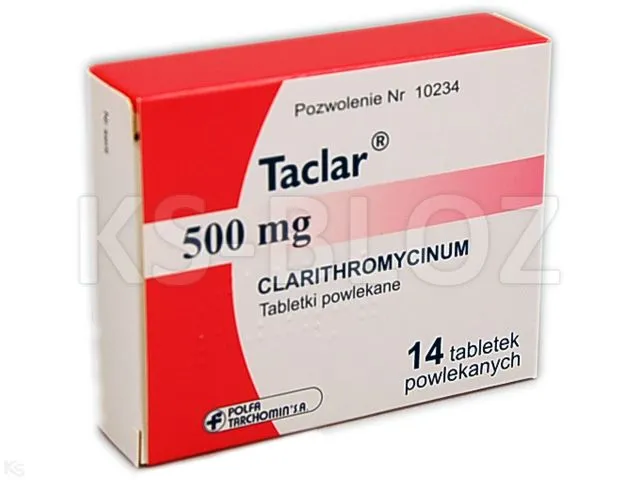
Table of Contents
Package leaflet: Information for the patient
Taclar, 500 mg, coated tablets
Clarithromycinum
Please read this leaflet carefully before using the medicine, as it contains
important information for the patient.
- Keep this leaflet for future reference.
- If you have any questions, please consult your doctor or pharmacist.
- This medicine has been prescribed for a specific individual. Do not share it with others. The medicine may harm others, even if their symptoms are similar.
- If you experience any adverse reactions, including those not listed in this leaflet, inform your doctor or pharmacist. See section 4.
Table of contents
- What Taclar is and what it is used for
- Important information before taking Taclar
- How to take Taclar
- Possible side effects
- How to store Taclar
- Contents of the pack and other information
1. What Taclar is and what it is used for
Taclar contains the active substance clarithromycin. It is a macrolide antibiotic that inhibits the growth of bacteria causing infections.
Taclar is indicated for use in adults and children aged over 12 years for the treatment of infections caused by microorganisms sensitive to clarithromycin. These infections include:
- upper respiratory tract infections (e.g. streptococcal pharyngitis, sinusitis)
- lower respiratory tract infections (e.g. bronchitis, pneumonia)
- acute otitis media
- skin and soft tissue infections (e.g. impetigo, folliculitis, cellulitis, abscesses)
- disseminated or localized infections caused by mycobacteria
In HIV-infected patients (CD4 lymphocyte count ≤100/mm³), Taclar is indicated for the prevention of disseminated infections caused by the Mycobacterium avium complex (MAC).
In patients with duodenal ulcer and a diagnosis confirmed by tests of Helicobacter pylori infection, treatment with Taclar is recommended in combination with agents that inhibit gastric acid secretion and another antibiotic.
2. Important information before using Taclar
When not to use Taclar
- If the patient is allergic to clarithromycin or other macrolide antibiotics (such as azithromycin, erythromycin) or any of the other ingredients of this medicine (listed in section 6).
- If the patient is taking any of the following medicines:
- medicines that may cause severe heart rhythm disorders, including:
- astemizole or terfenadine (medicines used in allergies)
- cisapride (a medicine used for gastrointestinal motility disorders)
- pimozide (a medicine used in psychiatric disorders)
- ergot alkaloids, such as ergotamine or dihydroergotamine (medicines used, among others, in migraine)
- lovastatin, simvastatin (statin medicines used to reduce blood cholesterol levels)
- midazolam administered orally (a medicine used in anxiety states and insomnia)
- colchicine (a medicine used in the treatment of gout)
- a medicine containing lomitapide (a medicine used in patients with high cholesterol to reduce it)
- If the patient is taking medicines called ticagrelor, ivabradine, or ranolazine (used in the treatment of angina pectoris or to reduce the risk of heart attack or stroke).
- If the patient has low blood potassium or magnesium levels (hypokalaemia or hypomagnesaemia).
- If the patient has, or has had in the past, heart rhythm disorders (ventricular arrhythmias, including torsade de pointes) or electrocardiogram (ECG) abnormalities known as "long QT syndrome", either in themselves or in their family.
- If the patient has severe hepatic insufficiency associated with renal insufficiency.
Warnings and precautions
If any of the following situations apply to the patient, discuss them with the doctor before starting
treatment with Taclar.
- The patient is pregnant or suspects she may be pregnant.
- The patient has impaired kidney or liver function.
- The patient has coronary artery disease, severe heart failure, or slow heart rate.
- The patient is taking any of the medicines listed in the section "Taclar and other medicines".
If any of the following situations occur during treatment with Taclar, inform the doctor immediately.
- Severe hypersensitivity reactions such as maculopapular rash, urticaria, petechiae, laryngeal oedema, or bronchospasm. Immediate medical attention is required, and the doctor will initiate appropriate treatment.
- Diarrhoea, especially acute or prolonged. Inform the doctor as soon as possible. If necessary, the doctor will recommend appropriate treatment. Do not use antidiarrhoeal medicines.
- Symptoms suggesting liver dysfunction, such as loss of appetite, jaundice, dark urine, itching, or abdominal pain. Discontinue treatment and consult a doctor immediately.
- New infection (superinfection) with bacteria resistant to clarithromycin or fungi, especially during prolonged antibiotic use. The doctor will recommend appropriate treatment.
Additionally, during treatment with Taclar, the following may occur:
- Cross-resistance of bacteria (bacteria resistant to clarithromycin may also show resistance to other macrolide antibiotics, as well as to lincomycin and clindamycin);
- Bacterial resistance (e.g. treatment of Helicobacter pylori infection may lead to emergence of drug-resistant microorganisms).
Taclar and other medicines
Inform the doctor about all medicines currently taken or recently taken, as well as any medicines the patient plans to take.
It is essential to inform the doctor if the patient is taking any of the following medicines,
as their concomitant use with Taclar is contraindicated:
- astemizole or terfenadine (medicines used in allergies)
- cisapride (a medicine used for gastrointestinal motility disorders)
- pimozide (a medicine used in psychiatric disorders)
- ergot alkaloids, such as ergotamine or dihydroergotamine (medicines used, among others, in migraine)
- statins – lovastatin, simvastatin (medicines that lower blood cholesterol levels)
- midazolam administered orally (a medicine used in anxiety or insomnia)
- colchicine (a medicine used in gout).
Inform the doctor if the patient is taking any of the following medicines,
as special caution is required when using them together with Taclar:
- rifampicin, rifapentine, rifabutin (antibiotics used in the treatment of tuberculosis)
- fluconazole, itraconazole (antifungal medicines)
- atazanavir, efavirenz, etravirine, nevirapine, ritonavir, saquinavir, zidovudine (used in the treatment of HIV infection)
- digoxin, quinidine, disopyramide, verapamil, amlodipine, diltiazem (used in the treatment of heart rhythm disorders or hypertension)
- alprazolam, triazolam, midazolam administered intravenously or orally mucosally (medicines used in anxiety or insomnia)
- warfarin or any other anticoagulant, e.g. dabigatran, rivaroxaban, apixaban, edoxaban (medicines used to thin the blood)
- quetiapine or another atypical antipsychotic medicine
- carbamazepine, valproate, phenytoin (antiepileptic medicines)
- atorvastatin, rosuvastatin (statins – medicines that lower blood cholesterol levels)
- methylprednisolone (an anti-inflammatory medicine)
- omeprazole (a medicine that reduces gastric acid secretion)
- cilostazol (a medicine used in intermittent claudication, characterised by leg muscle pain during exercise that resolves with short rest)
- cyclosporine, tacrolimus, sirolimus (medicines used, among others, after organ transplantation)
- sildenafil, tadalafil, vardenafil (medicines used in erectile dysfunction)
- vinblastine (a medicine used in cancer chemotherapy)
- theophylline (a medicine used in bronchial asthma)
- tolterodine (a medicine used in urinary incontinence)
- phenobarbital (an anticonvulsant medicine)
- St. John's wort (a herbal medicine used in mild depression)
- sulfonylureas, nateglinide, repaglinide, insulin (medicines used in diabetes).
It is also important when using the following medicines:
- hydroxychloroquine or chloroquine (used in the treatment, among others, of rheumatoid arthritis, and in the treatment or prevention of malaria). Taking these medicines together with clarithromycin may increase the risk of heart rhythm disturbances and other serious cardiac adverse effects.
- corticosteroids administered orally, by injection, or by inhalation (used to suppress the immune system, which is useful in treating many different conditions).
Pregnancy and breastfeeding
If the patient is pregnant or breastfeeding, suspects she may be pregnant, or is planning to become pregnant,
she should consult a doctor or pharmacist before using this medicine.
The safety of clarithromycin use during pregnancy and breastfeeding has not been established.
Taclar may be used during pregnancy only if, in the doctor's opinion, the benefit to the mother outweighs the potential risk to the foetus.
Since clarithromycin passes into breast milk, women who are breastfeeding should exercise particular caution when using Taclar.
Driving and operating machinery
The medicine may cause dizziness, confusion, and disorientation, which may affect the ability to drive
and operate machinery.
Taclar contains sodium
Taclar contains less than 1 mmol (23 mg) of sodium per tablet, i.e. the medicine is considered "sodium-free".
3. How to take Taclar
This medicine should always be taken exactly as directed by your doctor. If in doubt, consult your doctor or pharmacist.
This medicine is for oral administration.
The tablet should be swallowed whole with water. Do not chew or suck the tablet.
Tablets may be taken with or without food.
Respiratory tract infections, skin and soft tissue infections, acute otitis media
Adults
For severe infections – one 500 mg tablet twice daily (every 12 hours). Treatment usually lasts 5 to 14 days, except for pneumonia and sinusitis, when treatment lasts 6 to 14 days.
Children over 12 years of age
Dosage as for adults.
Children 12 years of age and younger
Use of Taclar oral suspension is recommended.
Patients with renal impairment
The doctor may recommend reducing the dose by half, meaning one 250 mg tablet once daily.
For severe infections – one 250 mg tablet twice daily.
In such cases, use of Taclar tablets containing 250 mg clarithromycin is recommended. Treatment should not last longer than 14 days.
Infections caused by mycobacteria
Recommended dose for adults: one 500 mg tablet twice daily.
Treatment of disseminated infection caused by Mycobacterium avium complex (MAC) in patients with AIDS should be continued as long as directed by the doctor. Taclar should be used concomitantly with other anti-Mycobacterium agents.
Treatment of other non-tuberculous Mycobacterium infections should be continued according to the doctor's instructions.
Prevention of MAC infections
Recommended dose for adults: one 500 mg tablet twice daily.
Helicobacter pylori infections
In patients with gastric or duodenal ulcer disease associated with Helicobacter pylori infection, clarithromycin may be administered for 7 to 14 days at a dose of 500 mg twice daily, in combination with other appropriate antibacterial therapy and proton pump inhibitors, in accordance with national and international guidelines for Helicobacter pylori eradication.
Taking more Taclar than recommended
If you take more Taclar than recommended, seek immediate medical advice from your doctor or pharmacist.
Taking more Taclar than prescribed may cause gastrointestinal symptoms (vomiting, abdominal pain).
If you forget to take Taclar
If you miss a dose of Taclar, take it as soon as possible, then take the next dose at the scheduled time.
Do not take a double dose to make up for a missed dose.
Stopping Taclar treatment
If you have any further questions about the use of this medicine, consult your doctor or pharmacist.
Do not stop treatment prematurely, even if you start feeling better and symptoms improve after a few days of treatment.
4. Possible adverse reactions
Like all medicines, this medicine can cause adverse reactions, although not everyone will experience them.
If any of the following adverse reactions occur in a patient at any stage of taking the medicine,
stop taking the medicine Taclar and consult a doctor immediately:
- severe or prolonged diarrhoea, possibly with blood or mucus in the stool (pseudomembranous colitis). Diarrhoea may occur even up to two months after completing treatment with clarithromycin. In such a case, contact a doctor immediately
- allergic reactions:
- rash, difficulty breathing, fainting, or swelling of the face, tongue, lips, eyes, and throat (anaphylactoid reaction, hypersensitivity)
- anaphylactic reaction (acute, life-threatening allergic reaction, manifesting, among others, by circulatory and respiratory disturbances), angioedema
- severe skin reactions:
- painful peeling of the skin, mouth, lips, eyes, and genitals (symptoms of an allergic reaction known as Stevens-Johnson syndrome or toxic epidermal necrolysis [Lyell's syndrome])
- red, scaly rash with subcutaneous nodules and blisters (symptoms of acute generalized exanthematous pustulosis [AGEP])
- rare skin allergic reaction causing a severe illness characterized by oral and lip ulcers, skin rash, fever, and internal organ inflammation (DRESS syndrome)
- yellowing of the skin (jaundice), skin irritation, pale-coloured stool, dark-coloured urine, abdominal tenderness, or loss of appetite. These may be symptoms of liver inflammation or liver failure
- muscle pain or muscle weakness known as rhabdomyolysis (a group of symptoms caused by breakdown of muscle tissue, potentially leading to kidney damage).
In clinical trials and after marketing of clarithromycin as a powder for solution for infusion, very common (occurring in more than 1 in 10 patients) adverse reactions reported were
phlebitis at the injection site.
In patients receiving clarithromycin intravenously or orally, the following adverse reactions were reported commonly (occurring in 1 to 10 out of 100 patients):
- pain at injection site, inflammation at injection site
- insomnia
- taste disturbances, headache, altered sense of taste
- vasodilation
- diarrhoea, vomiting, dyspepsia, nausea, abdominal pain
- abnormal liver function test results
- rash, excessive sweating.
Adverse reactions reported uncommonly (occurring in 1 to 10 out of 1000 patients):
- connective tissue inflammation, candidiasis (fungal infection), vaginal infection
- decreased white blood cell count, increased platelet count
- anorexia, decreased appetite
- anxiety
- loss of consciousness, dyskinesia (involuntary, uncoordinated movements of limbs or whole body), dizziness, somnolence, tremor
- balance disorders, hearing loss, tinnitus
- cardiac arrest, atrial fibrillation, extrasystoles, palpitations, ECG changes (prolongation of QT interval)
- asthma, pulmonary embolism, epistaxis
- oesophagitis, gastritis, oral mucositis, glossitis, abdominal distension, constipation, dry mouth, belching, flatulence
- increased liver enzyme activity
- bullous dermatitis, pruritus, urticaria
- musculoskeletal stiffness
- increased blood creatinine concentration, increased blood urea concentration, abnormal albumin to globulin ratio
- asthenia (weakness, lack of energy), malaise, fever, chest pain, chills.
Listed below are adverse reactions of unknown frequency (frequency cannot be estimated from available data), reported after marketing of various formulations of the medicinal product containing the active substance clarithromycin (tablets, granules for oral suspension, powder for concentrate solution for infusion):
- pseudomembranous colitis
- erythema
- agranulocytosis (decreased granulocyte count in blood), thrombocytopenia (decreased platelet count)
- acne
- psychotic disorder, confusion, depersonalization, depression, disorientation, hallucinations, abnormal dreams, mania
- seizures, ageusia (loss of taste), parosmia (distorted sense of smell), anosmia (loss of smell), paresthesia (numbness, tingling)
- deafness
- cardiac arrhythmias, ventricular tachycardia, ventricular fibrillation
- bleeding and changes in coagulation parameters (especially if the patient is concurrently taking oral anticoagulants)
- acute pancreatitis, tongue discoloration, tooth discoloration
- liver failure, hepatocellular jaundice
- muscle diseases (myopathies) manifesting as muscle weakness, in some cases difficulty in muscle relaxation, muscle atrophy
- renal failure, interstitial nephritis
- changes in diagnostic test results (increased international normalized ratio (INR), prolonged prothrombin time, abnormal urine colour).
Patients with impaired immunity
In addition to symptoms related to the course of the disease, the following adverse reactions have been observed in adult patients with impaired immunity:
- nausea, vomiting, taste disturbances, constipation, abdominal pain, diarrhoea, flatulence, dry mouth
- headache, hearing disturbances
- rash
- dyspnoea, insomnia
- abnormal laboratory test results: increased aspartate aminotransferase (AspAT) and alanine aminotransferase (AlAT) activity, increased blood urea nitrogen concentration, decreased platelet and white blood cell count.
Reporting of adverse reactions
If any adverse reactions occur, including any adverse reactions not listed in this leaflet, inform a doctor or pharmacist. Adverse reactions can be reported directly to the Department of Monitoring Adverse Drug Reactions, Office for Registration of Medicinal Products, Medical Devices and Biocidal Products,
Al. Jerozolimskie 181C, 02-222 Warsaw
Tel.: 22 49 21 301
Fax: 22 49 21 309,
Website: https://smz.ezdrowie.gov.pl
Adverse reactions can also be reported to the responsible entity.
Reporting adverse reactions helps to provide more information on the safety of the medicine.
5. How to store the medicine Taclar
Keep the medicine out of the sight and reach of children.
Do not use this medicine after the expiry date (EXP) stated on the packaging. The expiry date refers to the last day of the stated month.
Store at a temperature not exceeding 25°C.
Medicines must not be disposed of via wastewater or household waste. Ask your pharmacist how to dispose of medicines no longer in use. This will help protect the environment.
6. Contents of the pack and other information
What Taclar contains
The active substance is clarithromycin.
- Each film-coated tablet contains 500 mg of clarithromycin.
The other components are: pregelatinized maize starch, povidone, microcrystalline cellulose type 102,
sodium croscarmellose, magnesium stearate;
Film-coat composition: hypromellose, macrogol 6000, titanium dioxide.
What Taclar looks like and contents of the pack
Taclar is available as film-coated tablets.
The tablets are oval-shaped, white or almost white.
Pack: 14 film-coated tablets.
Marketing Authorisation Holder and Manufacturer
Tarchomin Pharmaceutical Works "Polfa" Joint Stock Company
A. Fleminga 2 Street
03-176 Warsaw
Telephone number: (22) 811-18-14
For further information about this medicinal product, please contact the Marketing Authorisation Holder.