Sympramol
Poland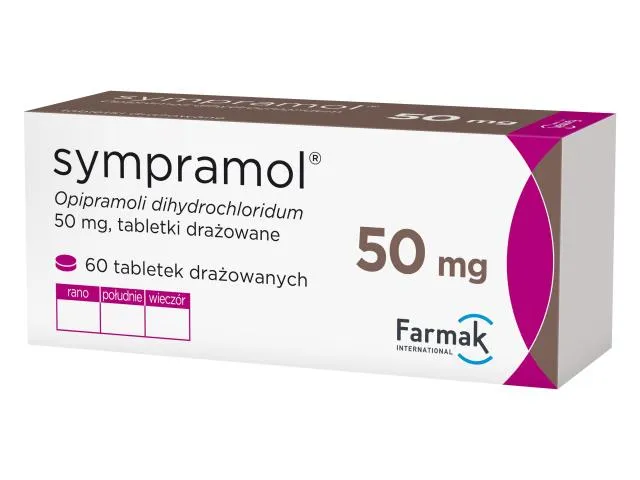
Table of Contents
Package leaflet: Information for the user
Sympramol, 50 mg, coated tablets
Opipramol dihydrochloride
Please read all of this leaflet carefully before taking this medicine, because it contains
important information for you.
- Keep this leaflet. You may need to read it again.
- If you have any further questions, ask your doctor or pharmacist.
- This medicine has been prescribed for a specific individual. Do not pass it on to others. It may harm them, even if their symptoms are the same as yours.
- If you experience any adverse effects, including any not listed in this leaflet, tell your doctor or pharmacist. See section 4.
Contents of the leaflet
- What Sympramol is and what it is used for
- What you need to know before taking Sympramol
- How to take Sympramol
- Possible side effects
- How to store Sympramol
- Contents of the pack and other information
1. What Sympramol is and what it is used for
Sympramol is an anxiolytic and calming medicine.
Sympramol is used in the treatment of:
- generalized anxiety disorders (anxiety characterized by excessive and uncontrollable worrying about everyday matters),
- somatic symptom disorders (physical discomfort not associated or inadequately associated with a physical cause).
2. Important information before using Sympramol
When not to use Sympramol:
- if the patient is allergic to opipramol dihydrochloride or any of the other ingredients of this medicine (listed in section 6);
- if the patient is taking monoamine oxidase inhibitors (MAOIs) (medicines used in the treatment of, for example, depression);
- if the patient has acute intoxication with alcohol, hypnotics, analgesics, or psychotropic drugs;
- if the patient presents acute confusion (disorientation), agitation with hallucinations, and sometimes severe physical disturbances (so-called delirium);
- if the patient has acute urinary retention;
- if the patient has benign prostatic hyperplasia with urinary retention;
- if the patient has paralytic ileus;
- if the patient has untreated narrow-angle glaucoma;
- if the patient has certain heart disorders (previously existing higher-degree atrioventricular block, supraventricular or ventricular conduction disturbances);
Warnings and precautions
When to exercise special caution when using Sympramol:
- if the patient has liver or kidney disease;
- if the patient has an increased predisposition to seizures (due to, among others: brain damage of various origins, epilepsy, alcoholism);
- if the patient has benign prostatic hyperplasia without urinary retention;
- if the patient has blood cell formation disorders;
- if the patient has insufficient cerebral blood supply (cerebrovascular insufficiency);
- if the patient has previous heart damage, especially conduction disturbances. In such cases, treatment with Sympramol should only be initiated under condition of regular ECG monitoring.
Since blood count changes (very rarely neutropenia, agranulocytosis) may occur during treatment with opipramol tablets, blood tests should be performed, especially if fever, flu-like infections, or tonsillitis occur.
Allergic skin reactions should be reported to a physician immediately.
During long-term treatment, liver function tests are recommended.
Sympramol and other medicines
Inform your doctor or pharmacist about all medicines currently or recently taken, as well as any medicines you plan to take.
The following interactions with other medicines should be considered:
- Sympramol may enhance the effects of medicines used to treat certain mental disorders (neuroleptics, e.g. phenothiazines), certain hypnotics, analgesics, and sedatives (so-called hypnotics, general anesthetics, and anxiolytics such as barbiturates, benzodiazepines).
- Sympramol may also enhance the effects of strong anticholinergic drugs (such as those used in Parkinson's disease).
- Concomitant use of Sympramol and certain antidepressants—serotonin reuptake inhibitors, particularly fluoxetine and fluvoxamine—may lead to mutual enhancement of effects and cause adverse reactions. If necessary, the doctor will reduce the dose of Sympramol.
- Concomitant use of Sympramol with certain medicines used to treat high blood pressure (e.g. beta-blockers such as propranolol) or cardiac arrhythmias (e.g. class IC antiarrhythmics), tricyclic antidepressants (including the active substance in Sympramol), and medicines affecting liver enzymes may alter blood concentrations of the active substance in Sympramol.
- Concurrent administration of medicines used to treat certain mental disorders (neuroleptics, e.g. haloperidol and risperidone) may increase blood levels of the active substance in Sympramol.
- Certain hypnotics (barbiturates) and antiepileptic drugs may reduce blood levels of the active substance in Sympramol, thereby reducing its therapeutic effect. If necessary, the doctor will adjust the dose of Sympramol.
- At least 14 days before starting treatment with Sympramol, MAO inhibitors must be discontinued. Similarly, Sympramol must be discontinued at least 14 days before initiating treatment with MAO inhibitors.
Sympramol with food, drink, and alcohol
Concomitant consumption of alcohol may cause drowsiness.
Pregnancy and breastfeeding
If the patient is pregnant or breastfeeding, suspects she may be pregnant, or is planning to become pregnant, she should consult her doctor or pharmacist before using this medicine.
Sympramol may be used during pregnancy, especially during the first three months of pregnancy, only when the physician has carefully weighed the benefits against the risks.
Sympramol should not be used during breastfeeding, as the active substance passes into breast milk in small amounts. If treatment is necessary during this period, breastfeeding should be discontinued.
Driving and operating machinery
Individual reactions to the medicine vary, but the ability to drive or operate machinery may be impaired. This is particularly relevant at the beginning of therapy or when switching to another medicine. The patient may be unable to react quickly or act precisely in unexpected or sudden situations. In such cases, driving a car or other vehicles should be avoided. The use of electrical tools or operating machinery should also be avoided. Alcohol may further impair the ability to drive.
Sympramol contains monohydrate lactose and sucrose
If the patient has previously been diagnosed with intolerance to certain sugars, the patient should consult a doctor before taking this medicine.
Sympramol contains sodium benzoate (E 211)
The medicine contains 0.100 mg of sodium benzoate per tablet.
3. How to use Sympramol
This medicine should always be used as directed by the physician. In case of doubt, consult your
doctor or pharmacist.
If the doctor has not prescribed otherwise, the usual doses are as follows:
Adults
Adults usually take 1 tablet of Sympramol in the morning and 1 tablet at midday, and 2 tablets in the evening
(corresponding to 50 mg of opipramol dihydrochloride in the morning, 50 mg at midday, and 100 mg in the evening).
After consultation with the doctor and depending on the efficacy and tolerance of the medicine, the dose may be reduced to
1 or 2 tablets of Sympramol (corresponding to 50–100 mg of opipramol dihydrochloride) taken once daily,
usually in the evening, or increased to 2 tablets (corresponding to 100 mg of opipramol dihydrochloride)
taken up to 3 times daily.
Use in children over 6 years of age
Children over 6 years of age should receive approximately 3 mg of opipramol dihydrochloride per kilogram of body weight.
The exact dose should be determined by the doctor.
Experience with the use of Sympramol in children is limited; therefore, the recommended dose is only a suggestion.
Treatment of adults and children over 6 years of age must always be conducted under medical supervision.
Tablets should be taken with liquid (water, fruit juice).
Duration of treatment
The therapeutic effect of Sympramol is not immediate, and mood changes occur gradually; therefore, the medicine should be taken regularly for at least 2 weeks.
The doctor will decide on the duration of treatment. The recommended average duration of treatment is 1 to 2 months.
If you feel that the effect of the medicine is too strong or too weak, consult your doctor or pharmacist.
Taking more Sympramol than recommended
After taking an excessive dose of Sympramol, the following symptoms of poisoning may occur within a few hours:
- cardiovascular disorders (increased or decreased heart rate, cardiac arrhythmias, decreased blood pressure, rarely cardiac arrest);
- psychiatric and/or neurological disorders (agitation, transient confusion, increasing anxiety, shock, coma);
- motor disorders [stupor, seizures, lack of coordination (ataxia)];
- other disorders (insomnia, drowsiness, dizziness, problems with urination – oliguria, anuria; respiratory disturbances).
Seek immediate medical advice or go to the nearest hospital if a significantly higher than recommended dose of Sympramol has been taken, or if poisoning is suspected.
Children are more sensitive to overdose; therefore, contact a doctor even in case of slight overdose.
It should be noted that even after a minor overdose, the ability to react is more impaired than after a normal dose.
Missing a dose of Sympramol
Do not take a double dose to make up for a missed tablet. Take the next dose as directed by your doctor.
Stopping Sympramol treatment
Before deciding to discontinue or prematurely stop treatment with Sympramol due to adverse effects, the patient must consult the doctor. If treatment is to be discontinued, it should be done gradually by slowly reducing the dose.
Avoid abrupt discontinuation of Sympramol after long-term use at high doses, as this may cause withdrawal symptoms such as: anxiety, sweating, nausea, vomiting, and sleep disturbances.
If you have any further doubts regarding the use of this medicine, consult your doctor or pharmacist.
4. Possible adverse reactions
Like all medicines, this medicine can cause adverse reactions, although not everyone experiences them.
The frequency of adverse reactions is defined as follows:
| Very common: | in more than 1 in 10 patients treated |
| Common: | in less than 1 in 10, but more than 1 in 100 patients treated |
| Uncommon: | in less than 1 in 100, but more than 1 in 1,000 patients treated |
| Rare: | in less than 1 in 1,000, but more than 1 in 10,000 patients treated |
| Very rare: | in less than 1 in 10,000 patients treated, including single cases |
Common:
especially at the beginning of treatment: fatigue, dry mouth and nasal congestion, low blood pressure (hypotension), drop in blood pressure upon standing (orthostatic hypotension).
Uncommon:
sexual dysfunction in men (ejaculation disorders; impotence), tremor, blurred vision (eye accommodation disorders), difficulty urinating, drowsiness, weight gain, increased thirst, constipation, transient increase in liver enzyme activity, skin allergic reactions (rash, urticaria), heart rhythm disorders (tachycardia, palpitations), dizziness.
Rare:
blood morphology changes, especially leukopenia; galactorrhea in women, restlessness, sweating, sleep disturbances, headache, skin sensation disorders (paresthesia), confusion and delirium (especially in elderly patients), indigestion, taste disturbances, intestinal obstruction (paralytic ileus), nausea, vomiting, edema, cardiovascular collapse, cardiac conduction disorders, worsening of existing heart failure, urinary retention.
Very rare:
loss of white blood cells in blood (agranulocytosis), narrow-angle glaucoma (glaucoma attacks), anxiety, movement coordination disorders (dyskinesia, ataxia), inability to sit still (akathisia), peripheral nerve diseases (polyneuropathies), seizures, hair loss, severe liver function impairment, after long-term treatment – jaundice and chronic liver damage.
If any adverse reactions occur, including any possible adverse reactions not listed in this leaflet, consult a doctor or pharmacist.
Reporting of adverse reactions
If any adverse reactions occur, including any not listed in this leaflet, inform your doctor or pharmacist. Adverse reactions can be reported directly to the Department of Monitoring Adverse Drug Reactions of the Office for Registration of Medicinal Products, Medical Devices and Biocidal Products,
Al. Jerozolimskie 181C, 02-222 Warsaw,
Tel.: + 48 22 49 21 301,
Fax: + 48 22 49 21 309,
website: https://smz.ezdrowie.gov.pl .
Adverse reactions may also be reported to the marketing authorization holder.
Reporting adverse reactions helps to provide more information on the safety of the medicinal product.
5. How to store Sympramol
Keep this medicine out of sight and reach of children.
Do not use Sympramol after the expiry date stated on the blister and the cardboard
pack after "EXP". The expiry date refers to the last day of the stated month.
Storage conditions
Do not store above 25°C.
Medicines must not be disposed of via wastewater or household waste. Ask your
pharmacist how to dispose of medicines no longer required. These measures will help protect the environment.
6. Contents of the pack and other information
What Sympramol contains
- The active substance is opipramol hydrochloride. Each coated tablet contains 50 mg of opipramol hydrochloride.
- Other ingredients are:
Tablet core
Corn starch
Shellac
Lactose monohydrate
Talc
Povidone K 30
Calcium carbonate
Microcrystalline cellulose
Sucrose
Talc
Light kaolin (white clay)
Magnesium stearate
Arabic gum
Titanium dioxide (E171)
Iron oxide red (E172)
Opaglos 6000 NS (carnauba yellow wax, white wax)
Sodium benzoate (E 211)
Povidone K 30
What Sympramol looks like and contents of the pack
Sympramol coated tablets are round, coated, reddish in colour.
Sympramol is available in packs containing 20, 40, 60 and 90 tablets.
Not all pack sizes may be marketed.
Marketing Authorisation Holder
Farmak International Sp. z o.o.
ul. Koszykowa 65
00-667 Warsaw
Manufacturer
Klocke Pharma-Service GmbH
Strasburger Strase 77
77767 Appenweier
Germany
or
Farmak International Sp. z o.o.
ul. Chełmżyńska 249
04-458 Warsaw